3 must-have skills for building rapport with real estate clients

By building rapport, The Agency’s John Antretter writes, agents can not only secure immediate business but also build a network of loyal clients who will return and refer others for years to come.

July is Luxury Month at Inman. Tune in as we survey the evolving luxury market, explore emerging trends, and talk to top producers and influencers in the ultra-luxury space about how they got where they are today and the insights they’ve gained along the way. The month culminates with the announcement of the expanded Golden I Awards live onstage at Luxury Connect (July 29-30) in Las Vegas.

After working for one of Wall Street’s largest investment banks for several years and serving as a top agent in New York for almost nine years, I’ve learned the importance of building rapport in this industry — and I believe it is truly an art form. The ability to connect with clients on a deeper level can be the difference between a one-time transaction and a lifelong business relationship.

Here are my top tips for agents, especially in this time of change and adaptation in our industry.

It starts even before your first meeting

Research your client beforehand. Before meeting a new client, take the time to get to know them. Understanding their background, interests and needs allows you to tailor your approach and make a lasting first impression.

It’s also the ultimate way to build a genuine connection and find common ground. Discovering shared interests or experiences can quickly establish a connection. Whether it’s a mutual love for a particular sport, hobby or travel destination, common ground fosters trust and openness. 

Stay connected

There are numerous ways to stay connected with clients after a closing, and you have to be willing to put in the time and effort to do so. Closing dinners are the perfect start. I find closing dinners to be more intimate and conducive to building long-term relationships.

During these dinners, I learn about my clients’ future plans and needs, organically uncovering opportunities for second homes or future referrals. I also bring closing gifts and invite their children, allowing for deeper connections and enhanced service longevity. Even if they decide to leave the kids at home, it is the thought and effort that shows I am invested in them, even after the transaction.

Another way to do this is through ongoing marketing. For example, share a “Global Listing of the Week” or other e-blasts to clients. Sending a curated listing of the week serves as a regular touchpoint. This keeps you on your clients’ radar and provides them with valuable market insights. Curate a monthly blog and newsletter with content on real estate, trends, luxury news and more, so there is never a shortage of interesting topics and articles to send to your clients.

Additionally, take note of your clients’ vacation plans and preferred destinations. If they mention wanting a winter home in Turks and Caicos, I note this and follow up with listings that match their desires. Leveraging our brokerage’s global network, I have also connected my clients with like-minded agents in top second-home markets to take care of them when the opportunity arises.

Be thoughtful with gifts

Thoughtfulness in client gifting is crucial. I have a strategy in place that avoids consumables like wine or beverages, which are temporary. Instead, I opt for conversation pieces that leave a lasting impression, such as Dior platters or trays or Hermes blankets. These beautifully wrapped, special gifts show clients they are valued and leave a lasting impression.

I also use gifts as a reconnection point. For instance, I send Tiffany piggy banks for baby gifts and always send winter gifts during holidays or New Year’s. The key is to avoid going cheap, as high-quality and thoughtful gifts reflect your appreciation and foster long-term relationships.

Building rapport in real estate is an art that requires dedication, empathy and a personal touch. Sincerity is also important throughout the process. Sincerity also can break the ice and make clients feel valued.

Whether you are meeting to tour their home to list it or you’re in the middle of negotiations during the closing period, acknowledge your client’s achievements, taste, or even the choice of their current or new home. Genuine feedback goes a long way in building rapport.

By following these tips, agents can not only secure immediate business but also build a network of loyal clients who will return and refer others for years to come.

After working for one of Wall Street’s largest investment banks for several years, John Antretter turned his passion for real estate into a career. Connect with John on Instagram and LinkedIn.

Credit reports should be non-negotiable in divorce proceedings

Credit reports offer a wealth of valuable insights and can be especially important in evaluating client needs post-divorce, Lindsey Harn writes.

At Inman Connect Las Vegas, July 30-Aug. 1, 2024, the noise and misinformation will be banished, all your big questions will be answered, and new business opportunities will be revealed. Join us.

Divorce proceedings can be complex and exhausting as every financial move is scrutinized and each asset evaluated. Amid all the details, credit reports can be a powerful and often underutilized tool that can distinguish between a fair conclusion and a financial disaster. They are a fundamental part of financial transparency and fairness and provide information that can alter case decisions.

TAKE THE INMAN INTEL INDEX SURVEY FOR JULY

For real estate agents, understanding the financial situation post-divorce is needed to facilitate better your client’s needs with property sales, new living situations, etc. As an expert, it’s a best practice for agents to recognize that professionals best handle all financial matters, and to point the clients in the right direction in the early stages of discovery in divorce legal proceedings. 

Insights revealed by credit reports

Credit reports offer a wealth of valuable insights. They can reveal hidden debts, distinguish between marital and separate debt, show violations of court-ordered payments and provide assessments of someone’s creditworthiness. Credit reports can also provide an overview of a person’s financial history, including details like revolving credit accounts, installment loans, bankruptcies, unpaid child or spousal support, and collection accounts. This provides a holistic understanding of both party’s finances, ensuring fair asset division and post-divorce financial planning.

Hidden debts, for instance, can often go undetected and are liabilities that can significantly impact the division of assets and finances after a divorce. Uncovering debts early on provides a more accurate assessment of each spouse’s financial obligation and ensures a more fair and transparent negotiation process. 

In many marriages, couples have joint accounts and debts. Credit reports can help unravel these intertwined financial commitments, clarifying each party’s obligations and facilitating fair resolution. This includes determining responsibility for joint debts and ensuring equitable distribution of shared assets.

The distinction between marital and separate debt provided by credit reports is also crucial for a fair split. With this information, clients can be confident they are only assuming responsibility for debts gained during the marriage and are not burdened with pre-existing liabilities. 

Financial disclosure requirements

Many jurisdictions require parties in divorce proceedings to disclose their financial information fully, like many U.S. states, including California, Florida and Texas. Credit reports serve as a vital component of this disclosure process, providing objective data on debts, assets and financial history. By adhering to these disclosure requirements and presenting accurate financial information, clients can uphold their legal obligations and promote transparency.

Prevalence of unauthorized credit activity

One of the main reasons clients need to monitor their credit reports during the divorce process is the prevalence of unauthorized credit activity. It’s not uncommon for someone to receive credit in their spouse’s name without their knowledge. Consistent credit monitoring provides early detection of suspicious or unauthorized transactions. By doing this, clients can prevent financial harm and protect their credit during a divorce.

Monitoring credit reports with National Credit Bureaus

Clients should monitor their credit reports with all three national credit bureaus — Experian, Equifax and TransUnion — as not all creditors report to every bureau. Platforms like AnnualCreditReport.com offer free access to credit reports from each bureau annually. Signing up for credit monitoring services can also provide continuous monitoring and alerts for suspicious activity or changes to a credit report. Setting up fraud alerts with credit bureaus can add an additional layer of protection by notifying clients if there is a request for new credit in their name. 

Following these steps can help clients stay vigilant and proactive in monitoring their credit health and detect any issues early on. 

Safeguarding against unauthorized access

Unfortunately, it’s not uncommon for the opposing party in a divorce case to attempt unauthorized access to their spouse’s credit report, even though this is illegal. This can lead to the misuse of sensitive financial information to open unauthorized accounts, obtain loans or even identity theft.

To safeguard against this, real estate agents can recommend their clients take proactive steps, such as freezing their credit reports. This prevents new creditors from accessing information without explicit permission. 

Empowering clients and ensuring fair outcomes

Credit reports serve as invaluable tools not only during divorce proceedings but also in empowering clients to navigate their financial landscape post-divorce with clarity and confidence. Gaining a holistic understanding of their financial standing enables clients to strategically plan for their future, setting them up to secure loans, effectively manage debts and improve their credit. 

Integrating credit reports into divorce proceedings isn’t just advisable; it’s essential. Shedding light on hidden debts and detecting unauthorized activity ensures fairness and transparency in negotiations. They also empower clients to make informed decisions about their financial future and pave the way for a brighter monetary outlook beyond the conclusion of their marriage. 

Lindsey Harn’s results-driven approach, work ethic, integrity, and honesty have earned her top-producer status. Connect with Lindsey on Instagram and Linkedin.

Eyeing next refi boom, lenders plan to maintain or grow payrolls

Lending industry leaders surveyed by Fannie Mae see the lack of housing supply as the biggest risk factor in 2024, but most expect refinancing to pick up next year if rates continue to fall.

At Inman Connect Las Vegas, July 30-Aug. 1, 2024, the noise and misinformation will be banished, all your big questions will be answered, and new business opportunities will be revealed. Join us.

Nearly two out three mortgage lenders trimmed their workforces in 2023, but most lenders expect to either maintain or grow their payrolls this year, according to a survey of more than 200 senior executives by mortgage giant Fannie Mae.

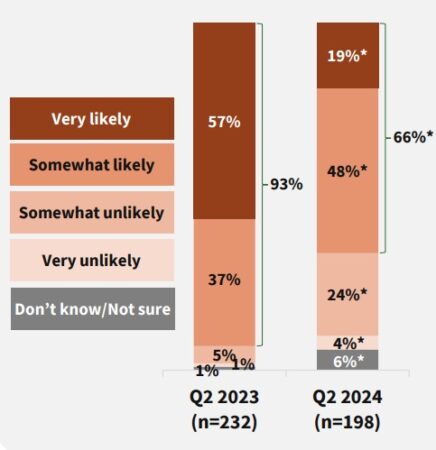
While the survey found two-thirds of mortgage industry executives think it’s likely the U.S. economy will tilt into a recession within the next two years, that’s down from 93 percent a year ago.

Lending industry leaders see the lack of housing supply as the biggest risk factor in 2024, but most (64 percent) expect a new mortgage refinance boom to kick off this year or next if rates continue to fall.

TAKE THE INMAN INTEL INDEX SURVEY FOR JULY

Doug Duncan

“After job cuts in 2023, and with lenders generally less pessimistic about the economy and the direction of the mortgage market, staff sizes appear to be normalizing” at the lowest level since 2014, Fannie Mae Chief Economist Doug Duncan wrote in summarizing the survey’s findings.

“Mortgage activity likely hit a post-pandemic floor following that era’s historically high mortgage purchase and refinance volumes,” Duncan wrote. “As a result, we believe some mortgage lenders are now preparing their workforces to meet potential growth in mortgage originations should the slow recovery of the housing market continue through the rest of this year and into 2025.”

Conducted in early May and released this month, Fannie Mae’s Mortgage Lender Sentiment Survey gathered perspectives from 215 senior executives at 198 lenders, including mortgage banks, depository institutions and credit unions.

Mortgage lenders’ top business priorities

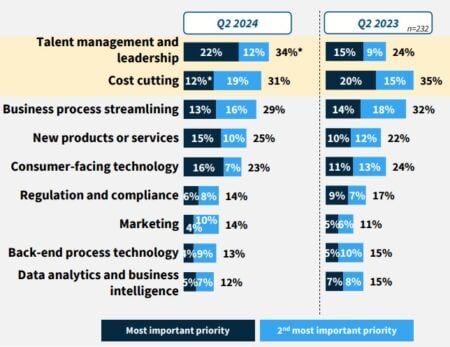
“Talent management and leadership” was the top priority for most executives, followed by cost-cutting and business process streamlining.

“Retention is top of mind,” an executive at one large institution told Fannie Mae. “We want to retain our LO (loan originations) team that is performing as well as continue to scout for new talent to join our organization. We are in growth mode for the foreseeable future.”

Fannie Mae defines large institutions as having more than $245 million in 2023 loan origination volume.

While 62 percent of mortgage executives said they cut their workforce last year, 54 percent said they expect 2024 staffing to stay about where it was last year, while 28 percent expect to staff up this year.

Last year, as mortgage rates were climbing past 7 percent to levels not seen in more than two decades, cost-cutting and business process streamlining were mortgage executives’ top two priorities.

An executive at a mid-sized institution with between $46 million and $245 million in originations said business process streamlining remains a top priority, with the lender migrating to a cloud-based system “to minimize new product introductions and streamline the process for employees and members seeking a loan.”

New products and services were a top priority for one in four executives surveyed, with a leader at a smaller institution (less than $46 million in originations) saying that “Traditional loan origination has decreased so much the last 18 months, we are looking at other types of ways to make money, be it new products or different services.”

Investments in consumer-facing technology — the top priority for lenders in 2019 — failed to crack the top three priorities for the third year in a row.

Lenders less certain of a recession in next 2 years

Mortgage execs think the odds of a recession in the next two years are better than even, but only 19 percent think a recession is “very likely,” down from 57 percent a year ago. Close to half of lending industry leaders (48 percent) still believe a recession is “somewhat likely.”

Scarce housing supply was the risk factor cited most often (64 percent) by mortgage executives, followed by mortgage rate changes (59 percent), household debt level (35 percent) and home prices (31 percent).

Fannie Mae economists, who last year were warning that Fed tightening would likely lead to a recession, backed away from that call in January.

In their June forecast, Fannie Mae’s highly regarded Economic and Strategic Research (ESR) Group forecast that purchase mortgage originations will grow by 14 percent next year, to $1.5 trillion, as 30-year fixed-rate loans will drop to 6.3 percent by the end of next year.

Fannie Mae economists are predicting even more dramatic growth in refinancing next year, with refi volume growing by 46 percent to $544 billion.

Two-thirds of mortgage executives surveyed by Fannie Mae are expecting a refi boom. While only 6 percent see that happening this year, 26 percent expect refinancing to pick up in the first half of next year, while 32 percent are planning on a refi boom kicking off in H2 2025.

Get Inman’s Mortgage Brief Newsletter delivered right to your inbox. A weekly roundup of all the biggest news in the world of mortgages and closings delivered every Wednesday. Click here to subscribe.

Email Matt Carter

Keller Williams hits milestone: $2B in profits shared with agents

The company celebrated during a live “growth call” with leaders from more than 1,000 franchisees in the U.S. and Canada. Nearly 150 KW agents have earned more than $1 million in lifetime profit share.

At Inman Connect Las Vegas, July 30-Aug. 1, 2024, the noise and misinformation will be banished, all your big questions will be answered, and new business opportunities will be revealed. Join us.

Keller Williams logged a milestone Monday: The major real estate franchisor has shared more than $2 billion in profits with its agents since the program’s launch in 1987.

The company, which has 174,000 agents, celebrated at 11 a.m. Central on a live “Growth Call” with top leaders from its more than 1,000 franchisees, also known as market centers, in the U.S. and Canada.

“This achievement is a quantifiable testament to our strong, growth-minded culture,” said Mark Willis, KW CEO and president, in a statement.

TAKE THE INMAN INTEL INDEX SURVEY FOR JULY

Keller Williams also shared on Monday that between Jan. 1, 2023 and June 30, 2024, its franchisees gave more than $148 million in profits to their affiliated agents. In a statement, Gary Keller, KW’s co-founder and executive chairman, said the profit share program allows franchisees to treat their agents as partners and allows agents “to build their businesses inside our franchise model, which is as powerful as if they owned a brokerage themselves.”

“This profit share milestone results from how we think of our relationship with our business partners,” Keller added. “Profit share is an equal opportunity, unequal reward. Those that put in effort will get the lion’s share of the results.”

Keller Williams is a private company, which means it is not obligated to share any financial information publicly. The franchisor is a defendant in several antitrust commission lawsuits and settled the cases earlier this year for $70 million.

Although that settlement has received final approval from a district court, several homesellers are appealing that decision, alleging the payout is far too low and objecting to the deal’s release of franchisees from liability without requiring them to pay anything to the people they allegedly harmed or change anything about their practices.

Keller Williams’ profit share program specifically is also the subject of multiple lawsuits due to a now-scrapped plan to slash profit sharing for defecting agents. The agents behind the suits alleged the plan would have amounted to breach of contract and unjust enrichment on the part of the company. Those suits are ongoing.

According to the company, through June 30, 2024, 137 KW agents have earned more than $1 million in lifetime profit share while 386 agents have earned more than $500,000. Tens of thousands of agents have earned at least five figures in profit share in that time frame:

  • 3,077 KW agents have gotten more than $100,000 in lifetime profit share
  • 6,648 KW agents have gotten more than $50,000 in lifetime profit share
  • 28,827 KW agents have gotten more than $10,000 in lifetime profit share

“Profit share is the engine of our culture,” said Shawn Rawls, an Atlanta-based KW agent, in a statement. “It gives everybody a seat at the table.”

Through Keller Williams’ current profit sharing model, associates who are with the company for more than seven years receive a portion of their former market center’s profit for life. Market centers take slightly more than 50 percent of their profit, then sponsored associates split up the rest.

The model works like a pyramid, with each associate taking 50 percent of that profit, then the rest being split among their sponsoring associate, and that associate’s sponsoring associate and so on, up to seven levels.

“Each of these programs are set in motion when an associate joins a Keller Williams office and names one person as the individual primarily responsible for bringing them to the company,” a white paper from Keller Williams describing the model states. “It may not have been the first person or the last person they talked to about Keller Williams.

“It may be someone from their Market Center, or it could be someone from another region, province, or country,” the paper continues. “It is the person who was most impactful on their decision to join the company.”

According to KW, agents can designate a beneficiary to receive their profit share distributions when they die.

“Profit share is a legacy that you can leave,” said Jessica Starr, a Simsbury, Connecticut-based KW agent, in a statement. “You can leave it to your loved ones, or you can leave it to a trust.”

Email Andrea V. Brambila.

Like me on Facebook | Follow me on Twitter

OpenAI CEO sues developer over $27M ‘lemon’ he bought in 2020

OpenAI boss Sam Altman sued embattled developer Troon Pacific over shoddy workmanship that allegedly included defects in a pool’s waterproofing and a so-called “Batcave,” according to reports.

At Inman Connect Las Vegas, July 30-Aug. 1, 2024, the noise and misinformation will be banished, all your big questions will be answered, and new business opportunities will be revealed. Join us.

OpenAI CEO and billionaire Sam Altman has filed suit against the embattled San Francisco developer that built the $27 million Lombard Street home he purchased in 2020, slamming the property as “plagued by poor workmanship.”

The lawsuit was filed in San Francisco Superior Court June 12 on behalf of plaintiff 950 Lombard LLC, The San Francisco Standard reported Tuesday. According to public records, Sam Altman is the current resident of 950 Lombard Street. Apollo Projects, an investment firm led by Altman and his brother Jack Altman, is also registered at the address.

TAKE THE INMAN INTEL INDEX SURVEY FOR JULY

The lawsuit claims Troon Pacific and CEO Greg Malin knowingly sold a home “plagued by poor workmanship” after concerns were to be addressed prior to sale. The suit seeks unspecified damages, including interest fees and attorneys’ fees.

Since the property, one of the most expensive listings in the city at one time, was purchased in March 2020, construction issues have emerged throughout the property — defects in the pool’s waterproofing design and installation that has led to flooding, improper installation of line dumping raw sewage, and a sewer line jammed with bags by an unpaid contractor.

The $27 million Russian Hill mansion will cost Altman over $4 million to repair.

Altman moved into the property expecting “luxury aesthetics and cutting-edge functionality,” as the company tells its customers. An Architectural Digest tour of the home sold Alton on a private garden with century-old olive trees, a garage “turntable” for cars that emerges out of a “Batcave” tunnel, and an infinity-edge pool with views of the bay.

According to The San Francisco Standard, Altman’s lawsuit is just another on the list of Troon Pacific’s legal battles due to poor workmanship. This year alone, the company has dished out over $48 million to investors who funded and sold four luxury properties. Troon Pacific brought in millions in fees, but only two of the homes were completed.

Altman was not met with the “Batcave” tunnel as he anticipated, but instead, a tunnel of repairs and money drainage.

OpenAI and artificial intelligence have taken off, transforming the world with technology that can learn and act without human intelligence. OpenAI has a plan to create more powerful systems and gain experience with them operating in the real world while transitioning to AGI, the company stated.

In the long run, OpenAI plans to shift towards aligned and steerable models, the shift from GPT-3 to InstructGPT and ChatGPT for example. The goal is to transform while avoiding the risk of misuse and societal disruption.

Email Richelle Hammiel

Michael Valdes leaves eXp to lead LPT Realty global division

After four years at eXp Realty, Michael Valdes is moving to LPT Realty. After surpassing 10,000 agents in the U.S., the Florida-based brokerage is ready to expand internationally, executives told Inman.

At Inman Connect Las Vegas, July 30-Aug. 1, 2024, the noise and misinformation will be banished, all your big questions will be answered, and new business opportunities will be revealed. Join us.

Four years after taking charge of eXp Realty’s global growth, Michael Valdes is starting the next chapter of his career as the CEO of cloud-based brokerage LPT Realty’s newly formed international division.

Valdes comes to LPT Realty with 19 years of executive experience at Sotheby’s International Realty, Anywhere Real Estate and eXp Realty.

Michael Valdes | Credit: eXp Realty

“I am thrilled to step into this role,” Valdes said in a statement on Monday. “LPT has been the fastest-growing cloud-based brokerage in history and is uniquely poised to expand this model globally. Robert is a true visionary, and I am honored and humbled to join this impressive company. I look forward to contributing to the unparalleled growth we are about to embark on.”

TAKE THE INMAN INTEL INDEX SURVEY FOR JULY

At Sotheby’s International Realty, Valdes served as the senior vice president of international relations for two Florida-based affiliates before moving up the ladder to lead SIR’s Europe, Middle East and Africa (EMEA) and Latin America and Carribean regions. By the end of his tenure with SIR, Valdes held dual roles as the global vice president for SIR and SVP of global servicing for SIR’s parent company, Anywhere.

Valdes joined eXp Realty in 2020 as the president of eXp Global; however, two years later, he was promoted to chief growth officer for eXp Realty and eXp Commercial. During his tenure with eXp, Valdes helped the brokerage expand to 22 new countries and add 60,000 new agents — results LPT Realty and LPT Holdings founder and CEO Robert Palmer couldn’t ignore.

“This is a strategic step in our company’s growth trajectory, and Michael is uniquely qualified to lead this endeavor, having previously opened 86 countries across seven brands in his career,” he said in a statement.

Robert Palmer | Credit: LinkedIn

In a phone call with Inman, Valdes and Palmer shared the genesis of their relationship and their belief in LPT Realty, which has grown to 10,000 agents across 24 states in two years. The Florida-based outfit offers agents marketing, technology and training with a $500 annual fee and a $195 transaction fee. Agents also choose their compensation plan: $500 per file with a $5,000 cap or an 80/20 split with a $15,000 cap.

“As Michael and I got to know each other, he really started to understand the LPT model, and I think he started to see the potential for our international expansion,” Palmer said. “I saw the potential in having someone with his expertise and experience in that space, and [him joining LPT] just made a ton of sense.”

Both men said the current market — despite headwinds — is the perfect environment to build LPT’s international reach as foreign consumers still recognize the benefit of buying and selling in the U.S.

“I always say that opportunity happens in down markets,” Valdes said. “WhatsApp and Uber came into the marketplace in 2009 and look at what they’ve built.”

“You also have the idea of expanding internationally — [there’s] currency diversification, opportunity diversification that actually makes you stronger,” he added. “You have a much stronger balance sheet by going out and trying to sort of create something on an international basis. That’s exciting to me.”

Email Marian McPherson