by Debra Trappen | Jul 24, 2024 | Industry, News Feed
Inventory is rising again, according to an analysis of housing data. But agents are still scrounging. Hundreds of brokers and agents shared what’s working in the latest polling from Inman Intel.
This report was originally published on July 15, 2024, exclusively for subscribers of Intel, the data and research arm of Inman. Subscribe to Inman Intel for a deeper analysis of the business of real estate.
Imagine the housing market as a grocery store.
In this metaphor, the pickings have been slim, the shelves poorly stocked for the last few years. It was the real estate version of a stereotypical Soviet supermarket — which is pretty depressing.
But lately, something has started to change.
“What we’re seeing is the supermarket shelves are starting to get restocked,” Realtor.com Senior Economist Ralph McLaughlin recently told Intel. “They’re not fully stocked like they were before the pandemic, but they’re on their way.”
TAKE THE INMAN INTEL INDEX SURVEY FOR JULY
In other words, the housing inventory situation in the U.S. is improving. This is good news. But for a variety of reasons, the market is actually complicated. So far, 2024 has hardly been a boom time.
To better understand what’s going on, Intel spoke to economists and polled hundreds of agents and brokerage leaders in late June as part of the Inman Intel Index survey.
The takeaway from these efforts is something of a two-edged sword: On the one hand, there’s more inventory on the market now than there was a year ago. But on the other, inventory is still far below pre-pandemic levels and demand remains suppressed.
The result is that agents have become heavily dependent on their existing spheres to cope with a market that’s still characterized by challenges.
Inventory is improving
Experts who spoke to Intel for this story agreed that overall inventory is improving.
- Redfin Chief Economist Daryl Fairweather recently told Intel that “inventory is the highest it’s been this time of year in at least the last four years.” She added that “we’re around three months of inventory.”
- McLaughlin said that inventory has improved most significantly in the South, where homebuilding has been strongest. “The supermarkets there are close to fully stocked compared to pre-pandemic levels, and their inventory is fairly priced,” he said.
But the trend of improving inventory is not limited to just the South.
- Altos Research founder and President Mike Simonsen told Intel that “available inventory of unsold homes is climbing pretty much everywhere across the country. Every state has more inventory now than last year at this time.”
The numbers bear this out, with data showing active listings steadily climbing.

Credit: Realtor.com data, visualized by Intel
- Realtor.com data shows that the number of active homes for sale was up 37 percent year over year in June. At the same time, homesellers listed 6 percent more homes in June compared to May. The search portals June housing trends report ultimately concludes that the “market stabilized as mortgage rates also stabilized in June.”
- Data from Realtor.com shows that the upward trend has been occurring over an even longer period. The number of active listings has risen rapidly to 839,992 in June, which is 70 percent more than were on the market in the same month in 2021.
- Data from the National Association of Realtors paints a similar picture, revealing that as of May there were 3.7 months of inventory in the U.S. housing market. That’s up from a low of about 1.6 months of inventory at the beginning of 2022.
So if there are more homes on the market, where’s the revenue?
Looking just at months of inventory or active listings might give the impression that after years of sluggishness, the U.S. housing market has come roaring back to life. The proverbial supermarket appears to be restocked and ready to go.
But anyone working in real estate knows it’s not that simple. And part of what’s going on has to do with why active listings are actually on the rise.
- Fairweather explained that new listings are up compared to 2023, but “only by 10 percent.” They’re also still lower than they were in 2021 and 2022. In other words, inventory isn’t rising because a lot of new homes are hitting the market. “It’s more that the homes that are hitting the market are staying on the market longer and we’re seeing them starting to sell for under list price,” Fairweather explained.

Credit: Realtor.com data, visualized by Intel
What this means is that inventory is rising less in response to new supply (though that is happening, slowly) and more in response to weak demand.
- “As mortgage rates moved higher, that has led to a demand slowdown that allows inventory to build,” Simonsen said. He added that other factors tamping down demand include fewer people changing jobs and thus relocating, and fewer new jobs being created. “With the employment numbers, there aren’t very many layoffs but there’s also not very many hires.”
- Optimal Blue data shows that average rates on a 30-year, fixed-rate mortgage peaked last fall at just under 8 percent, but have since fallen into the high 6 percent range — figures that explain both the modest uptick in new listings but also anemic demand. Loans remain expensive for many consumers, so homes sit on the market and inventory rises.
- On top of all of this, inventory may be rising, but Realtor.com data shows active listings in June were still about 23 percent below where they were during the average June from 2017-2019, right before the pandemic. So housing supply remains tight by historical standards.
The picture that emerges is one of an improving inventory situation where buyers may have an easier time finding homes they like, but where they still struggle to buy those homes due to high costs.
The situation also offers a stark contract to the pandemic years; inventory was also a problem then, but in that case it was because demand was high and outpaced supply growth.
So what are agents and brokers doing about all of this?
Respondents to Inman Intel Index survey in June do seem to be feeling the effects of a market that continues to struggle with a balance of supply and demand.
- Among agent respondents to the survey, 27 percent said their pipelines are “substantially lighter” than they were one year ago. Another 30 percent described pipelines as being merely “lighter” — meaning well over half of agents have experienced a weakening pipeline over the last year.
- In total, 24 percent of agent respondents pointed to lack of inventory as their top concern right now. That tied with commission compression for the second largest concern among agents. Mortgage rates — which have a strong relationship to inventory — were the most common top concern, garnering 29 percent of agent responses.
- Among brokers who took the survey, about 19 percent cited inventory as their top concern — second only to commission lawsuits in first place with 25 percent.
- In a similar vein, of more than 6,000 Realtors surveyed for last week’s NAR 2024 Member Profile, 26 percent pointed to inventory as one of two top issues holding their clients back. Only affordability, which like rates is deeply connected to inventory, ranked as highly as a client stumbling block.
The point is that agents are feeling the challenges — high rates, low demand, and still-low inventory — that are baked into the current market. And the survey shows that the most common response appears to be agents doubling down on their spheres:
- More than a quarter of agent respondents to the survey, or 28 percent, indicated that “almost all” of their recent listings came from repeat clients. That eclipsed all other responses to the question.
- Another 15 percent indicated that more than 75 percent of their listings came from repeat clients, while 23 percent revealed that between half and three quarters of their listings came from returning customers. All together, that means nearly two-thirds of agents are getting half or more of their listings from repeat clients.
- When brokers were asked what their agents should do to find new listings, a plurality of respondents, or 28 percent, selected “other” and then provided free response answers, many of which focused on sphere-building:
- “Staying in touch with previous clients”
- “Reaching out to sphere about existing equity in home”
- “Referrals and repeats”
- A significant share of broker respondents also said their agents should focus on social media or SEO, at 25 percent, followed by direct mailers at 18 percent.
The thesis that emerges is that in a still-sluggish market, agents and brokers alike see industry professionals’ existing contacts as better resources than an array of other activities such as open houses, paid ads, or buying leads — all activities that garnered fewer responses in the survey.
The survey also offers a ray of hope, which is possibly a response to the numbers at the top of this story showing that inventory at least is getting better.
- A plurality of agent respondents to the survey, or 43 percent, said they believe their listing pipelines will be about the same in a year compared to now.
- Another 35 percent believe their listingpipelines will be heavier in a year. Meanwhile, only 22 percent think their pipeline will be lighter.
- All of which is to say, agents believe the future will be at least as good as the present — and plenty think it’ll be even better.
Email Jim Dalrymple II
by Mauricio Umansky | Jul 24, 2024 | Industry, News Feed
Almost two-thirds of homes that were for sale in June had been listed for at least 30 days without going under contract. That figure is the highest share of any June since 2020.
At Inman Connect Las Vegas, July 30-Aug. 1 2024, the noise and misinformation will be banished, all your big questions will be answered, and new business opportunities will be revealed. Join us.
As the cost of owning a home has continued to rise, properties are sitting on the market longer, waiting for a willing buyer.
Almost two-thirds (64.7 percent) of homes that were for sale in June had been listed for at least 30 days without going under contract, Redfin reported on Wednesday. That figure is up from 59.6 percent the previous year, representing the largest annual increase in the last year and the highest share of any June since 2020.
TAKE THE INMAN INTEL INDEX SURVEY FOR JULY
The month also marked the fourth consecutive one in which the share of homes that had been on the market for at least one month increased on an annual basis.

Record home prices and higher mortgage rates are dissuading buyers, even though inventory is more robust than in recent years. In June, the total number of homes for sale posted its largest year-over-year gain on record because many listings are sitting on the market.
“Overall, the market is fairly stagnant,” Shay Stein, a Redfin Premier agent in Las Vegas, said in Redfin’s report.
“There are more listings hitting the market, but a lot of them aren’t in good condition or they’re not in a desirable neighborhood — and sellers are pricing unrealistically high. A lot of sellers are willing to let their home sit on the market until they get the price they want, and a lot of buyers aren’t willing to pay sky-high prices when mortgage rates are still high. My advice to serious sellers is to price fairly and make cosmetic repairs before listing.”
Properties that are move-in ready, relatively affordable and in good neighborhoods — as well as luxury homes that are priced well — are still moving quickly, Stein added.
Florida and Texas are seeing the largest rise in unsold inventory, Redfin reported, largely due to greater housing construction compared to other parts of the country. New homes are being built as demand dwindles, leading to higher levels of inventory.
Dallas saw the largest increase in stale inventory, with 63 percent of listings sitting on the market for at least 30 days in June, up 52 percent year over year. Meanwhile, in Tampa, 70 percent of homes for sale had been listed for at least 30 days, up from 60 percent in June 2023. In Fort Lauderdale, the portion of homes that had been sitting on the market for at least a month was 77 percent, up from 68 percent the previous year, while in Jacksonville, that figure was 70 percent, up from 61 percent the year prior. In Orlando, 69 percent of homes for sale had been listed for one month, up from 60 percent in June 2023.
The share of stale home listings grew on an annual basis in 44 out of the 50 most populous U.S. metro areas. The share of stale listings declined on an annual basis in five metros, but only by a small portion (2 percent or less): Nassau County, New York; New York, New York; Las Vegas, Nevada; Newark, New Jersey; and Warren, Michigan.

Meanwhile, 42.6 percent of homes on the market in June had been listing for at least 60 days without going under contract, up from 38.4 percent the previous year. That increase represented the largest such annual increase in almost one year. June also marked the third month in a row in which the portion of homes sitting on the market for at least two months has increased.
Email Lillian Dickerson
by Nina Dosanjh | Jul 24, 2024 | Industry, News Feed
Part of the relationship involves Local Logic providing iGo with a site license for NeighborhoodIntel, a recently released property reporting product that generates insights from more can 250 data points per home.
At Inman Connect Las Vegas, July 30-Aug. 1, 2024, the noise and misinformation will be banished, all your big questions will be answered, and new business opportunities will be revealed. Join us.
Part of Local Logic’s growth strategy has been to partner with like-minded technology providers and its latest move is no different, Inman has learned.
The company that provides data resources and tactical marketing tools to help agents become location experts has partnered with iGo, a digital home inspection and home management company, according to a July 24 press release. The partnership is a clever choice for Local Logic, as it gets no more location-specific in real estate than under the crawl space of a home about to sell.
Part of the relationship involves Local Logic providing iGo with a site license for NeighborhoodIntel, a recently released property reporting product that generates insights from more can 250 data points per home.
“IGo provides technology and services to home inspection companies, including HomeBinder, a system powered by home inspection data that helps home purchasers more easily manage moving and maintaining their homes with a personalized experience,” the release stated.
In 2023, iGo closed on more than $5.5 million in Series A funding and promptly acquired two industry software providers, HomeBinder and Repair Pricer, Inman reported.
HomeBinder is focused on helping people move, integrating a home’s physical characteristics and inspection data to help home purchasers more easily manage moving and maintaining their homes. It was reviewed by Inman in 2022 and noted for its Home Seller report, easy connection to local vendors, and ability to collect all of the closing documents and requisite loan data shortly after closing.
Vincent-Charles Hodder, co-founder and CEO of Local Logic, said in the press release that his company’s offerings overlap intuitively with iGo’s offer to the industry.
“Collaboration with iGo underscores our commitment to leveraging location intelligence to improve real estate transactions,” Hodder said. “By integrating NeighborhoodIntel into iGo’s services, we are equipping homebuyers with critical information to make more informed decisions about where they live.”
Local Logic has relationships in place on multiple industry fronts, including with MLS software provider VestaPlus, HomeGenius and, as of last month, AI disability resource Lundy.
“We are relentless about delivering an amazing consumer experience,” said John Russell, chief executive officer and co-founder of iGo, in a statement on the partnership. “By including NeighborhoodIntel reports with HomeBinder, we are able to provide homebuyers with unparalleled insights into their potential new neighborhoods, significantly enhancing their home buying experience.”
Local Logic landed $13 million in a Series B round in 2023, money that the company said will put toward general operations and services expansion to help the space “better understand the impact of location,” according to the announcement.
Email Craig C. Rowe
by Kate Hulbert | Jul 24, 2024 | Industry, News Feed
At Inman Connect Las Vegas, July 30-Aug. 1, 2024, the noise and misinformation will be banished, all your big questions will be answered, and new business opportunities will be revealed. Join us.
In the ever-evolving world of real estate, chaos is often the only constant. Market fluctuations, technological advancements and shifting consumer preferences create an environment that is both challenging and ripe with opportunity.
The recent Sitzer | Burnett lawsuit has created a meaningful moment for the real estate industry, particularly regarding the role of buyer’s agents. The case challenges traditional commission structures and brings to light the necessity for agents to rethink how they communicate their value, the services they offer and how they are compensated. This disruption underscores the need for agents to innovate and adapt.
As professionals navigate this dynamic landscape, one principle stands out as a beacon for success: the entrepreneurial mindset. According to Entrepreneurship: The Practice and Mindset by Heidi Neck of Babson College, this mindset is not only teachable but essential for every professional in the industry. Agents who embrace an entrepreneurial mindset distinguish themselves from those who merely focus on sales.
Entrepreneurial real estate agents see beyond the immediate transaction; they identify opportunities, innovate and create value in ways traditional salespeople do not.
These agents continually seek to improve their strategies, utilize technology and adapt to market changes to stay ahead of the curve. They build strong networks, understand the importance of branding and are adept at problem-solving, ensuring they offer tailored solutions to their clients. This proactive approach not only enhances client satisfaction but also drives long-term success, setting entrepreneurial agents apart as leaders in the industry.
The teachability of the entrepreneurial mindset
Neck emphasizes that entrepreneurship is more than starting a business; it is a way of thinking and behaving. This mindset can be cultivated through education and practice, enabling individuals to identify opportunities, innovate solutions and create value in any context.
For real estate professionals, adopting an entrepreneurial mindset means approaching challenges with creativity, resilience and a proactive attitude.
Buyer’s agents must now clearly articulate their value to consumers, demonstrating the unique benefits they provide. This might include offering comprehensive market analyses, negotiating expertise and personalized property search services. Agents should also explore new compensation models, such as fee-for-service or hourly rates, to offer greater transparency and flexibility.
By adopting an entrepreneurial mindset, buyer’s agents can turn these challenges into opportunities to differentiate themselves and build stronger client relationships.
Listing agents, too, must embrace an entrepreneurial mindset to reinvent traditional practices like open houses. Instead of relying on buyer’s agents to bring in potential buyers, listing agents should explore new ways to market homes. Virtual tours, immersive 3D walkthroughs, and interactive online listings can attract a wider audience.
Additionally, leveraging social media and targeted digital marketing campaigns can generate more interest and engagement. By thinking creatively and utilizing modern tools, listing agents can enhance the visibility and appeal of their properties.
5 key features of the entrepreneurial mindset
Adaptability and resilience
Real estate markets are notoriously volatile. Economic downturns, regulatory changes and unpredictable events can drastically impact the industry. Professionals with an entrepreneurial mindset view these disruptions not as obstacles but as opportunities to adapt and thrive. They develop resilience by learning from setbacks and continuously seeking ways to pivot and innovate.
Opportunity recognition
At the heart of entrepreneurship is the ability to recognize and seize opportunities. Real estate professionals who cultivate this skill are adept at spotting trends and gaps in the market. Whether it’s identifying underutilized properties, understanding emerging consumer needs or leveraging new technologies, the entrepreneurial mindset allows agents and brokers to stay ahead of the curve and offer unique value propositions to their clients.
Innovative problem-solving
In an industry where no two transactions are the same, problem-solving skills are crucial. An entrepreneurial mindset equips real estate professionals with the ability to think outside the box. This means developing creative solutions to complex issues, such as navigating financing challenges, negotiating deals or enhancing property value. Innovation is not just about technology; it is about finding new ways to meet client needs and exceed their expectations.
Proactive leadership
Leadership is a key component of the entrepreneurial mindset. Real estate professionals who embody this trait take initiative, inspire their teams and lead by example. They are proactive in seeking knowledge, building networks and staying informed about industry trends. By fostering a culture of continuous improvement and innovation, they position themselves and their organizations for long-term success.
Ethical entrepreneurship
Neck also highlights the importance of ethics in entrepreneurship. Real estate professionals must navigate complex transactions with integrity and transparency. An entrepreneurial mindset grounded in ethical principles ensures that decisions are made with the best interests of clients and communities in mind. This builds trust, enhances reputation and ultimately leads to sustained success.
Applying the entrepreneurial mindset in real estate
- Continuous learning: Embrace lifelong learning to stay abreast of industry trends, technologies and best practices. Attend seminars, pursue certifications and engage with thought leaders to sharpen your skills and knowledge.
- Networking: Build and maintain strong relationships with industry peers, mentors and potential clients. Networking can open doors to new opportunities and provide valuable insights and support. The upcoming ICLV event is a perfect opportunity to put this into practice.
- Technology adoption: Stay current with technological advancements that streamline operations, enhance marketing efforts and improve client experiences. Embrace tools like robust backend and CRM systems, and data analytics to gain a competitive edge.
- Client-centric approach: Focus on understanding and meeting the unique needs of your clients. Offer personalized services and solutions that address their specific challenges and goals.
- Strategic risk-taking: Don’t shy away from calculated risks. Evaluate potential opportunities and weigh the risks and rewards carefully. Be willing to step out of your comfort zone to achieve significant gains. Get comfortable with being uncomfortable.
Cultivating an entrepreneurial mindset
One effective technique to cultivate an entrepreneurial mindset is the practice of “opportunity recognition.” This involves regularly scanning the environment for changes, trends and gaps that can be turned into potential business opportunities.
Real estate professionals can develop this skill by staying informed about market developments, engaging in continuous learning, and maintaining an open and curious attitude.
By actively seeking out new information and being receptive to innovative ideas, individuals can train themselves to identify opportunities where others see obstacles, ultimately fostering a proactive and entrepreneurial approach to their work.
Design thinking for creative problem-solving
Design thinking is a powerful methodology for creatively solving current problems in the real estate industry. This approach involves five key stages: empathize, define, ideate, prototype and test. By starting with empathy, professionals can gain a deep understanding of their clients’ needs and pain points. Defining the problem sets the stage for ideation, where diverse solutions are brainstormed without judgment.
Prototyping allows for the creation of tangible representations of ideas, which can then be tested and refined based on feedback. This iterative process not only encourages innovative solutions but also ensures they are practical and user-centered, enabling real estate professionals to address challenges effectively and deliver exceptional value to their clients.
The entrepreneurial mindset, as articulated by Neck, is a powerful framework for navigating the complexities of the real estate industry. By fostering adaptability, recognizing opportunities, solving problems creatively, leading proactively and upholding ethical standards, real estate professionals can thrive amidst the chaos.
Embracing this mindset not only enhances individual success but also contributes to the growth and innovation of the industry as a whole. As the real estate landscape continues to evolve, the entrepreneurial mindset will remain a vital tool for professionals seeking to make a lasting impact.
Molly McKinley, co-founder of Redtail Creative, Intentionaliteas and author of The Intentional Business: A Path to Purpose & Prosperity, is an expert at connecting the dots. She is a serial entrepreneur, public relations and integrated marketing strategist with over 25 years of experience launching new products and brands.
by Drew Thompson | Jul 23, 2024 | Industry, News Feed
At Inman Connect Las Vegas, July 30-Aug. 1 2024, the noise and misinformation will be banished, all your big questions will be answered, and new business opportunities will be revealed. Join us.
Home price appreciation should slow dramatically next year if listings continue to surge but would-be homebuyers still have trouble finding properties that they can afford, economists say.
Economists at Fannie Mae and the Mortgage Bankers Association are predicting that annual home price appreciation will fall to about 3 percent by the final quarter of 2025, less than half the current rate. That’s a national forecast, so many local markets where supply exceeds demand could see price declines — some already have.
Realtor.com data shows active for-sale listings were up 37 percent in June from a year ago, but the pace of sales remains subdued, Fannie Mae economists said Tuesday in commentary accompanying the release of their latest economic and housing forecasts.
The National Association of Realtors reported Tuesday that June home sales were down 5.4 percent from a year ago and that the median sales price was up 4.1 percent from a year ago, to an all-time high of $462,900.

Doug Duncan
“The housing market continues to wait for affordability to improve, even as the supply of new and existing homes for sale slowly rises,” Fannie Mae Chief Economist Doug Duncan said in a statement. “The slight decline in mortgage rates of late, following data pointing to gradually slowing economic growth, has not been enough to overcome the significant affordability constraints imposed on would-be homebuyers.”
TAKE THE INMAN INTEL INDEX SURVEY FOR JULY
Home prices have shown surprising strength this year, with Fannie Mae’s Home Price Index projected to show home values rose 6.9 percent from a year ago during the second quarter.
But markets where listings are still below pre-pandemic levels are experiencing the strongest price appreciation. In some markets where listings have surged past pre-pandemic levels, home prices are already starting to come down, Fannie Mae economists noted, citing Zillow data.
Zillow data shows home prices continued to appreciate in 46 of the 50 largest metro areas in June, led by San Jose (12 percent), Hartford (10.5 percent), San Diego (9.4 percent), Providence (7.7 percent) and Los Angeles (7.6 percent).
But Zillow reported home values were down from a year ago in June in four big metros: New Orleans (-6 percent), Austin (-4.6 percent), San Antonio (-2.7 percent), and Birmingham (-0.6 percent).
“Many large metros in the Sunbelt … now have inventory levels that match or even exceed for-sale inventories in 2019,” Fannie Mae economists said, with total inventories in Florida and Texas “at or even a bit above” where they were before the pandemic.
“We continue to expect home price growth on a national level to decelerate – but remain positive — over the near term, but it should be noted that conditions often vary by region, particularly as it relates to supply,” Duncan said. “For instance, many Sunbelt metros are currently seeing significant increases in for-sale inventories, in part due to new construction, while supply in much of the Northeast and Midwest remains extremely tight.”
The varied market conditions have Fannie Mae economists predicting that new home sales will decline slightly this year, while sales of existing homes may see only a small bump. Sales of new and existing homes are expected to climb 9.3 percent next year.
Home price appreciation expected to cool
In their first update of their forecast for home price appreciation since April, Fannie Mae economists said they expect home price appreciation will cool to 6.1 percent by the end of this year and to 3 percent by Q4 2024. Due largely to the unexpected strength in home prices so far this year, that’s up from 4.8 percent and 1.5 percent in the April forecast.
“We have modestly upgraded our home price outlook for 2024 largely based on these stronger incoming data for the first half of the year, but we continue to expect deceleration going forward as affordability constraints weigh on home purchase demand,” Fannie Mae economists said.
In a July 19 forecast, economists at the Mortgage Bankers Association (MBA) laid out a similar path for national home price appreciation to fall to 4.5 percent annually by Q4 2024 and 3.3 percent by the end of next year.
Mortgage rates projected to ease
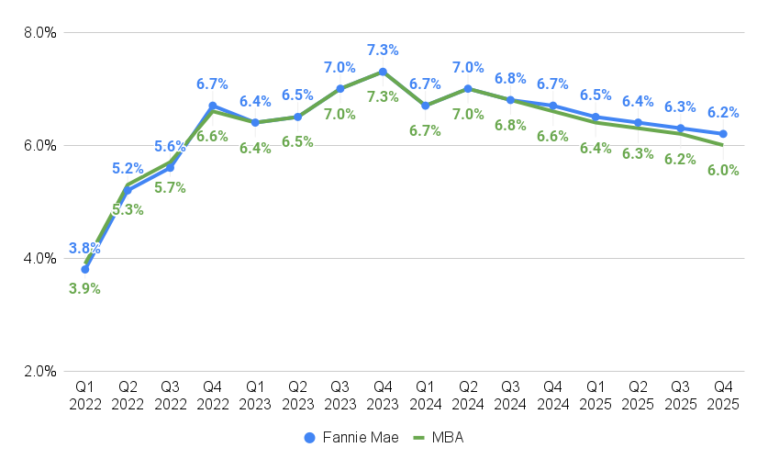
MBA and Fannie Mae forecasters are also aligned in their expectations that mortgage rates will continue retreating below 7 percent this year and next.
Fannie Mae economists project rates on 30-year fixed-rate mortgages will decline to an average of 6.7 percent during Q4 2024 and to 6.2 percent by Q4 2025.
The MBA’s slightly more optimistic forecast envisions rates averaging 6.6 percent in Q4 2024 before falling to 6.0 percent during Q4 2025.
Fannie Mae economists say they now expect the Federal Reserve to cut rates in both September and December, due to two consecutive lower-than-expected prints of the Consumer Price Index and signs the jobs market is cooling.
Economists at the mortgage giant expect the Fed’s preferred inflation gauge, the core Personal Consumption Expenditures (PCE) Index, to end the year at 2.5 percent — half a percentage point above its 2 percent target. The PCE price index fell to 2.6 percent in May and data for June will be released July 26.
Home sales expected to rebound in 2025
Fannie Mae economists are more pessimistic about the outlook for new home sales this year and next than their counterparts at the MBA, citing the likelihood that builders will pull back in Sunbelt markets where listings of existing homes are on the upswing.
Fannie Mae is forecasting new home sales will fall 4 percent this year, to 639,000, before rebounding by 12 percent next year, to 716,000.
“While metro-area single-family construction permitting data does not yet show a meaningful slowdown in new construction in the regions with the greatest growing supply of existing listings, historically, a looser resale market leads to a slowdown in new construction,” Fannie Mae forecasters said. “We have therefore modestly moved downward our single-family starts and new home sales forecasts to reflect comparative weakening in some of the top-building metros.”
The MBA is forecasting 6 percent growth in 2024 new home sales and another 13 percent surge in 2025, which would mean builders would have to sell 800,000 new homes in 2025 — 84,000 more than forecast by Fannie Mae.
Homebuilders’ margins “have been strong enough that they appear willing to help drive sales by offering consumers more incentives, so we are still expecting comparatively robust new construction over our forecast horizon — but more modest than previously forecast,” Fannie Mae economists said.
Both Fannie Mae and the MBA see sales of existing homes rebounding to around 4.5 million next year as appreciation slows and prices in some markets come down.
Fannie Mae’s forecast of 5.25 million sales of new and existing homes next year would represent 9.3 percent growth, while the MBA’s higher 2024 baseline has total home sales rising 7.2 percent next year, to 5.29 million.
While Fannie Mae hasn’t issued a forecast for 2026, MBA economists expect home sales to grow by an additional 5 percent to 5.55 million two years from now.
Get Inman’s Mortgage Brief Newsletter delivered right to your inbox. A weekly roundup of all the biggest news in the world of mortgages and closings delivered every Wednesday. Click here to subscribe.
Email Matt Carter
by Andy Florance | Jul 23, 2024 | Industry, News Feed
The median existing-home price jumped by 4.1 percent year-over-year to $426,900 for all housing types, marking the second month of record highs.
At Inman Connect Las Vegas, July 30-Aug. 1 2024, the noise and misinformation will be banished, all your big questions will be answered, and new business opportunities will be revealed. Join us.
In June, existing-home sales continued to decline across four U.S. regions while the median existing-home price reached a record high for the second consecutive month, according to data released Friday by the National Association of Realtors (NAR).
The median existing-home price jumped by 4.1 percent in June 2023 to $426,900 for all housing types, a record high for the second consecutive month and the 12th consecutive month with year-over-year price increases showing in all four U.S. regions.
Existing-home sales declined 5.4 percent nationally between May and June to an annual rate of 3.89 million, and were down from 4.11 million a year previous.
“We’re seeing a slow shift from a seller’s market to a buyer’s market,” NAR Chief Economist Lawrence Yun said. “Homes are sitting on the market a bit longer, and sellers are receiving fewer offers. More buyers are insisting on home inspections and appraisals, and inventory is definitively rising on a national basis.”
The total housing inventory registered at the end of June was 1.32 million units, up 3.1 percent from May and up 23.4 percent from a year before. The total of unsold inventory represents a supply of 4.1 months at the current sales pace, according to NAR.
According to the Realtors Confidence Index, properties typically remained on the market for 22 days in June, down from 24 days in May and up from 18 days the previous year.
“Some 1.32 million homes were on the market at the end of June, and that’s a quarter of a million more than 12 months earlier,” Holden Lewis, home and mortgage expert at NerdWallet, said. “Each month, buyers have more inventory to choose from, and eventually this dynamic will keep house prices from rising so fast.”
In the Northeast, existing-home sales declined 2.1 percent between May and June to an annual rate of 470,000, down 6 percent from the previous year. In the South, existing-home sales declined 5.9 percent from May to an annual rate of 1.76 million in June, down 6.9 percent from the year before.
Existing-home sales in the Midwest declined 8 percent to an annual rate of 920,000 in June, down 6.1 percent from a year before. In the West, sales dropped 2.6 percent to an annual rate of 740,000, identical to the year prior.
“Homebuying is likely to remain a cornerstone of the American dream. However, relatively steady rent, at a level that is up more than 20 percent compared to five years ago, and rising home prices make it challenging for aspiring owners to break into the market,” Realtor.com Chief Economist Danielle Hale said.
“An increase in new home construction, which would boost supply, and a reduction in the cost of borrowing, which we’ve started to see and expect to continue, should help improve conditions for buyers and thus the number of home sale transactions in the months ahead.”
Email Richelle Hammiel