by Amanda York | Jul 25, 2024 | Industry, News Feed
At Inman Connect Las Vegas, July 30-Aug. 1, 2024, the noise and misinformation will be banished, all your big questions will be answered, and new business opportunities will be revealed. Join us.
Denee Evans, CEO of the Council of Multiple Listing Services, came to the real estate industry a decade ago, when the word “antitrust” was occasionally whispered at events in reference to the U.S. Department of Justice and a desire to avoid its probing eye.
Now, that whisper has become a roar, and Evans is in charge of shepherding some 225 MLSs through one of the most tumultuous times in the industry’s history. In particular, most of CMLS’s members must implement several rule changes in a proposed nationwide settlement between the National Association of Realtors and homeseller plaintiffs in multiple antitrust lawsuits.
TAKE THE INMAN INTEL INDEX SURVEY FOR JULY
The changes are set to go into effect on Aug. 17, including a prohibition on listing brokers making offers of compensation to buyer brokers on MLSs and a requirement that brokers and agents sign contracts with buyers they are working with before a buyer tours a home.
Evans, who lives in the Las Vegas area, will be taking the stage at Inman Connect Las Vegas next week. In an interview, she told Inman what her members are asking her about, changes MLSs are considering as they implement the NAR settlement and why she believes NAR will not be creating new MLS rules in the next six to 12 months, but may offer guidance on the settlement’s requirements.
This interview has been edited for length and clarity.
Inman: Do you know yet what you’re going to be talking about at ICLV?
Denee Evans: I get to interview [Chief Strategy Officer Blair Hardiek] for the Las Vegas Aces, which is our WNBA team, about building a winning culture. I’m super excited about that because I have been a season ticket holder since they came to Vegas and sort of watched that whole building of that organization to where we just did back-to-back world championships.
I’ll also be talking on the MLS, where we’re at today with a few other CEOs of MLSs. Basketball and MLS: those are two of my favorite topics. Also, I will be on a panel for women leading in real estate. That would be another one of my passions, to help support women growing in their careers and leading.
Your panel on MLS operations and what comes next after the commission lawsuits – is there anything you want to say about that right now?
CMLS did publish a resource document for our members that if they were going to implement concessions going forward as a field, we gave some guidance on how they could potentially do that, everywhere from not implementing [the field] to having the most options about it. We provided five different options because it’s going to depend on that marketplace. What did the members there want? How do they meet the needs of consumers?
We’re at a point of change, and so that just requires us to change and think about things differently. Every part of the industry, whether you’re an agent, a broker, an MLS, a vendor, we all still provide great service to the consumers and help them navigate the journey of homeownership, so how do we embrace this change and still serve them?
Change is always uncomfortable. But I think the more we can lean into that and understand how we can take this opportunity to just continue to provide new and different value and just embrace that, I think will be important.
In that vein, what is it that you’re being asked the most about right now from your members?
A lot of the questions are like, “How do we comply with the settlement?” which is not necessarily something CMLS would do specifically, but that’s why we did the resource of, if you’re going to do concessions, what that might look like. We’ve been holding our MLS Matters [webinars], where people can share what they’re doing on different areas, and bringing them together to talk about opportunities with the changes that are coming. It’s a great opportunity for MLSs, and their boards of directors, to really explore innovative options of how to serve the market.
I think we’re going to see less direct “must-do’s” in the future within our environment and it’s going to leave the opportunity for MLSs to be more innovative, to serve their subscribers and their subscribers’ consumers.
When you say “less direct must-do’s,” do you mean there will be fewer rules from NAR?
Yeah, I think we’ll see less of that in the future, just as we work through the changes that are happening right now. There are a lot of questions on the forms, on the buyers’ rep agreements, on the fields, on the changes, on how much data do we keep from the past. Those are going to be a lot of individual decisions at the MLS level, and for their board of directors — which is agents and brokers — to have the thoughtful discussions of what makes sense in their marketplace.
When we were working on this resource about the concessions field, initially we were talking about potentially sending it out as a best practice. Then we were like, well, we don’t think this is a best practice, we’re thinking these are pick your own adventure — what fits for your marketplace. Truly, the best practice is that you’re having really thoughtful conversations in your market about what fits.
That expands over to lots of different topics right now, and also: What is our potential future? We’ve got to just engage in those really thoughtful conversations about what could it look like, and what are the needs of the consumers, what are the needs of the professionals, and how are we going to continue to meet those and be that efficient, transparent marketplace that is MLS.
When you said you think there’ll be fewer NAR MLS rules, at least in the near future, why do you think that is?
We need to implement what’s happening right now. Even that Aug. 17 deadline for the changes, that’s earlier than what the settlement requires. But I think NAR did that just to make sure we had time at MLSs to be able to implement those changes. Once that date passes, there’s going to be more and more learnings and understandings of how it’s really working in the marketplace and if there are changes that need to happen. Are there changes or refinements that need to be made? That’s going to be a given. That communication between subscribers and their MLS is going to be super important over the next six to 12 months, as we make sure we can continue to provide that marketplace.
Part of the reason I ask is because there haven’t been any MLS rules coming out of the Multiple Listing Issues and Policies Committee at NAR for a while now.
What we might see out of them is maybe some clarification or some more guidance around the current settlement. We think we have some answers now, and we’re making changes based on what we know. But I think there’s going to be some dynamics to this where we’re going to need to get additional feedback in markets, and it’ll be a little different per marketplace. So maybe that group has some requests to say, “Clarify this. Give us some more guidance on this.” I think we still have some bumps in front of us to work through as an industry, but I’m confident that we will get through it. We’ve got to really focus and make sure we get this we get this down, we get it right, and we continue to serve the marketplace.
What sort of bumps do you see?
There’s always this idea of how it works, like, in theory, and then when it actually goes out to market. One big thing could be consumer behavior. Is it going to change much based on this, or they have new requests or different, or how is that going to play out when these agreements roll out in the marketplace? Is there things that need to be altered?
I had lunch with Helen Hanna years ago, and she said her dad always told her that we had this sellers multi-list, but we needed a buyers multi-list. We’ve made [the MLS] a two-sided market at this point, but not necessarily as conscious as we could be of really matching buyers and sellers in a more formalized way. I think we could be at a place with the agreements, that maybe that really evolves us to this more robust and comprehensive marketplace of both the buyer and the seller in some new way.
How do you see that happening?
There’s a lot of smart people in the industry that have started talking about that a little bit. There’s a real opportunity there because the buyer side is just as important as the sell side. They’ve both got to be there to make it this marketplace.
Is there a reason you think that the settlement itself would lead to that?
The settlement has some key elements that cause fundamental change to to how things are working. Within that, I don’t know where the saying comes from, but “Never let a good crisis go to waste.” It just creates this moment. COVID was a perfect one. That was just awful, but a couple of those silver linings that came from [it are] e-signatures and online signings and all these things that would have taken us years to actually get movement on, but because of that severe disruption and event happening, it allowed us to move exponentially on a lot of important things, specifically for our industry, [such as] virtual tours and videos.
Is there any specific thing you’re thinking of that you might want to ask NAR’s MLS committee for guidance about?
I wouldn’t have an answer to that until after the 17th, as we’re just waiting for our members to give us more feedback.
You were talking about how it will depend on the marketplace, how these changes are implemented. Initially, you were talking specifically about concessions. What sort of factors will determine which way an MLS will go on that?
I’ve heard feedback across the board. Their discussions are from “We’re not implementing anything; we’re just removing a field” and “We’re deleting all data” to some MLSs believe that it’s still an opportunity to inform the marketplace and [for] transparency if a seller is wanting to offer an incentive. We issued four options or five options, and I think there’s probably an equal number utilizing each one of those.
So you’re not telling them, “This one’s the best practice.” You’re saying, “Here are your options; talk about it.”
Yep, the best practice is that you’re talking about it and you’re making a very thoughtful decision on which one of these fits your marketplace and also for rolling it out. One of the challenges is when there’s a policy and there’s one way to do it, it creates consistency. It’s really hard to scale a product when to scale it [is to] implement it in 500 MLSs and they’re all different. So rolling it out maybe in four or five different ways versus 500 different ways is beneficial for consumers, for the professionals, and then for the vendors that support the industry and provide these products and services.
You’ve heard that some MLSs are deleting their commission data?
I haven’t confirmed that, but it’s the discussion around previous data. How long do you hold on to it for? Do you capture it going forward? There’s been a lot of discussion around that as to what makes the most sense because you do need information for appraisers. You need information for market stats. Who is it made available to? Is it available to just the staff? Is it available to the subscribers? Is it not available at all? Again, I’m hearing a lot of different options across the country, which I think is good, because that means they’re all having their own discussions about what fits their marketplace and what are their needs.
I don’t know if you saw my interview with Ed Zorn, but he was talking about how, as a broker himself, how he was planning to use the commission data in future sales, like when he’s talking to sellers, saying, “We’ve changed this thing and we need to think about what that means for how much we’re gonna set for a list price and potentially offer as a concession.” So I think that, as a broker, he probably wouldn’t be very happy if that data were deleted.
It’s very interesting. I don’t even have anybody to refer you to, but I do think that’s been an active conversation and have heard different ways that they’re going to be capturing that and who they’re going to make it available to.
Is there anything you think MLSs should be doing to avoid antitrust trouble in the future?
If anything, I’d say comes back to those individual market decisions. How are you best serving your market? Compete on service. Compete on value. Competition is the heart of our industry.
You’ve talked a lot about opportunities coming out of all this. What specific opportunities are you talking about?
It’s more a mindset about opportunity within the disruption. Putting on a lens of: Where are the opportunities in this? How do I use this to better serve my subscribers? How does it better serve consumers? There was the old way. That was then, and there’s a point in time where we’ve got to move forward. I don’t have specifics because I would be telling you my members’ ideas, I guess.
If we use that knowledge and approach it just kind of changes our attitude about it and allows us to be open to new ideas. That’s the other thing that disruption and change does is it broadens the ability of what’s possible a little bit, thinking that maybe people wouldn’t be open to doing before.
Is there anything you’re telling your members not to do?
I think my biggest thing is not to have your head so down in the day-to-day of just implementing what it is, that you’re not still looking up and saying, “Where are we going?” Because there are a lot of people out there who are looking up and designing that future, and if we spend the next six months getting through this just head down, we’re going to be behind.
There are a lot of changes happening in a very short time frame, but we’ve got to make sure and keep our heads up and still talk about “Where’s the puck going, what’s in front of us, where do we want it to be, and how do we continue to build and make those things happen at the same time?” That’s really challenging because there’s a lot of resources going to put the changes into effect that we’re required to do. Then you’ve got to be thinking about “Where do I need to be in six months?” because the change in technology and information and data is happening so much faster today, and so it’s even more important that we’re just keeping our head up and saying, “What do we still need to build, design and innovate?”
Who do you think is thinking about that?
Everything from Wall Street to current participants in the marketplace to the person in their garage. They’re not necessarily slowing down for any of this, whereas the challenges for the MLSs and the brokerages are there are some significant changes we need to implement. We have to do that as well as still say there’s all this new stuff still happening. So we have to keep our eye out for it and make sure that we’re able to support those ideas as other companies may roll those out. We can still power them by way of what the MLS provides.
These are mandates coming out of NAR because of the settlement. Do you think that’s hindering MLSs’ ability to look toward the future in that way, having to implement all of this stuff?
Policy comes out, changes come out. MLSs are used to implementing that. I think the biggest challenge for us is just how tight that timeframe got. It’s a lot of change very quick, and there’s not, I think, quite as much information about what the changes must be or the specifics to them. There are more decisions to be made in each marketplace. That’s one of the other challenging pieces to this, the timeframe, the amount of detail, and that this is so much happening at one very small point in time.
Alright, anything else you’d like to add before we finish?
When people say “the MLS” [they] make it like it’s some The Wizard of Oz behind a curtain. Really own and embrace that the MLS is made up of brokers and agents. Yes, there is the MLS CEO, MLS staff, but really the ones making those decisions and helping to move the MLS forward are the people who are out in the marketplace.
It is the industry that actually makes up these boards of directors and these decision-making bodies to move us forward. So be active participants, even if you’re not on a board, give your feedback in a constructive way that helps us continue to navigate our future and design what needs to happen to power those professionals to serve their consumers.
Email Andrea V. Brambila.
Like me on Facebook | Follow me on Twitter
by Juston Martinez | Jul 25, 2024 | Industry, News Feed
At Inman Connect Las Vegas, July 30-Aug. 1, 2024, the noise and misinformation will be banished, all your big questions will be answered, and new business opportunities will be revealed. Join us.
Success in real estate isn’t just about closing deals — it’s about making informed decisions that drive your business forward. A little daunting and potentially yawn-inducing at first glance, marketing metrics are the secret sauce to understanding your efforts, your performance and where you can make strategic changes.
I know, I know. You’re here to sell homes, not become a data scientist. I get it. But whether you’re deciphering reports from your marketing team or venturing into the world of digital ads yourself, understanding these key performance indicators is crucial.
TAKE THE INMAN INTEL INDEX SURVEY FOR JULY
Let’s take the mystery out of these and learn how to harness the power of data to elevate your real estate game
Marketing strategies
Websites
It’s important to know how many visitors you’re getting on your site to know where to lean in or where to cut corners and how to measure its performance and popularity.
- Unique visitors: The number of unique individuals visiting your web page.
- Bounce rate: Gauges the engagement of a website. In its simplest definition, it’s the amount of time users leave the site and don’t take any action.
- Page load time: This is important for SEO purposes. If your page loads quickly, there is less of a chance for an increase in bounce rate. Test your site speed regularly, especially after updates are made.
- Search engine rankings: Monitor your website’s ranking on search engine results pages (SERPs) for relevant keywords to assess your SEO performance
Newsletters
Your email subscribers can be a great source for repeat business and referrals. The more emails you send and analyze, the better opportunity for success. Don’t be afraid to try new things with subject lines, content and calls to action. Don’t try them all at once or you won’t know what’s working. Make small incremental changes for big results over time.
- Open rate: The percentage of recipients who opened the email out of the total number of emails delivered.
- Click rates: This is the percentage of link clicks within in the email from those who opened the email.
- Hard bounce: Usually means the email address does not exist.
- Soft bounce: Not deliverable due to a temporary issue such as a full inbox or server issue.

Industry email averages per Mailchimp.com. Your newsletter provider should provide these statistics as part of their product offering.
Social media
Everyone loves the socials, but don’t expect to be an influencer. You’re a Realtor, remember? Here are a few metrics to consider if this is your preferred method for marketing your business, and spoiler alert — it isn’t all about the total number of your followers.
- Engagement: Measures the level of engagement (likes, comments, shares) your social media posts receive.
- Reach: The number of unique accounts that viewed your content.
- Impressions: The number of times your content was seen in aggregate. This is different from Reach, which measures unique views, whereas impressions are the total number of times the content was seen.
- Followers: The net increase in followers and unfollows over time.
Of these metrics, engagement is the most important metric for social media content and growth. Lean into the content that garners more engagement from your audience. And don’t forget to engage with your audience and others you want to reach on the platforms.
Digital ads
Metrics associated with Meta and Google Ads can be very complex and certainly are not limited to what I detail here. However, it’s worth noting common terms and industry averages.
- Cost per click: Cost associated with each click on a digital ad, whether their contact information is submitted or not. A click does not equal a lead.
- Cost per lead (CPL): Calculate the cost of acquiring a lead through each marketing channel to assess the efficiency of your marketing spend.
- Cost per mille (CPM): The cost per 1,000 impressions for any ad.
- Conversion rate: Measure the percentage of website visitors who take a desired action, such as filling out a contact form or requesting more information. This can also be used to determine your conversion rate further down the funnel. For example, of the leads received, how many did you turn into clients?

This measurement can help you identify which part of the funnel needs adjustment. Are you acquiring a relatively good number of leads but not setting any appointments? Are you setting appointments but not closing the deals? This data is feedback for your process at each stage of the customer journey. Use it to make measurable improvements in your conversion rates.
The bottom line
One of the most readily thrown-around metrics for marketing is ROI. And ROI will be subjective based on the tactics used..
Return on investment (ROI): Measure the overall return on your marketing investment to ensure you’re getting a positive return. The formula to calculate ROI is:
(Net profit / Cost of investment) x 100
While ROI is useful in determining success for specific campaigns, a holistic perspective would better serve long-term marketing goals and an overall assessment of your business success. Consider Client Acquisition Cost (CAC) as a general marketing metric to identify if you’re growing in the right direction.
Client Acquisition Cost (CAC): Calculate the average cost of acquiring a new client to assess the efficiency of your marketing and sales efforts.
Ideally, CAC declines as you ramp up your business and generate referrals. This is an excellent measure of your business and should be used as a Key Performance Indicator (KPI) every quarter.
If these numbers start to go the wrong direction (i.e. increases), it’s time to evaluate your marketing spend and how you’re converting within your funnel.
Are you converting the leads you’re paying for? Are you missing out on potential clients due to a lack of follow-up? Are you nurturing past clients and SOI in a meaningful and productive way that generates opportunities?
Always strive for efficiency in your business by keeping an eye on CAC.
Creating raving fans and cheerleaders organically adds more opportunities to the top of the funnel. This means low-cost to no-cost leads, which lowers CAC.
Consider client lifetime value over what is right in front of you or immediately behind you. You might be more inclined to keep them close when you realize their true value.
Client Lifetime Value (CLV): Estimate the total value in sales and commissions a client brings to your business over the lifetime of your relationship.
Think about a first-time home buyer client. Not only do they buy one house, they will likely sell that house and buy another. They might also refer a friend or colleague to you. That friend refers another home buyer who also needs to sell their house. You get where I’m going here.
That client who started with one transaction has turned into five transactions over time.
These are the clients you want to keep. They decrease your CAC and increase your Commissions. If your marketing costs stay the same and your sales increase — congratulations, you just got a raise.
This is the goal, my friends.
By monitoring these metrics, real estate professionals can gain valuable insights into the performance of their marketing efforts and make informed decisions to optimize their strategies for better results.
Measure, analyze, improve
So how do you track these numbers and know what to do with the trends? With any type of data, you need a baseline. Establish a starting point over a short period of time and start to adjust from there. Keep in mind the images contained in this article are industry averages. While they are a good starting point, your data will vary due to marketing efforts, audience size, market, skill and established reputation.
If you’re paying someone or a company to handle your digital ad campaigns, they should be able to provide your campaign results. Ask for it and get an understanding of how it’s performing.
Website metrics are best viewed on Google Analytics (GA) if you’re up to the task, but they can be intimidating for beginners. Again, your web developer should be able to provide information on website performance if GA isn’t in your wheelhouse and you have no desire to DIY.
Track social media metrics using the professional dashboard on each platform. Take snapshots or note performance metrics monthly. Alternatively, use a platform like Metricool, Hootsuite, Later or Buffer for detailed insights on individual posts and performance. Choose the one that works best for you and your budget. They’re all a little different.
Embracing data-driven strategies is no longer optional — it’s essential. By consistently tracking and analyzing these key metrics, you’re not just measuring performance; you’re uncovering opportunities for growth and efficiency.
As we enter the last half of 2024, make it your mission to understand these insights and how they can guide your decisions and ongoing processes. As you dive in, stay adaptable and watch your actions take the shape of success in the coming year.
Tara Meier is a Certified Google Digital Marketing Specialist, licensed Arizona real estate broker, NAR technology trainer and coach. Connect with her on LinkedIn and Instagram.
by Mingjie Markk Tong | Jul 24, 2024 | Industry, News Feed
At Inman Connect Las Vegas, July 30-Aug. 1, 2024, the noise and misinformation will be banished, all your big questions will be answered, and new business opportunities will be revealed. Join us.
The theft of trade secrets lawsuit between Move and CoStar Group has taken another turn.
On Tuesday, CoStar revealed it placed former Realtor.com News & Insights editor James Kaminsky on administrative leave “out of an abundance of caution” as both portals battle over Move’s July 19 request that CoStar relinquish Move-owned files and any electronic devices Kaminsky used after moving to CoStar Group in January.
“Mr. Kaminsky does not have any strategic role or input at CoStar beyond the localized content he and his team are generating regarding the New York condominium market,” court documents read. “CoStar has a wholly separate residential real estate data and information team, which is run by a different editor.”
“Out of an abundance of caution, CoStar has also placed Mr. Kaminsky on administrative leave through the continued hearing date so that he can focus on the defense of this case and to further eliminate any credible claim of imminent or irreparable harm during any continuance the Court may grant,” it added.
CoStar’s decision came as Move petitioned the court with an ex-parte request (i.e., the expedition of an order without giving the other party time to oppose) for an Order of Protection preventing the disclosure of confidential and trade secret information during the discovery process. Especially sensitive documents, they said, should only be available to Move’s counsel and CoStar Group’s outside counsel.
Move said the expedited approval is critical to preventing the “further [misappropriation]” of confidential information in the suit, as they fear additional competitive harm beyond Kaminsky’s alleged use of 37 Move-owned files from January to June.
“Move naturally needs a Confidentiality Protective Order that prevents Mr. Kaminsky from seeing Move’s confidential documents yet again, in the context of this litigation,” Move’s filing read. “In addition, if Move were to disclose its trade secrets to Defendants, unredacted, without a protective order in place, that could constitute a failure of Move’s obligation to take reasonable measures to maintain the secrecy of those trade secrets.”
CoStar answered Move’s expedited Order of Protection request with a filing requesting expedited discovery and the rescheduling of the preliminary injunction hearing from Aug. 15 to Sept. 19.
In their filing, CoStar’s counsel said the expedited discovery would allow both parties to access unredacted versions of previous filings and accompanying exhibits so each side can submit a “more fulsome briefing” ahead of the preliminary injunction hearing. They also said that now that Kaminsky is on administrative leave, there shouldn’t be any concern about providing unredacted files during the discovery process.
“Move has flatly rejected Defendants’ proposal to allow for such discovery even though it asked for certain expedited discovery as part of its [preliminary injunction] Motion,” the filing read. “It is telling that Move shows no interest in quickly discovering, in advance of the preliminary injunction hearing, the truth regarding the Defendants’ alleged conduct, and is unwilling to reveal the facts about its own investigation, the timing thereof, the supposed trade secret nature of the documents at issue, and Move’s basis for claiming that such documents were used to compete against it.”
In an emailed statement to Inman, CoStar Group General Counsel Gene Boxer once again called Move’s lawsuit a “PR stunt” while questioning Move’s legal strategy.
“Move took a month to file a complaint without ever approaching CoStar, and six weeks to seek an injunction,” he said. “It has offered not a single fact in support of its core claim that CoStar used Move’s information to compete against Move. And now—stunningly—it is trying to block early discovery and a brief extension of the preliminary injunction hearing to allow for such discovery.”
“Any company with a real trade secret concern wants to uncover the facts, and fast. Move is instead trying to hide the truth,” he added. “Its request for the Court to enter an overly restrictive protective order is more of the same. Move’s efforts to conceal the truth speaks volumes. By contrast, CoStar is seeking discovery, including about Move’s delays, and is doing so on the fastest possible track.”
He continued, “We call upon Move to drop its opposition and let the truth be known. What is Move scared of?… They have not a shred of evidence to support [their claims]. The press should be asking Move a direct question: ‘What’s your proof that CoStar used Move’s trade secrets to compete against Move?’”
A Realtor.com spokesperson said the company “doesn’t comment on pending litigation,” however they addressed Move’s claims that the suit is a stunt.
“We also don’t take action like this frivolously and have only had one similar case in the last decade,” they told Inman in an emailed statement. “We’re confident in the merits of our action, and out of respect for the judicial system, we will litigate in the courts, not the media.”
These filings are the latest chapter in Move and CoStar Group’s battle over which residential portal can rightfully claim the second-place spot during a pivotal point in a years-long portal war.
Both companies have publicly battled over traffic claims, with Move putting pressure on CoStar throughout July through an advertising challenge with the Better Business Bureau National Programs’ National Advertising Division, which recommended that CoStar stop using “Homes.com just reached 156M monthly unique visitors” and “Homes.com now has DOUBLE Realtor.com’s traffic” in its ads as both claims are based on traffic for the Homes.com Network.
CoStar Group acquiesced to NAD’s recommendations, with recent advertising highlighting Homes.com’s 100 million monthly unique visitors. The company can still highlight traffic numbers for the Homes.com Network if they “explicitly disclose it in the body of its advertisements.”
There’s no specific timeline on when the judge will answer CoStar and Move’s ex-parte requests.
Read both ex-parte requests below.
Email Marian McPherson
by Lee Davenport | Jul 24, 2024 | Industry, News Feed
Applications for purchase mortgages dropped last week for the second week in a row as rising home prices continue to shut many would-be homebuyers out of the market.
At Inman Connect Las Vegas, July 30-Aug. 1, 2024, the noise and misinformation will be banished, all your big questions will be answered, and new business opportunities will be revealed. Join us.
Mortgage rates are down half a percentage point from 2024 highs, but applications for purchase loans dropped last week for the second week in a row as rising home prices continue to shut many would-be homebuyers out of the market.
A weekly survey of lenders by the Mortgage Bankers Association (MBA) showed requests for purchase loans fell by a seasonally adjusted 4 percent last week when compared to the week before, and were down 15 percent from a year ago.

Joel Kan
“Mortgage rates continued to ease, with the 30-year fixed rate dipping to 6.82 percent, the lowest level since February 2024,” said MBA Chief Economist Joel Kan, in a statement. “Purchase applications decreased as ongoing affordability challenges persist with rates at their current levels and with home-price appreciation still strong in many markets.”
TAKE THE INMAN INTEL INDEX SURVEY FOR JULY
Applications to refinance existing mortgages were essentially unchanged from week to week but up 38 percent from a year ago. Refi applications accounted for 39.7 percent of all mortgage requests.
Mortgage rates continue to ease
Rates for 30-year fixed-rate conforming mortgages averaged 6.77 percent Tuesday, down half a percentage point from a 2024 high of 7.27 percent registered on April 25, according to rate lock data tracked by Optimal Blue.
Rates remain stubbornly above 7 percent for borrowers seeking jumbo mortgages that exceed Fannie Mae and Freddie Mac’s $766,550 conforming loan limit, thanks in part to the growing “spread” between jumbo and conforming loans.
In addition, home prices have shown surprising resilience as mortgage rates climbed from below 3 percent in early 2021 to above 7 percent last year.
The National Association of Realtors reported Tuesday that the median sales price for existing homes was up 4.1 percent in June from a year ago to an all-time high of $462,900. Sales also slipped 5.4 percent to a seasonally adjusted annual rate of 3.89 million.

Oliver Allen
“A sharp fall in June sales always looked likely given the further decline in pending home sales in May — they lead existing sales by about a month — and rock-bottom levels of mortgage demand,” Pantheon Macroeconomics’ Senior U.S. Economist Oliver Allen said in a note to clients.
The 1.32 million homes on the market at the end of June represented 4.1 months’ supply at the current monthly sales pace, NAR said, up from 3.1 months a year ago.
“But that improvement mostly reflects lower sales — this year was the weakest June since 1995 — rather than many more homes coming onto the market,” Allen said.
Economists at Fannie Mae and the Mortgage Bankers Association predict national home price appreciation will cool by half to around 3 percent by the final quarter of 2025, which implies that home prices will come down in some markets where supply exceeds demand.
Realtor.com data shows active for-sale listings were up 37 percent in June from a year ago, but the pace of sales remains subdued as the housing market continues to wait for affordability to improve, Fannie Mae Chief Economist Doug Duncan said Tuesday.
For would-be homebuyers in Sunbelt markets, relief could come in the form of lower prices if listings continue to come on the market faster than buyers snatch them up.
Zillow data shows that although home prices continued to appreciate in 46 of the 50 largest metro areas in June, home values were down from a year ago in four Sunbelt metros: New Orleans (-6 percent); Austin, Texas (-4.6 percent); San Antonio, Texas (-2.7 percent); and Birmingham, Alabama (-0.6 percent).
Homebuyers in many parts of the Northeast and Midwest, where inventory remains tight, might need to see mortgage rates come down some more before they’re ready to get off the fence, forecasters say.
Mortgage rates projected to ease
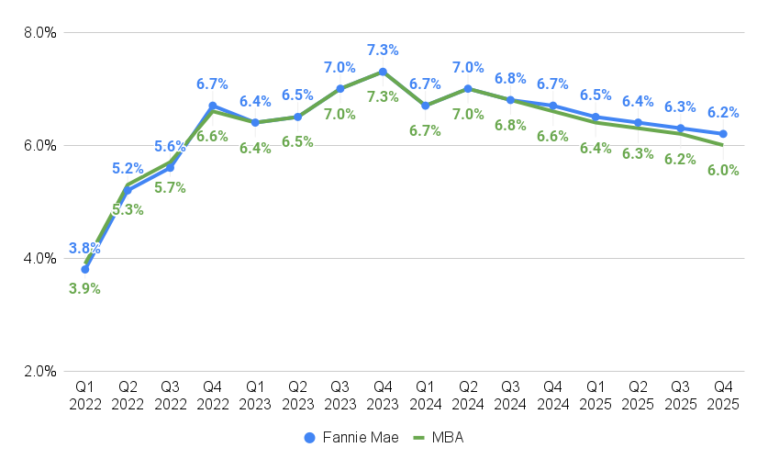
Fannie Mae economists project rates on 30-year fixed-rate mortgages will decline to an average of 6.7 percent during Q4 2024 and to 6.2 percent by Q4 2025. The MBA envisions rates coming down a little faster, to an average of 6.6 percent in Q4 2024 and 6.0 percent during Q4 2025.
Fannie Mae economists expect the Federal Reserve to cut rates in September and December, following two consecutive lower-than-expected prints of the Consumer Price Index and signs that job growth is slowing.
Because the Federal Reserve typically telegraphs its moves in advance, futures markets tracked by the CME FedWatch Tool on Wednesday predicted only a 7 percent chance that central bank policymakers will cut rates at their next meeting, which wraps up on July 31.
But futures markets investors have priced in a 100 percent chance that the Fed will bring short-term rates down by at least 25 basis points on Sept. 18, and an 8 percent chance of a 50 basis-point cut. A basis point is one-hundredth of a percentage point.
Futures markets tracked by the CME FedWatch Tool on Wednesday were predicting the odds of at least three rate cuts totaling 75 basis points by the end of the year at 59 percent, up from 23 percent on June 24.
Get Inman’s Mortgage Brief Newsletter delivered right to your inbox. A weekly roundup of all the biggest news in the world of mortgages and closings delivered every Wednesday. Click here to subscribe.
Email Matt Carter