Innovation is in our DNA at Inman — that’s why we’re excited about August’s Technology and Innovation Month. We’ll kick it off by celebrating the companies and individuals pushing the industry forward with an expanded slate of Inman Innovator Awards at Inman Connect Las Vegas. Then, we’ll continue to celebrate the brightest minds in real estate all month long.
As we kick off Technology and Innovation Month at Inman Connect Las Vegas, we’ll recognize the brightest minds in real estate with Inman’s Innovator Awards.
Then we’ll spend the rest of the month looking ahead at the future of technology in real estate and the innovations that are currently in progress.
What to expect
As we dig into the best that the industry has to offer, look for:
Tips for doing due diligence on new tech
Roundups of the best tech of the year thus far
A look at the future of home search
In-depth discussions with women in proptech
Follow-ups on past tech acquisitions
Weekly tech reviews from our tech expert Craig Rowe
How to get involved
Each week, watch for innovative questions in our Pulse survey. Please weigh in with your insights and experiences in our anonymous, one-question survey, and we’ll share the results the following week.
Have more to say? We’d love for you to become a contributor. For more information on that, reach out to our contributors editor.
Rumors surrounding the couple’s split have grown in recent months. Affleck and Lopez, meanwhile, have been transacting their own separate home deals as they jointly try to offload their shared Beverly Hills home.
HAPPENING NOW! At Inman Connect Las Vegas, July 30-Aug. 1, 2024, the noise and misinformation will be banished, all your big questions will be answered, and new business opportunities will be revealed. JOIN US VIRTUALLY.
Ben Affleck and Jennifer Lopez have each been transacting their own separate real estate deals as the couple also tries to sell their joint home, all while rumors of an imminent divorce have swirled in the media.
Affleck has purchased a $20.5-million, five-bedroom home in LA, TMZ reported. The property also reportedly features a separate guest house.
Located in the Sullivan Canyon community, the property is an equestrian home that includes horse stables as well as a central courtyard and spa, according to Robb Report. Affleck reportedly purchased the property from David Calvert-Jones, nephew of media mogul Rupert Murdoch.
The home Ben Affleck recently purchased for $20.5 million | Zillow
Meanwhile, Lopez has sold her Manhattan penthouse at 21 East 26th Street for $23 million, The Real Deal reported. Lopez had most recently asked $25 million for the apartment after having listed it on and off since 2017. The buyer was an anonymous LLC from West Palm Beach, according to records.
Chris Pomeroy and Richard Orenstein of Brown Harris Stevens represented the listing. The apartment is situated in the 1924-built row house known as The Whitman; previous notable residents include Chelsea Clinton and race car driver Jeff Gordon.
The Whitman | StreetEasy
Affleck and Lopez, who were married in July 2022, purchased their joint home in the Wallingford Estates neighborhood of Beverly Hills for $61 million last June after a year of house hunting. About two months ago, the couple started to shop the property off-market but opted to put it on the market one month later. The home is currently listed for $68 million, with Santiago Arana of The Agency repping the property.
The Wallingford Estates home Affleck and Lopez listed for $68 million | Zillow
For months, rumors have swirled about Affleck and Lopez’s marriage troubles. Reports have shown the couple spending time apart, with Lopez on the East Coast and Affleck on the West, but no divorce has been confirmed.
Get Inman’s Luxury Lens Newsletter delivered right to your inbox. A weekly deep dive into the biggest news in the world of high-end real estate delivered every Friday. Click here to subscribe.
HAPPENING NOW! At Inman Connect Las Vegas, July 30-Aug. 1, 2024, the noise and misinformation will be banished, all your big questions will be answered, and new business opportunities will be revealed. JOIN US VIRTUALLY.
Bond market investors who fund most home loans have cleared mortgage rates to continue their descent from 2024 highs after Fed policymakers dropped hints Wednesday that a September rate cut could be in the cards.
Wrapping up a two-day meeting Wednesday, members of the Federal Open Market Committee (FOMC) said they’d leave their target for the short-term federal funds rate at between 5.25 percent and 5.50 percent, as expected.
But the committee made some subtle changes to the language of its post-meeting statement explaining its rationale, Pantheon Macroeconomics Chief Economist Ian Shepherdson noted in an email to clients.
Ian Shepherdson
“Progress towards the committee’s 2 percent inflation objective has been upgraded to ‘some,’ from ‘modest,’ and inflation now is described as only ‘somewhat’ elevated,” Shepherdson wrote of the changes from June’s statement. “Meanwhile, the risks to achieving the employment and inflation goals ‘continue to move into better balance,’ and the committee now is ‘attentive to the risks to both sides of its dual mandate,’ rather than just to the inflation risks.”
In other words, Fed policymakers are acknowledging that while they’re determined not to cut rates until they’re certain that inflation is tamed, they’re also afraid of waiting too long to ease and throwing the economy into a tailspin.
Data released last week showed the Federal Reserve’s preferred measure of inflation, the personal consumption expenditures (PCE) price index, dropped to 2.51 percent in June from a year ago — just half a percentage above the Fed’s 2 percent target.
Mike Fratantoni
“The FOMC did not change its target for the federal funds rate but did shift its statement to acknowledge that inflation is slowing, unemployment is rising, and that there are now more balanced risks to the economy,” Mortgage Bankers Association Chief Economist Mike Fratantoni said in a statement. “While the Fed still hopes for a slower rate of inflation, there is a greater risk now that keeping monetary policy overly tight for too long could lead to unnecessarily higher unemployment.”
At a press conference following the meeting, Fed Chair Jerome Powell dropped more hints that the central bank will be ready to cut rates if it sees signs the economy is weakening.
“We know that reducing policy restraint too soon or too much could result in a reversal of the progress that we’ve seen” on inflation, Powell said. “At the same time, reducing policy restraint too late or too little could weaken economic activity and employment.”
Powell: ‘We are prepared to respond’
“If the economy remains solid, inflation persists,” Powell warned. “We can maintain the current target range for the federal funds rate as long as appropriate. If the labor market were to weaken unexpectedly or inflation were to fall more quickly than anticipated, we are prepared to respond.”
But the CME FedWatch tool, which tracks futures markets to gauge the odds of future Fed moves, shows investors are not only certain that the central bank will cut rates by at least 25 basis points in September but that there’s an 18 percent chance it will approve a more drastic cut of 50 basis points. A basis point is one-hundredth of a percentage point.
Bets placed by futures market investors as of Wednesday also suggest they see a 75 percent chance the Fed will cut rates by at least 75 basis points by the end of the year, up from 20 percent a month ago.
Shepherdson said forecasters at Pantheon Macroeconomics are only expecting the Fed to cut rates by 25 basis points in September, but that it will follow up with 50 basis-point reductions in both November and December.
That would bring the short-term federal funds rate down 1.25 percentage points, to a target range of 4 to 4.25 percent.
“Our view remains that the Fed is recognizing too slowly that the labor market is cooling and that high inflation is yesterday’s problem,” Shepherdson wrote. “With rates well above neutral, the easing cycle likely will be much faster than markets currently anticipate if, as we expect, the labor market data continue to weaken and inflation prints remain benign.”
Fratantoni said MBA forecasters are holding to their call for two rate cuts totaling 50 basis points this year.
Barometer for mortgage rates falls
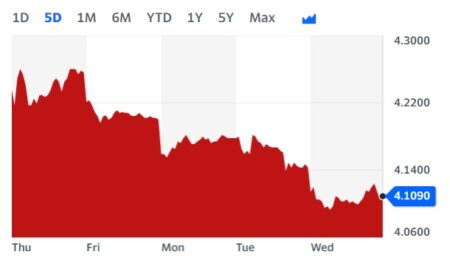
Yields on 10-year Treasury notes flirted with 4 percent Wednesday. Source: Yahoo Finance.
Yields on 10-year Treasury notes, a barometer for mortgage rates, remained on track for another weekly and monthly decline after Powell’s press conference. Since hitting a 2024 high of 4.74 percent on April 25, rising demand for bonds by investors who expect the economy to slow has brought yields on 10-year Treasurys down more than half a percentage point.
After closing at 4.14 percent Tuesday, 10-year Treasury yields touched a low of 4.09 percent Wednesday morning before rebounding to close at 4.11 percent Wednesday. That’s a 38 basis-point drop from July 1 and a 63 basis-point drop from a 2024 high of 4.74 percent on April 25.
Conforming mortgage rates in free fall
Rates for 30-year fixed-rate conforming mortgages averaged 6.71 percent Tuesday, down 30 basis points from July 1, according to rate lock data tracked by Optimal Blue.
Since hitting a 2024 high of 7.27 percent on April 25, rates on conforming mortgages have come down by 56 basis points — more than half a percentage point.
Borrowers seeking jumbo mortgages that exceed Fannie Mae and Freddie Mac’s $766,550 conforming loan limit haven’t seen as much relief, as the “spread” between jumbo and conforming loans has widened.
Borrowers were accepting locks on jumbo loans Tuesday at an average rate of 7.22 percent — a more modest drop of 34 basis points from a 2024 high of 7.56 percent registered on April 15.
Before the pandemic, rates on jumbo mortgages tended to be lower than conforming loans by an average of 9 basis points from 2017-2019, according to Optimal Blue data. But tightening by regional banks, which are major providers of jumbo loans, has flipped the spread, with rates on jumbo mortgages averaging 16 basis points above conforming loans in 2023 and 30 basis points so far this year.
With Fed rate cuts on the horizon, bond market investors who fund most conforming mortgage loans are happy to accept lower yields on mortgage-backed securities (MBS) backed by conforming loans. But jumbo lenders typically hold loans on their books, and their funding costs may come down more slowly.
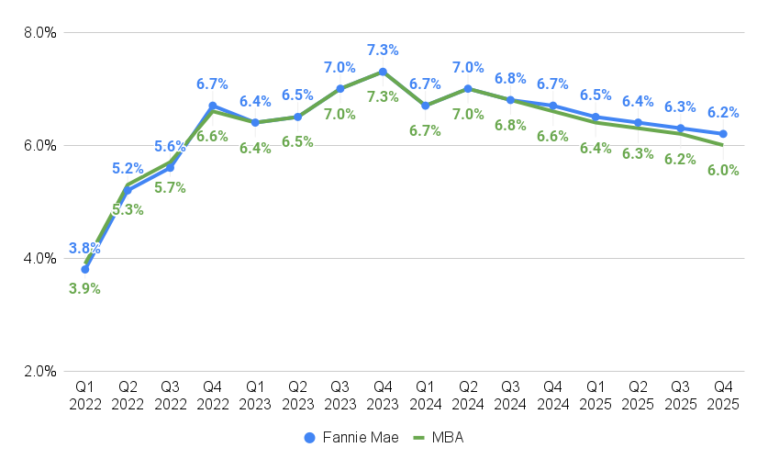
Economists at Fannie Mae and the Mortgage Bankers Association (MBA) predict the rate on conforming loans will continue to drop into the low sixes by the end of next year.
“Mortgage rates are now well below 7 percent, and there has been some modest pickup in refinancing activity in recent weeks,” the MBA’s Fratantoni said. “We expect that mortgage rates will continue to drift lower through the remainder of the year, particularly if the Fed does launch a series of rate cuts in September.”
So far, homebuyers have been slow to respond to the decline in rates, as the runup in home prices during the pandemic and elevated rates have priced many would-be buyers out of the market.
A weekly survey of lenders by the MBA showed applications for purchase loans were down by a seasonally adjusted 2 percent last week compared to the week before and were 14 percent lower than a year ago. Applications to refinance were down 7 percent week over week, but up 32 percent from a year ago.
Eric Orenstein
“Even with a September rate cut possible, mortgage companies will continue to face meaningful earnings headwinds for the foreseeable future,” Fitch Ratings Senior Director Eric Orenstein said, in a statement. “With most outstanding mortgages still carrying rates below 5 percent and record home prices driving down affordability, it may be a long road back to higher origination volumes.”
Get Inman’s Mortgage Brief Newsletter delivered right to your inbox. A weekly roundup of all the biggest news in the world of mortgages and closings delivered every Wednesday. Click here to subscribe.
HAPPENING NOW! At Inman Connect Las Vegas, July 30-Aug. 1, 2024, the noise and misinformation will be banished, all your big questions will be answered, and new business opportunities will be revealed. JOIN US VIRTUALLY.
Virtual brokerage leader EXp World Holdings’ revenue rose 5 percent year over year to $1.295 million during the second quarter, according to an earnings release on Wednesday.
The company was profitable for the quarter with its net income rising 3 percent to $11.8 million, despite higher taxes on continuing operations. The second-quarter adjusted EBITDA (earnings before interest, taxes, depreciation, and amortization) also experienced a boost, rising 22 percent year over year to $32.8 million.
EXp Realty seemed to begin turning the tide on agent loss in Q2, with the number of agents and brokers on the brokerage’s platform declining 1 percent year over year to 87,111 — an improvement from Q1, when the agent count slid 2 percent compared to the previous year.
Although 87,000 is far from eXp World Holdings founder, chairman and CEO Glenn Sanford’s bold five-year goal of reaching 500,000 agents by 2026, the brokerage said the drop in agents is due to the company offloading less productive members. Those measures were reflected in eXp’s real estate transactions and sales volume, which grew 1 percent year over year to 120,613 and 7 percent year over year to $51.9 billion, respectively.
Glenn Sanford, eXp World Holdings
“The power of the eXp platform is paying off for our agents and eXp worldwide,” Sanford said in a prepared statement ahead of the company’s earnings fireside chat. “We believe the investments we’ve made to provide our agents with the best tools, technology and training during this downturn are helping them outpace the industry in productivity while increasing our agent NPS score.”
“It’s clear that we have established the winning playbook for agents in the U.S. while our international segment is an untapped opportunity where I have taken a more active role guiding our ongoing growth,” he added. “Moving forward, we will continue to relentlessly pursue our core objective of being the most agent-centric real estate brokerage on the planet.”
Leo Pareja
EXp Realty CEO Leo Pareja said the brokerage’s performance during the quarter reflects its investment in agent initiatives, such as the launch of eXp Elevate Coaching and the decision to instantly release vested shares to heirs upon agent death through the eXtend A Hand program.
“After gathering feedback from agents during my first quarter as eXp Realty CEO, it is clear that our initiatives to support agent productivity are gaining traction,” he said in a written statement. “Agents love the expanded learning and development options, faster payouts and Gen AI-based self-service capabilities we have introduced, and they are eager for what’s to come.”
“I remain committed to seeking new ways to leverage technology to operate more efficiently, which will both fund our investments in agent productivity and drive agent satisfaction as increasingly automated processes enable agents to devote more of their time to serving their clients,” he added.
In the company’s Wednesday evening fireside chat (i.e. earnings call), Sanford and Pareja discussed the brokerage’s performance and highlighted the impressive growth outside of the U.S. and Canada. International revenues grew a startling 69 percent year over year during Q2, as the company focused on recruiting experienced agents for eXp Global.
“There was a strong performance in both sales, volume and productivity,” Sanford said of eXp Global. “Our agent count really didn’t change a whole bunch overall, but that’s because a lot of our agents that were in international in the initial launch into international were nonproductive.”
“We actually changed it to looking at agents who have two years or more experience are the ones that we’re actually bringing over to eXp now,” he added. “And that’s really changed the trajectory internationally.”
Sanford said the focus on expanding eXp’s global footprint means there’s a recruitable agent pool of roughly 20 million agents. That number, he said, has reignited the brokerage’s growth goals. EXp could have 1 million agents worldwide by 2034 — double the goal he set in late 2021.
“We’re really excited about that long-term vision — we’ll just say 10-year vision of where we’re going,” he said. And even more recently, I’ve been working directly with the international team, personally bringing a lot of the startup culture into international and working with various team leaders, country leaders and our existing amazing team that we’ve got growing [internationally].”
Although there are plenty of tailwinds pushing eXp’s sails, Pareja took time to address two primary headwinds. The first, he said, are current market trends, such as sticky mortgage rates, worsening affordability and weak existing-home sales.
The second is the looming Aug. 17 deadline for several landmark procedural changes connected to the National Association of Realtors’ buyer-broker commission lawsuit settlement. These include the removal of offers of compensation to buyer’s agents in Realtor-affiliated multiple listing services and the requirement that buyers’ brokers sign representation agreements with buyers before taking them on a home tour.
EXp has already made a push to be ahead of the curve with the rollout of a new listing agreement that said the company “does not share commissions with a buyer’s broker.” However, the agreement does leave room for homebuyers to request concessions from homesellers, which could be used to compensate a buyer broker.
The brokerage said it’s training its agents on how to discuss the new listing agreement and comply with the new rules. “All of our goals with listing agreements are to interpret the rules that are going to be enforced by the MLS,” Pareja said in a previous Inman article. “Our position as of right now is we’re going to make sure we’re going to reflect that broker-to-broker commission sharing on the MLS is no longer allowed.”
In the call, Pareja said there will be “an adjustment period” after the Aug. 17 deadline and that eXp leadership is prepared to help agents and brokers navigate challenges through continued rallies, virtual calls and educational toolkits.
“We’ve been providing as much education and tools through our regional rallies, virtual meetings and as many places as we can communicate with our agents,” he said. “Our buyer representation toolkit, which includes a buyer-broker representation agreement that the [Consumer Federation of America] recently recognized as much simpler, clearer and pro-consumer than any other agreement that’s been created recently, is something we’ve open-sourced so all agents in the industry have access to what’s being considered the best-in-class documents in order to make this transition as smooth as possible.”
EXp’s stock (NASDAQ: EXPI) rose in after-hours trading, with the price per share reaching $14.49 — 0.9 percent higher than the closing price of $14.36.
The company’s market cap stands at $2.22 billion.
Update: This story was updated after publication with additional details from eXp’s earnings call.
CHICAGO (August 1, 2024) – The National Association of Realtors® reminds members, real estate professionals, and consumers that on August 17, 2024 the practice changes following NAR’s Settlement Agreement that would resolve claims brought on behalf of home sellers related to broker commissions will be implemented across the country.
NAR recommends all MLSs implement practice changes by August 17. Realtor® MLSs (those owned exclusively by one or more Realtor® Associations) must implement the changes by this date to remain in compliance with NAR policy.
Under the settlement, the following practice changes will take effect:
Offers of compensation will be prohibited on Multiple Listing Services (MLSs). Offers of compensation will continue to be an option consumers can pursue off-MLS through negotiation and consultation with real estate professionals. Offers of compensation help make homeownership and the benefits of professional representation more accessible to buyers—especially first-time homebuyers—increase homeownership opportunities for historically underserved groups, and benefit sellers by expanding the potential buyer pool and ensuring they receive the best offer possible for their property.
Agents working with a buyer must enter into a written buyer agreement before touring a home. The practice changes do not require an agency agreement or dictate any type of relationship. NAR encourages all members to address form changes and prepare to educate real estate professionals and consumers about revised forms as soon as possible ahead of August 17. NAR policy does not dictate terms of buyer agreements, but NAR has created resources to assist with implementation of the settlement terms—such as tips on clarity and emphasizing consumer choice and a “Written Buyer Agreements 101” resource.
“NAR members are dedicated, intelligent, and highly adaptable experts in their fields—that’s why Realtors® are such an integral part of the homebuying and selling process,” said Kevin Sears, President of NAR. “These changes help to further empower consumers with clarity and choice when buying and selling a home. As the August 17 practice change implementation date approaches, I am confident in our members’ abilities to prepare for and embrace this evolution of our industry and help to guide consumers in the new landscape.”
Consumers can find additional information on what these changes mean for their homebuying and selling experiences in NAR’s buyers and sellers guides. For NAR members, the practice changes are outlined in detail here, and detailed information is available in NAR’s FAQ. Please visit facts.realtor for the latest updates on the settlement and practice changes.
About the National Association of Realtors®
The National Association of Realtors® is America’s largest trade association, representing 1.5 million members involved in all aspects of the residential and commercial real estate industries. The term Realtor® is a registered collective membership mark that identifies a real estate professional who is a member of the National Association of Realtors® and subscribes to its strict Code of Ethics.
HAPPENING NOW! At Inman Connect Las Vegas, July 30-Aug. 1, 2024, the noise and misinformation will be banished, all your big questions will be answered, and new business opportunities will be revealed. JOIN US VIRTUALLY.
Uncertainty in the housing market has failed to slow down Compass this year, with a new earnings report showing the brokerage’s revenue, transactions and agent count all made significant gains in the second quarter — results CEO Robert Reffkin described as a best-ever performance.
In an earnings report Wednesday, Compass revealed it brought in $1.7 billion in revenue between April and June. That’s a 14 percent increase compared to the second quarter of 2023. The company attributed the higher revenue to an 11.4 percent increase in transactions — a number the brokerage achieved even though, the report notes, “transactions declined by 3.3 percent for the entire residential real estate market.”
The jump in revenue also helped Compass turn a profit of $20.7 million during Q2 — a turnaround from the $47.8 million net loss the company suffered during the same period a year earlier.
The new report also shows that at the end of the second quarter, Compass had a total of 16,997 principal agents. That’s up considerably from the 13,698 it had at the end of Q2 2023. The company noted in the report that it added “543 principal agents organically and approximately 2,375 principal agents from the acquisitions of Latter & Blum and Parks Real Estate in Q2 2024.”
Robert Reffkin
In a call with investors Wednesday afternoon, Reffkin described Q2 by saying “we had the best performance we ever had as a company.” In the report, he added that he was “particularly pleased” with the brokerage’s latest financial results.
“Capitalizing on the structural advantages created by our end-to-end proprietary technology platform, national scale, top agent network and exclusive inventory, we have positioned Compass for what we believe will be significant upside when the market begins to recover,” Reffkin said in the report.
In addition to revenue and transactions, the report further shows that Compass saw free cash flow of $40.4 million in the second quarter. That’s significant because Compass has a long-stated goal of becoming free cash flow positive. The company originally believed it would hit that target last year but, amid a tough market, ultimately missed. However, Q2 is the second consecutive quarter Compass has managed to have positive free cash flow, suggesting it may be on track to hit its goal this year.
During Wednesday’s investor call, Compass Chief Financial Officer Kalani Reelitz confirmed that the company expects to be free cash flow positive for all 2024. However, free cash flow will only be “slightly” positive in Q3 and is likely to be negative in Q4. Reelitz attributed these likely results to seasonality.
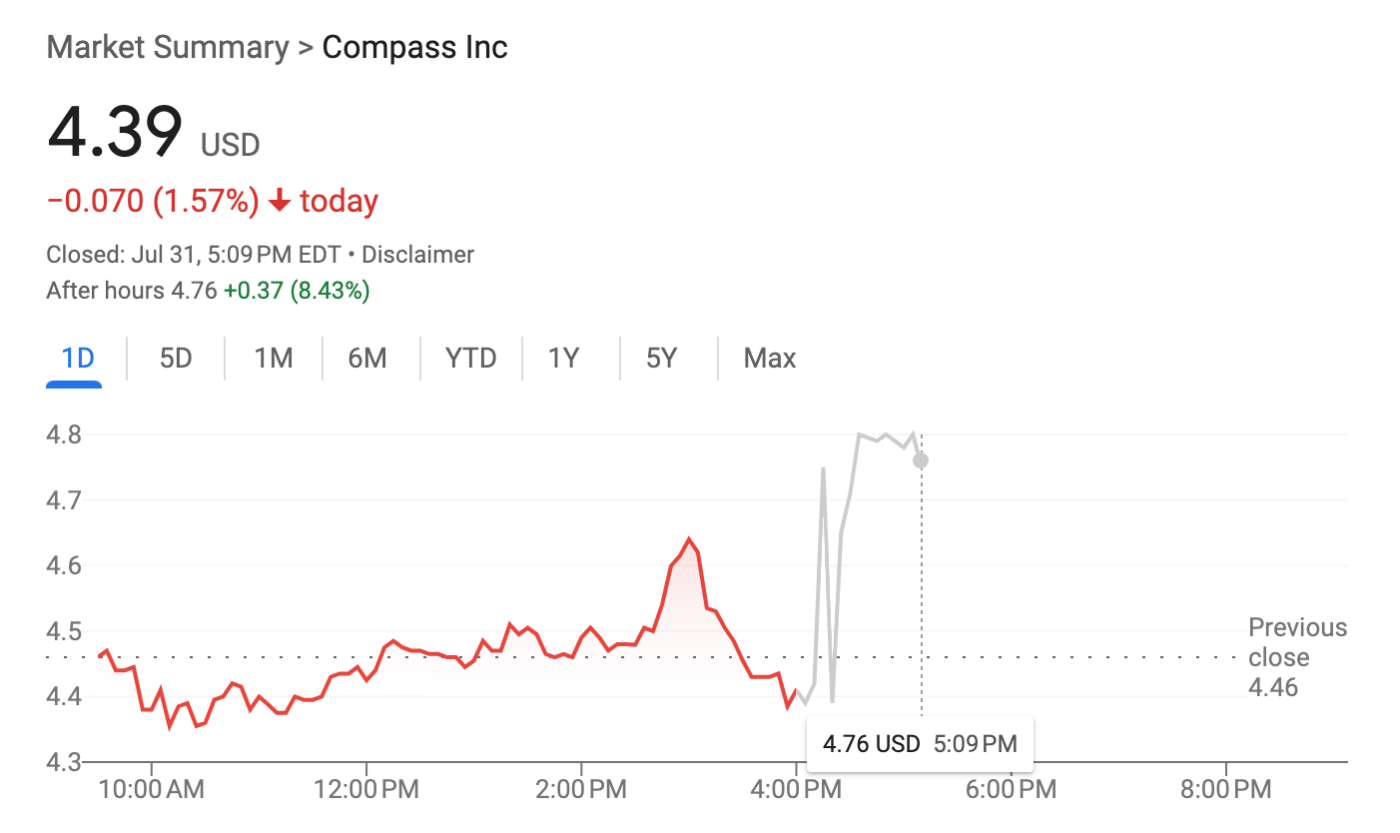
Heading into Wednesday’s earnings report, Compass shares were trading in the mid $4 range. That was down slightly for the day and up slightly for the week. But it was up significantly — about 24 percent — from where shares were at the beginning of the year.
Shares fluctuated but ultimately made significant gains in after-hours trading following the publication of Wednesday’s earnings report.
Credit: Google
Compass had a market cap of $2.17 billion as of Wednesday afternoon.
Compass last reported earnings in May. At the time, it revealed that it earned $1.05 billion in revenue between January and March. That number represented a 10 percent jump compared to the first quarter of 2023. In the May report, Compass attributed the higher Q1 revenue to a 7.1 percent increase in transactions.
Aside from financial numbers and agent counts, Wednesday’s report further states that Compass had a national market share of 5.13 percent in the second quarter of the year. The report describes that number as “an increase of 50 basis points compared to Q2 2023 and an increase of 37 basis points sequentially from Q1 2024.”
During his investor call, Reffkin said Compass wants to achieve 30 percent market share in its top 30 markets by 2026. The company calls this plan its “30-30 Vision” and, according to Reffkin, can achieve that objective thanks to various “structural advantages.” Those advantages include a unique tech platform, a national scale, a top agent network, and the “depth and breadth of our inventory,” according to Reffkin.
Reffkin also said Compass plans to make the company the “required destination for real estate,” with “more inventory than third-party websites.”
Compass’ website already includes a portal, which years ago caused some tension between the company and Redfin, which is also a portal-brokerage operator. However, in more recent years, Compass has largely been absent from the discussion of real estate portals and the so-called portal wars — which have become crowded thanks to the entrance of CoStar. Reffkin’s comments, however, suggest that Compass may have an appetite to vie for portal traffic after all.
Asked how close Compass is to achieving 30 percent market share in its top 30 markets, Reffkin said during the call that “we’re more than halfway there.”
Later during the investor call, Reffkin weighed in on antitrust commission lawsuits. Among other things, he said the settlements seem to have shown the benefits of working at a large real estate company, and that Compass is seeing increased interest from agents who want to join the brokerage.
Reffkin also said that since the National Association of Realtors agreed to settle multiple antitrust commission suits, there has not been a noticeable change in the number of sellers offering buyer agent commissions. Most sellers also continue to offer buyer agent commissions of 2 percent or more.
According to Reffkin, these findings suggest the commission suit settlements — and the August deadline for various new NAR rules — will not have a significant deleterious impact on real estate professionals, and that the biggest fears about the situation have “simply not materialized.”
“The data clearly shows,” Reffkin said, “that sellers continue to value incentivizing buyer agents.”
Update: This story was updated after publication with additional information from Compass’ earnings report, and with commentary from the company’s investor call.