by Joseph Santini | Sep 4, 2024 | Industry, News Feed
Whether it’s refining your business model, mastering new technologies, or discovering strategies to capitalize on the next market surge, Inman Connect New York will prepare you to take bold steps forward. The Next Chapter is about to begin. Be part of it. Join us and thousands of real estate leaders Jan. 22-24, 2025.
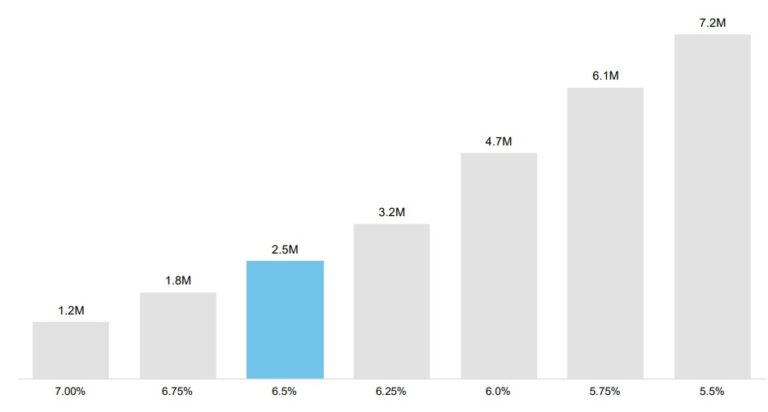
Declining mortgage rates and slowing home price appreciation have boosted affordability in many markets and made refinancing a tempting option for 2.5 million homeowners — many of whom are locking rates on refis at levels not seen in more than 2 years.
While that’s good news for mortgage lenders and real estate agents, the latest ICE Mortgage Monitor report from Intercontinental Exchange Inc. also shows the potential for a boom in homebuying and refinancing if mortgage rates keep falling as expected, with the Federal Reserve gearing up this month to shift its stance from fighting inflation to warding off a recession.
Optimal Blue data shows mortgage rates are already down 1.5 percentage points from the post-pandemic high of 7.83 percent registered in October 2023, and affordability is as good as it’s been in six months, ICE’s Andy Walden said.

Andy Walden
“Recent easing in mortgage rates brought some much-sought relief to prospective homebuyers,” Walden said in a statement. “Along with a general cooling in home price growth, rates falling below 6.5 percent made August the most affordable month for housing since February.”
While purchase mortgage demand picked up somewhat, the response has “muted in comparison to early 2023 and 2024 when rates fell to similar levels,” ICE Mortgage reported.
How falling mortgage rates could affect affordability
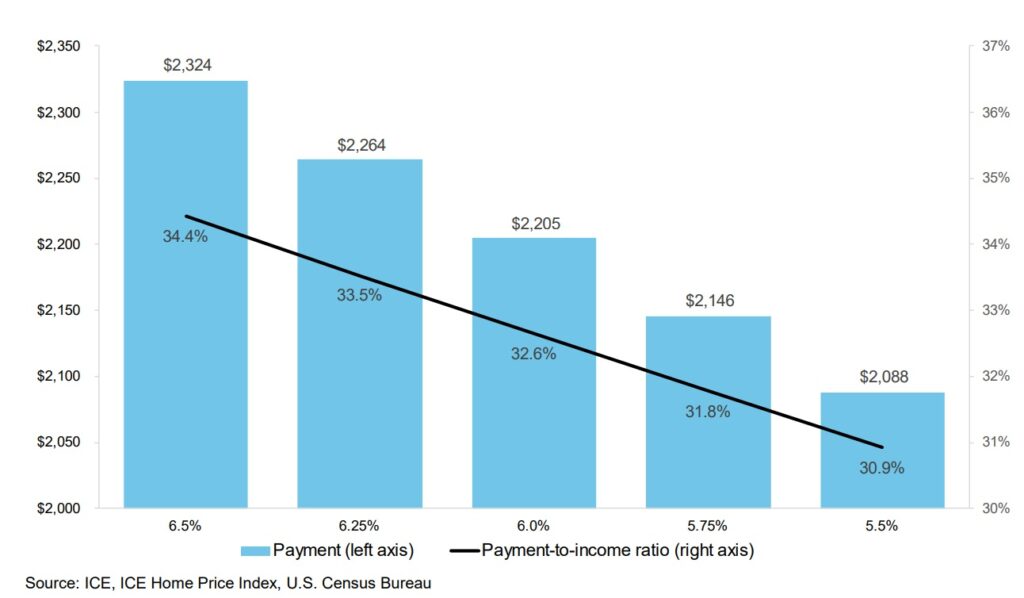
Monthly payment on average-priced home as percentage of income. Scenarios assume home prices and income hold steady as mortgage rates fall, and that buyers make a 20 percent down payment to finance their purchase with a 30-year fixed rate mortgage.
With mortgage rates at 6.5 percent, buying the average home still requires 34 percent of median income — about 10 percentage points higher than the historical average, Walden noted.
Each quarter point mortgage rate reduction reduces the mortgage payment required to purchase the average-priced home by around $60.
So if rates come down another percentage point, to 5.5 percent, payment-to-income ratio drops to 31 percent and homebuyers would be looking at a monthly payment of $2,088 instead of $2,324.
While forecasters at Fannie Mae and the Mortgage Bankers Association expect rates will continue to come down, they don’t anticipate rates on 30-year fixed-rate loans to dip below 6 percent until Q4 2025.
Mortgage rates are only part of the affordability problem. While home prices soared during the pandemic, they are now decelerating and even coming back down in some Sunbelt markets where inventories are growing.
Growing inventory and continuing soft demand slowed annual home price appreciation to 3.6 percent in July, down from 4.1 percent in June, ICE Mortgage estimates.
Looking at the nation’s 100 largest markets, ICE Mortgage sees affordability remaining a challenge in more than half, with the median income needed to make monthly mortgage payments still elevated by 10 percentage points from historical averages.
By that measure (payment-to-income ratio), affordability has returned to historical trendline in seven markets: Birmingham, Alabama; Des Moines, Iowa; McAllen, Texas; Cleveland and Toledo, Ohio; Memphis, Tennessee; and Baton Rouge, Louisiana.
Payment-to-income ratios are within 5 percentage points of historical averages in 22 other markets, ICE Mortgage estimates.
But elevated down payment and tight credit requirements may also be contributing to muted demand, the report warned.
Homebuyers making record down payments
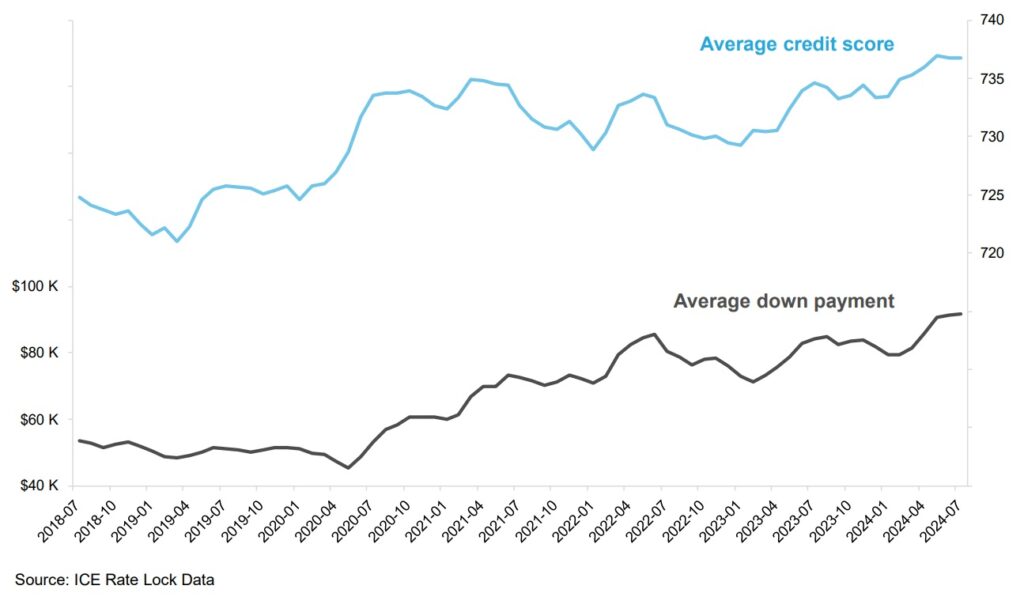
Homebuyers have better credit scores and are making bigger down payments than before the pandemic.
Homebuyers financing their purchases made down payments averaging $91,600 in July, a new record high. That’s up 9 percent from a year ago and 79 percent from July 2019 — the summer before the pandemic, when down payments averaged $51,100.
Would-be homebuyers are also facing tight lending requirements, with the average credit score for borrowers taking out purchase loans hitting a record 737 in May, according to ICE Market Trends data.
While homebuyers would welcome lower mortgage rates, they would also benefit recent homebuyers who took out loans when rates were higher.
More homeowners ‘in the money’ for refinancing
As of Aug. 22, 2.5 million homeowners were “in the money” for a refinance, meaning they could save money by refinancing at a lower rate.
Among that group, more than 60 percent took out their mortgages in the past two years, including 850,000 in 2023 and 560,000 this year.
ICE Mortgage calculates that “highly qualified” candidates with credit scores of 720 or higher and at least 20 percent equity in their homes could save $264 a month by refinancing into a new loan that shaves at least 75 basis points off their current rate.
If rates fell by a full percentage point to 5.5 percent, nearly 7.2 million homeowners would be “in the money” for a refinance, and 2.7 million of those would be considered highly qualified, ICE Mortgage estimates.
If rates fell that far, two-thirds of mortgages originated in 2023 and more than 80 percent of loans taken out in 2024 would be in the money for a refinance.
That’s a potential headache for loan servicers who collect monthly mortgage payments for investors, who don’t want their mortgage servicing rights (MSR) portfolios shrink as clients refinance with another lender.
Loan servicers retained only one in five borrowers who refinanced during Q2 2024, down from 25 percent in Q1 and the second lowest retention rate in more than 17 years.
Servicers were “particularly successful in retaining refinancing borrowers who’d recently obtained their loans,” with retention as high as 41 percent among 2023 and 34 percent among 2022 vintage loans, ICE Mortgage noted.
Get Inman’s Mortgage Brief Newsletter delivered right to your inbox. A weekly roundup of all the biggest news in the world of mortgages and closings delivered every Wednesday. Click here to subscribe.
Email Matt Carter
by Christian Ashley Harris | Sep 4, 2024 | Industry, News Feed
The residential and commercial real estate company sued over misuse of trade secrets in 2023, but revealed in a new court filing that a rival tech platform’s “limited nature” is no longer a threat.
Whether it’s refining your business model, mastering new technologies, or discovering strategies to capitalize on the next market surge, Inman Connect New York will prepare you to take bold steps forward. The Next Chapter is about to begin. Be part of it. Join us and thousands of real estate leaders Jan. 22-24, 2025.
One year after CoStar sued the founder of Homesnap, alleging he stole trade secrets, the commercial-turned-residential giant has now dismissed the suit, citing the “limited nature” of a rival product.
CoStar filed a notice of voluntary dismissal Wednesday. The filing brings to a close a case that has its roots back in 2020, when CoStar acquired Homesnap as part of its then-budding push into residential real estate. However, three years later, CoStar alleged that Homesnap founder Guy Wolcott hired away former Homesnap employees from CoStar. Wolcott then allegedly used the employees to aid him in a new business venture after they had been exposed to proprietary CoStar trade secrets.
Wolcott’s LinkedIn profile lists his current position as “founder” of Homesnap. But according to CoStar’s legal filing Wednesday, Wolcott founded Happening Technology after the Homesnap acquisition. He then presented his company’s product to CoStar executives as a potential alternative to CoStar’s own platform.
“What was shared of the Happening product, developed by former CoStar employees with detailed knowledge of CoStar’s proprietary systems, mirrored CoStar’s proprietary platform,” the filing states. “CoStar raised these concerns with Defendants, but they obfuscated.”
Happening and Wolcott were both named as defendants in the lawsuit, as were three former Homesnap employees, including former CEO John Mazur.
The case eventually moved into arbitration. CoStar was also able to conduct discovery in the case, which allowed the company to “compare what Mr. Wolcott initially presented to CoStar with the actual state of defendants’ product,” the filing states.
Evidently, CoStar found that Wolcott’s product didn’t pose a threat after all.
“CoStar has since learned of the limited nature of Happening’s initial product,” Wednesday’s filing states. “Moreover, CoStar has determined that the Happing product now lacks critical functionality present in CoStar’s proprietary data platform and cannot serve as a replacement for that platform. As a result, CoStar has confirmed that there is no longer a threat of imminent, irreparable harm and the need for further relief on its claims at this time.”
In a statement, Gene Boxer — CoStar’s general counsel — reiterated the conclusions mentioned in the filing to dismiss the case. And he stated that CoStar will continue to defend its technology and trade secrets going forward.
“We have also made clear to defendants,” Boxer said, “the potential future ramifications for any misappropriation of CoStar’s trade secrets.”
Email Jim Dalrymple II
by Jill Butler | Sep 4, 2024 | Industry, News Feed
Whether it’s refining your business model, mastering new technologies, or discovering strategies to capitalize on the next market surge, Inman Connect New York will prepare you to take bold steps forward. The Next Chapter is about to begin. Be part of it. Join us and thousands of real estate leaders Jan. 22-24, 2025.
With all the media coverage of today’s real estate industry, if you’re a concerned real estate licensee you’re not alone.
With confusion over “inflated commissions,” “conspiracy,” and “consumer’s rights,” allow me to shine a light on the matter. It is not just about the money — it’s the perception of behaviors within the Realtor trade organization’s systems and policies and the control it imposes.
In my opinion, at the core is the limiting of capitalism, free enterprise and the stifling of competition. At the heart of it all is antitrust. There is a ray of hope, because, in simplest words, you do have a choice.
Key Realty Group (KRG) is the only real estate brokerage independent of the National Association of Realtors (NAR) that is native to the Berkshires in Massachusetts, and with careful research, you can find other brokerages across the nation that have made the same choice as we did to become independent.
Why did we make the choice to leave NAR?
KRG was licensed in 2022 so that it could broker real estate transactions free from the control of NAR. As an independent, KRG had no affiliation and, therefore, no influence from NAR over policies.
KRG’s new economic paradigm was motivated by a desire to give consumers a choice and to provide transparency within the real estate transaction, all while giving real estate licensees more control over their own business plans, advertising and transactions.
What’s the difference between a licensed broker vs. a licensed Realtor?
So, let’s first understand the distinction between a licensed real estate broker versus a licensed real estate broker who is also a Realtor. The term Realtor is often used interchangeably with agent.
All licensees must complete the same educational hours and the same training and pass the same test to obtain the license, and the salesperson licensee must be affiliated with a supervisory broker before they can act as a fiduciary to a consumer.
While all licensees are educated, trained and licensed to do the very same job, and all are held to the state’s ethical and professional standards of that profession, the autonomy of a non-Realtor real estate broker versus a Realtor real estate broker is not the same. The choice to pay and join a trade organization is the sole act that makes that licensed real estate broker a Realtor.
A Realtor, as a trade organization member, must abide by the policies and rules dictated by the organization, whether they believe in them or not. A few policies within the NAR trade organization were the focus of the Sitzer | Burnett suit and the basis for the federal verdict that found Realtors guilty and awarded damages of $1.78 billion.
Rejecting the complacency requirement of a Realtor membership is how KRG first began.
The commission lawsuits emerge
In 2020, I learned of the first suit — U.S. Department of Justice v. National Association of Realtors (NAR). It was a case alleging antitrust violations. With looming questions in my mind, I began to research to find a better, independent way.
In 2021, I implemented change. In 2022, our team successfully licensed the KRG-Key Realty Group (KRG) brokerage, and in January 2023, KRG began servicing clients.
While KRG was plowing the path for the new brokerage with new ideals, NAR would find itself in another antitrust lawsuit (the aforementioned Sitzer | Burnett), which would be in the headlines throughout 2023.
In a Federal courtroom in October 2023, in less than two hours, a jury of average consumers would render a guilty verdict for antitrust behaviors and policies against NAR and award a historic sum of damages in the amount of $1.78 billion.
Fast forward to today. While the Realtor community was scrambling to meet the Aug. 17, 2024, deadline imposed upon them within the NAR’s settlement agreement, some may have missed the point. The atmosphere is hyper-focused on how to reallocate and redefine the compensations that came under scrutiny in this antitrust case.
Perhaps taking a good look at how attorney Michael Ketchmark was able to win against NAR — the largest, most powerful trade organization in real estate — will shed some light. The win was based on the perception that they had no choice. Consumers, unaware of the differentiation of real estate brokers and Realtor real estate brokers, felt they had no choice. The fee the Realtor broker was charging — the consumer felt they had no choice. The Realtor broker or agent may have also felt they had no choice since their trade organization controlled them and restricted creativity or business diversity.
Now, in the aftermath of that verdict, some licensee professional brokers are lashing back. They are bitter about more limitations and more control placed upon them by NAR’s universal settlement agreement. It’s an agreement that affects every NAR member (every Realtor broker, not every non-Realtor broker). It’s another agreement that they had no voice in crafting. Disappointed with a system that has held them hostage for decades, some have filed their own suit against NAR.
Maybe it’s about time they fight back. The undue influence would begin as early as the inception of the Realtor-owned MLSs. Looking at the history “once an MLS reached critical mass in a particular marketplace, brokers might find their business drying up if they didn’t join.”
It seems even back then, they had no choice.
In light of this past year, Realtor brokers and non-Realtor brokers alike are determined to change the system for the good of consumers. Many didn’t like NAR’s influence or control in the first place, nor did they feel an overpowering need to be involved as a political lobbyist just to run a small successful local real estate business.
Now, the real estate industry is changing, and that is a good thing. Hold on tight. When you let loose the number of brilliant, resourceful and moral entrepreneurs these brokers are, things are gonna change. I see opportunities everywhere I look. Opportunities for different business models, more services or fewer services, and more creativity.
Brokers have a choice
All brokers have choices, too. Brokers can be Realtor brokers or non-Realtor “independent” brokers. A broker can be proactive or reactive. With the power of a broker’s license, the professional can affiliate within multiple brokerages all at one time or just one brokerage.
The broker can open their own brokerage and affiliate hundreds of agents with them, or they can be a lone-ranger broker. A broker has a vast array of business model choices, some of which may not have even been invented yet.
The brokerage can utilize hundreds of advertising menus and social media platforms; subscribe to websites; and participate in one multiple listing service (MLS), several MLSs, or no MLS at all.
A broker can be a managing broker overseeing agents or an active, boots-on-the-ground broker helping consumers buy and sell or both. A broker can specialize in services to a seller, services to a buyer, or services to both buyers and sellers. There are many types of business models.
Brokers have choices. It’s all about choices. I can see opportunities for entrepreneurs within the real estate sales industry and for those all around it. Opportunities for advocates, negotiators, mediators, facilitators, estimators, contractors and, of course, more opportunities for fiduciaries than ever before. Buyers, sellers, agents and brokers have choices. Everyone has choices.
Nadine Hiser, broker associate, Key Realty and Broker of Record, KRG – Key Realty Group. Connect with her on Twitter, Linkedin and Instagram.
by Pacaso | Sep 4, 2024 | Industry, News Feed
Whether it’s refining your business model, mastering new technologies, or discovering strategies to capitalize on the next market surge, Inman Connect New York will prepare you to take bold steps forward. The Next Chapter is about to begin. Be part of it. Join us and thousands of real estate leaders Jan. 22-24, 2025.
The new commission rules went into effect on Aug. 17, and the multiple listing services (MLSs) are watching closely for mistakes — and issuing fines. Here is what you need to know about how the MLSs are keeping tabs on the new rules, how some MLSs are structuring fines, and what AI tools they are using to discover violations.
Fines are already being assessed
If you had any expectation that you were going to be able to work around the new MLS rules on buyer-broker compensation, let go of that right now. Michael Ketchmark, in an Aug. 19, 2024, Inman interview, shared the following warning:
“If anyone thinks they’re going to be able to avoid the application of this settlement agreement and the law by creating some new forms or hiding this cooperation on new websites, they’re wrong. If we get any sense that people or corporations are doing that out there as a way around this, we plan on taking swift legal action.”
The MLSs are dead serious about enforcing these new rules, and many have already started fining agents who violate them.
Some examples of the types of fines that are being assessed include:
ARMLS
ARMLS, which serves the Phoenix region of Arizona, has fines ranging from $500 to long-term suspension from the MLS.
CRMLS (California Regional Multiple Listing Service)
CRMLS has instituted a $2,500 fine for violating any of the following rules:
- Rule 7.15: Offering or Conveying Buyer’s Agent Compensation in the MLS
- Rule 7.16: Insufficient Disclosure of Compensation to Seller/Landlord
- Rule 7.19: Disclosure of Listing Broker’s Compensation
- Rule 9.1: Showing Listed Property w/o Written Compensation Agreement w/ Buyer; Insufficient Compensation Agreement w/ Buyer
- Rule 19.2.21: Display of Offer of Compensation – IDX
- Rule 19.3.26: Display of Offer of Compensation – VOW
Dallas (MetroTex MLS)
MetroTex MLS fully implemented the changes in compliance with the NAR settlement on July 29, 2024. Fines for violations start at $1,000.
San Diego MLS (SDMLS)
San Diego MLS has established a $1,500 fine “for including compensation, commission, bonuses, or broker/brokerage fees in an SDMLS listing.” This is how they explain it on their website:
The $1,500 fine for violations related to compensation information is not meant to be punitive, but rather to emphasize the importance of complying with the new NAR Settlement rules. These rules are in place to promote transparency and fair practices in the real estate industry. While we don’t intend to fine our members without warning, the severity of the fine reflects the seriousness of non-compliance and serves as a deterrent to ensure all members adhere to the new regulations. We are always open to listening to concerns from our members and providing guidance on compliance. There are antitrust issues, and Realtors have always errored on the side of caution when potential antitrust claims are a possibility.
Stellar MLS
Stellar MLS, which serves Central and Southwest Florida, has a $500 fine for first time offenders.
Effective Aug. 6, 2024, any violation of the rule requiring a Buyer Broker Agreement prior to touring a property will result in an automatic $500 fine for first-time offenders.
SWMLS
SWMLS (Greater Albuquerque Association of Realtors) has a tiered fine structure that went into effect on Aug. 17, 2024.
-
- First fine within a 12-month period will be assessed at $250.
- Second fine within a 12-month period will be assessed at $500
- Third fine and all subsequent fines within a 12-month period will be assessed at $750
- When the Participant or Subscriber receives a 3rd or subsequent administrative sanctions, the tribunal will hold a hearing in which the Subscriber and Participant will be required to attend.
Big Brother’s ‘little brothers’
Anyone who uses social media knows that certain types of posts can be removed or even get you kicked off a site if you violate the provider’s terms of use. The question is exactly how do these platforms identify this type of content?
This platform is widely used across multiple industries outside real estate to “detect explicit adult or suggestive content, violence, drugs, tobacco, alcohol, hate symbols, gambling, and disturbing content in images and videos.”
CoStar explains why they chose Amazon Rekognition to conduct their content moderation:
CoStar uploads around 150,000 images and videos to its platform daily and must also confirm that they are appropriate. Because manual analysis is not feasible, CoStar now uses Amazon Rekognition Content Moderation API to build a solution that automatically analyzes uploaded images and videos and ensures the highest quality and compliance of its data. It provides mass scanning, imagery classification, and detects unwanted or toxic content in images with text—saving time, increasing productivity, and reducing infrastructure costs.
(If you would like to know more about how these content moderation tools work, there’s an excellent article from Spectrum Labs called, “AI-Based Moderation: Enhancing Trust and Safety Online Platforms.” These tools are now being employed across the social media to spot various types of violations including bullying, hate speech, profanity, drug and sexual solicitation, etc.)
Listing Data Checker (a CoreLogic product)
Many MLSs are already using Listing Data Checker including Dallas MetroTex, Connecticut’s SmartMLS, Massachusetts MLS Pin, and New Hampshire’s Paragon MLS.
According the Listing Data Checker website,
Listing Data Checker automatically checks the accuracy of your data and enforces the correction of violations. It’s the most powerful and widely adopted system of its kind—and the best way to assure the quality of your listing data, your most valuable asset.
This tool can be used as a stand-alone or in conjunction with human checkers.
Bane or blessing?
Michael Lissack, who is a licensed broker based in Massachusetts and is also licensed in multiple other states, bumped into Listing Data Checker on Connecticut’s SmartMLS, Massachusetts’ MLS Pin, and New Hampshire’s Paragon MLS.
Lissack shared two different listing screenshots that illustrate how Listing Data Checker is being employed by SmartMLS. In the first example below, you can see the words “buyer,” “fee” and “pay,” flagged in this listing description as a possible violation of the new compensation rules.
Below, the site tells Lissack: “You can publish this listing on the MLS. However, it will be flagged for review by our Compliance Department.”
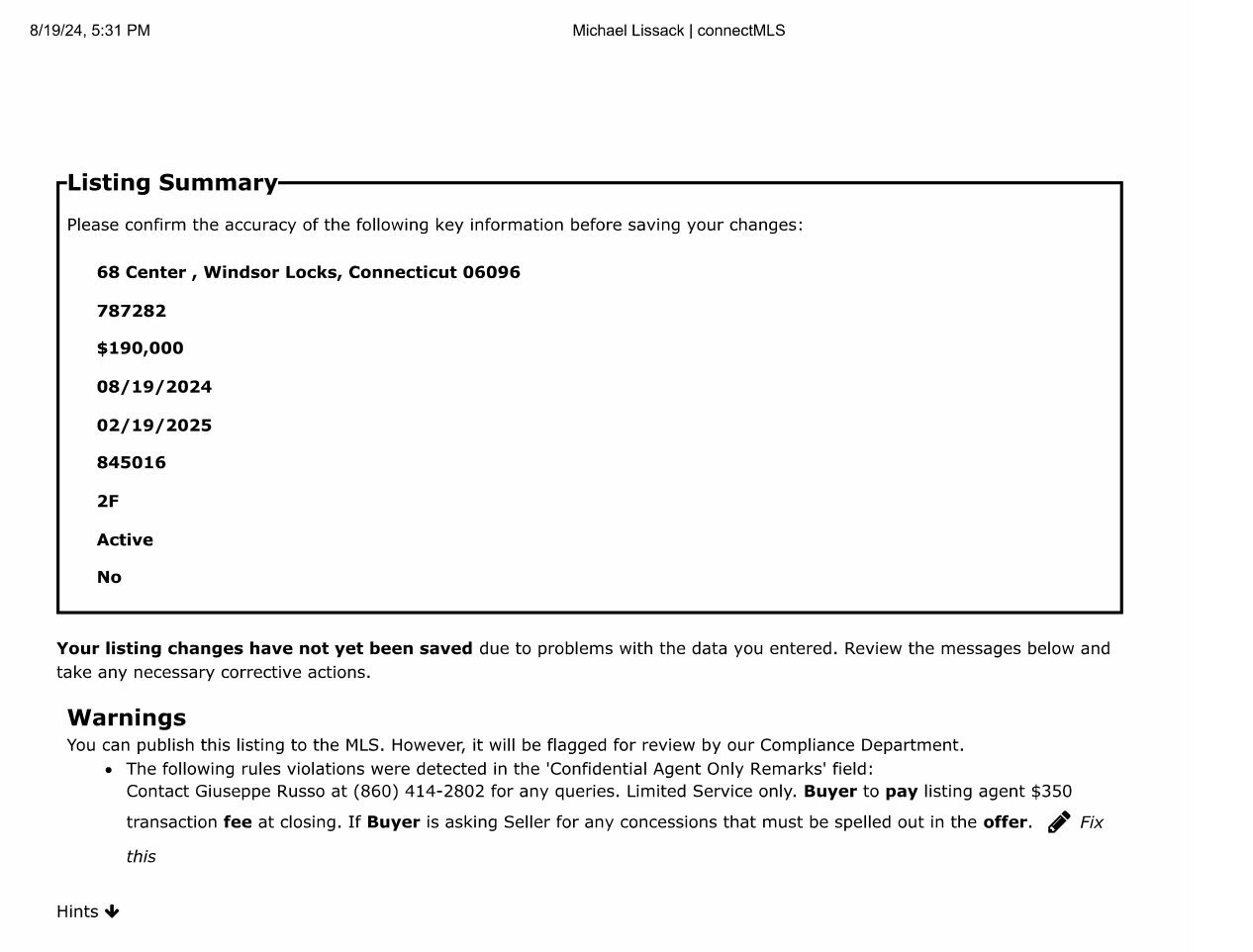
Quite frankly, I think how SmartMLS is using this tool to spot problems before they are published on the MLS is an extremely smart move. If there is an issue, they ask the agent to contact a specific person at the MLS and provide the phone number.
Lissack also shared that when there is an issue on MLS Pin, you are notified and asked, “Please call to discuss.” He also said that Paragon says, “We will call you.”
Clearly, it’s much better to stop a listing with problematic language in it from being published as opposed to finding out after the fact, having to assess an agent fine, and/or being sued for violating the new rules.
Are ‘transaction fees’ covered in the settlement agreements?
Lissack listed a different property and had more problems with the listing. (By the way, note how effectively he described the lifestyle for this luxury listing as opposed to only rattling off the features the way most agents do.)
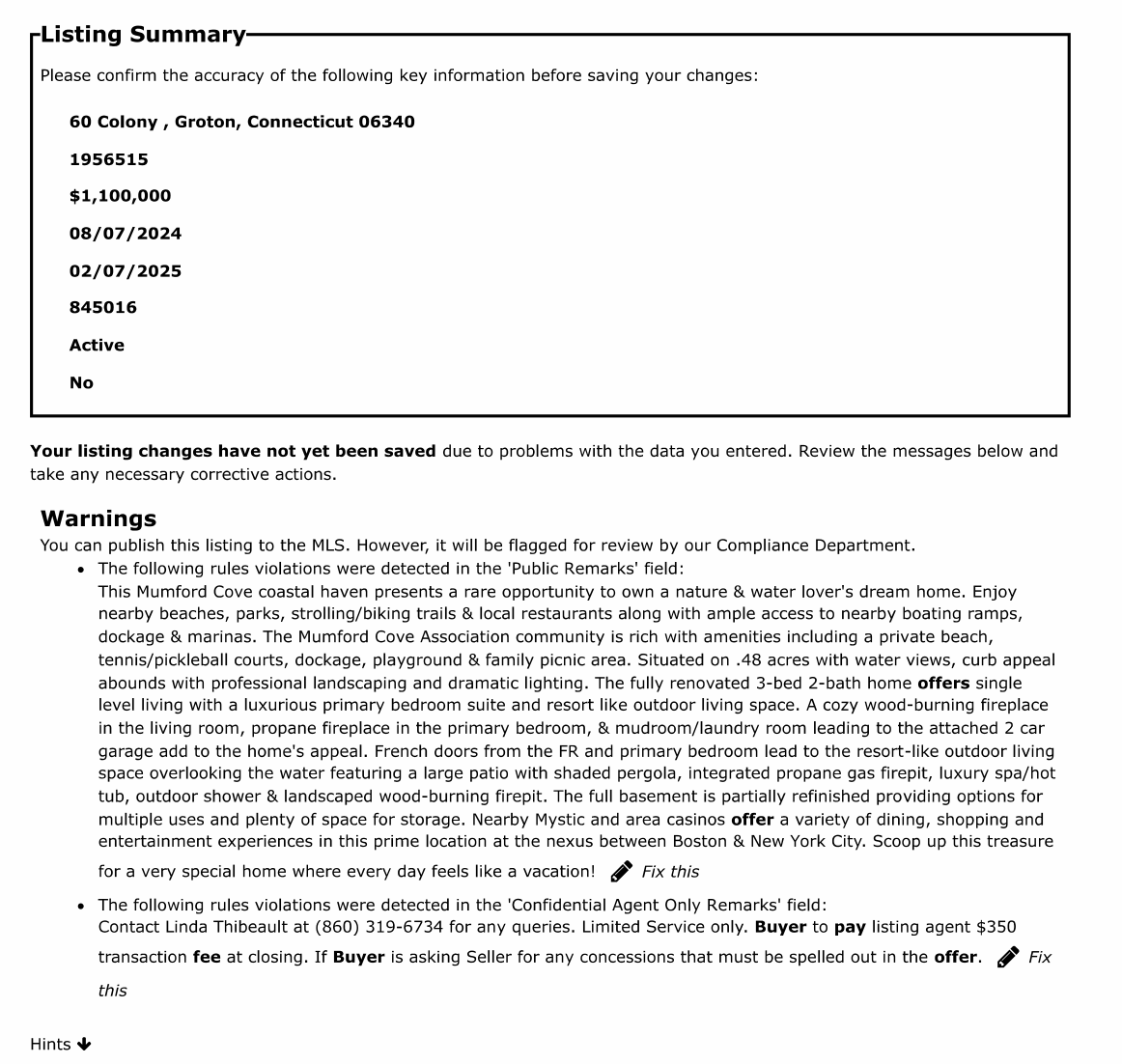
The offending words were again, “buyer,” “fee,” and “pay,” plus a new word, “offer.” According to Lissack, the person he spoke with at SmartMLS had a problem with him collecting a “transaction fee.”
Transaction fees have been used since at least the 1980s and are separate from commissions. They are especially important for brokerages who provide “limited services” or use a “menu of services.” Transaction fees are typically the vehicle that allows a buyer or seller to pick out the additional services they want (such as posting the listing to the MLS) and are willing to pay for.
‘Little brother’ is watching you
As AI-driven content moderation tools continue to improve, one would hope they will catch issues long before they ever are published on the MLS. On the other hand, if your MLS is not using one of these tools that identifies errors before they are posted on the MLS, you must be especially vigilant, especially when using any of the “C” words (commissions, compensation, concessions) as well as “fees” and “offers” that can result in a hefty fine, getting kicked off the MLS, and even being sued.
Bernice Ross, president and CEO of BrokerageUP and RealEstateCoach.com, and the founder of RealEstateWealthForWomen.com is a national speaker, author and trainer with over 1,500 published articles.
by Andrew Reichek | Sep 4, 2024 | Industry, News Feed
Whether it’s refining your business model, mastering new technologies, or discovering strategies to capitalize on the next market surge, Inman Connect New York will prepare you to take bold steps forward. The Next Chapter is about to begin. Be part of it. Join us and thousands of real estate leaders Jan. 22-24, 2025.
Not too long ago, we conducted most multifamily housing transactions at a table in an office. We signed property agreements, took apartment applications, processed rent checks, and renewed leases there. It was a busy table. And rightly, we don’t use it much any longer.
Property management software has redefined the multifamily housing industry, bundling marketing, showing, leasing, payment, and financial processes into seamless online hubs. The market for these products continues to expand. By 2030, property management software could be an $8 billion industry worldwide, with North America serving as its largest market.
Technology has transformed multifamily housing in ways similar to the taxi industry. Ride-sharing apps give customers agency over their transportation choices, and property management software empowers renters to take control of their living choices. The value is two-way, as operators and customers benefit from the technology.
But both industries still rely on people. Rideshare companies need drivers (for the moment, anyway), and multifamily properties need onsite managers. Renter retention is the most important factor in multifamily success and requires a human touch. That’s why we believe onsite management will remain essential to multifamily housing.
Renewals rely on onsite property managers
Every multifamily operator knows the value of lease renewals. They drive revenue while saving time and money. Unleased apartments cost the industry $50 million annually. As Multifamily Insiders notes, owners must deploy a variety of tools to determine rental discount rates, apartment turnover costs, optimal retention programs, and more. AI-driven software corrals this data into actionable insight. Multifamily operators, however, can’t abandon people entirely for data.
Tech hasn’t yet proven a substitute for the onsite property manager in retention. Renewals matter far more than new leases in a property’s long-term success. On-site managers build relationships with residents, which is essential at renewal time. While multifamily renewal rates generally hover around 60 percent nationally, we have properties with renewal rates as high as 75 percent. Site managers play key roles in this success.
Tech is terrific at helping to generate leads and new leases. It offers 24/7 access to services like rent payments and maintenance requests. But residents tell us often that they appreciate calling the manager about a renewal or stopping by the management office with an issue. Some just want to say hello.
Generally, properties should employ at least one inside (or office) person and one outside (or maintenance) person for every 100 units. While some third-party vendors are entering the on-site management space, we still hire and place qualified property personnel at our locations. Some live onsite, though that’s not required. What is required, however, is a commitment to nurturing an environment where people want to live — in other words, a community.
The value of community in multifamily housing
Renters, particularly those in Generation Z just entering the market, demand a growing list of digital conveniences where they live: high-speed internet, secure apps to pay rent and make maintenance requests, and smart-home technology. Yet they also crave a communal experience, one for which they’re also willing to pay.
RealPage noted that 8 percent of renters were more likely to renew after making friends in their apartment community. It also quoted National Apartment Association research that found “residents will pay up to $200 more to stay in a community where their friends live.” Relationships matter for multifamily residents, and property managers are integral to building them.
Yes, managers primarily provide professional services in maintaining properties and answering tenant questions and concerns. Those who go beyond also help build a sense of belonging in their properties. They personalize the rental experience. By doing so, they deliver value.
Consider the “Friendship Factor” in renewal rates. According to the Apartment Life blog, renters who don’t know their neighbors renew at a rate of 29 percent. Those who know seven or more fellow renters renew at a rate of 47 percent. Property managers can help facilitate these relationships.
How to find a good property manager
The key skills we look for when hiring property managers are interpersonal. Some states require property managers to have real estate licenses. Otherwise, we feel the rest of the job is trainable.
Property managers must be organized, efficient, and self-reliant, of course. Moreover, they must be the landlord’s public-facing representative and conduit to the community. Good managers are our in-market eyes and ears. They inform us when the paint is peeling or asphalt is cracking or landscaping is lacking. They listen to tenants. They are proactive.
Good managers, as noted earlier, also build communities. Some managers we employ have been at their properties for many years. They know the couples who become families, the kids who leave for college, and the retirees who have found their new homes. They organize events and activities for residents. They activate a sense of belonging not just among residents but with themselves as well. Good managers become active members of their communities.
Perhaps I’m biased, but I view property management as a wonderful job. Those who like people, solving problems, and forging relationships rarely have a bad day. When owners visit properties, they see primarily unit numbers. It’s comforting to have an on-site manager who takes ownership of the property, knows the people in those units, and wants to make the rental experience positive for everyone involved.
Proptech has and will make multifamily housing management easier. However, property management can’t be converted entirely into an online business. It’s an onsite business run by managers who love their properties. I can’t ever see an app replacing that.
Michael H. Zaransky is the founder and managing principal of MZ Capital Partners in Northbrook, Illinois. Founded in 2005, the company deals in multifamily properties.
by Latham Jenkins | Sep 3, 2024 | Industry, News Feed
Pre-sale renovation services company Revive has made its artificial intelligence-backed property valuation product, Revive Vision AI, free to all real estate consumers.
Inman Connect is moving from Las Vegas to San Diego in 2025 and it’ll be bigger, better, and bolder than ever before. Join us for Inman Connect San Diego on July 30-Aug. 1, 2025 with the brightest minds in real estate to shape the future of the industry. Reserve your spot today for an exclusive discount.
Presale renovation services company Revive has made its artificial intelligence-backed property valuation product, Revive Vision AI, free to all real estate consumers, Inman has learned exclusively.
The company said in a press release that now anyone can use its dynamic pricing predictor to determine “the maximum potential value of your home if it were updated to be in optimal market-ready condition.”
The company’s own vision is that its product reaches “Zestimate” status within the real estate zeitgeist, referring to Zillow’s free home value estimation tool.
“Making Revive Vision AI available to anyone marks a new era in property valuation, where agents and consumers alike can access real-time, data-driven insights to make informed decisions to maximize the value of a home,” said Dalip Jaggi, co-founder and COO of Revive, in the press release.
Part of Revive Vision is its May 2024-launched Neighborhood Report, which scores each home it finds using an ascending 1 to 5 scale, on which it considers overall interior condition, exterior presentation, bathrooms, kitchen design and finishes, and other core living areas. Each home’s score is then measured against the subject, and a Neighborhood Condition Score is generated on a letter-grade scale, A to F, taking into account overall sales activity, too.
Revive Vision AI initially rolled out a year ago in September 2023.
The company said then that its tool “analyzes property photos to assess a property’s current value and renovation potential, utilizing Revive’s renovation recommendation engine to provide estimates backed by local contractors that maximize listing values.”
Computer vision is a form of AI that provides deep insights by scanning and learning from still images and is rapidly supporting a number of products in the real estate software milieu. It was largely introduced to agents by a Barcelona, Spain-headquartered company called Restb.ai that started analyzing photos for multiple listing services here and abroad and moved into integrating with other third-party software companies, such as Revive.
In an interview with Inman Intel, Restb.ai’s Chief Product Officer Nathan Brannen said that the traditional real estate transaction’s dependence on photography and visual content led the company’s focus.
“If you look at e-commerce, there are a lot of photos, but it’s not as impactful as buying a home,” he told Intel. “There are about a million photos uploaded every day in the U.S. just in MLSs, and then if you look at photos uploaded in property insurance and appraisals, that number multiplies. You’re making the biggest decision of your life on these photos. Someone may buy a home without seeing it, but no one buys a home without seeing a photo of it. They contain so much information.”
Revive can provide consumers with the same sort of tool set typically reserved for licensed agents, such as regional sales activity, comparable homes and granular renovation ROI data to help potential sellers know where to focus on a home and buyers to understand how to position an offer.
Inman reviewed Revive’s solution in 2022, prior to it launching its AI-laced features. The software uses different user views and tools for sellers, agents and contractors.
At that time, renovation plans were assembled by Revive staff who use localized market data and previous projects to arrive at estimates and work with contractors. While it’s possible, Revive isn’t about managing large, multi-month home renovations. These are meant to be smaller in scope, high-quality turnarounds that are proven to maximize return in most cases.
Now, AI can power a lot of its pre-sale, post-renovation valuation features, which may become necessary as more consumers explore the free offering.
“With our AI tool, there are zero humans,” Jaggi told Inman in an email. “The renovation estimate and ARV value/potential is all driven through our Computer Vision tech. But they are still estimates … before Revive does a project we have [a] human sign-off.”
Have a technology product you would like to discuss? Email Craig Rowe
Craig C. Rowe started in commercial real estate at the dawn of the dot-com boom, helping an array of commercial real estate companies fortify their online presence and analyze internal software decisions. He now helps agents with technology decisions and marketing through reviewing software and tech for Inman.