by Inman | Apr 17, 2025 | Industry, News Feed
Bigger. Better. Bolder. Inman Connect is heading to San Diego. Join thousands of real estate pros, connect with the power of the Inman Community, and gain insights from hundreds of leading minds shaping the industry. If you’re ready to grow your business and invest in yourself, this is where you need to be. Go BIG in San Diego!
Achieving distinction is what sets luxury apart from the ordinary.
The Inman Golden I Club award recognizes elite agents and brokerages who have outstanding sales and exceptional client service. It honors those professionals with a dedication to greatness in a highly competitive market.
Inman’s Golden I Club celebrates innovation while fostering a culture of excellence and creativity that pushes the entire community forward to greater heights.
Nominations are currently open for the following categories:
- Top luxury agent
- Top luxury team
- Top luxury brokerage
- Top luxury technology or tool
- Best sales and marketing campaign for a luxury home/property
- Best sales and marketing campaign for a luxury development
- Best City Sale
- Best Beach Sale
- Best Mountain Sale
To nominate yourself, a colleague, company or campaign for an Inman Golden I, click here. Nominations close May 1, 2025.
This post was originally published on this site
by Lillian Dickerson | Apr 17, 2025 | Industry, News Feed
The support model, which is comprised of in-house human “client experience specialists” backed by Coldwell Banker Realty’s tech stack, can handle everyday administrative tasks for agents
Bigger. Better. Bolder. Inman Connect is heading to San Diego. Join thousands of real estate pros, connect with the power of the Inman Community, and gain insights from hundreds of leading minds shaping the industry. If you’re ready to grow your business and invest in yourself, this is where you need to be. Go BIG in San Diego!
Coldwell Banker Realty has rolled out to all agents nationwide the “human-led, tech-powered” Transaction Concierge, which will provide the brand’s agents with assistance from contract to close, the company announced on Tuesday.
The support model, which is comprised of in-house human “client experience specialists” backed by Coldwell Banker Realty’s tech stack, can handle everyday administrative tasks for agents that do not require a licensed agent’s expertise.
TAKE THE INMAN INTEL SURVEY FOR APRIL
Agents also have access to specialists who can assist them with onboarding, sales and marketing support as part of Coldwell Banker Realty’s services to agents.
“Agents play a crucial role in ensuring a smooth homebuying process from contract to close, and Transaction Concierge supports agents by handling administrative tasks, which frees their time to focus on clients and other business activities,” Kamini Lane, president and CEO of Coldwell Banker Realty, said in a statement. “Our strategic investment in a team of Client Experience Specialists ensures success by working directly with agents and clients. We are pleased with the positive response and feedback from agents, who report significant improvements in their businesses.”
Transaction Concierge can facilitate document handling, timeline management, coordination of deadlines and communication between parties on transaction progress for agents, a press release from Coldwell Banker Realty said.
During initial rollouts of the service in 2024, Transaction Concierge managed and closed 28,000 transactions and achieved a 94 percent agent satisfaction rate, according to Coldwell Banker Realty. The new support model will be available to all affiliated agents free of charge.
Email Lillian Dickerson
This post was originally published on this site
by Richelle Hammiel | Apr 17, 2025 | Industry, News Feed
Bigger. Better. Bolder. Inman Connect is heading to San Diego. Join thousands of real estate pros, connect with the Inman Community and gain insights from hundreds of leading minds shaping the industry. If you’re ready to grow your business and invest in yourself, this is where you need to be. Go BIG in San Diego!
Builders are beginning to pump the brakes on new construction as a mix of affordability pressures and threatened tariffs add fresh uncertainty to the market.
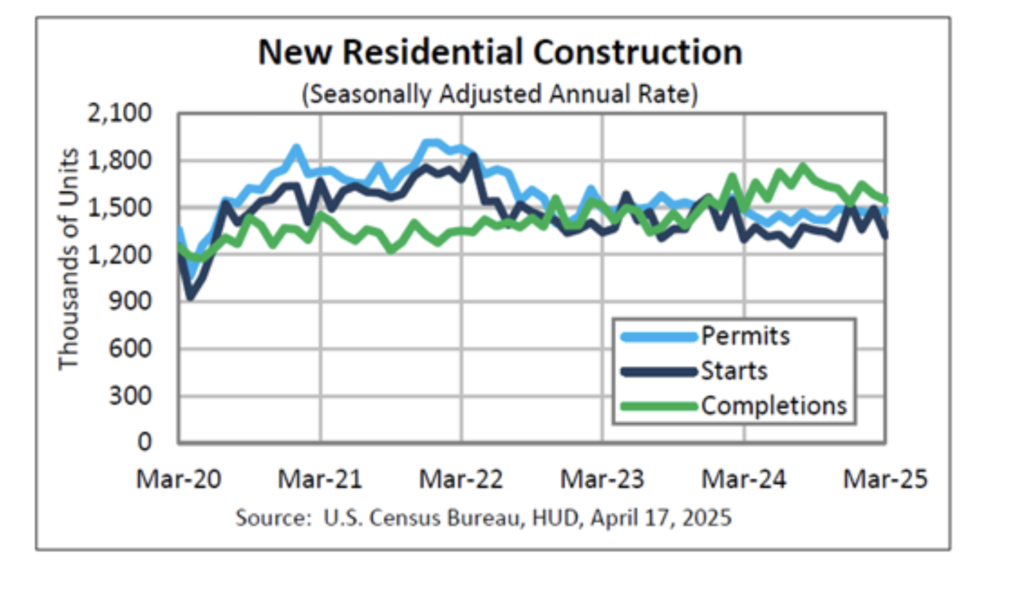
New residential construction improved modestly year over year in March, but the rebound wasn’t nearly as strong as expected, according to new data released Thursday by the U.S. Census Bureau and the Department of Housing and Urban Development (HUD).
TAKE THE INMAN INTEL SURVEY FOR APRIL
In March, privately owned housing starts fell 11.4 percent from February, dropping to a seasonally adjusted annual rate of 1,324,000. Although that figure is 1.9 percent higher than March 2024, it’s not enough to signal a strong recovery. Single-family starts bore the brunt of the pullback, falling 14.2 percent to 940,000 units — the lowest level in six months. Meanwhile, construction of multifamily buildings came in at 371,000.
Tariffs recently implemented or threatened by the Trump administration are already driving up the cost of building materials. According to the National Association of Home Builders (NAHB), 60 percent of builders say their suppliers have increased prices or announced price increases for building material prices due to tariffs.
Builders surveyed by the NAHB say their suppliers have increased prices by 6.3 percent in response to announced, enacted, or expected tariffs, driving up the cost of building a new home by $10,900 on average.

Robert Dietz | National Association of Home Builders
“Policy uncertainty is having a negative impact on home builders, making it difficult for them to accurately price homes and make critical business decisions,” NAHB Chief Economist Robert Dietz said in a statement.
Although builder sentiment inched up slightly in April, from 39 to 40, NAHB Chairman Buddy Hughes said that could reflect a dip in mortgage rates last month that may have helped push some buyers off the fence.
“At the same time, builders have expressed growing uncertainty over market conditions as tariffs have increased price volatility for building materials at a time when the industry continues to grapple with labor shortages and a lack of buildable lots,” Hughes said.

Odeta Kushi | First American Deputy Chief Economist
Builders pulled back more than expected in March amid rising tariff uncertainty, as housing starts slumped well below consensus expectations, First American Deputy Chief Economist Odeta Kushi said in a LinkedIn post.
“Builders face persistent supply-side and affordability challenges, from higher material costs to a shortage of skilled labor,” Kushi added. “Residential building material costs are still more than 40 percent higher than pre-pandemic levels, making construction more expensive.”
The Trump administration imposed 25 percent tariffs on steel and aluminum in March, a 25 percent tariff on autos on April 3, and a 10 percent blanket tariff on imports from most U.S. trading partners on April 5.
Many goods from Mexico and Canada are exempt from the 10 percent baseline tariff under the the United States-Mexico-Canada Agreement (USMCA), including lumber — a decision that the NAHB has called a “major win” for homebuilders. A Biden-era 14.5 percent tariff on Canadian lumber remains in effect.
While country-specific “reciprocal” tariffs of up to 50 percent against dozens of countries are on hold until July 9, imports from China are now subject to 145 percent duties, with additional tariffs of up to 100 percent on specific goods.
New Residential Construction| U.S. Census Bureau
Even so, some aspects of the housing market showed modest resilience. Housing completions dipped just 2.1 percent from February, coming in at a seasonally adjusted annual rate of 1,549,000. Single-family completions inched up by 0.9 percent while more than 503,000 units in multifamily buildings were completed, helping to ease rental supply constraints in some markets.
Looking ahead, the outlook for new construction remains uncertain.
Building permits painted a mixed picture. Overall, permits for privately owned housing units rose 1.6 percent to 1,482,000 in March. However, single-family permits declined 2.0 percent to 978,000, hitting their lowest level in five months, while multifamily permits landed at 445,000.
“The slower pace of single-family permits suggests a reduced rate of groundbreaking in the upcoming months, due to higher inventory levels in key markets and ongoing challenges with costs and affordability,” Kushi noted.
Builder outlooks for the months ahead also showed signs of softening. Optimism about single-family sales over the next six months dropped four points to 43 — the lowest reading since November 2023. While current sales ticked up from 43 to 45, and prospective buyer traffic rose slightly from 24 to 25, both measures remain in negative territory, according to Kushi.
“The gains in measures capturing current conditions are likely due to recent declines in mortgage rates, which could help to coax some buyers off the sidelines,” Kushi said. “However, the worsening outlook for future sales conditions reflects growing builder concerns about costs and affordability.”
This post was originally published on this site
by Lillian Dickerson | Apr 17, 2025 | Industry, News Feed
Bigger. Better. Bolder. Inman Connect is heading to San Diego. Join thousands of real estate pros, connect with the Inman Community and gain insights from hundreds of leading minds shaping the industry. If you’re ready to grow your business and invest in yourself, this is where you need to be. Go BIG in San Diego!
To help determine where the industry is heading next, Inman invites you to take real estate’s most ambitious monthly survey: the Inman Intel Index.
Each month, the Intel Index survey leans on the expertise of Inman’s readership to discover what’s top of mind for agents, mortgage professionals, proptech players and industry executives.
TAKE THE INMAN INTEL SURVEY FOR APRIL
The insights gathered from these responses help illuminate industry sentiment on real estate’s most important topics: the NAR settlement, the state of the economy, the current M&A landscape and more.
Click through to add your insights to the industry’s knowledge base, and check back for analysis of the results in the weeks to come.
Thank you,
Team Inman
This post was originally published on this site
by Jim Dalrymple II | Apr 17, 2025 | Industry, News Feed
The IDX feed shutdown, which ended Thursday morning, came amid a battle that previously included accusatory Instagram posts between top executives and the specter of lawsuits.
Bigger. Better. Bolder. Inman Connect is heading to San Diego. Join thousands of real estate pros, connect with the Inman Community and gain insights from hundreds of leading minds shaping the industry. If you’re ready to grow your business and invest in yourself, this is where you need to be. Go BIG in San Diego!
Washington-based Northwest MLS temporarily shut down its IDX feed to Compass amid an ongoing conflict over private listings, Inman has learned exclusively, before restoring it about a day later.
The shutdown appears to have been in effect throughout Wednesday, according to multiple Northwest MLS users who spoke to Inman on condition of anonymity. It was unclear exactly when it began, but by late Thursday morning the feed had been restored.
NWMLS declined to comment.
“Despite following NWMLS’s published rules, Compass’ IDX feed was suspended without warning — impacting our clients and agents alike,” Compass Regional Vice President Cris Nelson told Inman. “NWMLS is a broker-owned MLS and is the only MLS in the country that prohibits agents from marketing a property on the internet — privately or publicly — unless it’s listed in the MLS.”
The IDX suspension is only the latest chapter in an ongoing saga involving the country’s largest brokerage by sales volume and a powerful independent multiple listing service. The conflict began in late March when Compass CEO Robert Reffkin criticized NWMLS, describing it on Instagram as uniquely restrictive. Reffkin’s comments stemmed from Compass’ efforts to expand the listings it markets privately before posting them to an MLS.
The feud erupted on the same day as the National Association of Realtors announced it would uphold its Clear Cooperation Policy requiring Realtors to put their listings into NAR-affiliated MLSs within a day of public marketing — while also introducing a new delayed listing category. Clear Cooperation had been fiercely debated, and some had looked forward to a decision from NAR to settle the matter on private listings once and for all.
Nelson referenced those private listings in her statement, saying “we launched a compliant Private Exclusive marketing strategy using ‘non-exclusive’ and ‘unenforceable’ listing agreements — both of which, since the founding of NWMLS in 1984, have not been eligible for submission into the MLS.”
“This is a stark example of monopolistic control, with NWMLS having 100 percent market share of real estate agents, that limits homeowner choice, stifles competition, and sets a dangerous precedent for broker accountability and market fairness,” the Compass statement added.
In recent weeks, and leading up to the IDX feed suspension, the conflict between Compass and NWMLS has grown more intense.
At the end of March, Compass clients signaled they might sue NWMLS. Windermere — also a target of criticism in Reffkin’s Instagram posts — then fired back in a series of statements and opinion pieces.
Last week Windermere Co-President OB Jacobi told Inman Reffkin “has been a little bit of a bully when it comes to this movement.”
The IDX shutdown, however, further turns up the heat on the simmering cold war. Short for “internet data exchange,” the IDX feed takes information from the MLS and distributes it to MLS members. It allows MLS information to appear on third-party websites, and the technology is a key tool through which members of the real estate industry share listings. Being cut off from the feed could isolate agents from the rest of the market.
Whether Compass gets the NWMLS IDX feed back, the conflict over private listings is likely to persist. In addition to the dustup between NWMLS and Compass, Zillow and Redfin announced in recent days that they will not display listings that have been privately marketed.
On the other hand, a number of other brokerages besides Compass have also begun rolling out their own private listing networks.
Update: This story was updated after publication following the restoration of Compass IDX feed.
Email Jim Dalrymple II
This post was originally published on this site
by Marian McPherson | Apr 17, 2025 | Industry, News Feed
Bigger. Better. Bolder. Inman Connect is heading to San Diego. Join thousands of real estate pros, connect with the Inman Community and gain insights from hundreds of leading minds shaping the industry. If you’re ready to grow your business and invest in yourself, this is where you need to be. Go BIG in San Diego!
This month, Zillow and Redfin rocked the industry by banning listings that aren’t added to the multiple listing service within 24 hours of public marketing.
The similar portal policies, which came two weeks after the National Association of Realtors announced a new Delayed Marketing Exempt Listings option for its Clear Cooperation Policy (CCP), have led to mounting questions from agents and brokers over the legality of and logistics behind the ban.
Here are answers to the most frequent questions about Zillow and Redfin’s rules:
What is Zillow Group’s policy?
On April 10, Zillow Group announced its new listing access standard for Zillow and Trulia, which bans listings that aren’t added to the MLS within 24 hours of being publicly marketed. Zillow said public marketing includes yard signs, social media posts and brokerage private listing networks (PLN) where consumers must log into a site to see listings.
The ban, which goes into effect in May, is based on NAR’s CCP, which states listings must be entered into the MLS within one business day of public marketing. Zillow said “coming soon,” office exclusives, and Delayed Marketing Exempt Listings are A-OK within its listing access standard, as long as listing brokers are adhering to NAR’s guidance for each listing status.
The Coming Soon status is for sellers and brokers who’ve signed a listing agreement and need time to prepare a home for sale. The broker will put the home in the MLS under a Coming Soon status, which may allow a broker to share the listing on social media or create a yard sign with a Coming Soon rider. However, MLS regulations prohibit sellers and their brokers from showing the home to prospective buyers or accepting offers from brokers until the home becomes active.
Individual MLSs have different rules for how long a listing can be labeled as coming soon, with some MLSs giving sellers and listing brokers up to 30 days and others giving as little as 10 days. MLSs also handle the distribution of coming soon listings through an Internet Data Exchange (IDX) feed differently, with some MLSs allowing coming soon listings to appear on sites like Zillow, Realtor.com, Redfin and Homes.com, and others only distributing listings once they’ve gone active.
Meanwhile, office exclusives are listings where the seller has stated they don’t want their home to be publicly marketed or shared through the MLS. In this case, listing brokers will file the listing as an office exclusive with the MLS, which will make sure the listing isn’t shared with other MLS participants and subscribers.
Lastly, Delayed Marketing Exempt Listings are an option where the seller has asked their broker to delay the public marketing of their listing through an IDX feed. As with office exclusives, brokers will still file delayed marketing listings with the MLS and do not stop brokers from marketing the listing in other manners the seller has requested. MLSs have until Sept. 30 to implement the terms of Delayed Marketing Exempt Listings under NAR’s Multiple Listing Options for Sellers (MLOS) policy.
With office exclusives and delayed marketing, sellers must sign an exempt listing disclosure that outlines the relationship between the seller and broker and clearly outlines what they’re agreeing to alongside the potential downsides.
“Our standards say it’s okay to share office exclusives among agents within the same brokerage, or to have delayed marketing or coming soon listings that are entered into the MLS and available to all MLS participants,” Zillow Group’s listing standard reads. “And, of course, it’s okay to maintain a seller’s privacy when necessary by keeping a listing off the internet entirely. But when it’s time to market to buyers, that means all buyers.”
How does Zillow’s policy specifically impact Delayed Marketing Exempt Listings?
A main point of confusion with Zillow Group’s policy is how it might impact Delayed Marketing Exempt Listings.
Zillow Group said the ban does not apply to listings in this category; as long as they’re submitted to an MLS within one day of public marketing, they can be published on Zillow, Trulia and other sites that receive listing feeds.
What does Zillow Group mean when it says the ban applies to ‘the life of the listing?’
The “life of the listing” refers to the time a home is being sold by a broker who is not following Zillow Group’s listing access standard, resulting in that listing being banned from Zillow and Trulia’s sites.
However, if the seller terminates the listing agreement with that broker and signs a new agreement with a broker who follows the listing access standard, Zillow and Trulia will lift the ban and display the listing.
What is Redfin’s policy?
On April 14, Redfin joined Zillow Group and created a policy that bans listings if they aren’t added to the multiple listing service (MLS) within 24 hours of being publicly marketed.
Also like Zillow, Redfin said its ban won’t impact Delayed Marketing Exempt Listings.
The Seattle-based firm told Inman in an email that these listings are safe: “If they’re shared in the MLS and disseminated to sites like Redfin through a Virtual Office Website (VOW), where buyers can access them, those listings can be included on Redfin.”
Unlike Internet Data Exchange (IDX) sites, where visitors can view listings without a login, VOWs require visitors to create an account to view listings. NAR’s FAQ on Multiple Listing Options for Sellers (MLOS) notes that Delayed Marketing Exempt Listings can be displayed on VOWs as the sites are “not for advertisement but rather to help with the provision of brokerage services to consumers with whom there is an established broker-consumer relationship.” NAR also states that MLSs cannot exclude Delayed Marketing Exempt Listings from appearing on VOW feeds.
Alongside the listing ban, Redfin CEO Glenn Kelman called on MLSs to create a new Coming Soon designation that bans portals from displaying how long a home has been for sale and at what prices.
Redfin hasn’t said when it would implement the new policy, and leaders are still working on the technical logistics of the ban.
Do Zillow Group and Redfin have the right to ban listings?
Although some industry members have argued that Zillow doesn’t have the right to ban listings as an IDX-displaying broker, current NAR and MLS rules are on the portal’s side.
In a previous Inman article, California Regional MLS VP and General Counsel Ed Zorn said Zillow Group —and now Redfin — is within its rights to ban listings on Zillow and Trulia that don’t follow its listing access standard.
“There seems to be a misunderstanding that if you take an [Internet Data Exchange] data feed, that you are required to display all the listings,” he said. “And in fact, NAR’s [Handbook on Multiple Listing Policy] Statement 7.58 states the exact opposite principle.”
“What it says is participants may select the IDX listings they choose to display based on only objective criteria, including but not limited to factors such as geography or location, list price, type of property, or type of listing,” he added. “So type of listing is even included as one of the few types of objective examples that NAR provides.”
Will the DOJ get involved?
Industry members on both sides of the spectrum have called on the Department of Justice (DOJ) to investigate the opposing side.
CoStar Group CEO Andy Florance urged agents to report Zillow Group to the DOJ’s Antitrust Division, while two consumer watchdogs said the department should be stopping the industry’s largest brokerages from creating expansive PLNs.
It’s unclear whether the DOJ will answer either side’s clarion call, as the law enforcement agency has signaled that it’s less interested in the CCP now that NAR has scrapped the Participation Rule, which previously mandated that listing brokers include an offer of compensation as small as $1 to buyer brokers participating in a transaction.
The DOJ signaled in a March 18 Nosalek vs MLS PIN court filing that Clear Cooperation — on its own — is not anticompetitive. However, in situations where non-NAR-governed MLSs, like MLS PIN, enforce CCP while still allowing cooperative compensation, the DOJ might look at CCP with more scrutiny.
Consumer Policy Center senior fellow Stephen Brobeck said the DOJ isn’t fond of giving a heads-up on investigations, so the industry will just have to wait.
“I don’t have evidence they’re looking at it, but I’m sure they are,” he told Inman in a previous article. “… But, you know, the DOJ doesn’t tell anybody what they’re thinking or what they’re going to do until they actually do it.”
Are Realtor.com and Homes.com banning listings as well?
CoStar Group founder and CEO Andy Florance said Homes.com won’t ban listings that aren’t added to the MLS within 24 hours of being publicly marketed.
Florance characterized Zillow Group’s move as “anti-competitive” and “a pure power play of epic proportion” to quash consumer choice amid private listing networks’ growing prominence.
Realtor.com hasn’t revealed any plans for a ban, with a company spokesperson only revealing that the portal is giving “thoughtful consideration” on how to handle DMEL.
Hey, my question wasn’t listed. What gives?
With 167 days until the MLS deadline for implementing NAR’s MLOS policy, there’s still much more to understand about how MLSs will handle delayed marketing, which brokers will latch onto private listing networks or eschew them, and how portals will put their policies into action.
Keep an eye on Inman’s coverage as we continue to dig into what the next chapter of the CCP debate means for you and your clients, and let us know your questions in the comments below.
Email Marian McPherson
This post was originally published on this site