by Joseph Santini | Apr 18, 2025 | Industry, News Feed
Broker Joseph Santini offers 10 truths about real estate that will put you on the right track and save you some time on your path to success.
Bigger. Better. Bolder. Inman Connect is heading to San Diego. Join thousands of real estate pros, connect with the power of the Inman Community, and gain insights from hundreds of leading minds shaping the industry. If you’re ready to grow your business and invest in yourself, this is where you need to be. Go BIG in San Diego!
Real estate is an interesting business that has some key differences from other businesses. The one thing that stands out the most is the fact that it can be unclear exactly what you should be doing every day to make money and be successful in the real estate business.
Let’s take, for example, a stockbroker. He has a desk and a phone, and it’s very clear what he has to do all day: make calls and sell stocks. Real estate activities are not always clear, and agents often waste a lot of time on activities that don’t lead to a paycheck.
There are so many activities that you can fill up your day with, most of which don’t produce income, and the road to success is not very clear. There are also some misconceptions about the business for those looking in from the outside. In addition, many agents are not getting any direction from anyone, and you have a very reduced chance of succeeding in this business.
Like many occupations that require a license, the material you review to study for the real estate test really does not address the actual things you need to do to succeed in real estate. Hopefully, you will hang your license with a brokerage that will point you in the direction that you need to go and give you some education to find and speed up your path to success.
Read on to discover some myths about real estate, followed by the reality.
1. Myth: Real estate is an easy business and can be done part-time.
Reality: Real estate is one of the most time-intensive businesses in the world. To be successful, you will be very busy even doing it full-time. Anyone can do a deal or two, but real financial success will take time. All of your time.
2. Myth: You work for your broker and the company with which you hang your license.
Reality: You only work for yourself. This is your own business; you’re an entrepreneur, and your brokerage is your partner.
3. Myth: Once you get your license, people will be banging down your door to list their homes and asking you to write contracts for them to buy properties.
Reality: The hardest part of the real estate business is finding customers, especially sellers. The inability to find enough customers is what ends most people’s real estate careers. Nobody will be looking for you.
4. Myth: Your broker and everyone in the office will find you customers.
Reality: The only way to find customers is for you to do lead generation activities effectively on a consistent basis to find them yourself. Nobody is coming to save you and do this for you.
5. Myth: I can work whenever I want, and I will have a lot of time off.
Reality: Since it is your own business, you decide when, where and how much you work, but if you are not putting in a lot of time, usually much more than a regular 9-to-5 job, you won’t make the money that you are expecting.
6. Myth: It takes years and a lot of education to be successful in real estate.
Reality: Years in the business mean nothing. Someone can be in real estate for 10 years and have done 10 transactions, while another person may be two years in with 40 transactions. Anyone can decide to do the work, be effective, and see success rather quickly. Education helps, but you really need to just find people who want to buy and sell real estate. You will learn things on every deal that you do.
7. Myth: It doesn’t cost any money to be a real estate agent.
Reality: Real estate is one of the least expensive businesses to get into where you can make six figures, but like every business, you have to spend money to make money.
8. Myth: You need to know many people to succeed in real estate.
Reality: Knowing a lot of people will make your real estate career much easier, but for those of you who don’t know a lot of people, good lead generation activities will overcome this.
9. Myth: Successful agents can just coast when they get to a certain level of success.
Reality: It sure looks like that, doesn’t it? But in reality, those very successful agents that you see are working harder than most to keep their business where it is. Once they stop working and lead generation, their income will quickly drop to zero.
10. Myth: Real estate is not like other sales jobs, so you don’t have to be a salesperson.
Reality: Real estate is exactly like any other sales job, and it takes the same kind of drive, determination and assertiveness. People who enter the business with prior sales experience have a much better chance of succeeding. People coming from traditional non-sales jobs will have to be ready to learn some new things and be effective at them to succeed.
So, there you have it: 10 truths about real estate that will put you on the right track and save you some time on your path to success. When we know how the business works, we can then focus on what needs to be done.
The great thing about real estate is that anyone can jump in and find success, if they are willing to do the work and be effective.
Joseph Santini is a managing broker at Coldwell Banker Realty in Boca Raton, Florida. Connect with him on LinkedIn.
This post was originally published on this site
by Craig C. Rowe | Apr 17, 2025 | Industry, News Feed
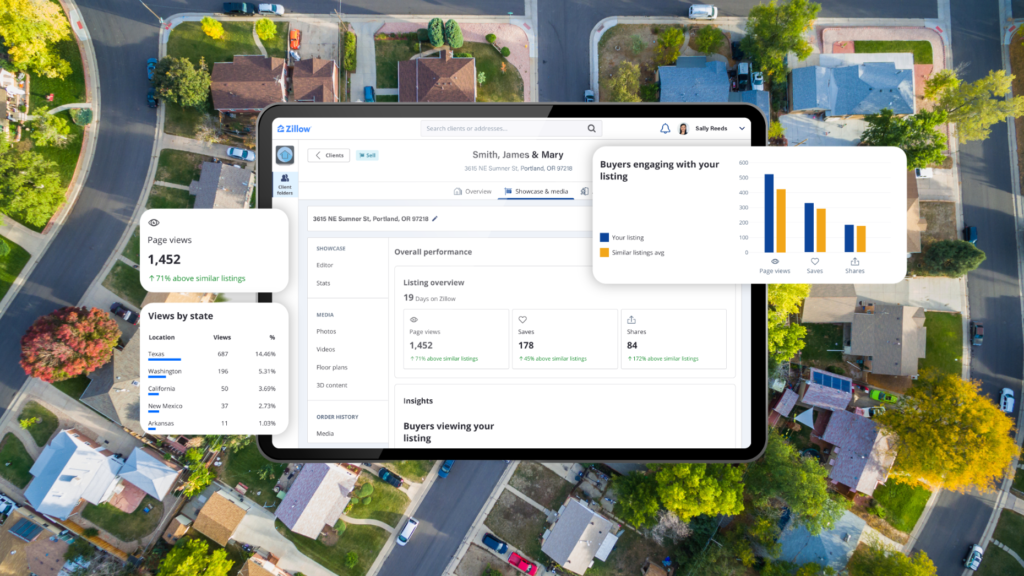
Available to agents whose sellers’ properties are leveraging Showcase, the insights dashboard is designed with transparency in mind, allowing agents to unravel which home features may be leading to more online attention.
Bigger. Better. Bolder. Inman Connect is heading to San Diego. Join thousands of real estate pros, connect with the power of the Inman Community, and gain insights from hundreds of leading minds shaping the industry. If you’re ready to grow your business and invest in yourself, this is where you need to be. Go BIG in San Diego!
Zillow is giving Listing Showcase an update that will provide users with a series of metrics for determining a property’s performance on the portal, an April 15 statement from the portal said.
Available to agents whose sellers’ properties are leveraging Showcase, the insights dashboard is designed with transparency in mind, allowing agents to unravel what home features may be leading to more online attention specific to location, for greater market-by-market accuracy.
“Now, agents have a clear picture of how their Showcase listing is performing over time with detailed insights, including page views, saves and shares, compared to similar non-Showcase listings on Zillow located in the same area,” Zillow said.
Showcase is an advanced service offered by Zillow that includes a suite of elevated marketing features, such as high-end photography and digital tours, interactive floor plans, prominent listing agent branding and other agency-grade benefits. The service was announced in 2023 in limited markets under the ShowingTime+ wing of Zillow, the consolidated offspring of its many marketing-focused acquisitions, including ShowingTime.
Upon its rollout, Mike Lane, vice president of ShowingTime+, described the tool in a statement as creating an “unmatched listing experience for agents and sellers.”
Zillow said it’s found listings enriched with Showcase sell for more money, to the tune of 2 percent. Its data also found that agents who use it in pitches to win business land the listing 20 percent more often than non-users.
Todd Chapman is a licensed real estate agent and the chief operating officer with Delhougne Realty Group in St. Louis, Missouri. He said in the Zillow statement that clients “love” seeing the statistics associated with their listing.
“We have more than a marketing tool,” Chapman said. “We have a way to bring more traffic to the home, which for us is turning into more showings, more offers and better outcomes for our sellers, and that is winning us more business.”
Website traffic statistics are powerful drivers of marketing decisions when used correctly. Most website content management systems (CMS) offer them down to the page level, and countless third-party software providers can do the same. It’s a big part of search engine marketing and website optimization. However, implementing such tools is commonly an afterthought, and a lot of sellers don’t think to ask about it, either.
Zillow’s advantage in this case is its vertical integration, not specifically the innovation. The fact that it’s included with what agents buy under the Showcase brand means a user can benchmark hard numbers against their marketing investment and also use the insights when working with stubborn or anxious sellers, as reports are downloadable.
“Showcase is all about helping agents deliver exceptional experiences to sellers and buyers. In doing so, agents build their own brand — which leads to winning more listings and growing their businesses,” said Cynthia Taylor, Zillow’s senior vice president of Agent Software & Advertising, in the release. “We’re integrating more insights and solutions into the tools agents use every day to make agents more efficient and ultimately more successful.”
Zillow’s impact on how listings are marketed is the industry’s hottest topic. The company has thrust itself into the now industry-wide Clear Cooperation melee by stating it will withhold properties from its website unless they are publicly marketed from the outset.
The decision, considered a gamble by many and a strong show of support by others, has been part of an inferno of hot takes, commentary and related moves, such as Washington-based Northwest MLS temporarily shutting down its IDX feed to Compass amid an ongoing conflict over private listings.
Email Craig Rowe
This post was originally published on this site
by Taylor Anderson | Apr 17, 2025 | Industry, News Feed
If passed into law, the bill would end the seven-member body that oversees licensing and disciplinary matters for 320,000 real estate professionals. Florida Realtors and other groups slammed the plan.
Bigger. Better. Bolder. Inman Connect is heading to San Diego. Join thousands of real estate pros, connect with the Inman Community and gain insights from hundreds of leading minds shaping the industry. If you’re ready to grow your business and invest in yourself, this is where you need to be. Go BIG in San Diego!
A bill moving through the Florida Legislature seeks to eliminate the commission responsible for handling licensing and disciplinary matters for the state’s 320,000 real estate professionals.
The bill — which takes aim at the Florida Real Estate Commission, the body that is responsible for licensing and regulating real estate agents and brokers in the Sunshine State — has drawn fierce opposition from the real estate community.
TAKE THE INMAN INTEL SURVEY FOR APRIL
The seven-member commission, which is made up of brokers, agents and everyday Floridians and is appointed by the governor, also handles rulemaking.
“Right now we’re 320,000 active licensees across the state,” Millie Kanyar, a broker who is chair of the commission, told Inman. “Basically, our role is crucial in maintaining the public trust and potential integrity in real estate transactions.”
It’s not immediately clear how disputes and disciplinary action would be handled if the bill, HB1461, passes the House and Senate with the provision in place.
The bill is part of a broader deregulation push by the sponsor, Rep. Taylor Yarkosky, a central Florida Republican, that also takes aim at dozens of other commissions under the state’s Department of Business and Professional Regulation.
Among the other commissions targeted for elimination are the Board of Architecture and Interior Design, the Board of Landscape Architecture and the Construction Industry Licensing Board.
When Yarkosky introduced the bill in February, it didn’t include any mention of the real estate industry. It proposed updates to the construction licensing board and architecture board. It was revised last week to propose the outright elimination of a slew of boards and commissions, including the Florida Real Estate Commission.
The Florida Real Estate Commission routinely handles dozens of disciplinary cases during its monthly meetings. It is scheduled to decide on dozens of applicants looking to obtain real estate licenses to operate in Florida at its meeting next week.
Hundreds of complaints are filed with the Real Estate Division each month. Many are investigated by the division’s 31 investigators. Depending on the outcome of a probable cause hearing, cases will go before the commission.
The Florida Homebuilders Association has come out in support of the bill.
The International Association of Certified Home Inspectors and Florida Realtors were opposed, among others.
“We do welcome continued conversation, including the conversation around the privatization of what would happen with the administration and oversight of Florida licensure within the state of Florida,” said Tim Weisheyer, broker of Dream Builders Realty and president of the Florida Realtors, during a hearing on the bill in a House subcommittee on Tuesday.
“We understand the intent of the bill and what the state is trying to do with deregulation in our state,” he said. “But we do truly believe that real estate is one of those that should be preserved.”
The Florida Realtors have five lobbyists working on the bill, according to state records.
The National Association of Realtors referred questions about the bill to the Florida Realtors, which didn’t immediately respond to questions about the bill.
Other opponents to the bill said it would threaten the integrity of the state’s real estate industry.
“FREC is a regulatory body composed of experienced brokers, agents, and public members who understand the nuances of real estate transactions, ethics, and consumer protection,” the American Real Estate Association said in a statement. “Replacing that expertise with a generic bureaucracy not only weakens professional oversight — it jeopardizes the public trust.
“Let’s be clear: this is not deregulation,” the group continued, “this is de-professionalization.”
Email Taylor Anderson
This post was originally published on this site
by Richelle Hammiel | Apr 17, 2025 | Industry, News Feed
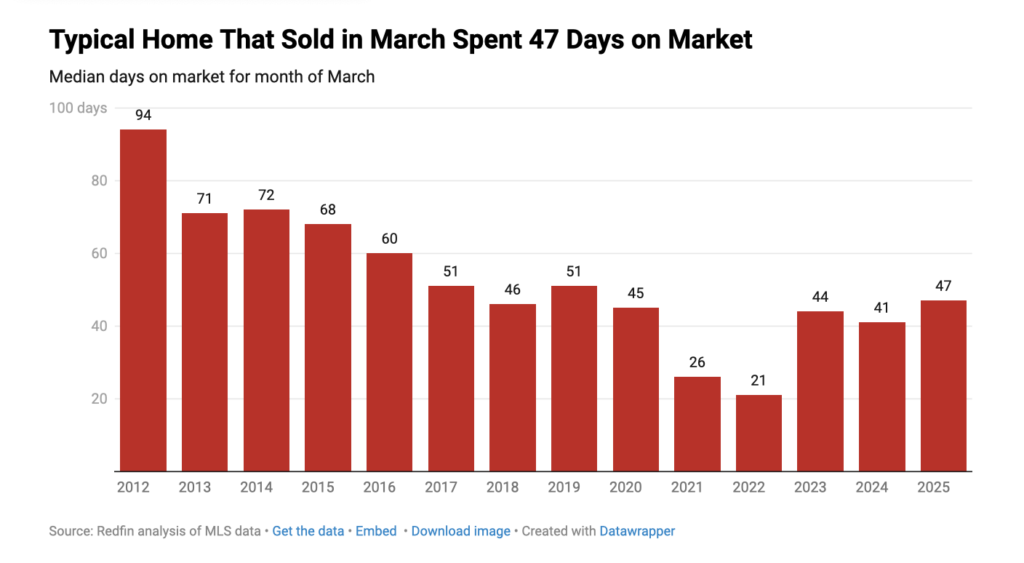
According to a new Redfin report, concerns over affordability, economic uncertainty and tariff fears under a second Trump administration are giving buyers serious pause. As of March, the typical U.S. home took 47 days to sell, the longest stretch in six years.
Bigger. Better. Bolder. Inman Connect is heading to San Diego. Join thousands of real estate pros, connect with the Inman Community and gain insights from hundreds of leading minds shaping the industry. If you’re ready to grow your business and invest in yourself, this is where you need to be. Go BIG in San Diego!
Homes are sitting on the market longer than they have in years, and it’s not just high mortgage rates that are to blame. According to a new Redfin report, concerns over affordability, economic uncertainty and tariff threats under a second Trump administration are giving buyers serious pause.
TAKE THE INMAN INTEL SURVEY FOR APRIL
As of March, the typical U.S. home took 47 days to sell, the longest stretch in six years. Those longer stretches on the market tend to discourage competition, often signaling buyers to either wait or negotiate.
Redfin analysis of MLS data
Redfin Senior Economist Elijah de la Campa says that sellers must lower their expectations to adapt to today’s market.

Elijah de la Campa | Redfin Senior Economist
“There’s a growing disconnect between what sellers think they can get for their homes and the direction the market is actually moving,” Redfin Senior Economist Elijah de la Campa said in a statement. “Tariff fears and widespread economic uncertainty are making homebuyers nervous, so if sellers don’t lower their price expectations, home sales may slow in the coming months.”
The hesitation is showing up most sharply in Fort Lauderdale, Florida, where homes spent 88 days on the market, up 24 days from the previous year. Miami and West Palm Beach, Florida, followed with increases of 19 days each on the market. San Francisco was the only metro where Days on Market decreased — though only by one day.
Even as demand slows, inventory is climbing, which could cool price growth in the months ahead. Active listings in March rose 0.1 percent month over month and 14.1 percent year over year, reaching the highest level in five years. New listings also climbed 0.7 percent month over month and 6 percent year over year.
The largest inventory gains were seen in Oakland, California (38.4 percent), Denver (37.7 percent) and Las Vegas (32 percent), while new listings grew fastest in Los Angeles (23.5 percent), Boston (23.4 percent) and Anaheim, California (23.3 percent).
Houston-based Redfin Premier agent Alicia Grifaldo has noticed the shift firsthand as many pandemic-era homebuyers re-enter the market.

“Many people who bought homes in 2021 and 2022 are selling now, some of them because they can’t afford their property taxes and insurance payments. Because they bought at the peak of the market, they’re overpricing their homes to try to recoup their investment,” she said. “Sellers are competing with one another, and buyers are sparse, so pricing your listing reasonably is everything right now.”
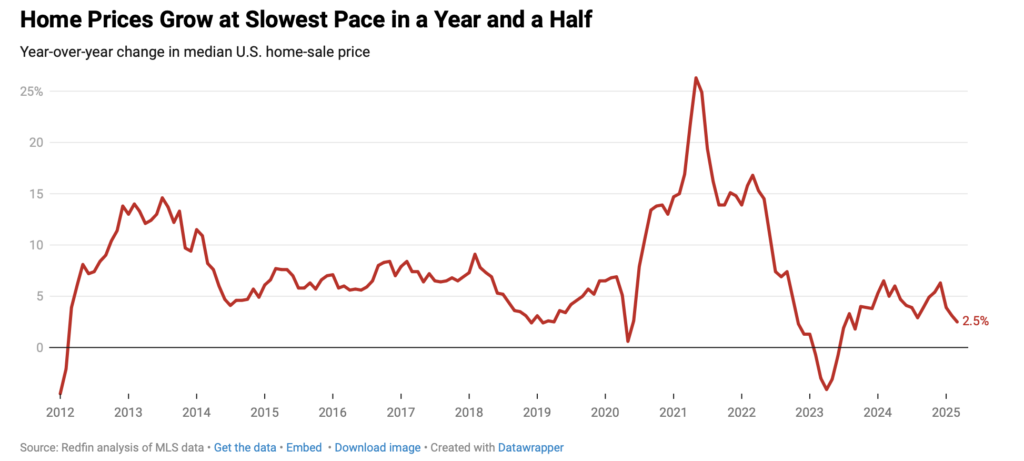
That pricing mismatch is reflected in the numbers. In March, the median home-sale price was $431,057, a modest 2.5 percent increase from the previous year and the slowest pace of price growth since September 2023. However, list prices are rising faster than sale prices, which is a sign that sellers are still hoping to push for more than the market is willing to give.
Redfin analysis of MLS data
However, the market is pushing back. The typical home that sold in March closed for about 1 percent below its list price.
Price trends varied widely by region, with the biggest increases in Cleveland (11.8 percent), Nassau County, New York (9.8 percent) and Newark, New Jersey (9.5 percent). The largest decreases were seen in Jacksonville, Florida (-3.8 percent), San Francisco (-2.6 percent) and Austin (-1.6 percent).
Sales activity also sent mixed signals. Pending home sales rose 1.7 percent month over month in March, but closed sales and existing sales fell by roughly 1 percent, remaining below pre-pandemic levels.
Pending sales grew the most in Montgomery County, Pennsylvania (13.7 percent), Denver (6.9 percent) and Sacramento, California (5.7 percent). Closed sales rose most in San Francisco (13 percent), Oakland (11.7 percent) and New York (5.3 percent).
One major headwind remains: mortgage rates. While the average 30-year-fixed mortgage rate dipped 6.65 percent in March, it’s still more than double the record lows seen during the pandemic, and that is keeping many buyers on the sidelines.
Email Richelle Hammiel
This post was originally published on this site
by Amy Chorew | Apr 17, 2025 | Industry, News Feed
Bigger. Better. Bolder. Inman Connect is heading to San Diego. Join thousands of real estate pros, connect with the power of the Inman Community, and gain insights from hundreds of leading minds shaping the industry. If you’re ready to grow your business and invest in yourself, this is where you need to be. Go BIG in San Diego!
As market pressures continue to squeeze real estate brokerages and startup tech companies alike, many leaders are discovering a smarter, more scalable way to build momentum — without committing to full-time executive hires. Enter fractional leadership.
“Fractional leadership is about getting high-level, strategic expertise without the cost or time commitment of a full-time executive,” says Laura O’Connor, a veteran operator in the brokerage and proptech space. “It’s agile, focused and designed to solve specific problems with measurable results.”
What is fractional leadership?
Fractional leaders are seasoned executives — often with 10 to 20-plus years of experience — who step into part-time roles to guide companies through pivotal transitions. Unlike consultants, fractional leaders don’t just advise; they sit at the table, lead internal teams, build systems and stay long enough to see outcomes through.
“They don’t just hand you a report and leave,” O’Connor notes. “They’re hands-on, often attending key team meetings and actively managing initiatives. They offer flexibility and cost control, while also transferring knowledge to internal staff.”
This model is especially valuable for broker-owners and founders at a crossroads: scaling, selling or trying to innovate without disrupting day-to-day operations.
Why enterprise companies are turning to fractional leaders
Enterprise brokerages and tech firms often use fractional executives to bridge leadership gaps, especially when there’s C-suite turnover or a need for specialized transformation, like integrating AI or restructuring operations.
In one case study, a large brokerage hired a fractional CMO and an outsourced marketing team instead of building a full-time internal department. The result? A cost savings of $240,000 annually and better outcomes from more specialized resources.
“You can deploy a team of fractional leaders to assess, optimize and transition your business — for less than the salary of one traditional exec,” O’Connor explains. “That’s incredibly powerful, especially in uncertain markets.”
T3 Sixty’s Talent division, T3 Talent, which is headed up by Dan Breault, has seen the decline in employment firsthand based on daily conversations it has with both job candidates and employers. “Brokerages have eliminated staff positions and have added additional job responsibilities to existing employees. As of August 2024, virtually no one was adding net new positions.” Breault emphasizes. “Again, if you’re looking for contract or fractional talent, the chances are good that the talent is available.”
How growing brokerages can benefit
For smaller companies — think independent brokerages with 20 to 50 agents — fractional leadership is often the first right hire.
“Too often, these brokerages jump to hiring a virtual assistant or bring in a family member with no real systems in place,” says O’Connor. “But unless someone builds the SOPs, onboarding guides and defines roles — those hires don’t work.”
Instead, a fractional COO, CMO or CTO can step in for as little as five to 10 hours a month to design processes, manage offshore or junior staff, and set the company up for scale. They’re not interns — they come with real-world experience and metrics to back it up.
A smarter transition plan for aging broker-owners
One of the most compelling use cases for fractional leadership is succession planning. Many brokerage owners nearing retirement face tough decisions: Should they sell, promote someone internally or wind down?
O’Connor emphasizes that legacy owners often underestimate how much they do — and struggle to translate that into a viable leadership transition plan. A fractional executive can come in to:
- Shadow the current owner
- Document processes and responsibilities
- Identify and train a successor (internal or external)
- Build a job description rooted in reality, not guesswork
Start with a strategic leadership audit
If you’re unsure where to start, O’Connor recommends beginning with a strategic team audit. For residential real estate brokerages, O’Connor offers an organizational assessment exercise that delivers detailed roles and responsibilities for each person supporting the brokerage and outlines the specific details for their next hire.
This 30- to 60-day engagement positions the fractional leaders and business owner to observe, assess and map out your team’s structure — identifying misalignments, gaps and opportunities.
“Before we recommend adding any new support — whether it’s a fractional exec, a virtual assistant, an outsourced team or automation — we take the time to roll up our sleeves and understand the current picture. Who’s doing what? What’s falling through the cracks? Are people working in their zone of strength? That clarity creates a foundation we can build on — so any new layer of support amplifies your existing team, rather than creating more noise,” says Daniel Butbul of Systato.
“From there,” O’Connor explains, “you can move into a 90-day focused project — whether that’s building onboarding systems, launching a new brand strategy or managing a marketing team.”
Fractional leadership isn’t a trend; it’s a flexible, future-ready model built for the realities of modern business.
“Brokerages and tech companies don’t need to jump into another full-time hire,” says O’Connor. “They need someone who can get in, lead and leave things better than they found them.”
Whether you’re looking to scale up, clean house or hand off your legacy, the right fractional leader might be your most brilliant next move.
Amy Chorew is an active Realtor involved in investment properties and listing well-staged homes in Connecticut. Connect with her on LinkedIn and Instagram.
This post was originally published on this site
by Taylor Anderson | Apr 17, 2025 | Industry, News Feed
Jerome E. Milko filed an antitrust lawsuit against the National Association of Realtors, saying the requirement to join local, state and national Realtor organizations is an illegal conspiracy.
Bigger. Better. Bolder. Inman Connect is heading to San Diego. Join thousands of real estate pros, connect with the Inman Community and gain insights from hundreds of leading minds shaping the industry. If you’re ready to grow your business and invest in yourself, this is where you need to be. Go BIG in San Diego!
Yet another broker is targeting the National Association of Realtors over the so-called three-way agreement, saying that fees that are required to do business in the real estate industry are being used for luxurious perks and salaries by the trade organization.
That’s according to a new antitrust lawsuit filed this week by a Maryland agent and broker who alleges the requirement that real estate professionals must become members of local, state and national Realtor organizations to access the multiple listing service is anticompetitive.
Jerome E. Milko joined a growing list of real estate brokers and agents who have filed similar lawsuits in recent months.
“Defendant NAR’s requirement of triple membership to meaningfully participate in the real estate market encourages discrimination between sellers, buyers, consumers, agents, and brokers, and the Defendant will continue protecting their cash flow from their fees obtained through compulsory membership,” Milko’s complaint reads.
Milko is an agent in Ocean City, Maryland, and holds licenses in that state as well as in Delaware and in Georgia, where the case was filed. He is a resident of Georgia, according to his complaint, which was filed in U.S. District Court for the Northern District of Georgia in Atlanta.
He said that in his 37 years as a licensed agent, he’s paid just over $26,000 to NAR, in addition to fees he’s paid to state and local Realtor organizations over that timeframe.
Milko cited a report from The New York Times in November that outlined the various perks and payments received by NAR leadership and members of their families.
“‘Volunteers’ with Defendant NAR have used membership ‘fees’ collected from the Plaintiff and other real estate market participants to pay for excessive salaries for volunteer positions, for ‘perks’ such as hotel resort stays for volunteers and spouses, golfing outings, wine, dinners, Broadway tickets, pet-care, and flights which constitute free luxury vacations for said ‘volunteers’ and their relatives,” Milko wrote in the complaint.
The Times article found NAR’s volunteer leaders are paid lavish stipends and other benefits that may skirt U.S. tax laws for nonprofits. In addition to former CEO Bob Goldberg’s $2.6 million annual salary, NAR agreed to cover the cost of private clubs in Chicago and Washington along with up to $75,000 of the initiation fee plus dues at a country club near his home in Maryland and may still be remunerating him as a paid consultant, according to the report.
NAR, the sole defendant targeted by the Milko’s lawsuit, has defended the three-way agreement, which requires agents and brokers to join a local, state and national Realtor association in order to qualify for membership in any of those NAR affiliates.
In response to the complaint, an NAR spokesperson said that becoming a member with NAR was “optional.”
“Similar to other national membership organizations, NAR’s federated ‘three-way’ structure connects members at every level, giving them a unified voice on policy issues, access to business tools, professional development opportunities and a uniform Code of Ethics,” the spokesperson said. “State and local associations set their own dues for members, but when agents opt to become a Realtor®, they’re not just joining a local association—they’re becoming part of a nationwide partnership that includes their state and the National Association of Realtors®, which helps to fund advocacy at all levels of government, as well as legal and economic research, consumer advertising, and the technology platforms that support the entire Realtor® community. We believe this structure delivers real value to help our members thrive in their careers—and we will respond to the Plaintiff’s claims in court.”
Milko’s suit alleges the agreement constitutes an illegal restraint of trade and unjust enrichment. He has requested a jury trial, damages and an injunction barring the agreement.
Email Taylor Anderson
Editor’s Note: This story was updated to include comment that came in after the story was initially published.
This post was originally published on this site