The antitrust suit, filed Monday in the Southern District of New York, accuses Zillow of using anticompetitive behavior to “protect its monopoly and revenues in violation of the antitrust laws.”
Real estate is changing fast, and so must you. Inman Connect San Diego is where you turn uncertainty into strategy — with real talk, real tools and the connections that matter. If you’re serious about staying ahead of the game, this is where you need to be. Register now!
Compass, the U.S.-based brokerage that has become a champion for private listings, has sued real estate portal Zillow over new rules that ban privately marketed listings from the platform.
The antitrust lawsuit that was filed in United States District Court in the Southern District of New York on Monday alleges that Zillow has employed “anticompetitive tactics to protect its monopoly and revenues in violation of the antitrust laws.”
The lawsuit was the latest escalation between two powerhouses of the industry: Zillow is the largest real estate portal, with 2.4 billion visits during the first three months of this year alone. Compass is the No. 1 brokerage in the country by sales volume.
It is the latest signal that the industry remains divided over recent updates to the rules that govern real estate in the U.S., especially when it comes to how, when and where homes are marketed for sale.
“This lawsuit is about protecting consumer choice. No one company should have the power to ban agents or listings simply because they don’t follow that company’s business model,” Compass CEO Robert Reffkin said in a statement. “That’s not competition. It’s coercion. Imagine if Amazon banned a seller for offering a product on their own website first. That’s what Zillow is doing in real estate. Consumers should have the right to choose how they sell their homes.”
The fight over private versus public listings seems to have reached a peak with the new legal action. The suit also follows months of brokerages teasing or releasing their own private listing networks (including Compass, Corcoran and Douglas Elliman). Meanwhile, Redfin has joined Zillow in banning private listings that are publicly marketed.
In March, the National Association of Realtors (NAR) weighed in on the subject by opting to keep the Clear Cooperation Policy, which stipulates that agents must list properties on the MLS within 24 hours of marketing them. However, NAR also added a “delayed marketing exempt listings” option for homesellers, allowing them to delay listings to Internet Data Exchange (IDX) feeds while still making them accessible to MLS participants. Individual MLS’s are creating their own policies for how long listings may be delayed, when opting into the new listing feature.
In the complaint, Compass goes on to characterize Zillow as “relentless” in its quest for dominance in the home portal space, even releasing this spring its new “exclusionary policy” to ban listings — what Compass calls the “Zillow ban” — that had been previously marketed privately from its platform as part of its “3-Phased Marketing Strategy.”
Thousands of listings first appear only on Compass’ internal platform, where they can be viewed by Compass agents and their clients. The second phase involves marketing a listing publicly as a “coming soon” listing that isn’t yet on the MLS. Ultimately, Compass said that 94 percent of its seller clients who use the company’s private listing strategy ultimately list their homes on the MLS.
Compass alleged that Zillow moved to prevent the private listings strategy because it can’t monetize those listings.
“The strategy poses a significant threat to Zillow’s home search monopoly and its revenues,” Compass wrote in its complaint. “For Zillow, every home buyer search conducted on Compass instead of Zillow is a lost opportunity for Zillow to lock that prospective home buyer into Zillow’s ecosystem and make money selling her information to real estate agents for a lead fee—Zillow’s central business model.”
Lead-monetization was another point of contention in Compass’ suit. When properties are first marketed elsewhere, Compass alleges, “Zillow cannot make money” from those listings.
“Zillow uses the Zillow Ban to block real estate search rivals like Compass from competing head-to-head,” Compass wrote.
Compass alleged that Zillow is large enough to amount to a monopoly, and that it may have colluded with Redfin and worked directly with eXp on administering and complying with the ban.
EXp is the nation’s largest real estate brokerage by transactions. It announced on April 10 that it would support Zillow’s policy.
Neither Redfin nor eXp was named as a defendant in the Compass lawsuit. Compass named Zillow and its subsidiary Trulia as the sole defendants in the antitrust case.
In response to the complaint, Zillow said that it planned to “vigorously” defend itself from the claims, which it called “unfounded.” The company said that “most brokerages, consumer advocates and fair housing experts” supported its policies.
“At the heart of this issue is a simple principle: when a listing is publicly marketed, it should be accessible to all buyers—across all platforms, including Zillow,” the company said in a statement. “Hiding listings creates a fragmented market, limits consumer choice and creates barriers to homeownership, which is bad for buyers, sellers, and the industry at large, especially in this inventory and affordability-constrained environment.”
“Our listing access standards are designed to ensure transparency, equal opportunity, and broad visibility for everyone so sellers can maximize price and time to sell and so buyers have access to all available inventory,” the statement continued. “Limiting visibility hurts buyers and sellers, disadvantages smaller brokerages, and undermines an open market. Our focus remains on creating a level playing field that serves the best interests of everyone in the home buying and selling journey.”
Update: This story was updated after publication with additional background and details from the lawsuits.
This is a deep dive into a local real estate market powered by Inman Market View. The goal: To put more local data in the hands of the Inman community, and to place it in a context that’s highly relevant for the U.S. brokerage industry.
One of the biggest housing stories this spring has been a much-needed boost in inventory in many parts of the U.S.
Nationwide, inventory exceeded 1 million for the first time since the winter of 2019, with 50 of the largest metros in the country posting annual inventory gains in May.
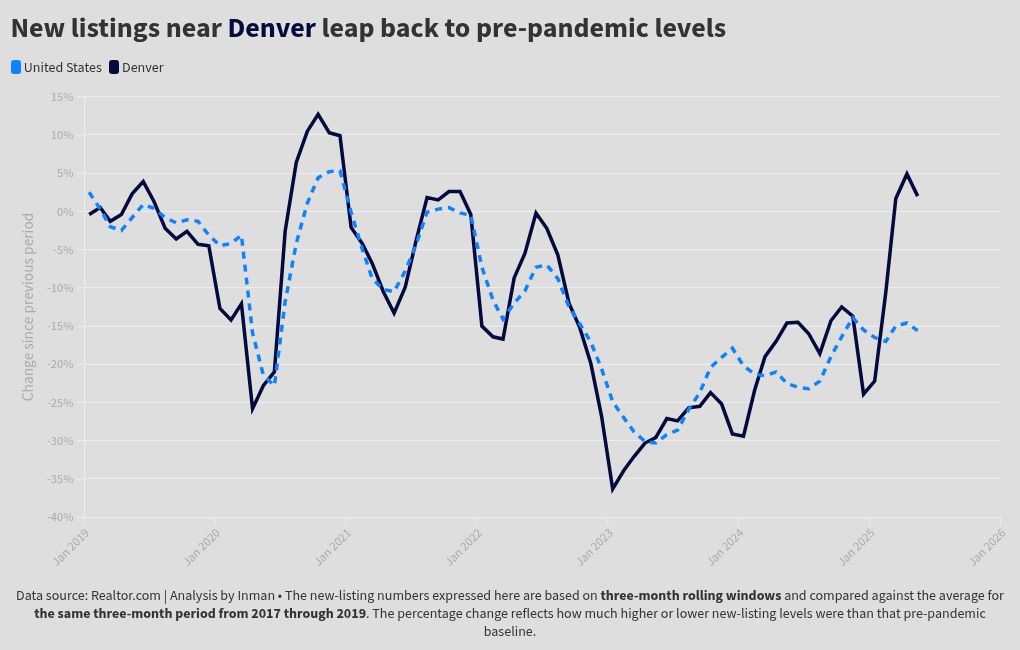
Out of those metros, one that has seen a significant inventory improvement is Denver. The Western mountain market posted a 20 percent annual growth in new listings during the three-month period of March through May, the second-highest jump among any large U.S. market, according to listing data from Realtor.com.
In a market where many buyers have felt locked into their existing low-rate mortgages, and where current prices are unaffordable for many, some have pointed to new construction as a possible explanation of a listing resurgence in places like Denver.
But local agents and Denver market experts who spoke with Inman suggested that existing homeowners — not builders — have done the most to provide new supply to the market over the past year.
The reasons Inman’s sources gave were complex, ranging from broad factors that much of the country is experiencing alongside the greater Denver housing market, and unique issues with regulations and ownership costs that are sending some investors and other owners packing.
These are the numbers — and reasons — behind Denver’s year of extraordinary inventory gains.
Steady gains
The Denver-Aurora-Centennial, Colorado, metro area has seen sustained growth in new listings this spring, providing buyers with more options and opportunities.
Almost 20 percent more new listings hit the market in the greater Denver area this spring than during the same period last year, bringing overall new supply levels to roughly where they were in a typical spring before the pandemic began.
Active listings over the same three-month period were up 65 percent in the metro on an annual basis, and were 89 percent higher than their 2017-2019 levels at the same time of year, according to data from Realtor.com. All in all, inventory in May represented a solid, three-months’ supply.
Still, there were signs that this robust momentum in new supply might be slowing down in recent weeks.
During the month of May alone, new listings were up only 4 percent year over year to 7,017 new listings, according to REcolorado numbers that align closely with those tracked by Realtor.com.
As inventory has grown, sales have also been a mixed bag.
Closed listings were down 5 percent year-over-year in May, according to REcolorado. In perhaps a more encouraging sign for June sales, however, the number of pending listings over the same period was up 12 percent from the year before.
Buyers taking their time
While new listings are up across the board, subdued demand for homes in Denver and nearby areas has further pushed the local market in a more buyer-friendly direction, Inman found.
Because of high prices (the median closed price on Denver homes has hovered around $600,000 since 2022, according to REcolorado) and mortgage rates, as well as general economic uncertainty in the U.S., many potential buyers have taken a more careful approach to homebuying than has been typical in recent years.
Christine Dupont-Patz | RE/MAX of Cherry Creek
“I feel right now that the buyers are just being very selective,” Christine Dupont-Patz, broker and co-owner of RE/MAX of Cherry Creek Inc., told Inman. “There seems to be no rush.”
Jackie White of Your Castle Real Estate said she sees a lot of what she calls “tire-kickers” these days: buyers who want to take their time and do more due diligence than they’ve been afforded in recent years during what used to be a rapid-fire market.
“With the cost of insurance having gone up in recent years as well as the interest rate [increasing the cost of homeownership], it’s just making [buyers] do a lot more due diligence before making an offer,” White said. “The total cost of ownership is being met with more scrutiny because of those increasing costs, and with homes having longer days on market, they feel like they have time to consider the home and it’s OK if it goes under contract and they lose out because there’s likely several other homes active that they would consider.”
By contrast, in the years during and shortly after the COVID-19 pandemic, buyers were scrambling to find any home that would suffice, Dupont-Patz explained, both to find shelter and hop on low interest rates. Without those factors at play today, and with more inventory at their finger tips as well as impending economic uncertainty in response to tariffs, there’s no real urgency for buyers.
“Now, you really feel where buyers are, ‘I want this to be my forever home. I want this to be where I’m going to raise my kids,’” Dupont-Patz said. “And I have clients who are downsizing, so the big thing is, how can they age in place? Is the neighborhood walkable for them? Does it have the amenities that they want as they get older? So it’s really taking a much longer term view of what they want to buy.”
People from all over the country for a long time have found Denver an attractive market to move to because of its city amenities paired with easy access to nature. But some buyers from out-of-state today can be surprised by the area’s price points, Dupont-Patz said. As she’s seen the parents of millennials and Gen Z’ers start to move to the area to be closer to their grandchildren, their homebuying process is often more prolonged than expected because those transplants have slightly unrealistic expectations about how much property their can get for their dollar.
Insurance and homeowners association fee hikes have also put a significant damper on demand in the condo market in Denver, Dupont-Patz said.
Insurance premiums increased by an average of 58 percent between 2018 and 2023, according to the Rocky Mountain Insurance Information Association, and are expected to rise by about 11 percent this year in response to wildfire and hailstorm risks, according to Insurify.
One of Dupont-Patz’s clients decided to pull their relatively new one-bedroom one-bath condo from the market after two months without a single showing.
“Unfortunately, we were not the only condo in the building that did not have one showing,” Dupont-Patz continued. “[Other agents and I] all came together and said, ‘OK, we’re all going to have an open house at the same time on a Saturday. We’re going to all cross-advertise it.’ If people came to the open house, we would give them a gift card to see the Rockies — and you can make all the jokes you want, ‘Well you can’t give that shit away with your Rockies,’ I know that’s a whole ‘nother conversation — no one, no one came to see the condos.”
Sellers ready to cash out
Jackie White | Your Castle Real Estate
White said that many condo owners are wanting to list now because those higher insurance fees, which are spurring higher HOA fees, are making it so that it’s more expensive to own a condo than to rent an apartment. “So we’re finding much longer days on the market for condos and townhomes and a really big inventory in that product.”
Some investors are likewise considering offloading rental properties because of recent legislation in the state that places more restrictions on landlords, White said.
As of last year, restrictions were put in place that make it more difficult for landlords to evict tenants, put limits on the cost of pet security deposits and rent and prohibit municipalities from limiting the number of people who can live together in a unit based on familial relationships, among other measures.
“So there are investors that are opting to cash in on the equity that they’ve gained on their properties as well,” White said. “When they look at the annual cash flow compared to the equity in their home, in many cases, the returns are 3 to 4 percent and so choosing to take that money and invest it elsewhere, perhaps out of state or in the stock market, would serve them well compared to hanging onto these properties with a lot of the legislation and regulation that’s in place.”
New construction’s part
Denver’s commitment to building during and after the pandemic seems to have had some role in its current healthy inventory levels, according to a Realtor.com report.
“Metros that built more housing like Austin, Nashville and Denver have generally returned to pre-2020 inventory levels,” the report stated. “Those with less new construction like New York, Boston and Buffalo, New York, have not.”
Ted Leighty | Colorado Association of Home Builders
However, more recent new construction is contributing little to new inventory this spring, Ted Leighty, CEO of the Colorado Association of Home Builders, told Inman.
“We do not believe that new construction is adding a lot of homes to the current number of properties on the market in the metro Denver area,” Leighty said in an email. “In 2024, our members pulled about 650 to 700 permits per month, and those homes are either coming to the market now or are already sold to their future owners. These new homes would represent a small fraction of the 13,000-plus homes currently on the market.”
In 2021, 30,006 building permits were issued in the Denver metro area, according to the U.S. Census Bureau’s Building Permits Survey, and in 2022, 23,009 permits were issued. By comparison, just 15,570 permits were issued in 2024.
That support from new construction was further weakening in the early months of this year, the data shows.
Only 4,881 residential permits were issued in the first four months of this year, down 10 percent from the year before. This annual decline was driven primarily by a 17 percent reduction in permits for single-family homes, while permits for multifamily units remained steady.
This multiyear decline has yet to feel much impact from the Trump administration’s tariffs on the kinds of imported goods that are used in residential construction, Leighty said.
According to the National Association of Home Builders, roughly $204 billion worth of goods were used in constructing new multifamily and single-family homes in 2024, $14 billion (or about 7 percent) of which were imported from outside of the U.S.
Colorado has not felt an impact as of yet, Leighty said, but builders are trying to prepare for them.
“At this point, we are not seeing tariffs having a direct impact on permits here in Colorado,” Leighty said in an email. “Mostly we are hearing that our members are adjusting their supply chains and budgets to adapt to the tariff situation. Like other markets across the U.S., we believe that mortgage rates and a general lack of consumer confidence are having a bigger impact on home sales and demand for new construction.”
The controversial Grand Theft Auto streamer secured the 10-acre property with a $12.7 million mortgage. The sellers are aerospace executives who built a new home on the estate in 2024.
Bigger. Better. Bolder. Inman Connect is heading to San Diego. Join thousands of real estate pros, connect with the Inman Community, and gain insights from hundreds of leading minds shaping the industry. If you’re ready to grow your business and invest in yourself, this is where you need to be. Go BIG in San Diego!
Gaming streamer Adin Ross has broken a sales record in Davie, Florida, with his purchase of a 10-acre estate for $25.5 million.
The 24-year-old internet personality is known for livestreaming himself playing video games and collaborating with celebrities.
Ross bought the home by way of an LLC, according to property records, and financed the property with a $12.7 million mortgage, The Real Deal reported.
The 11,325-square-foot home has seven bedrooms and nine baths, according to Zillow. The home was custom-built in 2024 and designed by Florida-based interior design firm Clive Daniel.
Amenities include a home theater, spa, office, smart home automation, elevator, art studio and pool house. Outdoor space features synchronized fountains, a reflecting pool with fire features, a swimming pool and outdoor kitchen.
The sellers are Laurent and Laure Parelle, both of whom are aerospace executives. The couple purchased the property in 2009 for $775,000, according to records. They listed it in March for $32 million.
Enzo Rosani, broker and managing partner of Barnes International Realty, represented the listing. William Abreu of The Nicolas Group at Compass repped Ross in the deal.
Other home sales in Davie haven’t come anywhere near Ross’ new pad. Previously, the sales record was held by a property at 10850 Southwest 23rd Street, which sold for $5.6 million in February.
Davie is located just west of Fort Lauderdale-Hollywood International Airport. The town and several of its neighboring towns have become popular among professional athletes, including Miami Dolphins quarterback Tua Tagovailoa, who bought a $1.7 million home in Davie in 2020.
Ross first gained attention by streaming himself playing NBA 2K and Grand Theft Auto V on Twitch. He was banned from the platform in 2023 for various platform violations, including having a guest who used a homophobic slur and for not moderating comments in his chat. He was subsequently allowed back on the platform this spring.
Ross had a heated encounter with NBA legend Shaquille O’Neal at UFC 314 on April 12, according to social media footage captured at the event showing O’Neal directing threats in Ross’ direction. The pair have also had a bit of back-and-forth online in the past, with Ross often jabbing at the former Lakers center.
Get Inman’s Luxury Lens Newsletter delivered right to your inbox. A weekly deep dive into the biggest news in the world of high-end real estate delivered every Friday. Click here to subscribe.
Nearly 40 percent of homebuilders cut prices in June, the highest portion since the National Association of Home Builders began tracking the cuts. A decline in single-family starts is projected this year.
Bigger. Better. Bolder. Inman Connect is heading to San Diego. Join thousands of real estate pros, connect with the Inman Community and gain insights from hundreds of leading minds shaping the industry. If you’re ready to grow your business and invest in yourself, this is where you need to be. Go BIG in San Diego!
Homebuilder sentiment wavered in June as the industry responded to elevated mortgage rates and economic uncertainty impacting consumers today.
Builder sentiment dropped 2 points between May 2025 and June 2025 to 32 on the National Association of Home Builders (NAHB) / Wells Fargo Housing Market Index (HMI), according to a report released on Tuesday. In June 2024, the index was at 43. An index below 50 is considered negative.
June’s HMI marked the third-lowest reading of builder sentiment since 2012. In December 2022, the index hit 31 after a spike in mortgage rates post-pandemic, and in April 2020 at the start of the pandemic, when the index tanked by more than 40 points to 30.
“Buyers are increasingly moving to the sidelines due to elevated mortgage rates and tariff and economic uncertainty,” NAHB Chairman Buddy Hughes said in a statement on Tuesday. “To help address affordability concerns and bring hesitant buyers off the fence, a growing number of builders are moving to cut prices.”
Thirty-seven percent of builders cut prices in June, the highest portion since the NAHB started tracking price cuts in 2022. In May, 34 percent of builders reported cutting prices, and 29 percent reported doing so in April. The average price reduction remained consistent at 5 percent, which is about what is has been since November, the NAHB reported. Sales incentives were used by 62 percent of builders, up one percentage point from the previous month.
Because of recent tariff negotiations and pullbacks from the Trump administration, many analysts expected a small improvement in builder sentiment, but growing inventory and little enthusiasm for buyers to enter the market right now has continued to weigh on builders.
The HMI index for current sales conditions dropped 2 points in June to 35, the component relating to sales expectations in the next six months dropped 2 points to 40 and the component tracking prospective buyer traffic slid 2 points to 21, its lowest level since November 2023.
“Rising inventory levels and prospective homebuyers who are on hold waiting for affordability conditions to improve are resulting in weakening price growth in most markets and generating price declines for resales in a growing number of markets,” NAHB Chief Economist Robert Dietz said in a statement. “Given current market conditions, NAHB is forecasting a decline in single-family starts for 2025.”
According to the three-month moving averages of regional HMI scores, the West saw the greatest decline, by 4 points, to 28. Meanwhile, the South fell by 3 points to 33, the Northeast fell by 1 point to 43 and the Midwest actually gained 1 point to hit 41.
The new policy was signed into law by Governor Maura Healey during the first week in June and is included in the state’s larger Affordable Homes Act. The law will apply to sales after Oct. 15, 2025.
Bigger. Better. Bolder. Inman Connect is heading to San Diego. Join thousands of real estate pros, connect with the Inman Community, and gain insights from hundreds of leading minds shaping the industry. If you’re ready to grow your business and invest in yourself, this is where you need to be. Go BIG in San Diego!
Officials in Massachusetts have passed a new state policy prohibiting homesellers and their agents from pressuring or requiring buyers to waive a home inspection as a contingency of buying their property.
The new policy was signed into law by Governor Maura Healey during the first week in June and is included in the state’s larger Affordable Homes Act, the Executive Office of Housing and Livable Communities (EOHLC) announced on June 6. The law will apply to home sales after Oct. 15, 2025.
The policy also stipulates that sellers may not accept an offer if they are informed in advance that the buyer plans to waive their right to an inspection. Still, buyers may choose to not get a home inspection if they wish, but sellers must provide a written disclosure affirming the buyer’s right to an inspection.
“A home inspection is an important step in buying a property,” Executive Office of Housing and Livable Communities Secretary Ed Augustus said in a statement.
“Homebuyers must have the ability to make informed financial decisions and be given a clear picture of needed repairs or safety issues that could arise,” he added. “This new regulation creates a fairer, more even playing field for buyers and sellers, and HLC is proud to implement yet another smart policy from the historic Affordable Homes Act.”
The new regulation is a sharp rebuke to the pandemic-era days of buyers waiving their right to a home inspection all too readily, simply for the chance to have their offer considered by a seller.
Bidding wars and waived contingencies that hit a peak around 2020-2021 as buyers were fighting for a chance at scant inventory amidst record-low mortgage rates had some taking measures like “walk-through” or “walk-and-talk inspections” rather than no inspection at all. Although such inspections cannot replace a full home inspection, these abbreviated inspections could at least help buyers uncover major issues in a home before they purchase it.
Errors and omissions lawsuits against real estate professionals saw a substantial increase in 2022, according to a report from underwriting firm Victor Insurance Managers, and likely correlated with increased waived inspection contingencies. The amount in damages that losing agents in these lawsuits were liable for also ballooned 13 percent higher than the previous year to an average of $39,000.
After a draft home inspection regulation was published by the EOHLC, the office welcomed public comments on the policy in May, and received more than 100 submissions.
In response to feedback, the EOHLC pushed the implementation date to October so that real estate industry professionals would have time to create new forms, trainings and educational materials in compliance with the regulation. The extended timeline also allows consumers and the public more time to become aware of the law.
Any contract terms that impede on the effectiveness of an inspection will also be prohibited. Limits on repair costs or deposit returns that are negotiated between buyer and seller will still be allowed.
The EOHLC is also providing a standard disclosure form, and those individuals facilitating the transaction in a business capacity will be required to provide the disclosure, or risk violating consumer protection law. Other violations will be addressed on a case-by-case basis.
Pre-sales of new construction homes will have a limited exemption from the regulation to support new construction in the state, as long as a purchase contract is signed before “substantial completion” and the seller offers a one-year written warranty, at a minimum. Exemptions will also be applied to domestic partners, extended family members and estate planning, the EOHLC said.
The Greater Boston Real Estate Board, Massachusetts Association of Realtors, Massachusetts Mortgage Bankers Association and the Commercial Real Estate Development Association all opposed the regulation in a joint statement published during the May feedback period.
Concerns about the policy included an earlier timeline (which the EOHLC responded to by pushing the implementation date to October), profession-based exemptions (a previous version of the legislation also exempt licensed home inspectors from the prohibition on waiving inspections) and a need for more clarity and consistent guidance within the regulations. The organizations also questioned whether the state would have the capacity to meet a resulting surge in home inspection demand.