Why the Miami luxury market has boomed amid lower-price slump

Luxury homes continue to sell in big numbers in prime locations throughout Miami, a market where most price points have seen a protracted dip in transactions.

Bigger. Better. Bolder. Inman Connect is heading to San Diego. Join thousands of real estate pros, connect with the Inman Community, and gain insights from hundreds of leading minds shaping the industry. If you’re ready to grow your business and invest in yourself, this is where you need to be. Go BIG in San Diego!

Even as the lower end of the real estate market remains stuck in limbo, there’s never been a better time to broker real estate deals in the glitzy world of Miami luxury.

TAKE THE INMAN INTEL SURVEY FOR MAY

And for agents of the rich and famous, the future may look even brighter along the Florida coastline, a real estate analytics expert argued this week.

Sales in certain classes of high-end, single-family homes in prime Miami locations were up from the first quarter of last year, reaching an all-time high that was seven times their pre-pandemic transaction counts, Analytics Miami founder Ana Bozovic told Inman On Tour conference attendees Tuesday. Newly constructed luxury condo sales were also booming.

“There’s just a whole ’nother reality happening at the very high end,” Bozovic said, “and it’s separated itself from the rest of the market.”

Analytics Miami founder Ana Bozovic briefs Inman On Tour attendees on the Miami luxury market. (Photo by Mike Nyffeler with AJ Canaria Creative Services)

And Bozovic sees this dynamic continuing indefinitely.

An increasingly disparate interstate tax environment is expected to drive even more wealth from high-tax strongholds like New York and California into the waiting arms of Florida and Texas, Bozovic said. 

“Nothing is forever,” she said. “New York was the capital of the 20th century world; before that it was London; before that it was Amsterdam. There’s always an inevitable shift in focus.”

On top of that economic shift to places like Florida and Texas, she said that general wealth-creation trends nationwide will ensure a steady pool of new buyers for the top luxury markets.

Advancements in technology, she said, may only serve to widen the wealth gap — further supporting top-dollar transactions in today’s hottest luxury markets.

Bozovic is particularly focused on the role that AI tools might play in propelling early adopters into the wealthy class, even as many workers on the lower rungs are displaced by the new technology.

“Yes, it’s wealth moving to Miami, but on top of that, … it’s a wealth gap in action that’s growing,” she said.

Bozovic rejected the notion that the luxury market in Miami is in a bubble that might burst anytime soon.

She pointed out how more than 80 percent of deals are conducted entirely with cash in the highest-rung portions of the Miami market. 

“Bubbles are built on debt,” Bozovic said. “We have cash — heavy, heavy cash — that is buoying up the highest parts of our market, and I don’t see this changing either.”

Email Daniel Houston

This post was originally published on this site

Take the Inman Intel Index survey for May

Bigger. Better. Bolder. Inman Connect is heading to San Diego. Join thousands of real estate pros, connect with the Inman Community, and gain insights from hundreds of leading minds shaping the industry. If you’re ready to grow your business and invest in yourself, this is where you need to be. Go BIG in San Diego!

To help figure out where the industry is heading next, Inman invites you to take real estate’s most ambitious monthly survey: the Inman Intel Index.

Each month, the Intel Index survey leans on the expertise of Inman’s readership to discover what’s top of mind for agents, mortgage professionals, proptech players and industry executives.

TAKE THE INMAN INTEL INDEX SURVEY

The insights gathered from these responses help illuminate industry sentiment on real estate’s most important topics: the NAR settlement, inventory opportunities, new U.S. tariff policy and its impact on real estate, and more.

Click through to add your insights to the industry’s knowledge base, and check back for analysis of the results in the weeks to come.

Thank you,

Team Inman

This post was originally published on this site

1 in 10 agents in Intel survey say they’ve seen tariffs blow up a deal

Agents and brokers are already feeling the impact of new trade policies, new Intel polling shows, an indication that the brokerage business might not be as insulated from tariffs as once thought.

This report is available exclusively to subscribers of Inman Intel, the data and research arm of Inman offering deep insights and market intelligence on the business of residential real estate and proptech. Subscribe today.

While U.S. importers, retailers and homebuilders found themselves on the front lines in the government’s sweeping new tariffs on imports, American real estate brokerages were already beginning to feel the pain.

Just over 1 in 10 agents who responded to April’s Inman Intel Index survey said that they had witnessed a sale fall apart in their market because of “tariff impact.” Brokerage leaders Intel surveyed, from their higher perch within their respective organizations, were even more likely to have seen a deal blow up because of tariffs.

This early temperature check was taken a few weeks after the Trump administration announced — then paused — sweeping reciprocal tariffs on U.S. imports, leaving in place a new 10 percent baseline tariff on imports from most countries. 

They also reflect a period of time when duties imposed on Chinese imports were as high as 145 percent, before those too were temporarily brought back down.

The ever-changing policy environment has introduced a fresh wave of angst within the brokerage world, which by late April was broadly concerned about the direction of the U.S. economy, Intel’s survey found.

Dive into the numbers in this week’s full report.

A lurking threat

At first glance, real estate brokerages aren’t the most exposed business model to the impact of broad universal tariffs.

Brokerages have relatively low reliance on capital goods to conduct transactions and make commissions, aside from the computers and electronics that they need to do their jobs.

And the broader impacts of new tariffs on housing supply — such as on prices of lumber and other inputs to residential construction — are unlikely to be fully felt for months or years.

But that doesn’t mean brokerages have seen no effect in their day-to-day experiences with clients, who are weighing the same uncertainty of the new policy in their own complex and often high-stakes decisions to list or buy a home.

  • Nearly 14 percent of real estate agents surveyed in April by Intel said they had seen a recent deal fall apart due to job loss.
  • 11 percent of respondents said “tariff impact” had caused a deal in their market to fall apart.
  • And 8 percent pointed to unexpected complications involving the Federal Housing Administration, the Department of Housing and Urban Development or the Federal Housing Finance Agency.

It should be noted that a large majority of agents surveyed — 74 percent — said that they had not seen any of these factors blow up a deal at any point in the last three months.

It’s also unclear in what ways the tariffs have impacted these deals, or whether the transactions in question were for their clients or those of other agents in their market.

In future surveys, Intel will dive deeper into this group to better understand this complex and evolving issue for the industry.

But in the meantime, part of the picture is clear: A lot of clients are asking about the tariffs during the homebuying process, and expressing unease about how they might affect them.

  • 45 percent of agent respondents and 51 percent of brokerage leader respondents told Intel in April that clients have inquired about the effect of new trade policies on real estate prices — even though the tariffs are not expected to directly apply to domestic real estate sales or brokerage commissions.

Some real estate professionals also reported they are already anticipating a negative impact on their markets from federal layoffs — although the impact is expected to remain modest.

  • 55 percent of agents surveyed in April said their market has seen no impact from federal government layoffs.
  • 43 percent of agents in the survey said their market had been negatively impacted by federal job cuts, but less than 8 percent of all agents surveyed described a “very negative impact” from these cuts.
  • Just over 1 percent of agent respondents in April described positive effects in their markets from federal job cuts so far.

This newfound unease was also felt by the broker-owners, executives and investors Intel surveyed last month.

The view from the top

When Intel has asked in the past about concerns over the market — such as with changes to commissions resulting from the NAR settlement — agents have often been more prone to worry than the leaders at their brokerages.

But when it comes to the tariffs, both groups reported a broad range of concern in late April. 

  • 75 percent of agent respondents in April said they were concerned or very concerned about the U.S. economy right now, compared to only 8 percent who said they were pleased with the economy.
  • For brokerage leaders, 65 percent told Intel that they were concerned or very concerned, while 15 percent said they were pleased with the state of the economy.

Brokerage leaders were just as likely as their agents to say that their business decisions have been affected by recent economic uncertainty, but less likely to describe that effect as “significant.”

  • Only 28 percent of agent respondents said recent economic uncertainty has had no impact on their business decisions at all — nearly identical to the share of brokerage leaders who said the same.
  • Meanwhile, 32 percent of agents said that uncertainty has had a “significant” effect on their decisionmaking, compared to 20 percent of brokerage leaders who said the same. 

The responses in this report reflect a slice of industry sentiment at a specific snapshot in time: specifically, the survey date range of April 17 through May 2. 

Since then, trade barriers have continued to shift — and in some cases, on a temporary basis, ease — as the White House has responded to market uncertainty and expressed openness to striking deals with major trade partners.

Intel will continue to track the effect of trade policy on brokerages in the months to come.

Methodology notes: This month’s Inman Intel Index survey was conducted April 17-May 2, 2025, and received 428 responses. The entire Inman reader community was invited to participate, and a rotating, randomized selection of community members was prompted to participate by email. Users responded to a series of questions related to their self-identified corner of the real estate industry — including real estate agents, brokerage leaders, lenders and proptech entrepreneurs. Results reflect the opinions of the engaged Inman community, which may not always match those of the broader real estate industry. This survey is conducted monthly.

Email Daniel Houston

This post was originally published on this site

Agents’ iron commission grip slips slowly in spring: Intel Index survey

Most agents feel like they have compensation talks under control. But as the busy season ramped up, Intel Index survey results suggest homebuyers and sellers alike made only incremental gains.

This report is available exclusively to subscribers of Inman Intel, the data and research arm of Inman offering deep insights and market intelligence on the business of residential real estate and proptech. Subscribe today.

As the spring market shifted into high gear, more clients than ever started seeking favorable deals with agents under the rules of the NAR settlement.

But for most agents, the impact on commissions in the short run remains minimal, according to Intel’s latest survey of real estate professionals.

Nearly 58 percent of the agents Intel surveyed in late April said that commission rates have remained unchanged or even increased as a share of the purchase price since the new rules went into effect last year. That share has steadily climbed since 48 percent gave the same response in December’s survey.

Still, there are clear signs of ongoing downward pressure on commissions, which, if they continue, could meaningfully erode compensation rates over a longer period of time.

And the agents who are feeling the heat most say it’s coming from both ends of the deal.

Read the full breakdown of the latest industry survey results in this week’s report.

A loosening grip

Since the new rules went into place in August, agents have been largely successful in persuading most of their clients to guarantee buyer’s agents their full commission, and to pay it primarily through the seller side.

Still, there have been clear signs in recent months that this success might be slipping as more clients try to negotiate a lower buyer’s commission — or try to pocket the buyer-side fee that sellers have traditionally paid to agents on the other side of the deal.

  • The share of agents who say at least some of their buyer clients are trying to negotiate commissions over the previous three months rose from 33 percent in December to 41 percent in April.
  • Despite this, few agents say that they are beset by demands from a majority of their recent buyers. Only 6 percent of respondents in April said that more than half of their buyers were trying to negotiate their compensation downward, while another 10 percent of agents said that the share was between 1-in-10 and half of buyers they worked with.

But even as negotiations heated up in the spring, agents continued to score wins as they made the case for the value they bring to buyers, the results suggest.

  • Only 30 percent of agent respondents in April said that any of their signed buyer agency agreements ended up agreeing to a below-market commission rate. 
  • The share of agents who gave that response crept upward from 25 percent at the end of 2025.

On the seller side, agents are facing even more settlement-related questions from clients — and having even more success arguing for a traditional listing approach.

But that power of persuasion may be weakening over time.

  • 78 percent of agent respondents in April said they face these questions from sellers about whether they should cover the buyer’s agent, a share that has remained essentially unchanged throughout the opening months of the year.
  • Despite the widespread questions from sellers, only 36 percent of agents in April told Intel that any of their sellers have opted to take a hard-line approach against covering the commission. Notably, this share has climbed from 26 percent in December.

A clearer picture emerges

All this adds up to an increasingly divided environment for agents.

Instead of a single fairly standard compensation rate for buyer’s agents, a greater share of real estate professionals say that rates have fallen — or even increased.

  • 11 percent of agents in April told Intel that they have seen an increase in their negotiated compensation rates since the new rules went into effect.

This group, while small, has steadily grown over time as more agents have been able to make a strong value case with clients. 

Still, it was outnumbered 3-to-1 by agents who reported their compensation rates have declined. 

  • Nearly 2 in 5 agent respondents said that their rates had declined since August, but only 1 in 20 agents described a “significant” decrease.

Agents are also increasingly confident they understand the effect that these new policies are having on their business revenue. 

  • Only 4 percent of agent respondents now say it’s too early to determine the effect of the new rules on their business, down from 12 percent in December.

As agents have become more familiar with the rules — and the way their counterparts are handling edge cases with clients — many have also shifted their go-to methods of dealing with them.

  • In August, when the rules had just gone into effect, only 21 percent of agent respondents said they were submitting buyer’s offers that stipulated the seller would cover the full buyer’s side commission without first reaching out to the listing agent. Under this model, their buyer client would first learn of the seller’s position on covering their commission later on in the process of normal negotiations.
  • In the months since, the share of agents opting for this approach has grown steadily, and by April had more than doubled to 43 percent of agents
  • The other main group — agents who start out by reaching out to the listing agent to learn their client’s position on the buyer-side commission — declined from 63 percent in August to 48 percent in April.

It’s important to note that real estate is a highly seasonal business, and this is the first spring buying season in which these new rules have been in place.

Whether they are part of an ongoing long-term trend dragging lightly downward on commissions, or merely a seasonal blip, will be a question Intel will track closely as it continues to survey the brokerage world in the months to come.

Methodology notes: This month’s Inman Intel Index survey was conducted April 17-May 2, 2025, and received 428 responses. These results are preliminary and may be revised. The entire Inman reader community was invited to participate, and a rotating, randomized selection of community members was prompted to participate by email. Users responded to a series of questions related to their self-identified corner of the real estate industry — including real estate agents, brokerage leaders, lenders and proptech entrepreneurs. Results reflect the opinions of the engaged Inman community, which may not always match those of the broader real estate industry. This survey is conducted monthly.

Email Daniel Houston

This post was originally published on this site

Buyer client pools are thinner this spring than agents had hoped: Intel

Many brokerage professionals say they’re concerned about the economy. They’re just not expecting it to hit their client pools quite yet, the latest Inman Intel Index survey results suggest.

This report is available exclusively to subscribers of Inman Intel, the data and research arm of Inman offering deep insights and market intelligence on the business of residential real estate and proptech. Subscribe today.

For the broader economy, the last month has been a disorienting whirlwind.

Sweeping new tariffs were announced on U.S. imports, then some were paused. A trade war with China ramped up to fever pitch. And stock prices plunged, then recovered as investors sifted through financial numbers and hung on policymakers’ every word.

But for the brokerage business, the waters have remained relatively calm, for now.

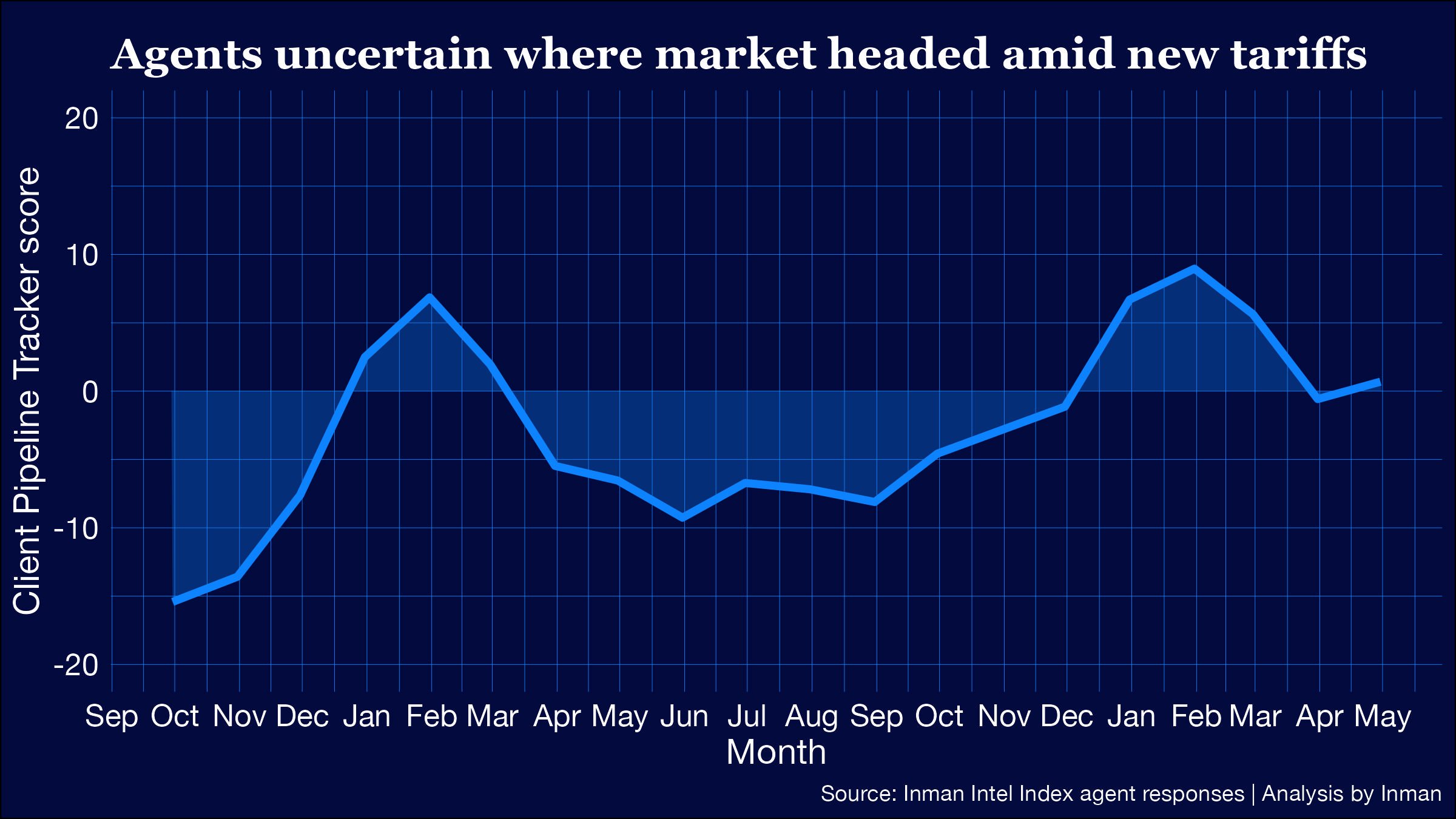
The uncertainty roiling financial markets has yet to infect agents in their assessment of their current client pool or their business prospects for the year ahead, according to the latest update to Intel’s Client Pipeline Tracker metric.

Still, agents who responded in late April to the Intel Index survey affirmed that their buyer client pools were thinner in the spring than they had once hoped. Their expectations for future revenue growth have also moderated over the past three months.

  • The share of agent respondents who said their buyer pipelines are healthier than last year’s has slipped from 55 percent in January to 44 percent in April.

While the overall outlook by agents is less bullish than it was to start the year, agents in late April weren’t anticipating a broad downturn in an already depressed housing transaction environment.

Client Pipeline Tracker score in April: +1

  • Previous score: -1 in March
  • Recent high point: +9 in January

Chart by Daniel Houston

But under the surface, Intel’s surveys reflect that agent expectations may be shifting — just in one direction for their buyer clients, and a different one for sellers.

Intel explores these complex dynamics in more detail in its latest Client Pipeline Tracker report.

A buyer-seller split emerges?

Intel’s Client Pipeline Tracker is a compilation of how agents feel about their buyer and seller pipelines — both over the past year and in the near future.

Intel described the methodology in this post, but here’s a quick refresher on how to interpret the scores.

  • score of 0 represents a neutral period in which client pipelines are neither improving nor worsening.
  • positive score reflects a market in which client pipelines have been improving, or are widely expected to improve in the next 12 months. The higher the rating, the more confident agents are in that conditions are moving in a positive direction.
  • negative score suggests client pipeline conditions are worsening, or are widely expected to get worse in the year to come.

An extremely positive combined score falls somewhere around the +20 mark. This type of score would signify that much of the industry is in agreement with the fact that pipelines are improving and will continue to improve.

An extremely negative combined score, on the other hand, falls closer to -20. That’s a bit lower than where the industry stood in September 2024, the first time Intel surveyed agents about their pipelines.

For each of the four individual components that go into the score, results as high as +50 or as low as -50 are sometimes observed.

Here are the component scores from the most recent survey, and how each sentiment category changed from the previous one.

Tracker component scores

March → April

  1. Present buyer pipelines: -22 → -27
  2. Future buyer pipelines: +5 → +5
  3. Present seller pipelines: -8 → -3
  4. Future seller pipelines: +8 → +13

The big takeaway this month: Recent market swings since the beginning of April appear to be further decoupling agent outlooks for buyers and sellers.

As discussed, buyer pipeline scores trended down from March to late April. But at the same time, some agents appear to be gaining in optimism about their prospects for nabbing new listings.

  • The share of agent respondents who told Intel they had observed “significant” year-over-year improvements in their seller pipelines jumped from 4 percent in late March to 9 percent in late April.
  • Optimism for future listings also grew from month to month. Nearly 43 percent of agent respondents said they thought they would see growth in listing pipelines, up from 37 percent the month before.

The potential explanations for this growing gap between buyer and seller outlooks are complex.

If some agents expect present uncertainty may tilt the economy into recession, that could bring about reductions in mortgage rates and possibly force sales of distressed properties — both of which could free up some new inventory that hits the market.

But recessions have also historically reduced incentives for homeowners to list. Falling sale prices and the expectation of fewer buyers often persuade would-be sellers to remain on the sidelines.

Regardless of the effect on new listings, agents are clearly lowering their expectations that there will be enough buyers to spur a true transaction rebound, at least in the next few months.

The recovery that wasn’t

While the circumstances are different, many agents appear to be experiencing a case of deja vu, Intel survey results suggest.

For the second year in a row, real estate agents opened the year with cautious optimism for the trajectory of their client pools.

And for the second year in a row, they’ve had to tamp down these hopes while their brokerages muddle through another period of uncertainty in the broader economy.

And make no mistake, agents are concerned about the broader economy.

  • In Intel’s survey in late April, 3 in 4 agents and 2 in 3 brokerage leaders said they were “concerned” or “very concerned” about the U.S. economy right now.

Throughout much of 2024, this caution deepened into outright pessimism as agents grappled with the implications of new settlement rules and rate cuts that kept getting pushed out into the future.

So far in 2025, agents expectations appear to just be stuck in neutral. Intel will continue to closely follow changes in brokerage sentiment as the year progresses.

Methodology notes: This month’s Inman Intel Index survey was conducted April 17-May 2, 2025, and had received 426 responses as of Friday morning. These results are preliminary and may be revised. The entire Inman reader community was invited to participate, and a rotating, randomized selection of community members was prompted to participate by email. Users responded to a series of questions related to their self-identified corner of the real estate industry — including real estate agents, brokerage leaders, lenders and proptech entrepreneurs. Results reflect the opinions of the engaged Inman community, which may not always match those of the broader real estate industry. This survey is conducted monthly.

Email Daniel Houston

This post was originally published on this site