A tactical guide to generating predictable listing volume—even when the market won’t cooperate.
By Texas Ally Real Estate Group
Most agents don’t have a listing problem. They have a pipeline problem.
They know they need listings. They know listings are the highest-leverage activity in real estate. But when you ask them what their system is for generating listings consistently—month after month, regardless of motivation or market conditions—most don’t have a clear answer.
That gap between knowing and doing is where production dies. And in 2026, the margin for error is thinner than ever. Inventory is finally rising (up over 10% year-over-year nationally), which means more sellers are entering the market—but so is more competition for their attention. The NAR settlement has rewritten how buyer-agent compensation is communicated, putting listing agents at the center of new conversations about commissions and value. And home prices have moderated, with national appreciation slowing to roughly 1–2%, meaning sellers are more cautious, more informed, and more likely to interview multiple agents before choosing one.
The agents who win in this environment aren’t the loudest or the flashiest. They’re the ones with a repeatable system that runs whether they feel like prospecting today or not.
This article lays out that system—from the mindset shift you need, to the daily activities that fill your pipeline, to the specific lead sources that produce the best return on effort.
First, Understand Who You’re Talking To
The 2026 seller is not the same person who panic-listed during COVID or casually threw their house on the market in 2021 expecting 15 offers by Friday. Today’s sellers are deliberate. Many have been sitting on historically low mortgage rates for years, waiting for conditions to feel “right.” Life events—job changes, divorces, growing families, retirement—are what’s finally pushing them to move, not fear of missing out.
They’re also doing their homework. According to NAR’s Profile of Home Buyers and Sellers, roughly two-thirds of sellers found their agent through a referral or by using an agent they’d worked with before. That means the vast majority of listing decisions are made before a seller ever Googles “top real estate agent near me.” They’re asking friends. They’re remembering who sent them a market update last month. They’re hiring the person who stayed in touch.
This has a direct implication for your strategy: if you’re not already in a seller’s consideration set before they decide to list, you’re starting from behind. The work you do six months before a listing appointment matters more than your presentation at the table.
Think in Stages, Not Transactions
The most common mistake agents make with listings is thinking about them as events—something that either happens or doesn’t. In reality, every listing is the result of a process that moved through stages, whether you were conscious of it or not.
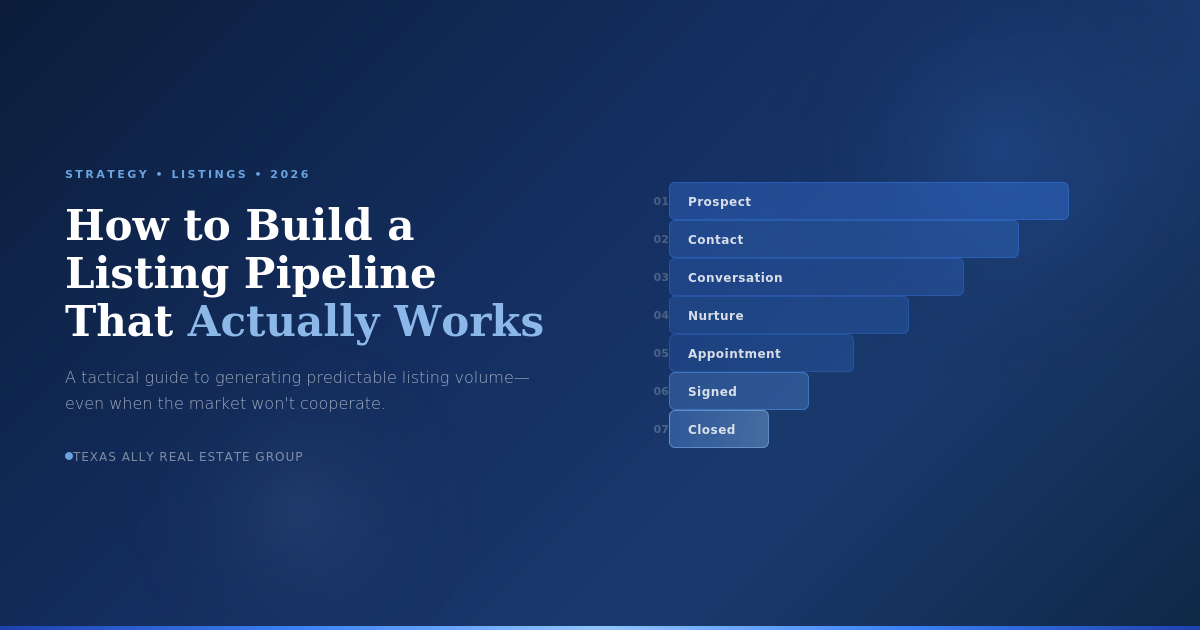
A useful framework looks like this: Prospect → Contact → Conversation → Nurture → Appointment → Listing Signed → Closed. Each stage has a conversion rate, and those rates are where your real leverage lives.
For example, if you need two new listings per month, you might need to set four listing appointments (assuming a 50% close rate at the table). To get four appointments, you might need 20 meaningful conversations. To have 20 conversations, you might need to make 60–80 contact attempts. And to make those attempts, you need a database of 200+ prospects you’re actively working.
This isn’t theory—it’s math. When agents start tracking their pipeline stages, two things happen almost immediately. First, they stop feeling like listings are random. Second, they can diagnose exactly where their system is breaking down. Not enough appointments? You probably aren’t having enough conversations. Enough conversations but no appointments? Your value proposition needs work. The pipeline tells you what to fix.
Your Sphere Is Still Your Best Asset (If You Actually Work It)
There’s a reason every experienced agent preaches sphere of influence, and the data backs it up year after year. NAR research consistently shows that approximately two-thirds of sellers choose their agent through a referral or a past relationship. Agents earning over $100,000 annually report that roughly a third of their business comes from referrals and another third from repeat clients.
Yet most agents treat their sphere like a storage unit—full of stuff they know is valuable but never actually open. The fix isn’t complicated, but it does require discipline.
Start by building a real database. Not a phone full of contacts, but a CRM-managed list of at least 150–300 people you can contact with intention. Categorize them: A-list contacts are people likely to transact or refer in the next 12 months (past clients, close friends, people who’ve mentioned moving). B-list contacts are people who know you’re in real estate but haven’t signaled intent. C-list contacts are acquaintances and wider network connections.
Then implement a contact cadence. For your A-list, this means a monthly phone call or face-to-face, a monthly market update personalized to their neighborhood, a quarterly in-person touchpoint (coffee, a client event, dropping by), and one to two handwritten notes per year. For your B and C contacts, a monthly email with genuine value—not a generic newsletter, but something useful like a local market snapshot or a piece of advice—keeps you top of mind without being intrusive.
The key word is value. Nobody wants another “Just checking in!” text. Send them something that makes their life better, answers a question they didn’t know they had, or demonstrates that you understand their market.
Pick a Farm and Commit
Geographic farming—choosing a specific neighborhood and becoming the go-to agent there—remains one of the most reliable long-term listing strategies. But it only works if you pick the right area and stay consistent for at least 12–18 months.
Select a neighborhood of 300 to 1,500 homes with a healthy turnover rate (ideally 5–8% annual turnover). Look for areas where no single agent dominates more than 20–25% of the listings—there’s room for you. Avoid areas where one agent has locked down 40%+ market share unless you’re prepared for a multi-year campaign.
Your farming activities should layer on top of each other: monthly direct mail (market reports, just-sold cards, neighborhood-specific content), door knocking when you have a new listing or recent sale to share, hosting open houses in the farm area, and providing hyper-local market data that no national website can replicate.
The goal isn’t to be known as “an agent.” It’s to be known as the agent for that neighborhood—the person who knows the comps cold, who can tell you what the house three doors down sold for and why, and who shows up consistently whether they have a listing there right now or not.
Expired Listings and FSBOs: High Effort, High Reward
These two lead sources get a bad reputation because they’re uncomfortable. Calling someone whose listing just failed, or approaching a homeowner who specifically chose not to hire an agent, requires thick skin. But the upside is significant: these are people who have already decided to sell. You’re not creating demand—you’re redirecting it.
Expired listings are sellers who wanted to sell, hired an agent, and it didn’t work. Something went wrong—pricing, marketing, market conditions, or the agent’s effort. Your job isn’t to pitch. It’s to diagnose. Lead with questions: What do you think went wrong? Were you getting showings but no offers, or was traffic the problem? Did your agent recommend any price adjustments? These questions position you as a problem-solver, not another salesperson. Follow a structured cadence: call on day one, follow up on days 3, 7, 14, and 21. If they haven’t re-listed by week four, move them into a long-term nurture sequence. Many expired sellers re-list 60–90 days later after the sting wears off.
FSBOs represent a shrinking but still valuable opportunity. According to NAR’s 2025 Profile, FSBO transactions have dropped to just 5% of all home sales—the lowest share ever recorded. And FSBO homes sell for a median of $360,000 compared to $425,000 for agent-assisted sales. That’s not a coincidence. Pricing, marketing reach, and negotiation expertise matter, and that price gap is your most compelling talking point.
When approaching a FSBO, don’t lead with “You need an agent.” They’ve already decided they don’t. Instead, offer something useful: a complimentary pricing analysis, insight into what comparable homes have sold for, or help understanding how the new buyer-agent compensation rules might affect their sale. Build trust first. The listing often follows within 4–6 weeks.
Your Online Presence Is Your 24/7 Listing Presentation
Here’s something that surprises a lot of agents: NAR data shows that fewer than one in ten buyers and sellers found their agent through a website. The internet didn’t replace referrals—it became the place where referrals get validated. When someone hears your name from a friend, the first thing they do is Google you. What they find determines whether they call.
This means your online presence doesn’t need to be a lead generation machine. It needs to be a credibility machine. A few fundamentals go a long way.
Start with your Google Business Profile. It’s free, it shows up in local searches, and it’s where your reviews live. Ask every satisfied client for a Google review—this is the single highest-ROI marketing activity most agents ignore. Then focus on producing consistent, educational content. You don’t need to go viral. You need to demonstrate expertise. Topics that resonate with potential sellers include pricing strategy in a shifting market, how to prepare a home for sale without overspending, what the current buyer pool looks like in your area, and how the commission landscape has changed post-settlement.
Publish this content wherever your audience already is—your website, social media, email newsletters, even short video. The format matters less than the consistency. One valuable post per week beats a burst of five posts followed by two months of silence.
The Daily Discipline That Makes Everything Else Work
Strategy without execution is just a wish list. The difference between agents who consistently generate listings and those who don’t almost always comes down to daily habits, not annual goals.
A productive daily rhythm for listing-focused agents looks something like this: spend the first 60–90 minutes of your workday on prospecting—adding new contacts, making calls, sending personalized follow-ups. This is your “money time” and it should be protected from meetings, emails, and admin. Log every interaction in your CRM. If it’s not tracked, it didn’t happen.
Weekly, review your pipeline numbers. How many new prospects did you add? How many contact attempts did you make? How many conversations turned into appointments? Identify where the bottleneck is and focus your energy there.
Monthly, send a market update to your entire database, review your conversion rates across the pipeline, and adjust your approach based on what the numbers are telling you. If your contact-to-conversation rate is dropping, you might need better scripts or a different approach. If your appointment-to-listing rate is low, your presentation might need work.
None of this is glamorous. It’s not a hack or a shortcut. It’s the accumulated result of showing up every day and doing the work that most agents know they should do but consistently avoid.
What the 2026 Market Means for Your Strategy
The current market creates both challenges and opportunities for listing-focused agents. NAR economists project a roughly 14% increase in existing home sales this year, driven by job growth, rising inventory, and gradually improving affordability. Mortgage rates have settled closer to 6%, which is enough to bring sidelined buyers back into the market. Early 2026 data already shows strengthening buyer demand and rising new listings, suggesting the spring selling season could be significantly more active than 2025.
For agents, this means more potential sellers will be entering the market—but many will be nervous. They’ve been watching from the sidelines and they want to know their home will actually sell, at a fair price, without sitting on the market for months. Your ability to communicate market conditions clearly and set realistic expectations will be a differentiator.
The post-settlement compensation landscape also creates a new conversation at the listing table. Sellers now need to understand how buyer-agent compensation works outside the MLS, what offering (or not offering) buyer-agent fees means for their home’s visibility, and how to think about commission as a strategic tool rather than a fixed cost. Agents who can navigate this conversation with confidence—rather than awkwardness—will stand out.
The Bottom Line
Generating listings in 2026 isn’t about finding a magic lead source or mastering a new technology. It’s about building a system that puts you in front of potential sellers consistently, delivers value before you ever ask for their business, and runs on discipline rather than inspiration.
Work your sphere with intention. Pick a farm and commit. Don’t ignore the uncomfortable lead sources like expired listings and FSBOs. Make your online presence a credibility asset. And above all, track your pipeline and do the daily work.
The agents who thrive in this market won’t be the ones waiting for listings to fall into their lap. They’ll be the ones who built the pipeline six months ago—and kept filling it every single day.
Sources & Further Reading
• HousingWire: Rising Inventory Brings Balance to the 2026 U.S. Housing Market
• NAR: 2026 Real Estate Outlook — What Leading Economists Are Watching
• J.P. Morgan: U.S. Housing Market Outlook
• NAR: FSBOs Reach All-Time Low, More Sellers Rely on Agents
• NAR: Compensation, Commission and Concessions
• HousingWire: 8 Ways to Expand Your Sphere of Influence in Real Estate
• HousingWire: Early 2026 Housing Market Gains Traction