Why this matters for Texas buyers, sellers, and builders
Texas has spent the last decade building at a pace few states can match, driven by strong job growth, steady inbound migration, and relative affordability compared to many coastal markets. But in 2025 and into 2026, that momentum is running into a new constraint: people. A Texas construction labor shortage—made sharper in some areas by recent ICE raids and worksite enforcement—has collided with higher borrowing costs, cautious lending, and elevated material and insurance expenses. The result is a noticeable construction slowdown that touches everyone: buyers waiting on new homes, renters facing limited options, and sellers trying to price against shifting competition.
For the real estate sector, labor availability is not just a “builder problem.” It shapes inventory, timelines, pricing, and even which neighborhoods see new supply first. Below is a Texas-specific look at how workforce disruptions and broader economic impacts are contributing to real estate development delays and housing supply challenges—plus what consumers and industry professionals can do next.
What’s driving the Texas construction labor shortage right now
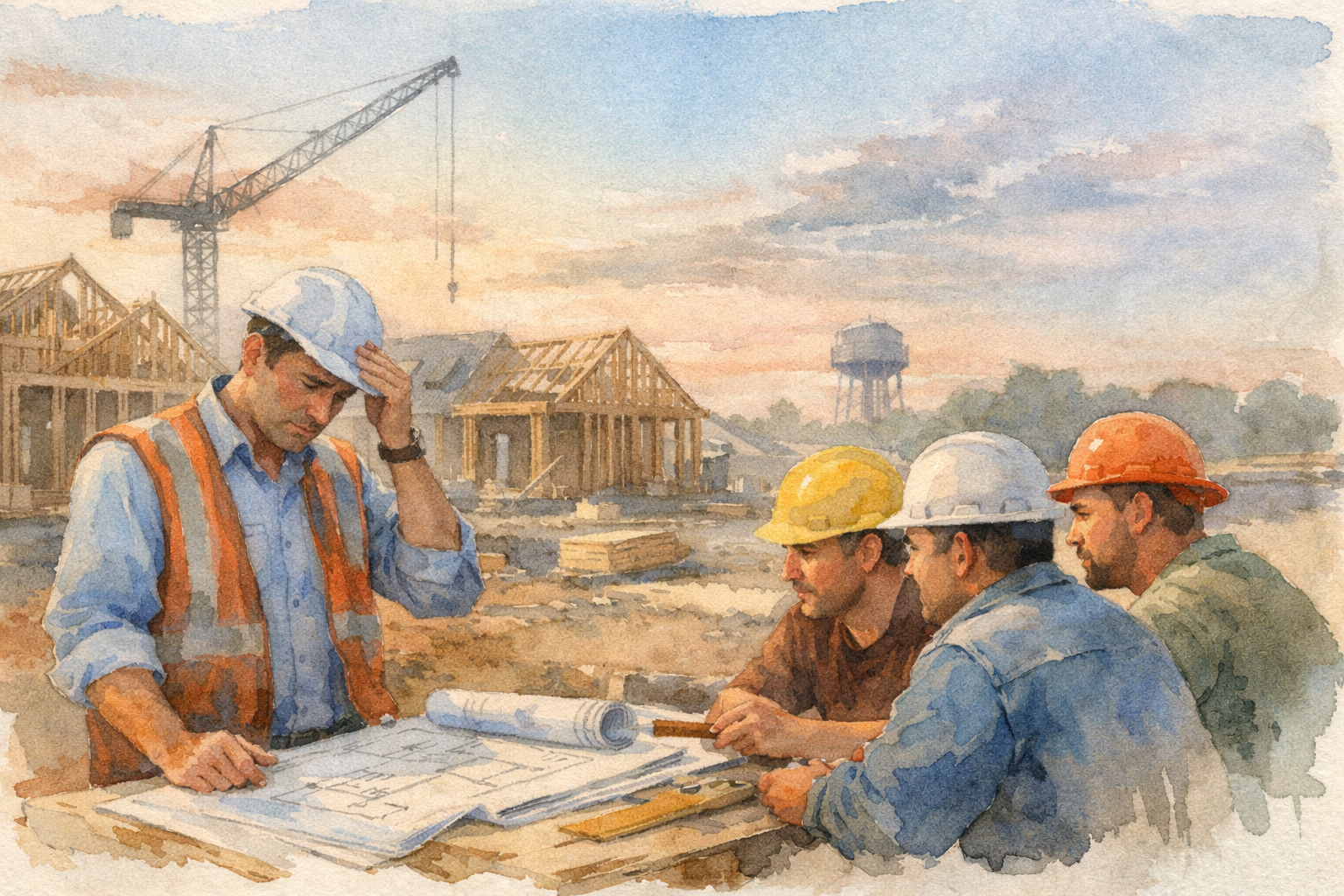
Construction in Texas has long relied on a mix of skilled tradespeople and specialized subcontract crews—framers, drywall teams, roofing crews, concrete finishers, tile setters, and HVAC technicians. When a portion of that workforce becomes unavailable, even temporarily, the bottleneck shows up quickly in scheduling.
1) Enforcement actions and heightened worksite anxiety
Industry leaders describe the current environment as more cautious and more disrupted. In regions where ICE raids or high-profile enforcement actions have occurred, subcontractors report sudden crew shortages, missed start dates, and slower cycle times as firms scramble to re-staff or reassign crews.
“When a crew doesn’t show up, it’s not just a day lost,” said a Houston-area residential general contractor who requested to be identified only as “Miguel R.” due to the sensitivity of the topic. “It pushes inspections, it pushes the next trade, and now you’re rescheduling five different people. On a subdivision, that ripple is huge.”
Another downstream effect is the “silent slowdown”: workers who remain employed may avoid certain job sites, travel less between counties, or move to smaller projects with less visibility. Those behavioral shifts can be hard to quantify, but they often show up in longer completion times.
2) A deeper, longer-running skilled-trades gap
Even without enforcement events, Texas builders have faced a tight labor market for years. The state’s growth has kept demand for trades high, while the pipeline of new skilled workers has not always kept pace. Training programs, apprenticeships, and licensing pathways vary by trade, and smaller subcontractors can struggle to compete on wages and benefits when demand spikes.
“We’ve had open positions for electricians and HVAC techs for months,” said a workforce manager at a Dallas-Fort Worth (DFW) trade contractor. “The problem isn’t a lack of projects. It’s a lack of qualified applicants who can pass checks, show up consistently, and keep pace with the schedule.”
3) Economic pressure: rates, insurance, and cautious financing
Broader economic impacts also matter. While high demand can attract labor, uncertainty can do the opposite—especially for smaller firms. Elevated interest rates can slow project starts or change phasing, leading to inconsistent work pipelines. Meanwhile, rising insurance costs (including general liability and builders risk) and auto costs can squeeze subcontractor margins.
“Subcontractors are making choices based on cash flow,” noted San Antonio-based real estate attorney Lauren DeWitt. “When projects get delayed or change scope, smaller companies can’t always float payroll and materials. That turns into more turnover and more disruption.”
How labor shortages translate into real estate development delays
When people hear “construction slowdown,” they often picture cranes stopping. In practice, most projects keep moving—just with more gaps, more rework, and more schedule reshuffling. That’s where real estate development delays become visible to consumers.
The scheduling domino effect (trade stacking)
Residential construction depends on trade stacking: each crew follows another in a tight sequence. A missed framing window can delay mechanical rough-ins. A delayed rough-in can push insulation. That can push drywall, paint, trim, flooring, and final inspections. Texas municipalities also have varying inspection backlogs, and a shifted schedule can put a project back into a longer queue.
“We can sometimes absorb a one-week delay,” said a project manager for a mid-sized homebuilder in Austin’s suburbs. “But two or three weeks can push closings into the next month, and then buyers’ rate locks or lease endings become the issue.”
Material availability is better, but coordination is harder
Compared with the peak supply-chain disruptions of 2021–2022, many building materials have improved in availability. But coordinating deliveries becomes harder when labor is unpredictable. If drywall shows up but the hang crew is short-staffed, materials may sit longer, increasing the risk of damage, theft, or weather exposure on partially enclosed structures.
Quality-control risk when crews are stretched
One under-discussed consequence of labor tightness is quality variance. When subcontractors are overbooked, they may add less-experienced workers or rush to meet schedules. That can increase punch-list items and warranty claims, and it can raise the stakes for inspections.
“I’m seeing more ‘almost right’ work,” said a Central Texas home inspector, Dana Holloway. “Not necessarily dangerous, but it creates delays because the city fails an item, or the builder has to bring someone back to correct it. Buyers need to understand that a new home still needs a thorough inspection.”
Housing supply challenges: where Texans feel it most
Texas housing supply challenges are not uniform. The effects differ by metro, price point, and product type (single-family, townhome, mid-rise, or apartment). But labor constraints tend to hit the most labor-intensive segments first—especially entry-level single-family construction and fast-turn multifamily renovations.
DFW: volume helps, but timelines can stretch
DFW remains a national leader in new construction, supported by large master-planned communities and a deep network of subcontractors. Even so, builders report that certain trades—concrete, framing, roofing, and mechanical—are increasingly hard to schedule during peak season (late winter through early summer), when projects ramp to meet typical summer move-in demand.
For buyers, this can mean fewer quick-move-in homes in the most affordable price tiers and more competition for completed inventory. For sellers, it can mean less immediate new-build competition in some submarkets, especially on the outer edges where infrastructure and labor availability are more variable.
Houston: rebuilding, weather risks, and subcontractor churn
Houston’s construction market is shaped by weather events, insurance realities, and a large footprint. After major storms, labor demand can pivot quickly toward repairs and remediation, pulling crews away from new builds. If enforcement actions reduce available labor at the same time, the pipeline can tighten further.
“After a storm, everyone needs roofers and drywall,” said a Houston-area brokerage team leader, Keisha Grant. “That’s when you see timelines extend, and buyers of new construction start asking for closing flexibility because the trades are booked out.”
Austin and Central Texas: affordability pressure meets slower delivery
Central Texas has seen rapid growth and a strong apartment pipeline in recent years. As new supply delivers, it can ease rent growth in certain corridors. But if labor shortages slow completions, the easing effect may arrive later than expected. For single-family buyers, delayed construction can be particularly stressful when rate locks, school enrollment timing, and lease expirations are in play.
San Antonio and the I-35 corridor: steady demand, tight entry-level supply
San Antonio often benefits from relatively stable demand and lower price points compared with Austin, but entry-level supply is still sensitive to labor availability. Smaller builders who focus on more affordable product can be hit harder when subcontractor capacity is tight, because they have less leverage to secure crews at premium pricing.
Economic impacts: pricing, rents, and transaction activity
Labor shortages don’t automatically mean prices jump overnight. Texas is a big, diverse market, and home values depend on demand, rates, and local inventory. Still, the economic impacts of slower construction tend to show up in a few predictable ways.
1) New-home premiums can become stickier
When fewer homes are delivered on time, builders may have less need to discount finished inventory. That can keep the new-home premium firmer in neighborhoods with limited resale supply—especially when buyers want warranties, energy efficiency, and modern layouts. However, incentives can still appear when builders are managing financing costs, community absorption targets, or competition across nearby subdivisions.
2) Rent relief may arrive later in some submarkets
Many Texas metros have delivered substantial multifamily supply, which can moderate rent increases. But if construction timelines stretch, the arrival of new units may lag, particularly in areas with heavy reliance on subcontract labor for interior finishes. That can keep pressure on rents for longer, especially for popular unit types near job centers.
3) Fewer listings can amplify seasonal swings
Texas real estate is seasonal. Spring and early summer typically bring more listings and more buyer activity, while late fall and winter slow down. If labor shortages reduce the flow of new construction completions heading into peak season, the market can feel tighter than expected, even if overall demand is moderate.
4) Appraisals and comps can get tricky
When delivery slows, neighborhoods may have fewer recent closed sales, making appraisal support more challenging—especially for unique floorplans or smaller communities. This can be an issue for both new construction and resale transactions. Buyers should be cautious about overpaying based on “future” neighborhood pricing that hasn’t closed yet.
Policy and labor: what’s being debated and what could help
Policy and labor issues are tightly intertwined in construction. Employers need predictable rules, workers need clarity and safety, and communities need housing that can be built on schedule and at attainable price points. In Texas, conversations tend to cluster around a few themes.
Work authorization, verification, and compliance costs
Stricter enforcement can increase compliance costs and reduce available labor, at least in the short term, especially for subcontractor-heavy industries. Larger builders may be able to absorb more verification and administrative burden, while smaller subcontractors may struggle with paperwork, legal guidance, or the risk of abrupt workforce disruption.
“The uncertainty is what’s hardest for scheduling,” said a procurement director for a regional builder active in multiple Texas metros. “We can plan around higher wages. It’s harder to plan around crews disappearing mid-project.”
Training, apprenticeships, and fast-track credentialing
Longer term, expanding Texas-based training pipelines can reduce dependence on an unstable labor supply. Apprenticeships, community college partnerships, and trade-school programs can help, especially when aligned with employer needs for electrical, plumbing, HVAC, welding, and heavy equipment operations.
“A lot of young people don’t realize these careers can be stable and well-paid,” said Monica Reyes, a construction workforce coordinator in the Rio Grande Valley. “But we have to make entry accessible—paid training, clear pathways, and support to get licensed.”
Housing affordability as an infrastructure issue
Many local leaders increasingly frame housing supply as economic infrastructure. If construction slows, employers may find it harder to recruit, commute patterns can worsen, and rent burdens can rise. That’s why housing is often discussed alongside transportation, utilities, and public safety planning in fast-growing Texas counties.
What this means for Texas homebuyers (step-by-step)
If you’re shopping for a home—especially a new build or a home that’s being renovated—timelines and contingency planning matter more in a labor-constrained environment.
Step 1: Get pre-approved and understand your rate-lock options
A pre-approval is more than a quick online estimate. It’s a lender-reviewed file that clarifies your budget, strengthens your offer, and helps you move quickly if a property becomes available. Ask your lender about:
- Rate-lock periods (30, 45, 60 days) and extension costs
- Float-down options if rates improve
- How new construction financing differs from resale timelines
Step 2: If buying new construction, ask for a schedule that includes milestones
Instead of only asking, “When is closing?”, request key milestones: foundation, framing, rough-ins, insulation, drywall, cabinets, final inspections. Labor shortages tend to cause delays at specific stages, and milestones help you track progress realistically.
- Green flag: The builder provides a written timeline range and explains what could change.
- Red flag: The builder promises an exact date early on and dismisses questions about inspections or subcontractor availability.
Step 3: Build time buffers into your moving plan
In Texas, many buyers try to time moves around school calendars and summer work cycles. If you’re buying new construction, consider short-term housing options or flexible lease terms. A two- to four-week buffer can reduce stress if closings slip.
Step 4: Don’t skip inspections—especially on new homes
Even brand-new homes can have issues, particularly when crews are stretched. Consider a phased inspection approach:
- Pre-drywall inspection: Checks framing, wiring, plumbing, and HVAC rough-ins before walls close up.
- Final inspection: Identifies functional issues, missing items, drainage concerns, and safety items.
- 11-month warranty inspection: Helps catch items before the builder warranty period ends.
Step 5: Negotiate with facts, not frustration
When real estate development delays happen, focus on solutions. Depending on your contract and builder flexibility, you may be able to negotiate:
- Closing date flexibility or per-diem credits (where permitted)
- Rate-lock extension assistance
- Upgrades or appliance packages in lieu of price reductions
What this means for Texas sellers (and how to position your home)
Sellers often assume that construction slowdowns automatically boost resale demand. Sometimes they do—particularly when buyers can’t wait for a new home to finish. But buyers are also payment-sensitive, and they compare your home to both resale listings and builder incentives.
Step 1: Price with an eye on “monthly payment reality”
Work with your agent to review active competition, recent closed sales, and current builder incentives nearby. In some Texas submarkets, builders may offer interest rate buydowns or closing-cost help that changes the affordability comparison. Your list price should reflect what buyers can reasonably finance today.
Step 2: Highlight move-in readiness and documentation
In a market where timelines are uncertain, certainty sells. Consider providing:
- A pre-listing inspection (or at least receipts for major repairs)
- HVAC service records and roof age details
- Survey (common in Texas) and a clear disclosure package
Green flag for buyers: A well-maintained home with clear records can feel like a safer bet than a delayed build.
Step 3: Be ready for repair negotiations and lender requirements
If a buyer is using FHA, VA, or certain conventional programs, property condition can matter more. Address obvious issues upfront: peeling paint, missing handrails, active leaks, or electrical concerns. These can trigger appraisal conditions and slow closing—exactly what buyers want to avoid.
How builders and developers are adapting in Texas
Builders aren’t standing still. Many are changing how they staff projects, manage schedules, and select product types to reduce labor exposure.
More prefabrication and simplified product lines
Some builders are leaning into panelized framing, truss systems, and simplified elevations to reduce on-site labor hours. Others are standardizing finishes to minimize specialized install work and avoid delays from custom selections.
Pay increases and retention strategies
Higher wages can attract and retain workers, but they also raise construction costs. Builders must decide whether those costs are absorbed, offset by design changes, or passed into pricing. In affordability-focused communities, there’s limited room to pass costs along without reducing demand.
Longer scheduling windows and phased releases
Instead of releasing large batches of homes at once, some developers are phasing releases to match labor capacity. That can help keep quality consistent, but it can also limit how quickly inventory reaches the market.
Outlook: scenarios for 2026 inventory and timelines
Forecasting in real estate is best framed as scenarios, not guarantees. Based on current conditions, three plausible paths could shape Texas construction and housing supply over the next year:
- Stabilization scenario: Labor participation improves through higher wages and better scheduling, while enforcement activity becomes more predictable. Timelines remain longer than pre-2020 norms but stop worsening.
- Persistent disruption scenario: Continued labor volatility and subcontractor churn keep real estate development delays elevated, especially for entry-level homes and finish-heavy projects. Inventory improves slowly, and affordability gains are uneven.
- Demand-cools scenario: If consumer demand softens due to rates or job-market uncertainty, builders may slow starts, reducing labor demand. That could ease scheduling pressure but would also limit new housing supply, keeping the market balanced rather than oversupplied.
Across all scenarios, the common thread is that labor remains a key input to Texas housing outcomes—right alongside land, financing, and infrastructure.
Practical takeaways for Texans navigating today’s market
- Expect longer timelines for new construction and some renovations, particularly during spring and early summer.
- Plan your financing around uncertainty: rate locks, buffers, and contract timelines matter more when schedules slip.
- Use inspections strategically to protect yourself in a market where crews may be stretched thin.
- Sellers can compete on certainty by offering strong documentation, condition, and realistic pricing.
- Watch policy and labor developments because enforcement patterns and workforce programs can influence supply faster than many buyers realize.
Texas real estate has weathered boom-and-bust cycles before, and the state’s long-term demand drivers remain strong in many regions. But in the near term, a Texas construction labor shortage—and the policy and labor dynamics behind it—are reshaping how quickly homes get built and how easily Texans can find their next place to live.