by Taylor Anderson | May 8, 2025 | Industry, News Feed
The cloud-based brokerage lifted agent count 11 percent between the end of December and March, according to quarterly earnings data released Thursday. Real now boasts over 27,000 agents.
Bigger. Better. Bolder. Inman Connect is heading to San Diego. Join thousands of real estate pros, connect with the Inman Community and gain insights from hundreds of leading minds shaping the industry. If you’re ready to grow your business and invest in yourself, this is where you need to be. Go BIG in San Diego.
The Real Brokerage lifted its agent count in the first quarter of 2025 and slashed net losses amid a decline in closed sides, according to an earnings call Thursday that positioned artificial intelligence as the answer to a sluggish market.
In the first quarter, The Real Brokerage continued its efforts to leverage technology, commission splits and other tools to attract more agents to the cloud-based brokerage. Real’s agent count jumped 11 percent between the end of December and the end of March, and the firm now boasts over 27,000 agents, according to the earnings data.
“The housing market has kicked off 2025 on a slow note, with existing-home sale units down about 2 percent year-over-year during the first quarter,” Real President Sharran Srivatsaa said while unveiling the results on Thursday. He attributed the slowdown to “ongoing affordability pressures that have weighed on the market.”
A voice that sounded similar to Real CEO Tamir Poleg announced during the call that over 800 agents had already joined the brokerage since the end of the first quarter. To highlight the power of Leo, The Real Brokerage’s artificial intelligence service, Poleg unveiled that his statements were actually made by Leo.
“My prepared remarks today, including this section, were read entirely by LeoAI,” the AI service said. “That’s not a gimmick. It’s a reflection of how far we’ve come, and a hint at where we’re going.”
The “real” Poleg later added, “At this time, Leo is able to have real-time voice conversations, and we are planning to test these capabilities with our agents in the coming weeks.”
The company’s sides fell for the third straight quarter, with Real agents closing 33,617 sides in the quarter. Agents closed 35,832 sides in the third quarter of 2024 and 35,370 in the fourth quarter.
Nonetheless, closed sides clocked in 76 percent higher in the quarter than the same time a year ago.
The brokerage posted a $5.1 million net loss in the quarter as it continued to scale debt-free. That was down from $16 million in the same quarter a year earlier.
Total revenue grew to $353.9 million in the quarter, up from $200.7 million a year earlier. Its median home sale price remained flat at $380,000.
Srivatsaa used the call with investors to differentiate Real from other brokerages that are leading conversations around private listings and other key policy issues facing the real estate industry.
Real has so far not created its own private listings network, as Compass, Douglas Elliman, The Corcoran Group and others have done. But it could.
“As a top 10 brokerage, we have the scale to launch a massive exclusive listing network if we believed it was in the best interest of agents and their clients,” he said.
In the meantime, Srivatsaa said, Real would continue to focus on training its agents and offering them tools and tech to succeed through a sluggish market.
“While the industry debates, we stay focused,” he said. “It’s important to understand that at Real, we don’t chase headlines.”
Email Taylor Anderson
This post was originally published on this site
by Richelle Hammiel | May 8, 2025 | Industry, News Feed
To bring the vision of The Investor Scoop to life, Ross has assembled a growing team of industry pros, longtime colleagues and fresh thinkers. This lineup will deliver a wide range of content, from tax tips and tech tools to credit strategies to legal know-how.
Bigger. Better. Bolder. Inman Connect is heading to San Diego. Join thousands of real estate pros, connect with the Inman Community and gain insights from hundreds of leading minds shaping the industry. If you’re ready to grow your business and invest in yourself, this is where you need to be. Go BIG in San Diego!
Real estate investing is finally getting a glow-up — and not the kind that requires granite countertops.
Industry veteran and CEO Bernice L. Ross will launch Profit.RealEstate, a new educational platform, aimed at demystifying investing for the everyday buyer, on Thursday, May 8. Alongside it comes “The Investor Scoop,” its daily newsletter packed with bite-sized insights that make smart investing feel more like a power move and less like a chore, with a laugh or two along the way, Ross informed Inman.
With over four decades in the industry, seven books and over 1,600 articles under her belt — many of them published with Inman — Ross is on a mission to help others build wealth through strategic, real-world investing.
“Real estate is No. 1. We want to have more people become aware of down payment assistance and know that they can get into a house now,” Ross said in an interview with Inman. “The second thing is, I want to show them a path to becoming a real estate investor.”
“The Investor Scoop” is built for people just starting out, whether it’s first-time buyers exploring down payment assistance, house hackers or agents working with one- to four-unit properties, this resource meets them where they are.
This focus on the one- to four-unit market isn’t accidental; it’s strategic. Ross emphasizes that this niche is one of the most accessible and underutilized markets in the real estate industry.
“Instead of looking at a single-family [unit], look at a duplex, triplex or fourplex, where you can rent out part of it, or look at getting something that has an extra bedroom that you might be able to rent out to help with your payments,” Ross said. “Look at becoming a real estate investor on your first purchase.”
Profit.RealEstate isn’t simply about education; it’s about momentum, Ross said. She views the platform as a launchpad for new investors ready to scale their portfolios and creativity, whether that means flipping, fractional ownership or simply finding new ways to stretch their finances.
“We want to take a look at house hacking and flipping, and it depends on all these mom and pops out there,” she said. “That’s really who we want to reach. We want to show them ways to manage their money and how they can become their own banker.”
To bring the vision of “The Investor Scoop” to life, Ross has assembled a growing team of 25-plus contributors — a mix of industry pros, longtime colleagues and fresh thinkers.
“We’re bringing together this incredible bunch of people who are writing great content,” Ross said. “I’ve got some of my longtime friends, and they’re going to be contributing. We’ve got some real powerhouses, and I’ve got a few more very big ones coming on.”
Together, this lineup will deliver a wide range of content — from tax tips to tech tools, credit strategies to legal know-how — written in plain English and short enough to fit into a reader’s coffee break.
“It’s usually pretty clear, because these people are explaining what they do. A lot of times, they’ll tell stories of what they have experienced,” Ross explained. “Everybody that I’m working with is accustomed to working with people at all levels, from the beginner all the way to the more sophisticated. And I don’t care how sophisticated you are, there’s always more that you can learn.”
Beyond serving individual investors, Ross is especially passionate about helping real estate professionals create long-term financial security.
“I want more Realtors to be able to retire with something to have,” she said. “We want to show them the path.”
For over two decades, Ross has been a regular contributor to Inman, breaking down everything from home strategies and branding techniques to negotiation tactics agents can use daily. Most recently, Ross shared insights in articles on joining a team and marketing listings to other agents, and there’s plenty more advice in the pipeline.
Email Richelle Hammiel
This post was originally published on this site
by Christy Murdock | May 8, 2025 | Industry, News Feed
Find out how Massachusetts real estate team leader Michelle Fermin got her start and where she’s planning to take her team next.
Bigger. Better. Bolder. Inman Connect is heading to San Diego. Join thousands of real estate pros, connect with the Inman Community, and gain insights from hundreds of leading minds shaping the industry. If you’re ready to grow your business and invest in yourself, this is where you need to be. Go BIG in San Diego!
Sharing is central to the culture that Michelle Fermin is building at The Fermin Group. “We’re trying to build something that is a benefit to everyone,” she said. “We are all about sharing our wins. Sharing with others how we got there.”
By sharing both her success and the mistakes made along the way, she’s educating the real estate community and her clients. “It’s important to us not only to be able to service our clients but also educate them so we can help them build lasting financial wealth,” Fermin said.
As she works to build a national team, launching in Q2 of 2025, she’s also seeking to bring more value to her team in New England. Find out how this team leader got her start and where she’s going next.
Name: Michelle Fermin
Title: Team lead
Experience: 27 years in Real Estate
Location: Lawrence, Massachusetts
Team name: The Fermin Group, Century 21 North East
Rankings: No. 3 Century 21 team in the world, No. 1 Century 21 team in the country
Team size: 41 agents
Awards:
- Dick Loughlin International Hall of Fame Honoree 2025
- NAHREP Top 10 Latino team in the United States 2024
- Best Team in the Boston Agents’ Choice Awards 2021 and 2023
How did you get your start in real estate?
My mom, who was an immigrant with limited resources and English, wanted to buy a house. When we went down to local real estate companies, they shunned her because we didn’t have the funds to purchase a home at the price point that they were offering. They saw her as a challenging buyer.
I got my real estate license to help her. When she closed, her close friend wanted me to help her. I helped them and their friends, and that’s how my first year went. I ended up becoming Rookie of the Year by helping immigrants and challenging buyers who no one wanted to help.
What do you wish more people knew about working in real estate?
It is a long and very challenging beginning. They should expect the first year to be the most challenging. It should be about education and learning, and it’s not where it’s made out to be where you’re driving around in $100,000 cars. In reality, you’ll probably be living in poverty your first few years while you start to build a name, a book of business and your confidence.
For those who do make it, they can expect a long career, but 9 out of 10 do not make it past the five-year mark.
What makes a good leader?
A good leader is someone who is willing to consistently be a good student. Someone who is open to hearing from their peers where they need improvement and help focusing on getting 1% better every day.
Someone who is innovative and is open to change. Understands that to stay relevant and effective, we consistently need to change based on the needs of our clients.
Someone who is empathetic and sensitive. It’s not just about being No. 1 but about the journey.
What’s your top tip for newly formed teams?
Look for structure. Make sure you have a really good coach who is focused on building teams. Make sure that you understand who your avatar is and what your journey is. Make sure that you hire only people who are in line with the culture you are trying to build.
Be wary of overpaying. Don’t hire anyone and pay them anything, thinking that something is better than nothing. Make sure you understand what your expenses are.
Tell us about a high point in your career
A high point in my career was winning the No. 1 Century 21 Team in the World. But I think that winning the Dick Loughlin award was even more heartfelt. It hit me deeper because I knew it wasn’t just about sales; it was about impacting other people’s lives and giving back. That was a huge honor for me.
Email Christy Murdock
This post was originally published on this site
by Darryl Davis | May 8, 2025 | Industry, News Feed
A recession doesn’t have to wreck your business bottom line, coach Darryl Davis writes, but ignoring the warning signs can set you up for financial disaster.
Bigger. Better. Bolder. Inman Connect is heading to San Diego. Join thousands of real estate pros, connect with the Inman Community, and gain insights from hundreds of leading minds shaping the industry. If you’re ready to grow your business and invest in yourself, this is where you need to be. Go BIG in San Diego!
Let’s get one thing straight: A recession doesn’t have to wreck your real estate business. But ignoring the warning signs? That’ll do it every time.
Agents who thrive during economic shifts don’t wait for calm — they build clarity, confidence and consistency into their daily business before the storm hits.
Here’s how to do just that — seven ways to prepare, perform and prosper when the market tightens.
1. Lead with service, not sales
In uncertain times, clients want a guide — not a pitch. Check in. Ask questions. Be a resource. That “How’s the family?” call today becomes tomorrow’s listing lead. Focus on delivering value without expecting an immediate return.
Teachable moment: People remember how you made them feel — especially when things feel shaky. The agent who listens wins.
2. Get clear on your value (and how to explain it)
Your “professional fee” isn’t just a number — it’s a reflection of your value. Can you explain, without flinching, exactly what you bring to the table?
Teachable moment: Confidence is contagious. The more clearly you can explain your worth, the less you’ll need to defend it.
3. Streamline like a CEO
Now’s the time to cut the fluff and double down on what works. Audit your budget, trim subscriptions and upgrade your CRM. Spend less time reacting and more time executing.
Teachable moment: An innovative business doesn’t spend more during slow seasons — it spends smarter.
4. Stop chasing everyone. Start farming like a pro
Recession markets demand deeper, not wider. Instead of chasing the whole ZIP code, target your warmest leads — your past clients, sphere and farm.
Teachable moment: A strong database beats a cold call list any day, especially when wallets tighten and trust matters most.
5. Stay loud when others go quiet
Most agents pull back when the market slows. Don’t. Stay visible. Post-market updates. Host workshops. Send newsletters. Keep showing up.
Teachable moment: When you disappear, so does your credibility. Visibility builds trust — even when clients aren’t ready to buy or sell yet.
6. Become the local economist of choice
National headlines won’t help your clients decide. Local data will. Know your town like the back of your hand—inventory, days on market, trends — and share it often.
Teachable moment: In a market full of noise, the agent with clarity becomes the voice of reason.
7. Sharpen your skills — before you’re desperate for them
Waiting until things get really tough to learn objection handling or lead gen? Rookie move. Hone those muscles now — scripts, time blocking, marketing, negotiation.
Teachable moment: You don’t rise to the occasion — you fall to the level of your training. Raise your level. Then, keep raising it.
You don’t need to brace for impact — you need to build for it. The agents who start now will not only weather what’s coming, they’ll grow from it.
Darryl Davis is the CEO of Darryl Davis Seminars. Connect with him on Facebook or YouTube.
This post was originally published on this site
by Melanie Klein | May 8, 2025 | Industry, News Feed
Bigger. Better. Bolder. Inman Connect is heading to San Diego. Join thousands of real estate pros, connect with the Inman Community, and gain insights from hundreds of leading minds shaping the industry. If you’re ready to grow your business and invest in yourself, this is where you need to be. Go BIG in San Diego!
This series highlights inspiring stories of women who have created successful and sustainable careers in real estate and/or invested in real estate to achieve financial independence, gain lifestyle flexibility, and create lives built on their own terms.
Throughout history, societal norms and legal restrictions have limited women’s access to wealth-building opportunities. It wasn’t until the late 19th and early 20th centuries that women in the U.S. gained the right to own property independently.
The Fair Housing Act of 1968 further advanced women’s rights in real estate, ensuring they could buy, sell, and invest in property without discrimination. Today, real estate stands as a powerful vehicle for women to gain financial independence, build generational wealth, and carve out a life of choice and stability.
Danielle Lurie is a testament to the transformative power of real estate. She began her career as a filmmaker, passionate about human rights and storytelling. Fresh out of Stanford University, she dedicated herself to the arts, believing financial stability was a sacrifice for creative freedom.
After achieving early success — her short film was accepted into Sundance and led to a whirlwind of Hollywood meetings — Lurie soon faced the harsh realities of the entertainment industry’s instability. Just as she secured a major film deal, it fell through when a studio executive was let go, leaving her financially stranded and disillusioned.
Needing a fresh start, Lurie moved to New York City, where her mother, Tamar Lurie, was a top real estate agent on the East Coast, specializing in Greenwich, Connecticut. Despite initial embarrassment about pivoting into real estate, she approached it with an open mind, aiming to make just enough to support her filmmaking dreams.
Lurie calculated that selling three $1 million apartments would bring in around $45,000 — similar to what she had been making in Hollywood through odd jobs. However, her first year far exceeded her expectations. She ended up selling $12 million in property, earning approximately $166,000 — more than three times her initial goal — and receiving Corcoran’s Rookie of the Year award.
To put this in perspective, the median annual salary for women in the United States is approximately $52,260, according to the U.S. Bureau of Labor Statistics (BLS, 2023). This means Lurie’s first-year earnings in real estate were more than three times what the average woman earns. This financial leap underscores the potential for real estate to offer women not only a stable income but also a pathway to significant wealth-building (bls.gov).
With no preconceived expectations and an eagerness to learn, she built a strong business by focusing on relationships and strategy. She later founded The Jane Advisory, an all-female real estate team at Compass, with a mission to support women in business.
The Jane Advisory has fluctuated between four and seven members and consistently earns a spot in the top 1.5 percent of all agents nationwide. Through this team, Lurie has been able to share financial opportunities with other women, fostering an environment where they can thrive professionally and achieve their own wealth-building goals.
Additionally, she launched the Women in Real Estate Collective (WIREC), a network for female agents across NYC to collaborate, share insights and uplift one another.
Challenges and triumphs as a woman in real estate
While real estate is often seen as an accessible industry for women, it comes with its unique challenges. One of the most significant hurdles is navigating the emotional and financial stress that comes with guiding clients through major life transitions.
As Lurie explains, real estate sits at the intersection of people’s finances, emotions and relationships, often requiring agents to be both advisors and mediators. Learning to set boundaries, maintain emotional resilience and build a steady client base are crucial skills for long-term success.
Another challenge is financial unpredictability. Unlike traditional salaried jobs, real estate income is commission-based, meaning earnings can fluctuate dramatically. Lurie’s approach has been to embrace the slower periods as opportunities to invest in marketing, personal growth and business strategy — an approach she instills in her team.
Building wealth and expanding opportunities
Real estate has transformed Lurie’s financial reality, taking her from a struggling artist to a successful entrepreneur. Beyond the income from sales, she has learned to invest in her own financial future, diversifying her wealth through investments in the stock market and reinvesting in her business.
Perhaps most significantly, real estate has given her the ability to return to filmmaking — on her own terms. She is currently working on a documentary about motherhood in the U.S., fully funded by her real estate earnings.
Advice for women considering real estate
For women looking to enter the industry, Lurie emphasizes the importance of diligence, creativity, and resilience. While real estate offers incredible financial potential, it demands commitment and hard work. She advises newcomers to embrace the learning curve, build strong relationships and seek mentorship.
More practically speaking, Lurie advises, “Put yourself out there. See everything you can that’s on the market, even if you don’t yet have clients. Go to all the high-end open houses. Believe you belong there. You will be surprised by the ways what you have just seen will come up in conversation soon after with a potential client.”
She also challenges the misconception that real estate is all about homes — it’s about people. Successful agents must understand human behavior, communication and strategy to navigate complex transactions effectively.
The future of women in real estate
Real estate continues to be a powerful avenue for women’s financial empowerment. With relatively low barriers to entry but high standards for success, the industry rewards those who show up with dedication and vision. Lurie sees immense potential for women to support one another, collaborate instead of compete, and create new opportunities for collective success.
Through initiatives like WIREC, she hopes to see more women leveraging real estate not just as a career, but as a wealth-building tool that provides long-term security, flexibility and the freedom to pursue their passions.
As her journey illustrates, real estate is not just about buying and selling properties — it’s about transforming lives, opening doors and redefining what financial independence looks like for women everywhere.
Melanie C. Klein, M.A., is an empowerment and mindset coach.
This post was originally published on this site
by Matt Carter | May 7, 2025 | Industry, News Feed
Purchase loan demand was up 11 percent last week, with “surprisingly strong” demand from conventional loan borrowers given lingering economic uncertainty, MBA economist Mike Fratantoni says.
Bigger. Better. Bolder. Inman Connect is heading to San Diego. Join thousands of real estate pros, connect with the Inman Community, and gain insights from hundreds of leading minds shaping the industry. If you’re ready to grow your business and invest in yourself, this is where you need to be. Go BIG in San Diego!
Homebuyers moved to take advantage of a dip in mortgage rates last week, despite economic uncertainty that has rates rebounding this week, according to a weekly survey of lenders by the Mortgage Bankers Association.
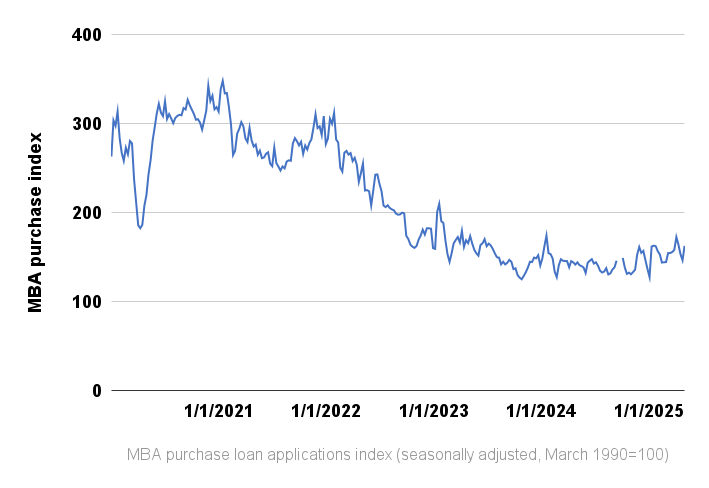
Applications for purchase loans were up a seasonally adjusted 11 percent last week when compared to the week before and 13 percent from a year ago, the MBA’s Weekly Mortgage Applications Survey found. Requests to refinance also climbed 11 percent week over week, to a level 51 percent higher than a year ago.

Mike Fratantoni
“The economic news last week included a negative reading for first-quarter GDP growth and further signs of contraction in the manufacturing sector, mixed with a solid employment report for April,” MBA Chief Economist Mike Fratantoni said in a statement. “The net impact on mortgage rates was mostly downward but just back to levels from early April.”
Mortgage rates range-bound
Mortgage rates have been range-bound this year, with 30-year fixed-rate mortgages oscillating between 6.5 percent and 7 percent, according to rate lock data tracked by Optimal Blue.
At 6.82 percent on Tuesday, rates on 30-year fixed-rate conforming mortgages were closer to a 2025 high of 7.05 percent registered on Jan. 14 than the low for the year of 6.48 percent, seen on April 4.
Mortgage rates climbed sharply during the first week in April as tariffs announced by the Trump administration renewed worries about inflation. Those worries have been tempered by hopes that the U.S. will negotiate trade agreements with countries subject to tariffs, and fears that tariffs will lead to a recession.
Federal Reserve policymakers left short-term interest rates unchanged after wrapping up a two-day meeting Wednesday, and a June rate cut is now seen as off the table as the Fed assesses the Trump administration’s “substantial policy changes” in areas including tariffs, immigration, taxation and regulations.
Purchase loan applications on the rise
At 162.8, the MBA’s seasonally-adjusted purchase loan index was up from 146.6 the week before and 144.2 a year ago, but down 6 percent from a month ago. The index was benchmarked at 100 in March 1990.
Fratantoni said a 13 percent surge in demand last week for conventional purchase loans eligible for backing by Fannie Mae and Freddie Mac was “a surprisingly strong move given lingering economic uncertainty.”
Conventional loan borrowers “tend to have larger loan sizes and [are] more apt to be move-up buyers,” Fratantoni noted. The average loan size for conventional purchase loans was $475,000, compared to $357,500 for government-backed FHA and VA loans.
First-time homebuyers accounted for a record 56 percent share of purchase mortgages securitized by Fannie Mae, Freddie Mac and Ginnie Mae during the first three months of the year, according to an analysis by Intercontinental Exchange Inc. (ICE).
ICE’s latest Mortgage Monitor Report showed first-time homebuyers accounted for 80 percent of FHA purchase originations and about half of purchase mortgages backed by Fannie and Freddie.
“While first-time homebuyers continue to face affordability headwinds, they don’t have the same disincentive to transact as many repeat buyers, who remain locked in the golden handcuffs of relatively low monthly payments on their existing homes,” ICE analyst Andy Walden said in a statement.

Andy Walden
“Younger homebuyers are picking up market share with lenders this spring, with people age 35 and under accounting for more than half of financed home purchases by first-time buyers in Q1.”
Get Inman’s Mortgage Brief Newsletter delivered right to your inbox. A weekly roundup of all the biggest news in the world of mortgages and closings delivered every Wednesday. Click here to subscribe.
Email Matt Carter
This post was originally published on this site