Stop trying to DIY your compliance or ignore difficult clients. According to coach Darryl Davis, keeping careful records, researching thoroughly and communicating regularly are your best bets for staying on the right side of the law.
Since the NAR commission suit settlement, buyer agents have faced new rules, new documents and a new normal. This month, Inman drills down on Today’s Buyers Agent with the fresh marketing strategies, skills and tools buyer agents are using to prosper in changing times.
Let’s get something straight: In real estate, the legal landmines are everywhere. Even if you’ve dotted every “i” and crossed every “t,” you can still end up in a courtroom. That’s not fear-mongering — that’s the nature of the job.
But here’s the good news: You can dramatically reduce your risk by being intentional, informed and yes, maybe just a little bit paranoid (the healthy kind without the tinfoil hats).
5 ways to stay out of trouble
These five strategies aren’t just best practices — they’re essential armor for staying protected in today’s high-risk, post-settlement industry.
1. Document everything like your career depends on it, because it might
If it’s not in writing, it didn’t happen. Period.
Every phone call, showing or negotiation that even might matter later? Back it up with an email.
“Hi [Client Name], just confirming our conversation this morning where you said you wanted to hold off on submitting that offer.”
Boom. Timestamp. Proof. Protection.
I’ve told agents for years: Assume you’re going to get sued. Not because you’re doing anything wrong, but because that’s the nature of the beast. A solid paper trail isn’t just smart; it’s survival.
2. Stop confusing MLS rules with license law
One of the biggest mistakes agents make is assuming that MLS rules or association policies carry the same legal weight as your state’s license law. They don’t.
If someone claims something is “illegal,” don’t panic; ask for the source. “Show me the law” should be your default response. MLS policy violations and legal violations are two different animals. Don’t take the bait. Don’t get burned.
3. Your association is not a law firm, so stop treating it like one
Associations serve a purpose, but that purpose is not legal counsel. Their forms and opinions are designed to cover their own liability, not necessarily yours.
If you have a legal question, your first call should be your broker. Your second? The state’s licensing department or hotline (yes, you should have that number saved in your phone). It’s amazing how many lawsuits could be prevented if agents stopped asking the wrong people for legal advice.
After all, would you get parenting advice from someone who’s never had children? Probably not. Why, then, would you get legal advice from people who aren’t attorneys?
4. Stay educated because what you don’t know will hurt you
Real estate is an ever-changing industry. What was legal or standard a year ago could be a lawsuit today. If your education ends when you check off your CE credits, you’re falling behind. Every agent should block time off in their week just for training, reading and getting up to speed. Make this time a non-negotiable, because your career may depend on it.
Subscribe to trusted sources (like Inman News). Attend quality trainings. Join mastermind groups. And yes, read the fine print on your board’s updates. The agents who stay informed are the ones who stay in business — and out of court.
5. Over-communicate like a pro (Even when there’s nothing new to say)
If there’s one thing that drags agents into drama, it’s silence. When clients or cooperating agents don’t hear from you, they fill in the blanks — and usually not with anything flattering. In fact, the longer the silence continues, the worse the assumptions become. That’s not how to create a positive experience for your clients.
Here’s the rule: No update is still an update. Tell your clients, “Hey, still waiting to hear back; just wanted to keep you in the loop.” It builds trust. It calms nerves. And it gives you written proof you kept everyone informed.
If you want to stay out of court, you have to stop playing defense and start playing offense. That means being disciplined, detail-oriented and willing to slow down long enough to protect your future.
Do the boring stuff. Send the recap email. Make the extra call. Read the update from your state’s real estate commission. Because in this business, the agents who survive are the ones who prepare like it’s already hit the fan.
And when in doubt? Don’t guess. Ask your broker or attorney. That five-minute call could save you five years of regret.
Bigger. Better. Bolder. Inman Connect is heading to San Diego. Join thousands of real estate pros, connect with the Inman Community and gain insights from hundreds of leading minds shaping the industry. If you’re ready to grow your business and invest in yourself, this is where you need to be. Go BIG in San Diego!
“You get what you pay for.”
It’s a common refrain when real estate agents and brokers who charge a typical commission refer to their counterparts who charge less — the implication being that a lower fee results in lower quality service.
But low-fee brokers with experienced, full-service agents exist and can offer consumers great value, according to a report from the Consumer Policy Center, a think tank founded earlier this year by Stephen Brobeck and other senior fellows.
The report, “Reducing Real Estate Commissions: Are Low-Fee Brokers a Viable Alternative for Home Sellers?,” is written by Brobeck and CPC fellow Wendy Gilch. They found that, for those willing to comparison shop, such brokers can indeed be a viable alternative and potentially offer “superior value” to “traditional” brokers in the sense that they provide quality work for less.
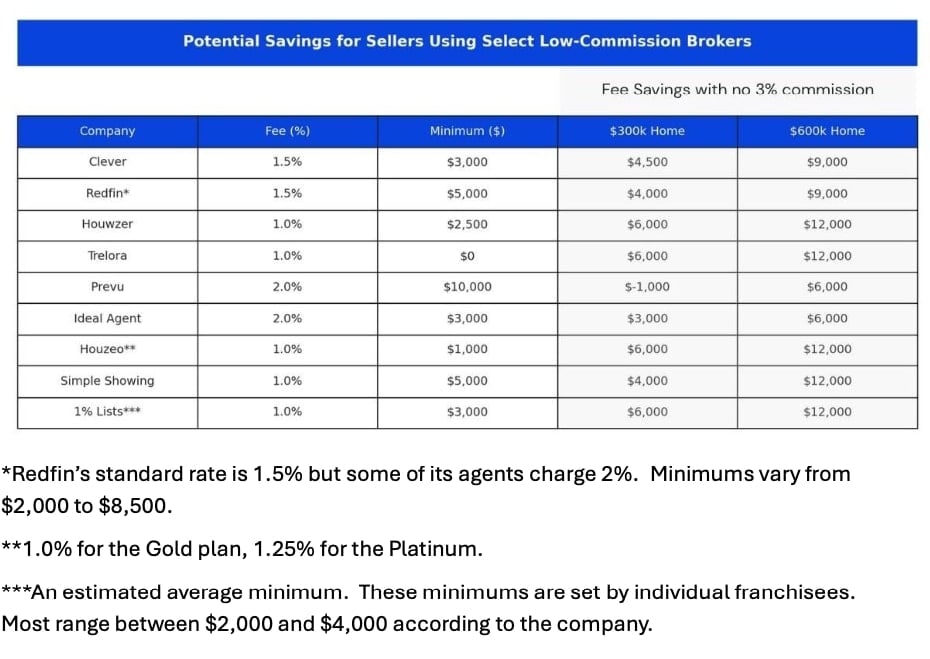
For instance, a seller who hires an agent that charges a 1.5 percent commission rather than a 3 percent commission will spend $6,000 less on the sale of a $400,000 home.
Stephen Brobeck
“Many low-commission brokers work with successful, full-time agents who are either employed by the brokers or by independent firms,” Brobeck said in a statement.
“There is every indication that, for significantly reduced fees, many low-commission agents provide the same quality of service offered by successful traditional agents.”
Source: Consumer Policy Center
Some in the real estate industry say that traditional brokers are more likely than low-commission brokers to sell homes for higher prices, thereby negating the savings of using a lower-fee broker, and point to data showing that for-sale-by-owner (FSBO) homes sell for lower prices than those sold by traditional agents, the report notes. But Brobeck and Gilch stress that such data doesn’t account for differences between the sellers.
“FSBO sellers have lower average incomes and less expensive homes so are more likely to try avoiding brokerage costs,” the report says.
“More importantly, there has been academic research on the issue of whether traditional listing agents secure higher sale prices than do low-fee agents, and the finding is that they do not. To quote one study: ‘We find no evidence that the use of a broker leads to higher average selling prices, or that it significantly alters average initial sale prices.’”
However, at least a couple of studies have found that using a traditional broker reduces time on market “by several days,” the report added.
For this report, Brobeck and Gilch considered 45 low-commission or flat-fee brokers and narrowed in on 15 “because of their visibility and success.”
Of the 15, nine are low-commission brokers, meaning they charge less than a typical 2.5 percent or 3 percent commission, typically between 1 and 2 percent, for “full, personal services”:
Clever
Houwzer (merged with Trelora, but they maintain separate public brands)
Houzeo (which also offers flat-fee services)
Ideal Agent
1% Lists
Prevu
Redfin
Simple Showing
Trelora
Six are flat-fee brokers, meaning they charge a specific dollar amount — usually between $100 and $1,000 — to list properties on local multiple listing services (MLSs) and listing sites such as Zillow and Realtor.com and also provide generic information on homeselling. They get paid regardless of whether a home sells.
Beycome
Circle One Realty
Cottage Street Realty
Flat Fee Group
FSBO.com
Houzeo (which also offers low-commission services)
Brobeck and Gilch found that, unlike “traditional” brokers, low-fee brokers almost universally clearly disclosed their fees and specific services online.
To compare the companies they considered information provided by the brokers themselves, assessments of the firms by other discount brokers, third-party reviews, and data on customer satisfaction related to customer comments and complaints, such as that found on Google, Trustpilot, Yelp, Pissed Consumers, Consumer Affairs, and the Better Business Bureau.
They also asked for agent recommendations from six of the low-commission companies (Clever, Redfin, Houwzer, Prevu, Ideal Agent, and Houzeo) and called those agents, posing as homesellers.
Flat-fee brokers
Regarding flat-brokers, the report notes they “offer the potential of huge cost savings” to the tune of thousands of dollars, though most do not offer personalized services. One exception was Cottage Street Realty, which offers experienced agents who provide personal service but don’t meet with sellers or see the listing in person.
Wendy Gilch
“The expansion of different types of flat-rate services has provided new opportunities to owners wishing to sell themselves,” Gilch said.
Likely referring to the waning use of the National Association of Realtors’ no-commingling rule, she added, “The fact that major MLSs and portals, such as Zillow, no longer segregate FSBOs from Realtor listings helps these sellers immeasurably.”
Regarding specific firms, however, the report said there were not enough available reviews to evaluate them.
“There is insufficient information about flat fee brokers to make reliable judgements about individual companies,” the report says.
The report suggests the sellers that might find flat-fee brokers most attractive would be those under no time pressure to sell who want to figure out what their property is worth and maybe find an unrepresented buyer to sell to with the help of an attorney or lower-cost agent; knowledgable sellers who can manage the sale themselves with the help of an attorney or title com[any; or sellers and buyers who know each other and can negotiate among themselves and close with the help of an attorney or title firm.
“To best utilize these lower-cost options, sellers must decide how much of the home pricing, listing, posting, showing, bidding, negotiating, and closing they wish to take on as responsibilities,” the report said.
“In most cases, at minimum they will need some assistance from an attorney or title company. If they decide to delegate these responsibilities to a licensed agent, they should carefully consider the qualifications, track record, and reputation of the candidates they consider. Sellers under no pressure to sell, those with some knowledge of brokerage practices, and those who themselves find a buyer will be most likely to find low- cost flat fee services to be attractive.
“Sellers under pressure to sell (and often to also buy), those unfamiliar with brokerage practices, and those who want to minimize their involvement in the sale are most likely to prefer their own loyal, fiduciary agent. The latter group constitutes a large majority of all sellers.”
Low-commission brokers
The report found that nearly all of the low-commission brokers studied offered full agent services, though they differed in their local availability, type, cost of services and who provides them.
For example, the report says, Clever, Redfin, and Ideal Agent offer their services throughout most of the country and each has at least 2,000 agents, while Houzeo is also a national company but has a limited number of low-commission agents. The remaining five brokers are regional.
“At all companies, sellers are assisted personally by licensed agents,” the report says.
“We believe that the most important factor, apart from cost, that sellers should consider in deciding whether to use a low-commission agent is the quality of the agent.”
The report emphasized the importance of sellers assessing their prospective agents and brokers.
“[A]ll low-commission brokers employ at least some competent, experienced agents, which emphasizes the importance of sellers doing their own assessment of recommended agents,” the report says.
“That assessment should include not only recent selling experience and client reviews, but also information about how well agents explain the sales process and how involved they will be in the sale. With this in mind, low-fee brokers do represent a viable alternative for home sellers.”
The report advised sellers to look for brokers that offer:
“Availability for full, in-person service including an initial meeting, home inspection, home showings, and the closing. Companies with agents within ten miles of the seller are preferable to those living 50 miles away.
Agents who have been hired because of their experience and good client reviews.
Agents whose performance is evaluated by their company using customer reviews.
Commissions that are 1.5 percent or lower with low minimums.
Good evaluations by sellers and by independent reviewers.”
Of the six companies from which Brobeck and Gilch requested an agent recommendation, they found that most such agents had had at least 10 sales the previous year, were positively reviewed by clients on Zillow or Realtor.com, and “in a phone conversation, convinced us they were a viable option.”
Asked why they only reached out to six of the companies, Brobeck told Inman, “We could not request assistance from companies operating outside the DC and Pittsburgh areas because all companies require inclusion of much information about the owner and the home, and we didn’t feel it was reasonable to ask others, besides Wendy and me, to do so given privacy issues and the possibility of their being subjected to aggressive phone and email marketings.”
The report singled out Clever, an online referral service with more than 15,000 partner agents, as unique among low-commission brokerages for explicitly only recommending agents with strong credentials, including that they must be full-time professionals with more than five years experience, be favorably reviewed by past sellers and possess “extensive local market knowledge” — criteria many agents at traditional brokerages would not meet.
Clever, the report added, is also available nationwide, charges a 1.5 percent commission with a low minimum sale price, offers sellers the ability to pick among experienced full-time agents, and has consistently positive client reviews.
“No other low-commission broker shares these characteristics,” the report said.
“Trelora, Houwser, 1% Lists, and Simple Showing all charge lower commissions but limit their services to certain local areas.”
The report notes that Clever partner agents pay a portion of the 1.5 percent commission to Clever and that one might question whether such an agent would work as hard for a 1 percent net commission as for a 1.5 or 2 percent net at a higher-cost brokerage.
“Three considerations — there is intense competition for clients, agents depend on referrals from satisfied clients, and Clever monitors the performance of its partner agents – suggest that this risk is worth taking when the savings is usually considerable,” the report says.
Asked whether anyone in the real estate industry helps finance the CPC or its research, Brobeck told Inman, “No! Financed entirely by the Fellows.” The CPC has a similar disclosure on its website.
The market has undeniably shifted from the extreme seller’s environment of the early pandemic. But in much of the U.S., buyers still face substantial inventory constraints, an Intel analysis shows.
This report is available exclusively to subscribers of Inman Intel, the data and research arm of Inman offering deep insights and market intelligence on the business of residential real estate and proptech. Subscribe today.
The U.S. housing market has entered a new era — one in which homebuyers in most parts of the country actually have more negotiating power than they had before the pandemic.
But the market is also deeply divided.
Broad swaths of the nation now provide far more options for buyers than they were used to even a decade ago. At the same time, the other half of the country remains substantially inventory-strapped, a scenario that supports high prices even as buyers and brokerages fight to wrest new listings from competitors.
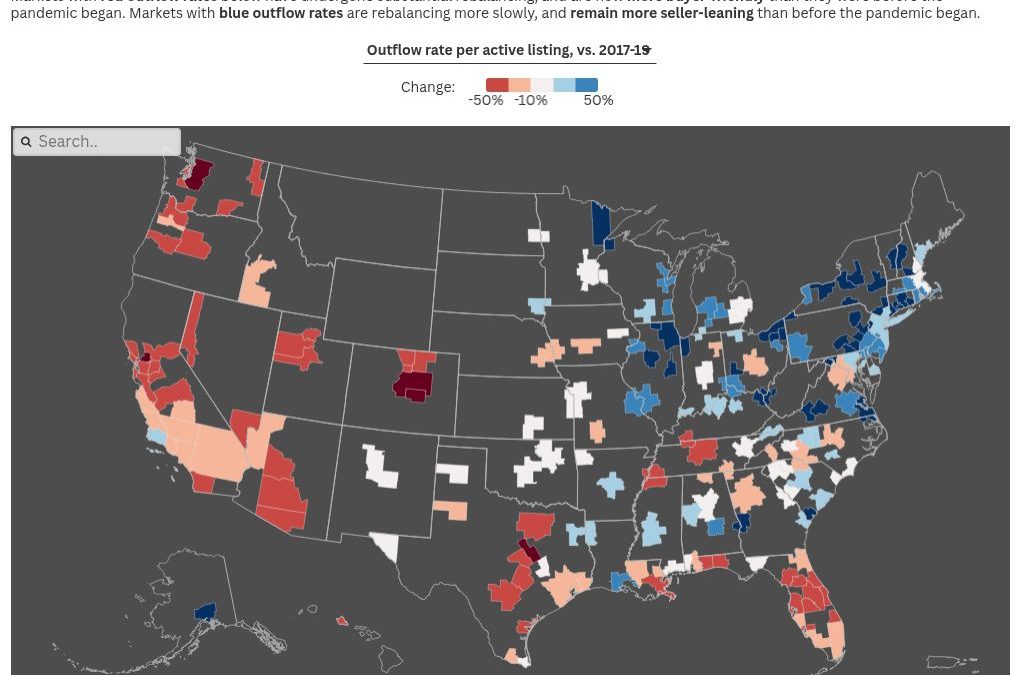
These two Americas follow distinct geographic patterns, an Intel analysis of Realtor.com data found.
And while much of the nation still faces severe supply challenges, Intel found that others are rebalancing for the wrong reasons — screeching to a halt as new supply remains depressed amid a listless sales environment.
Intel breaks down where the 150 largest metro areas in the U.S. stand on inventory in this week’s report.
Slow to adjust
To an extent, nearly every market has participated in the ongoing transaction downturn, and the Great Rebalancing of housing inventory that has accompanied it.
But while researching this piece, it became clear that the pandemic’s lasting imprint on local markets remains much deeper in some places than others.
Agents throughout much of the South and the West regions of the United States are seeing conditions where the typical buyer’s pleas to bring down prices now hold more weight.
That doesn’t mean these markets are suddenly buyer’s markets by the traditional definition, where it would take six months or longer for the current stock of inventory to sell in its entirety at present sales rates. Even before the pandemic, inventory had been getting relatively tight, pushing most places into firmly seller-market territory.
But those same places are significantly less seller-friendly today, and it’s weakened price growth in some places and brought prices down in others.
For brokerages, this is a double-edged sword. Lower prices directly cut into a broker or agent’s commissions. At the same time, today’s price levels remain unaffordable for many potential buyers at today’s mortgage rates, which puts a significant damper on sales.
On the other side of the country, agents in the Midwest and Northeast are likelier to see conditions that are rebalancing much more slowly.
Many of these markets remain stuck in an overheated situation, a sort of lingering phantom of the pandemic dynamic where razor-thin inventory is still hard to come by, even in the current depleted buyer pool.
Inside the Great Rebalancing
If roughly half the country is undergoing a significant rebalancing toward more buyer-friendly dynamics, what’s driving it?
There are two main answers, Intel found.
The most unusual path is the one taken by Texas and Florida. In these places, new inventory — including new construction and existing listings — is now coming online each month at a rate that rivals or even exceeds pre-pandemic norms.
These states appear to be benefiting from healthier conditions than what’s being seen in other rebalancing markets, including more inbound migration in recent years.
More new listings helps support more new transactions and demand. And while listings are recovering in most parts of the country, Texas and Florida have been at it for longer, and have reached healthier levels sooner.
Using listing outflow as a rough proxy for sales, transaction levels are also much closer to normal levels in many Texas and Florida markets, even as dynamics have shifted in a more buyer-friendly direction.
In the greater Dallas area, listings are moving off the market at levels that are 94 percent of where they were in a typical spring before the pandemic struck. Houston-area listing outflow is back above normal levels, and San Antonio is back right below its pre-pandemic outflow trend.
So in these places, decent sales volume and a buyer-friendly rebalancing have been able to coexist, offsetting the effect of softening prices for brokerages. But that hasn’t been typical of other parts of the rebalancing nation.
Examining San Diego, listing outflow remains stuck at only 58 percent of its typical levels, while new-listing levels are at 67 percent of normal.
The result is typical of many markets along the Pacific Coast and even deeper inland throughout the West: markets where low transaction levels, rather than robust supply growth, are now creating significantly more buyer-friendly conditions — to an extent that may even threaten price stability.
Here’s how some of America’s biggest population centers fit into four major classes of market.
Rebalanced in large part by healthy supply:
Texas cities: Austin, Dallas, Houston, San Antonio
Eastern seaboard: Tampa, Orlando, Charlotte
Western supply pockets: Denver, San Francisco
Rebalanced primarily by a plummet in demand:
California population centers: San Diego, Los Angeles, Riverside
Other Western cities: Phoenix, Portland, Seattle
Strong competition on decent supply:
Scattered large metros: Pittsburgh, Kansas City
Overheated on short supply:
Northeastern hubs: New York, Philadelphia, Baltimore, Boston
Midwestern metros: Chicago, Cleveland, Cincinnati, St. Louis
When you hit a bump in the road in your real estate career, you’ll know how to handle it and push through with these tips from coach Darryl Davis.
Bigger. Better. Bolder. Inman Connect is heading to San Diego. Join thousands of real estate pros, connect with the Inman Community, and gain insights from hundreds of leading minds shaping the industry. If you’re ready to grow your business and invest in yourself, this is where you need to be. Go BIG in San Diego!
No need to sugarcoat, right? Real estate isn’t always sunshine, commission checks and champagne closings (but wouldn’t that be awesome?). It’s a rollercoaster. One minute you’re up. The next, you’re screaming into a pillow because a deal blew up at the eleventh hour. But here’s the good news: Every problem has a solution — if you’re prepared.
7 common problems
That’s what this article is about. Looking under the hood of seven common real estate problems and how to overcome them like a true professional (the kind who doesn’t lose sleep when things go sideways).
1. Unrealistic client expectations
The problem: Sellers think their home is worth a million bucks because they painted the cabinets and updated the flooring. Buyers think their dream home exists — complete with quartz countertops, a pool and walkability to Starbucks — for $200,000.
The fix: Set expectations from Day 1. Show data. Use comps. Walk through actual outcomes in today’s market. Real people, real houses, real scenarios. And, for the love of listings, learn to speak in analogies:
“Trying to sell an overpriced home is like walking into Starbucks and trying to sell a $5 coffee for $10. It doesn’t matter how good it smells or how many hearts and smiley faces you draw on the cup — people know the going rate for a coffee.”
When you can reframe the scenario and parallel it with something they already know to be true, they’ll get it. They might not like it, but it will bring them back into more realistic thinking.
2. Deals falling apart at the finish line
The problem: Inspections, financing hiccups, cold feet — oh my! Deals can fall apart in the blink of an eye during this crucial time, and for any number of reasons. It’s disappointing (maybe even crushing) for your clients who thought they had this in the bag.
The fix: Be proactive, and look for any potential hiccups early on. Vet buyers fast. Encourage pre-inspections for sellers. Over-communicate with all parties like you’re the conductor of a very fragile orchestra. And always, always have a Plan B. Even a Plan C. No surprises, just solutions.
3. Low inventory (AKA ‘the search for unicorns’)
The problem: Buyers want homes that aren’t on the market. Sellers are waiting for a variety of reasons – trying to time the market to their advantage, waiting for interest rates to change – whatever their reason, they aren’t ready to sell.
The fix: This is where you earn your stripes. Knock on doors. Mail letters. Work your expireds and FSBOs. Call your sphere and say, “Hey, I’ve got a family looking to buy in your neighborhood — know anyone thinking of selling?”
Don’t wait for the market to serve up listings — go out and create them.
4. Nervous buyers on the fence
The problem: Interest rates tick up, and suddenly buyers freeze like deer in headlights. They’re scared to move. Scared to breath. Worried that one wrong move will end their dreams of buying a home.
The fix: Don’t downplay their fear — educate it. Show them the power of long-term equity growth. Walk them through what waiting could cost. Show them the long-term effects that waiting might have. You can say:
“You don’t stop buying groceries when prices rise — you shop smarter. Real estate’s the same. The right time is when you’re ready, not when the headlines say so.”
5. Time management mayhem
The problem: You’re running around like a chicken without a CRM. Maybe your client list is an Excel spreadsheet. Maybe it’s on file cards. Heck, maybe your to-do list is written on a napkin. It’s time to face facts: You don’t have a strong system.
The fix: Structure is sexy. (OK, maybe just effective.) Time-block your prospecting. Use a CRM that doesn’t confuse you. Prioritize your dollar-productive activities. Remember: Consistency beats intensity. A focused 60 minutes a day trumps chaos every time.
6. Objection overload
The problem: Commission complaints. Buyer agency pushback. “We want to think about it.” Every listing appointment or buy conversation seems to be filled with Negative Nellies and excuses, and nobody wants to commit.
The fix:Objections aren’t rejections — they’re requests for clarity. Don’t get defensive — get confident. If someone questions your fee, try this: “Hiring me is like hiring a top attorney on contingency. I don’t get paid unless I win — for you.”
Boom — Professional. Relatable. Powerful.
7. Trust takes time
The problem: Clients are skeptical. You’re “just another agent” until you prove otherwise. How many times have you heard, “I get calls from 20 agents a week? What makes you different?” They’re tired and maybe even annoyed.
The fix: Overdeliver. Every time. Share real testimonials. Offer references before they ask. Respond quickly. Show them you’re not just in it for the commission — you’re in it for them. Trust isn’t built in a day; it’s built in every interaction.
Be the problem-solver, not the panic button
Look — real estate problems aren’t going anywhere. But neither are you. The agents who thrive in this business aren’t the ones who avoid problems — they’re the ones who lean in, stay ready and show up with solutions. So, when the rollercoaster dips, don’t scream. Stand up, smile and say, “Let’s solve this.” Because that’s what real professionals do.
Bigger. Better. Bolder. Inman Connect is heading to San Diego. Join thousands of real estate pros, connect with the Inman Community, and gain insights from hundreds of leading minds shaping the industry. If you’re ready to grow your business and invest in yourself, this is where you need to be. Go BIG in San Diego!
Thinking about buying a second home to use as a short-term rental (STR) or adding a rentable unit to your primary residence? Dreaming of scaling into a full-blown business with multiple Airbnbs andVrbos? While STRs are often hyped as a fast track to wealth, the reality is far more complicated than what you see on TikTok. If you’re serious about entering the STR market, here’s exactly what is required to succeed.
Make the shift from tourist to investor
Having a great location where you have a beachfront view or where you can ski directly to the lifts from your unit is great but avoid making the mistake of choosing a property based upon what you would rent. When you’re investing, the decision must be tied to a variety of other factors that are even more important than the location.
1. ALWAYS investigate the local regulations and restrictions governing the property BEFORE you begin your property search
Many popular cities such as Austin, New York, San Francisco, Honolulu and large parts of Florida, have severely restricted or banned short-term rentals. For example, Austin has very specific requirements governing how homeowners may use part or all of their primary residence as an STR. Other areas require all STR stays to be a minimum of 30 days.
Check the zoning and HOAs
Even in short-term-rental-friendly markets, neighborhood HOAs and condo associations often prohibit rentals under 30 days. If you’re looking at a condominium property, always check the property’s HOA’s CC&Rs to make sure short-term rentals are allowed.
Use data tools
Platforms like AirDNA, Rabbu, and Mashvisor let you compare occupancy rates, average daily rates (ADR), and seasonality for Airbnb and Vrbo listings side-by-side. By the way, don’t assume Airbnb is your best choice. Vrbo is strong in many vacation markets.
2. Airbnb vs. Vrbo: Which one is right for you?
Both platforms offer short-term rentals, but they often serve very different types of travelers. The question is what type of guests would you like to attract?
Airbnb
Airbnb appeals more to urban travelers, younger guests, digital nomads and quirky stays. Think: tiny homes, Airstreams and well-designed condos near downtown attractions.
Vrbo (Vacation Rentals by Owner)
Vrbo attracts families and larger groups looking for traditional vacation homes, often in beach towns, mountain resorts and suburban getaways.
Vrbo guests often stay longer and spend more
Their average booking value tends to be higher, but they also expect more space and amenities, including full kitchens, multiple bathrooms and kid-friendly features.
Cross-listing is smart
Most successful hosts list on both Airbnb and Vrbo (and sometimes Booking.com), using tools like Lodgify, Guesty for Hosts, or Hostaway to sync calendars, automate messages and avoid double bookings. Guesty claims that users who switch from Hostaway to their platform increase their revenue by 16.4 percent.
3. Buy a property that performs — not just one that looks good
Not every cute cottage is a winner. To succeed with short-term rentals, you need a property that guests love and that fits your management strategy.
Size matters
One-bedroom units often get higher occupancy, while three- to four-bedroom homes attract family groups on Vrbo and command higher nightly rates.
Outdoor amenities boost income
Fire pits, hot tubs, BBQs and fenced yards add value, but pet-friendly may add the most.
Themed properties stand out
A mountain retreat, midcentury modern hideaway or coastal beach bungalow can help you charge more and get booked faster.
Avoid big renovation projects
Unless you’re experienced with permits, design, code, supply chain issues, time delays due to slow responding city/county inspectors, unexpected costs can destroy your return.
4. Beware: Pitfalls that can turn your investment into a money pit
Short-term rental ownership isn’t just mortgage + dreams. There are layers of costs that can turn a profitable property into a money pit.
Furnishing and staging
In terms of your budget for furniture, decor, kitchenware, linens, cable, internet, etc., it’s smart to hold your budget between 10–15% of the property’s value.
Licensing, taxes and inspections
These requirements can vary based on the city, the state, subdivision or even a specific condominium building. For example, some cities require short-term rental permits, business licenses, hotel taxes and annual safety inspections. Penalties for noncompliance can be steep.
Caveat: Your homeowner’s insurance policy doesn’t cover short-term rentals
Standard homeowners’ insurance does not cover STRs. Resources for STR insurance include the following companies:
Proper: Offers comprehensive short-term rental insurance, including property damage, liability and lost income.
Safely: Known for its flexible “pay as you go” model and short-term rental coverage.
CBIZ: Provides tailored insurance solutions for short-term rental businesses.
American Family Insurance: Offers short-term rental coverage as an add-on to existing home insurance.
Allstate:Offers HostAdvantage home-sharing insurance with a discount.
Nationwide: Offers comprehensive protection for landlords with short-term and vacation rental property.
Vrbo’s damage protection is separate
Unlike Airbnb’s AirCover (which has limits), Vrbo allows hosts to set damage deposits or require guests to purchase protection, providing you with control but also increased paperwork.
5. How will you manage your short-term rental?
There are three options when it comes to managing your short-term rental: handle it all yourself, hire a property manager or use a hybrid model.
Do-it-yourself
As mentioned above, use tools such as Lodgify, Guesty for Hosts, or Hostaway to sync calendars, automate messages and avoid double bookings. Other useful tools include:
Hospitable for automated guest messaging and channel management
PriceLabs for dynamic pricing and revenue management
Turno Automated cleaning scheduling for short-term rentals worldwide.
Hire a local property manager
Expect to pay 20 percent to 30 percent of gross rental income. This is ideal if you don’t live near the property or are seeking true passive income. Thorough vetting of your property manager is an absolute must.
Hybrid approach
Handle bookings and messaging yourself but outsource the cleaning and maintenance. This reduces costs while keeping you involved in guest experience and reviews.
6. Marketing your short-term rental: Good images mean more bookings
Your photos will make or break the number of bookings you receive. Here are some important guidelines to follow.
Hire a professional photographer
High-resolution, professionally shot images are one of the best investments you can make. Properties with great photos often see up to 40 percent more bookings.
Stage your STR like a boutique hotel
Cozy throws, coffee setups and books on the nightstand evoke a lifestyle, not just a short-term stay.
Highlight key amenities
Pools, views, fire pits, bunk rooms and spacious kitchens should be front and center. Also, if you’re property is “pet friendly,” make sure that is featured as well. If there’s a local dog park or hike and bike trail nearby, be sure to show that as well.
Photograph all the spaces in your STR
Include outdoor areas, entrances, workspace setups and bathrooms — guests want to see everything.
7. Provide your guests with the little touches that make a big difference in your reviews
The guidelines below are essential to getting great reviews and booking repeat business.
Be in constant communication with your guests
Respond quickly when your guests reach out to you or risk receiving a poor review. Both Airbnb and Vrbo reward responsive hosts with better visibility.
Cleanliness is king
A missed crumb or unwashed dish can tank your reviews. Systematize cleanings and quality control.
Overdeliver
Provide a basket of local snacks, a handwritten welcome note, games for kids or a guide to local restaurants. These little touches make a big impact on guest satisfaction and future bookings.
8. Additional resources
Letting strangers into your short-term rental, particularly if it’s also your second home, isn’t risk-free. Here are additional steps to take that can reduce the chance of damage or complaints.
Guest vetting
Consider minimum stay requirements, ID verification or even hosting only guests with prior positive reviews.
Smart locks and cameras
Use code-based entry, doorbell cams (at the front door only).
Have strict house rules
Spell them out in the listing as well as clearly posting them on-site. Include quiet hours, guest limits, and rules for smoking, pets and events.
Insurance and deposits
Airbnb’s AirCover provides up to $3,000 in damage protection, but it’s still recommended that you carry commercial STR insurance. Vrbo allows hosts to require damage deposits or renter protection directly from guests.
Other issues to consider include booking your short-term rental, security, noise monitoring, protecting your property and guest vetting.
Hostfully provides direct booking websites as well as digital guidebooks for assistance.
Minut is a great service that not only monitors the noise in your STR like NoiseAware does, but also detects “crowd events,” temperature and cigarette smoke as well.
Short-term rental buyer checklist:
Before you buy, ask yourself:
Are short-term rentals legal in this location?
Is this a high-demand market for Airbnb and Vrbo?
Have I identified how the cleanings, emergencies and other communication will be handled?
Have I budgeted for furniture, insurance, taxes and software?
What makes my listing more attractive than others nearby?
Would I want to stay here?
If you answered all these questions, “Yes,” you’re ready to take the next step and launch your STR business.
Bigger. Better. Bolder. Inman Connect is heading to San Diego. Join thousands of real estate pros, connect with the Inman Community, and gain insights from hundreds of leading minds shaping the industry. If you’re ready to grow your business and invest in yourself, this is where you need to be. Go BIG in San Diego!
One of the things I most admire about the real estate industry is how many hard-working dads are not only coaching their real estate teams to success, but then they roll out of the parking lot and head to the ballfield to help out their kids and the kids in their community as well.
The spirit of community is alive and well in the real estate industry. This Father’s Day, let’s celebrate and recognize the Dads doing the most and appreciate the laughter and love they bring to their offices, homes, and communities.
What Dads really want this year
Here are three things that Dads really want this Father’s Day weekend.
1. They want room to step away from stereotypes without the fear of social criticism
I cannot tell you how many men I have spoken to recently who feel like being a man, a father, a business professional, a son and a friend is extremely challenging right now. They think that no matter what path they choose, they feel like someone is ready to argue with them and tell them they are wrong.
They feel conflicted and frustrated that, even if they exhibit good behaviors and habits, it’s overshadowed by the bad that lesser men inflict on society every day.
Don’t just praise men for doing the bare minimum; praise them when they are doing the hard work of managing their emotions without anger, managing the office with attention to detail and consideration for others, and above all, give them space to be soft and kind without derogatory comments.
Masculinity is under the microscope, and it’s been turned into a political weapon that does not favor men or women. It fosters power, oppression and closed-mindedness.
Men are encouraged and praised for choosing violent hobbies and interests, but not commended for sharing equal labor in the home and when raising children. Men are often praised for titles, financial gains and awards, but they are not often commended for compassion, kindness and adopting non-violent practices as part of child rearing and interacting with society.
Men deserve to eliminate the phrase: “Just wait until your father gets home,” and replace it with the phrase “Your Dad will want to talk to you and spend time with you when you get home because your relationship is important to him.”
2. Dads deserve a chance to break away from ‘tradition’ and build new legacies
There was a powerful scene in one of my favorite new shows, The Last of Us, where a young Joel sits with his father at the kitchen table and has a beer with him as they discuss a serious family issue. The father, in a rare show of emotional openness, explains that despite his parental failings, he knows he is doing better for his sons than his father did for him.
Look, friends, therapy is cool, and I think everyone should try it at least once because we all carry issues that need to be resolved. Having a space to talk about these issues should not be seen as weakness. Men shouldn’t be seen as a “lesser man” because they admit they need help or that they went through some trauma. It’s about taking action so you don’t pass it on to your wife, kids, friends or coworkers.
June is Men’s Mental Health Awareness Month. Dads need support. We all need support. Life is incredibly challenging, and we shouldn’t be afraid to discuss it. Currently, men outnumber women in suicide rates, and the risk increases if they have had personal trauma or are veterans.
Break away from traditional expectations of what you think a father should be, and become the Dad you want to be. Dads need room to do it their way and build a better future, instead of just masking their problems.
3. Dads need to think about fitness and health, without having pressure to become a bodybuilder
Trying to make time for the gym is rough, and as a woman, going into the gym can sometimes be very intimidating. However, I actually feel worse for the men in there, putting on some strange caveman show for each other. Who has the biggest arms, can press the most weight, can run the fastest, can jump around and yell the loudest?
It doesn’t make for a calm and peaceful experience, and if you are mentally worn out or overweight, it’s hard to immediately jump into that mindset and not feel like it’s a punishment. I’m all for encouraging fitness, providing help and maintaining accountability with friends, but most of the time, what I see is men pushing themselves too far for the sake of showing off to random people around them.
Dads need to know that they can be healthy without being “sexy,” it’s OK to have a “dad bod,” and they can go to the gym and play sports without blowing out knees, shoulders and whatever else joints they haphazardly ruin while trying to keep up with the show.
Dads, please go on a family walk, and eat something healthy once in a while, so you don’t develop heart issues, diabetes and mobility issues. Dads need to be OK with self-care, so they can be here longer for us and be stronger for us in the long run.
Grateful for Dad jokes
I’m so grateful for the great dads I know, especially those who excel at telling terrible dad jokes and giving hugs. A dad who knows how to bring laughter into sad situations, who gives good hugs, who can be a best friend when you need to work on a serious project and who is the best listener when you need help.
Those are the Dads we need more of in today’s challenging world. Dads need room to show love and to be soft as well as firm. Happy Father’s Day to all the special men and Dads in the real estate industry who are raising the bar and making a difference.
Cheers to those who support them, and may we raise a new generation of Dads who are part of the solution as they bring more compassion and kindness into this world.
Rachael Hite is a seasoned housing counselor and thought leader in the real estate industry. Connect with her on Instagram and LinkedIn.