by Daniel Houston | Jul 7, 2025 | Industry, News Feed
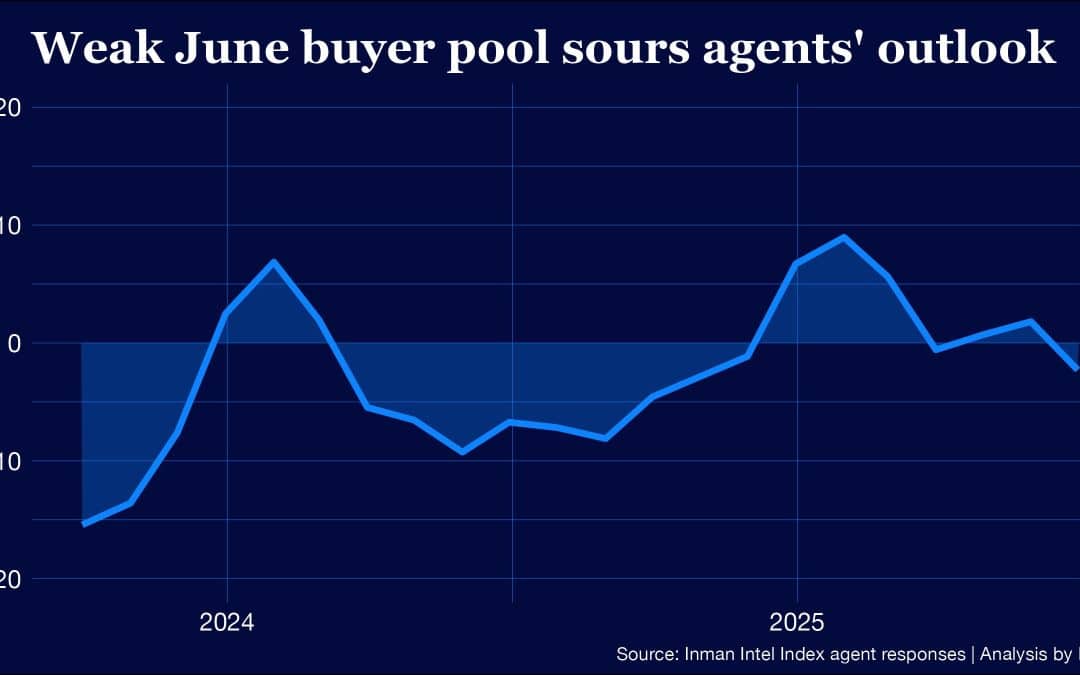
Intel observed a notable rise in late June in the share of agents who said their buyer client pools were “substantially” slimmer than at the same point last year.
This report is available exclusively to subscribers of Inman Intel, the data and research arm of Inman offering deep insights and market intelligence on the business of residential real estate and proptech. Subscribe today.
A weaker-than-expected lineup of buyer clients to open real estate’s most crucial closing season forced agents to downgrade their outlook for the year ahead, a new Intel survey shows.
The share of agent respondents to June’s Inman Intel Index survey who said they experienced a year-over-year decline in buyer pipelines rose from 52 percent in May to 57 percent in June, according to the latest results.
And that helped push overall agent sentiment to its lowest point since September, as measured by Intel’s Client Pipeline Tracker metric.
Client Pipeline Tracker score in June: -2
- Previous score: +2 in May
- Recent high point: +9 in January
Short-term listing client conditions remained mostly unchanged as the page turned to summer and an inventory recovery continued apace. Still, the agents Intel surveyed had substantially scaled back on their optimism for future business on both sides of the transaction.
This week’s report breaks down all the survey components that inform the score — and lays out what they mean for the months ahead.
A weak start to summer
Intel’s Client Pipeline Tracker is a compilation of how agents feel about their buyer and seller pipelines — both over the past year and in the near future.
Intel described the methodology in this post, but here’s a quick refresher on how to interpret the scores.
- A score of 0 represents a neutral period in which client pipelines are neither improving nor worsening.
- A positive score reflects a market in which client pipelines have been improving, or are widely expected to improve in the next 12 months. The higher the rating, the more confident agents are in that conditions are moving in a positive direction.
- A negative score suggests client pipeline conditions are worsening, or are widely expected to get worse in the year to come.
An extremely positive combined score falls somewhere around the +20 mark. This type of score would signify that much of the industry is in agreement with the fact that pipelines are improving and will continue to improve.
An extremely negative combined score, on the other hand, falls closer to -20. That’s a bit lower than where the industry stood in September 2024, the first time Intel surveyed agents about their pipelines.
For each of the four individual components that go into the score, results as high as +50 or as low as -50 are sometimes observed.
Here are the component scores from the most recent survey, and how each sentiment category changed from the previous one.
Tracker component scores
May → June
- Present buyer pipelines: -27 → -33
- Future buyer pipelines: +11 → +6
- Present seller pipelines: -9 → -9
- Future seller pipelines: +13 → +9
Summer is supposed to be the season where agents close on the highest volume of transactions — and secure the biggest chunk of their revenues for the year.
And while that seasonal ramp-up is likely happening, the momentum has not been as strong as agents are accustomed to at this time of year.
- 24 percent of agent respondents described buyer pipeline declines from last June that were “substantial” in scope, while another 33 percent described more moderate hits to buyer-side client pools.
- The previous month, fewer than 21 percent of respondents told Intel they observed “substantial” year-over-year declines in their buyer pipelines, and another 31 percent said they experienced a smaller fall.
These buyer-side struggles coincided with declining outlooks for the year ahead.
- On the buyer side, the share of agents who told Intel that they expected to be working with more clients 12 months from now fell from 40 percent in May to 34 percent in June.
- The seller-side trend was even more pronounced, with 44 percent of agent respondents in May expressing optimism for their listing pipelines in the year ahead, and just under 37 percent doing the same in June.
But for many of these agents, the optimism wasn’t replaced with pure pessimism, but with more of a wait-and-see stance.
- The share of agent respondents who said they expect their buyer pipelines to be “about the same” a year from now crept up from 43 percent in May to 46 percent in June.
- Meanwhile, seller pipelines were expected to remain about the same 12 months from now by 46 percent of respondents in June, up from 38 percent the month before.
Where the market stands
Despite this relatively weak start to real estate’s busy season, agents are still more or less treading water with their listing clients amid a slow but steady climb in inventory.
- Drawing from both ends of the spectrum, the share of agents in June who told Intel that their listing client pools were “about the same” as last year rose from 27 percent in May to 34 percent in June.
As a result, the present condition of listing pipelines were the only component of the Client Pipeline Tracker that didn’t meaningfully worsen in the early weeks of summer.
These results come in the context of a general rising tide of new listings that have served as a silver lining to the nation’s ongoing depressed sales environment.
But as Intel explored a few weeks ago, many markets have yet to fully participate in that recovery, including many large metros sprawling throughout the Midwest and Northeast.
As the market recovery enters a distinct new chapter, Intel will continue to closely follow these and other trends.
Methodology notes: This month’s Inman Intel Index survey was conducted June 21-July 3, 2025, and received 522 responses. The entire Inman reader community was invited to participate, and a rotating, randomized selection of community members was prompted to participate by email. Users responded to a series of questions related to their self-identified corner of the real estate industry — including real estate agents, brokerage leaders, lenders and proptech entrepreneurs. Results reflect the opinions of the engaged Inman community, which may not always match those of the broader real estate industry. This survey is conducted monthly.
Email Daniel Houston

by Amy Stockberger | Jul 7, 2025 | Industry, News Feed
Text replacements and keyboard shortcuts are the OGs of automation, broker-owner Amy Stockberger writes. They’ve saved her business hundreds of hours and thousands of decisions.
Real estate is changing fast, and so must you. Inman Connect San Diego is where you turn uncertainty into strategy — with real talk, real tools and the connections that matter. If you’re serious about staying ahead of the game, this is where you need to be. Register now!
Let’s talk automation. Not the robust CRM you’re building your pipeline with. Not the AI-driven platforms that are reshaping how we work — I’ve previously shared why you absolutely need those, and I stand by it.
But today, I’m talking about the automation hiding in plain sight — the kind built into the tools you already use daily.
No onboarding. No learning curve. No extra cost.
Text replacements and keyboard shortcuts are what I call the OGs of automation, and they’ve quietly saved our business hundreds of hours and thousands of decisions for over a decade.
They don’t just save time. They protect your energy, your consistency and your brand voice.
If you’re serious about building a business that runs on systems, not stress, this is the fastest, frictionless place to start.
If you’re not building a SADD business, you’re building burnout
Every process in our company runs through one filter: Systematize it. Automate it. Delegate it. Or Delete it.
That’s what we call the SADD filter, and it’s how we decide whether a task belongs on our plate or in our process.
Most agents are buried in busywork because they’re defaulting to memory. They’re typing the same emails. Writing the same texts. They’re slowly burning out because there’s no system to catch the repeatables.
But here’s the truth: If you’re doing it more than twice, it needs a code.
Text replacements: Your brand’s secret weapon (right in your pocket)
Text replacements are pre-set shortcuts you can program into your phone. You type in a short code — like byrtmp — and your phone instantly expands it into a full paragraph, prewritten by you, that delivers a clear, on-brand message.
We use them for everything (literally everything):
- byrtmp → Buyer inquiry response with next steps and value positioning
- sllrtmp → Seller inquiry response with next steps and value positioning
- rlcfm → Relocation onboarding for families (we have a different message we send to individuals, too)
- ofr / cntr → Offer submitted / counter update to co-agent
- rrbc → Referral thank-you (sent instantly, reinforcing referral behavior of our clients)
- lu → “Love you!” (I work with a lot of my fam so get to say this a lot during the day but do not have time to type it all out)
- dddb → “Did you do the dishes, babe?” (Yes, even for my son back when he lived at home)
These are fast, frictionless and powerful.
They help us maintain excellence even when we’re moving fast.
Desktop shortcuts: High touch at high volume
On desktop, we use Text Blaze to expand our automation across departments:
- Buyer and seller onboarding emails
- CRM notes with smart fields (autofill names, addresses)
- Internal messages for recruiting, onboarding, transaction updates
- Admin and accounting process responses
These codes are shared across teams, so whether it’s my listing coordinator, executive assistant or transaction manager, everyone uses the same phrasing, the same tone, the same timing.
And guess what? That consistency compounds trust. Clients feel like they’re dealing with one seamless company, not a jumble of disconnected emails.
Text Blaze now includes built-in AI, but honestly, the shortcut feature alone is worth its weight in gold.
And when you have new staff stepping into roles, these shortcuts ensure there is zero learning curve — just follow the shortcuts. We have a shortcut sheet for all to reference.
Real results from these OG automations
These OG automations fuel:
- Buyer/seller conversion speed
- Referral reinforcement (in minutes, not days)
- Internal task routing and communication
- Vendor handoffs and scheduling
- Lead nurture (even cold leads get hot when followed up properly)
- Recruiting and agent retention (same system, same voice, less ramp-up)
In other words: We’re not winging it. We’re replicating it. That’s how you build a business that grows without adding chaos.
The simplicity multiplier: Less thinking = more serving
Most people underestimate how much energy goes into small decisions.
- “Should I say this differently?”
- “Where’s that old email?”
- “Did I remember to follow up?”
When you automate what’s repeatable, you free up cognitive capacity to do what matters — serve your clients, connect with your community and lead your team.
That’s how you move from reactive to proactive. From chaotic to clear.
Software and systems are essential, but even the best platforms only perform when your foundation is strong. Text replacements and keyboard shortcuts are where that foundation begins. They’re fast. Frictionless. And proven.
Start here. Scale smarter. Build the system your business and your future deserve.
Amy Stockberger is the founder of Amy Stockberger Real Estate. Connect with Amy on Instagram.

by Troy Palmquist | Jul 7, 2025 | Industry, News Feed
As Troy Palmquist refreshes his consumer-facing real estate brand online, he takes you along on the journey, including the nuts and bolts decisions related to content marketing.
Real estate is changing fast, and so must you. Inman Connect San Diego is where you turn uncertainty into strategy — with real talk, real tools and the connections that matter. If you’re serious about staying ahead of the game, this is where you need to be. Register now!
One of the tasks I’m working on as I move back into production is refreshing my consumer-facing online presence. I’m pivoting some of my digital content toward buyers and sellers, updating my bio and working on search engine optimization.
In an effort to make my consumer-focused website more effective for lead generation and brand building, I’ve purchased my name in both the .realtor and .realestate domains. The .realtor domain is available exclusively for members of the National Association of Realtors and the Canadian Real Estate Association, while anyone can purchase a .realestate domain.
Here are seven reasons why I decided to make the switch:
1. Strong professional branding and credibility
For agents and brokers who want to lean into their professional status through their NAR or CREA membership, the .realtor extension is a great way to communicate it. In addition, top-level domains that are industry-specific — like .realtor as opposed to .com or .net — are easier to remember, keeping agents top-of-mind with the people they meet.
2. Cost-effective marketing
Realtors get the full first year of a .realtor domain at no cost, while renewals begin at $39.95/year. The .realestate domain starts at $69/year. Multi-year and multi-domain discounts between 10 percent and 25 percent are also available. That’s an affordable investment for ongoing branding and is, in many cases, far cheaper than other domains.
3. Strategic hybrid domain approach
If you’re wanting to explore multiple approaches to branding and marketing — for example, content marketing that focuses on both your local market and a specialty niche — you can cover multiple audiences, highlight your authority and attract traffic with multiple SEO strategies. With both domain types, you also have a better chance of dominating search results.
4. Setup and technical support
For those who are tech-savvy, the complimentary website offered with a domain name purchase is a simple DIY process, often under five minutes. However, for those who need a little more help, there are premium options that allow you to outsource customization, optimization and content development. SSL security, ADA compliance and reliable hosting are baked in, so your site can be up and running almost immediately.
5. Lead generation and SEO lift
Among the tools offered are built-in contact forms, pop-ups, MLS integrations and done-for-you blog posts aimed at converting website visitors into warm leads. In addition, case studies show that some clients have seen significant spikes in both traffic and engagement, suggesting that there may be an SEO boost as well.
6. Domain forwarding and multi-domain strategy
If you have an existing .com website, you can route traffic to or from your .realtor or .realestate site, creating more comprehensive domain authority. By owning multiple domains, you strengthen your online presence and reduce the risk of a copycat competitor horning in on your brand. In my case, I’ll be pointing to my website sellingtheaddress.com built on the access.com, Agent Image-designed website, giving me multiple domains for better brand coverage.
7. Exclusivity and brand differentiation
Since only NAR/CREA members can access .realtor domains, you’ll enhance your credibility and deter so-called “cybersquatters” who buy desirable domains and sell them back at a premium. In addition, a .realestate domain can help you more accurately communicate your niche or location along with what you do, often far more affordably than a .com domain.
As an example, take my local market, Oxnard, California. I can purchase OxnardRealEstate.com from GoDaddy for $9,699. I can grab Oxnard.realestate, a premium URL, for $500/year, or I can niche down to OxnardHomes.realestate or OxnardWaterfront.realestate for only $69/year.
For enhanced professionalism, differentiation and affordability, a .realtor or .realestate URL just makes sense, and I’m looking forward to seeing how it will boost my online presence. It’s a simple step that puts me in control of my brand and gives clients one more reason to trust they’ve come to the right place.
Troy Palmquist is the founder and principal at HomeCode Advisors. Connect with him on LinkedIn.

by Bernice Ross | Jul 7, 2025 | Industry, News Feed
Technology doesn’t take the place of relationship-building, Bernice Ross writes. The agent who masters both is ready to move forward with confidence in today’s market.
Real estate is changing fast, and so must you. Inman Connect San Diego is where you turn uncertainty into strategy — with real talk, real tools and the connections that matter. If you’re serious about staying ahead of the game, this is where you need to be. Register now!
Have you become stuck in the tar pit of doing business the way you have always done it? If so, your business may be closer to extinction than you can possibly imagine.
Our entire industry is at a crossroads. Will you aggressively pursue implementing the latest AI and AI-powered tech tools to capture market share, or will you refuse to adapt and watch your business wither away and die?
Answer these questions to see if you’re already falling behind
- Do you follow up on leads in minutes rather than hours?
- Is your CRM integrated with AI-powered automation?
- Are you using a transaction management system that tracks your documents from contact to close?
- Are you using AI tools to help you write listing descriptions, do client follow-ups, or make your social media videos and posts more effective?
- Are you using QR codes that instantaneously capture contact information from those who scan them on your print marketing materials and your listing brochure boxes? More importantly, do you follow up on these leads within minutes of receiving them?
- Thirty-eight percent of sellers found an agent through referral from friends or family, and 28 percent were repeat clients, according to data from the National Association of Realtors. Are you still staying in personal contact at least once monthly with the 150 past clients and those in your sphere who are most likely to send you business?
If you answered any of these basic questions “no,” you’re already falling behind.
What clients expect in 2025 (Spoiler: It’s not a postcard)
Today’s clients, especially those under 50, expect instant responses, mobile-first experiences and seamless communication. They assume you will text them, not call. They expect to e-sign, not print and fax. Most importantly, clients are increasingly expecting their agents to leverage AI to make their lives easier.
Here are some of the tools AI-powered agents are already using today:
- AI-powered CRMs that trigger personalized follow-ups based on client behavior.
- Custom ChatGPT prompts to write listing descriptions that reflect each home’s unique style and neighborhood appeal.
- Video walkthroughs with AI voiceovers that give clients a high-touch experience without requiring a showing.
- Virtual staging that allows buyers to picture themselves in the home from anywhere in the world.
- AI chatbots that respond 24/7 to site visitors and text inquiries, even when you’re sleeping.
AI and tech alone don’t cut it
If you’re relying solely on print advertising or weekly email blasts without customization and a call to action such as scanning a QR code, you’re marketing in slow motion while your competitors are sprinting ahead using AI and other tech tools.
On the other hand, if you’re leaning too hard on your tech without building deep connection and trust by investing in the human side of the relationship, the leads you generate will seldom convert or send referrals to you.
It’s not about age. It’s about how you adapt to the tech your clients and leads use
For decades, we have talked about how younger generations will change our business because of the new tools they bring in.
Today, age has nothing to do with it. I’ve met boomers who are crushing it with AI, and Gen Zs and millennials who won’t answer their phones even though the person calling may be sitting in front of one of their listings.
The agents who will succeed in today’s market are those who adapt to a new, AI-powered real estate playing field, combined with the old-school techniques that work as well today as they did 50 years ago. The includes:
- Identifying which tech tools in your current tech stack produce actual results.
- Shifting from canned marketing messages addressed to the masses to customizing your communications using AI to fit the profile of the type of buyer or seller you would like to attract.
- Communicating with clients the way they prefer, whether it’s text, email, video or phone. AI can help here because it can help you craft the right message for a text, email, video or social media post in seconds.
Where to start
You don’t need to become a social media influencer or a TikTok star, but you do need to clearly identify the types of clients who are closing deals with you today (not leads — closed deals).
- Whenever you begin working with a client, be sure to ask, “How would you like me to communicate with you — text, email, phone or a mix?”
- For your older clients, handwritten notes, personal calls, plus posts on their favorite social media sites (where they often connect with their grandkids) are usually very effective. For your younger clients, it’s all about digital speed and transparency. For both groups, authenticity and walking your talk is critical to establishing the trust on which solid client relationships are built.
- Adapt your message, not just your medium. Today, people prefer direct, personal communication over generic ads. Instead of saying you or your company is the top performing agent/company, replace it with, “I just saved a client in your area $20,000 on their home purchase — let me do the same for you.” Go for intentional, targeted content.
- Master at least one AI tool. My personal recommendation is to start with ChatGPT. Begin by using the Master Prompt method I outlined. Provide ChatGPT with as much local market data as possible, facts about your community, your social media profiles on Facebook, Instagram, LinkedIn, etc. Do this first, and watch the beautiful, customized results it creates when you query it.
Other tech/AI tools include:
- Claude or Gemini for listing descriptions, client responses and writing email follow-ups.
- Canva and CapCut for quick branded graphics and short-form video.
- QR codes on signage and print materials that direct the lead to custom landing pages or property videos. Click here for a list of top QR code generators.
- Voice-to-text tools that let you update client records, send notes and create social media content on the go. Zapier has list of their favorites.
Technology doesn’t replace relationships — it supports them. The agents winning today aren’t choosing one or the other. They’re using smart tools to enhance how they show up for their people.
So, if you’re feeling like your business has stalled and your marketing is not producing leads that convert, start now by doing two things. First, sign up for ChatGPT, do the master prompt, and then ask it for what you want. Once it answers, it will ask you if you want it to do other related tasks. Say “Yes,” and see where it takes you.
Second, because more than 60 percent of all real estate business today comes from referrals from past clients, your sphere and other agents, make a point of contacting five people from this group every day via text, email, by responding to one of their social media posts or, when possible, seeing them face-to-face. That’s how to build a successful business for today as well as many years into the future — by doing both.

by Bernice Ross | Jul 7, 2025 | Industry, News Feed
Real estate is changing fast, and so must you. Inman Connect San Diego is where you turn uncertainty into strategy — with real talk, real tools and the connections that matter. If you’re serious about staying ahead of the game, this is where you need to be. Register now!
Are you clinging to the old marketing strategies that no longer work in today’s market? If so, it’s time to inject some creativity into your marketing efforts and make every marketing dollar count.
No matter how long you have been in real estate, there are always new ways to market your business. If your marketing could use a refresh, here are some great ways to market more effectively and to convert more leads into signed business as well.
1. Post-closing marketing
Having a “sold” sign on your listings is one of the most powerful ways to advertise, especially when you sell the property quickly at a good price. On the other hand, how can you, as a buyer’s agent, capitalize on the fact that you just sold a house to your buyer?
The classic approach to this issue is to send out a postcard that says, “I participated in the sale of 123 Main Street.” (In most areas, only the listing agent can send out “Just Sold” cards.)
Here’s a terrific way to overcome this challenge. Once the transaction closes, ask your buyers for permission to place a sign in their front yard. The sign should say, “This property sold by Jane Agent of ABC Real Estate 555-1212.” Give your buyers a gift card or some other item of value in exchange for allowing you to post the sign for 30 days after the transaction closes.
The agent who created this approach didn’t have many listings, but he did sell a lot of homes in this area. His approach really upset many of the listing agents. The reason? People are more likely to remember the agent’s sign that they have seen the most recently. Moreover, most people who see the “Sold By” sign conclude that the agent who sold the property actually had the listing.
2. Track your success
Most agents fail to track where their leads originate. A great habit to establish is to ask every potential client always, “Where did you hear about this property?” If someone is inquiring about your services, ask, “Where did you happen to hear about me?” Finally, if another agent shows one of your listings, do your best to determine where the buyer heard about the property.
Once you obtain this information, carefully evaluate which marketing strategies are effective and which strategies are not producing a return. Eliminate costly activities that don’t work, and focus on activities that result in closed transactions.
3. 3 creative open house ideas
First, instead of waiting until Sunday to post your open house sign on your listing, post it early in the week so that people who drive by the property can see what time it will be open on Sunday.
Second, posting your open house on your Facebook Profile page violates the Facebook Terms of Use. Here’s a much more effective alternative: Use the Facebook Event function. While you won’t want to invite all of your Facebook friends, do select those who may be a good fit for the property, live in the area or are current clients.
Third, people love getting something for nothing. A simple way to do this is with a small gift bag that includes information about the listing you are holding open, any other listings you may be marketing, as well as a piece of individually wrapped chocolate candies or anything else that will remind the client of you.
4. Return phone calls
Regardless of which generation a buyer belongs to, if they’re sitting in front of your listing and they’re very eager to see it, many will decide to phone you. For decades, the statistics on how many listing agents return buyer and buyer agent phone calls have been abysmal.
I can’t tell you how many times I’ve spoken to all cash buyers who couldn’t get the listing agent to call them back, even when they said they wanted to write an offer.
In terms of your marketing, it makes no sense to waste money marketing if you are not going to follow up on the leads you generate. If you can’t personally return calls, consider hiring an assistant, or better yet, make the move to an AI assistant who is available to convert those leads 24/7. Two excellent sources are Structurely and Roof.ai.
5. Create a lead-generating brochure box
Brochure boxes are an often-overlooked source of lead capture. The secret is to combine old-school street visibility with on-the-spot-instant lead conversion using a QR code that links to a digital brochure or dedicated landing page.
Make sure the page includes a lead capture form, a quick video tour and perhaps even a neighborhood guide. Most importantly, add a call to action like, “Want a private tour? Text me directly at 555-1212.”
This strategy gives you 24/7 lead generation — all you have to do is call them back as soon as possible before they go on to another property.
6. Become a hyperlocal content creator
If your social media feed is 90 percent listings, it’s time for a refresh by doing a deep dive into being the hyperlocal expert. Be the agent who posts about what’s happening in your neighborhood or local market area.
Shoot short, engaging videos where you talk about the best coffee shops, farmers markets, new restaurants or hidden neighborhood gems. Interview local business owners and preview upcoming community events.
This builds trust and engagement. Most importantly, you will start appearing in local searches as a resource for people who are looking for information, not just homes. Less than 10 percent of the population will move this year, but they’re all interested in what’s happening around them. Best of all, who do you think they’re most likely to call when they get ready to list or purchase?
Refreshing your marketing doesn’t require a total overhaul, only a few smart, creative shifts that will keep you top of mind with clients and prospects. From leveraging your listings to leading with local expertise, small changes can generate big results. The key is consistency, creativity and a commitment to always tracking what is working in today’s ever-shifting market.

by Troy Palmquist | Jul 7, 2025 | Industry, News Feed
Buyers are paying attention to “best-of” rankings. Are you? Troy Palmquist teaches you to add this leverage to supercharge your real estate business.
Real estate is changing fast, and so must you. Inman Connect San Diego is where you turn uncertainty into strategy — with real talk, real tools and the connections that matter. If you’re serious about staying ahead of the game, this is where you need to be. Register now!
Recently, my market of Oxnard, California, was ranked No. 1 in a USA Today article titled “Coastal gems of California: 10 best beaches that have it all.” The expert panel cited ‘Olol’koy Beach Park (formerly Oxnard Beach Park) for its beauty, amenities and cultural significance. Subsequently, that ranking was picked up by other publications, which added their own takes and insights.
“Best places to live” lists are everywhere, online, in magazines and on television. Even a fluffy feature in a YouTube video can carry weight when it introduces buyers to your market and aligns with what sellers already believe about their city or region.
Here are five ways to position yourself as the savvy local agent or broker who understands how to use that buzz to drive interest and sell homes.
1. Recognize the opportunity
Anytime your market receives a “best-of” designation, that’s a built-in conversation starter. Even the ranking of a local attraction, restaurant or development creates a marketing opportunity. The validation of a ranking provides a selling point you don’t have to generate — just amplify.
Remember, however, that this type of ranking is time-sensitive, so share related content while it’s still trending, usually within a year of publication or less.
2. Turn rankings into marketing touchpoints
There are many ways to incorporate a new “best-of” ranking into your marketing:
- Social media post: Share the article along with your personal take or market insight.
- Client email: “Thought you’d like to see this — [Your neighborhood] made the list!”
- Newsletter content: Share the article along with current listings in the area. Add a call to action that invites buyers to look at houses in the area.
- Blog post or video: Break down what the ranking means and what locals love about the area. Add it to your website along with a search engine optimized headline to juice your site’s SEO.
- Listing consultation: Talk about how you’ll use the ranking to draw attention to and elevate the listing in your marketing.
- Property description: Launch into your listing copy with the designation. For example: “Located in one of California’s top-ranked coastal towns … ”
3. Make it easy for agents with Google Alerts
Set a saved Google Alert for “[Your City] + best place” and another for “[Your City] + best of.” That way, you’ll be the first to know when your market gets a shoutout. This offers set-it-and-forget-it convenience, as you let marketing opportunities come directly to you.
4. Bring it into the listing appointment
Before your next listing consultation, print the article or include a PDF of it in your digital listing portfolio. It adds local credibility and shows sellers how you’ll use the “best-of” designation to boost exposure for their home and their neighborhood. In a competitive market, track pricing and show how the ranking is or could add value to their home sale.
5. Localize and elaborate on the ranking for added benefits
Don’t just share a link to the article or video on your social media channels. Use it as a springboard, translating it into talking points that get to the heart of what buyers care about. Take a tip from the commentary included to examine features like walkability, schools, commute times and lifestyle.
Go further by adding quotes, photos or testimonials from past clients and members of your sphere about the neighborhood or its best features. The goal? Reinforcing the impact of the ranking with a dose of reality and taking it beyond the headline.
Build momentum with every media mention of your market, and be ready when an award or designation falls into your lap. Us “best-of” designations to talk about what you and your neighbors love best about your town or community.
Troy Palmquist is the founder and principal at HomeCode Advisors. Connect with him on LinkedIn.
