Private listing portal ban fallout, reaction, forms: Inman Top 5

Turn up the volume on your real estate success at Inman On Tour: Nashville! Connect with industry trailblazers and top-tier speakers to gain powerful insights, cutting-edge strategies, and invaluable connections. Elevate your business and achieve your boldest goals — all with Music City magic. Register now.

Every Friday, Inman Service Editor Dani Vanderboegh rounds up the most popular, most read, most critical stories of the week to give you a quick catchup on the big headlines you might have missed in the hustle and bustle of the workweek. Here’s this week’s Top 5 as chosen by our readers.

P.S. Don’t miss The Download, our weekly column that breaks down one of the week’s top stories and equips you with what you’ll need to meet next Monday head-on.


CEO Glenn Kelman on Monday also called on MLSs to create a “coming-soon” designation for listings that would conceal Days on Market and historical pricing data from consumers.


The IDX feed shutdown, which ended Thursday morning, came amid a battle that previously included accusatory Instagram posts between top executives and the specter of lawsuits.


Blefari has helmed HomeServices of America for more than five years. Kelly had been serving as an executive vice president before being promoted.


NextHome threw its support behind Zillow’s private-listing policy Friday, the second brokerage to officially back the plan, as rival portals and critics of NAR’s Clear Cooperation Policy sounded off.


Credit: Canva and eXp Realty

The open-sourced form warns homesellers that selling a property privately without listing it on the MLS may have negative financial impacts but recognizes sellers hold the “final choice” in how to market their homes.


Email Editorial

This post was originally published on this site

The revolution will be televised: Software’s remaking of real estate

Bigger. Better. Bolder. Inman Connect is heading to San Diego. Join thousands of real estate pros, connect with the power of the Inman Community, and gain insights from hundreds of leading minds shaping the industry. If you’re ready to grow your business and invest in yourself, this is where you need to be. Go BIG in San Diego!

Want to level up your business? Inman Access offers expert-led tutorials with insights, advice and ideas designed to help you build your skills every day.

One of the great technology innovators, Docusign CEO Allan Thygesen, shares what’s ahead for the role of software and technology in real estate (think end-to-end transparency) — and why the technological revolution we’ve all talked about forever may finally be here.

Elevate your skills and set yourself up for success in 2025. Watch the session above, plus get fresh content added weekly, with Inman Access.

Watch now.

This post was originally published on this site

NWMLS, Compass offer differing versions of IDX dustup

Northwest MLS on Thursday reinstated a data license it says it yanked after Compass violated its rules. Compass says the rules were changed after it started doing private listings in Washington.

Bigger. Better. Bolder. Inman Connect is heading to San Diego. Join thousands of real estate pros, connect with the Inman Community and gain insights from hundreds of leading minds shaping the industry. If you’re ready to grow your business and invest in yourself, this is where you need to be. Go BIG in San Diego!

A flare up in the conflict over private listings between Compass and Northwest MLS ended Thursday, but in its wake the two parties presented differing versions of what happened.

The issue began Tuesday when Northwest MLS (NWMLS) suspended Compass’ IDX feed, which is what distributes MLS data to MLS users. The move escalated what had previously been a war of words, but the feed was restored Thursday.

TAKE THE INMAN INTEL SURVEY FOR APRIL

In a statement to Inman Thursday, NWMLS indicated that the suspension was intentional and a response to Compass’ use of privately marketed listings — which NWMLS disallows but which are a core part of Compass’ current strategy.

“The suspension was the result of Compass’ failure to input numerous of its own listings and share those listings with other member real estate firms and their clients in accordance with Northwest MLS’s rules,” the statement indicated. “Northwest MLS offered Compass a data license for its own listings, but Compass did not respond to that offer. Compass’ brokers access to all other Northwest MLS systems remained uninterrupted.”

The statement also indicated that the conflict, at least as it pertained to the IDX feed, had been resolved.

“Northwest MLS worked with Compass on April 15th and 16th to facilitate Compass’ compliance with Northwest MLS’s rules,” the statement continued. “With Compass’ commitment that it would comply with Northwest MLS’s rules going forward, Northwest MLS reinstated the data license to Compass on April 17th.”

However, when Inman asked Compass about the resolution, the company responded by saying it had already been following the rules.

“Compass has always held itself to the highest standards and has always followed NWMLS rules,” the company said in an email to Inman Thursday evening. “When Compass listed Private Exclusives, we followed the NWMLS ruleset. The NWMLS changed its rules to block Compass clients from using Private Exclusives. Compass remains committed to giving homeowners the choices they deserve and enjoy in every other state.”

“Private Exclusives” is the term Compass uses to refer to privately marketed homes, which is the initial status given to properties moving through the brokerage’s “three-phase marketing strategy.” After going on sale as a private exclusive, homes then move on to “coming soon” status, but it is only after that in the third phase of the strategy that they go to the MLS.

The conflicting statements get at a core question in the NWMLS-Compass conflict: How is Compass doing private listings in Washington state? Inman had asked individuals on both sides of the conflict this question in a number of recent off-the-record calls. But the response was generally that supporters of Compass believed the company was in compliance with the rules while supporters of NWMLS believed the company was not.

Compass’ statement offers the brokerage’s answer to that question: The rules changed, to Compass’ disadvantage.

The company also provided Inman with PDFs showing NWMLS rules. The PDFs indicate that on March 28 — days after Reffkin first criticized NWMLS on Instagram — multiple rules having to do with non-exclusive listing agreements were changed.

The PDFs also show a number of other changes that took place on other dates, but there is no information in the document about what prompted any of the modifications. Inman has reached out to NWMLS for more information.

Whether the two versions of this saga can be reconciled remains to be seen.

But either way, the conflict has taken place against the backdrop of intense wrestling within the real estate industry over private listings. That conflict began with pressure on the National Association of Realtors over Clear Cooperation Policy — which was recently modified — and has continued in recent days with bans on private listings from Zillow and Redfin. And for the time being, the issue remains hotly contested.

Email Jim Dalrymple II

This post was originally published on this site

Bright MLS CEO: Time for fence-sitting is over. It’s time to decide

If you’re arguing for secrecy in a marketplace that is built on trust and efficiency, Bright MLS CEO Brian Donnellan writes, then maybe it’s not the model that’s outdated — maybe it’s the mindset.

Bigger. Better. Bolder. Inman Connect is heading to San Diego. Join thousands of real estate pros, connect with the power of the Inman Community, and gain insights from hundreds of leading minds shaping the industry. If you’re ready to grow your business and invest in yourself, this is where you need to be. Go BIG in San Diego!

The amount of time, energy and resources this industry is spending debating how to limit listing visibility — often under the guise of academic, moral or legal nuance — is staggering. To those outside our bubble, it must look like a turf war on a middle-school playground.

The difference? What’s at stake here is whether American homebuyers and sellers are being deliberately kept in the dark. 

For decades, we’ve seen a carousel of new business models come and go — each claiming it would “change the game.” They didn’t. Then came the listing portals, and like it or not, they did change the game. For consumers, it was for the better. Visibility improved, the tools became more sophisticated, and agents eventually adapted.

Yet here we go again: The industry has not structurally changed since at least 2009, and the latest wave of disruption isn’t really delivering anything new; it’s just shifting power around. And that power can also mean informational asymmetry for homesellers and buyers. 

Certain consumers (not all consumers, just some) are being steered into off-market transactions, disguised as exclusivity and efficiency. But let’s be clear: The data shows time and again that when properties aren’t marketed openly, sellers typically leave money on the table, buyers lose access, and the market as a whole becomes less transparent.

Hiding listings isn’t innovation. It’s a step backward.

So, who is this really benefiting? 

Keeping listings hidden isn’t solving a consumer problem. It’s designed for competitive positioning, not better outcomes. Without intervention, this will persist. No clear lines are drawn. No consistent consumer-first standard is enforced.

And in many ways, MLSs can be left being the first line of defense, forced to implement and police rules that often contradict the spirit of an open marketplace. In practice, that means everyone is unhappy.

At Bright MLS, we support all business models. We believe in flexibility that goes beyond NAR’s recommendations. There are certainly use cases for office exclusives for homeowners whose privacy and security are of top concern. We recognize and support that ability for brokers to serve those homesellers. 

But we also believe in facts. And the facts are that homes marketed “exclusively,” and outside of the open system, sell for less and take longer to sell. That’s not speculation, and we’re not guessing. We have the hard data.

We studied over 100,000 property sales across the Mid-Atlantic over the past six months. The results are conclusive: Properties marketed “privately” by licensed brokers and agents but off the MLS are not delivering better outcomes that are backed by data for buyers or sellers.  

So, let’s ask ourselves: Who is truly advocating for the consumer? Who’s willing to say out loud that open access is better than curated exclusivity? Who’s willing to acknowledge that ethics aren’t just a side conversation, they’re the backbone of real estate? 

At Bright, we are unapologetically pro-transparency. We decided when we started studying off-MLS transactions nearly five years ago that we would share what the data said. We will continue to be transparent and report on future trends. We will shine a light on what the data says. And the data shows that consumers benefit from homes being marketed transparently to everyone. 

And we invite everyone — even our fiercest critics — to engage in this conversation openly, with the facts in hand. Because if you’re arguing for secrecy in a marketplace that is built on trust and efficiency, then maybe it’s not the model that’s outdated — maybe it’s the mindset. 

So, what’s next? We have always had those who push the boundaries under the guise of innovation or a new business model, but we now have the data to evaluate those impacts. We believe most professionals in the industry understand a transparent marketplace is best for the consumer.

On the other hand, consumers only buy and sell a house every 10 years. The question is — who is ensuring the consumer has all the facts? 

Brian Donnellan is President and CEO of Bright MLS.

This post was originally published on this site

10 things your broker wishes you’d learned in real estate school

Broker Joseph Santini offers 10 truths about real estate that will put you on the right track and save you some time on your path to success.

Bigger. Better. Bolder. Inman Connect is heading to San Diego. Join thousands of real estate pros, connect with the power of the Inman Community, and gain insights from hundreds of leading minds shaping the industry. If you’re ready to grow your business and invest in yourself, this is where you need to be. Go BIG in San Diego!

Real estate is an interesting business that has some key differences from other businesses. The one thing that stands out the most is the fact that it can be unclear exactly what you should be doing every day to make money and be successful in the real estate business. 

Let’s take, for example, a stockbroker. He has a desk and a phone, and it’s very clear what he has to do all day: make calls and sell stocks. Real estate activities are not always clear, and agents often waste a lot of time on activities that don’t lead to a paycheck.

There are so many activities that you can fill up your day with, most of which don’t produce income, and the road to success is not very clear. There are also some misconceptions about the business for those looking in from the outside. In addition, many agents are not getting any direction from anyone, and you have a very reduced chance of succeeding in this business.

Like many occupations that require a license, the material you review to study for the real estate test really does not address the actual things you need to do to succeed in real estate. Hopefully, you will hang your license with a brokerage that will point you in the direction that you need to go and give you some education to find and speed up your path to success.

Read on to discover some myths about real estate, followed by the reality. 

1. Myth: Real estate is an easy business and can be done part-time.

Reality: Real estate is one of the most time-intensive businesses in the world. To be successful, you will be very busy even doing it full-time. Anyone can do a deal or two, but real financial success will take time. All of your time.

2. Myth: You work for your broker and the company with which you hang your license. 

Reality: You only work for yourself. This is your own business; you’re an entrepreneur, and your brokerage is your partner. 

3. Myth: Once you get your license, people will be banging down your door to list their homes and asking you to write contracts for them to buy properties.

Reality: The hardest part of the real estate business is finding customers, especially sellers. The inability to find enough customers is what ends most people’s real estate careers. Nobody will be looking for you.

4. Myth: Your broker and everyone in the office will find you customers.

Reality: The only way to find customers is for you to do lead generation activities effectively on a consistent basis to find them yourself. Nobody is coming to save you and do this for you.

5. Myth: I can work whenever I want, and I will have a lot of time off.

Reality: Since it is your own business, you decide when, where and how much you work, but if you are not putting in a lot of time, usually much more than a regular 9-to-5 job, you won’t make the money that you are expecting.

6. Myth: It takes years and a lot of education to be successful in real estate.

Reality: Years in the business mean nothing. Someone can be in real estate for 10 years and have done 10 transactions, while another person may be two years in with 40 transactions. Anyone can decide to do the work, be effective, and see success rather quickly. Education helps, but you really need to just find people who want to buy and sell real estate. You will learn things on every deal that you do.

7. Myth: It doesn’t cost any money to be a real estate agent.

Reality: Real estate is one of the least expensive businesses to get into where you can make six figures, but like every business, you have to spend money to make money. 

8. Myth: You need to know many people to succeed in real estate.

Reality: Knowing a lot of people will make your real estate career much easier, but for those of you who don’t know a lot of people, good lead generation activities will overcome this. 

9. Myth: Successful agents can just coast when they get to a certain level of success.

Reality: It sure looks like that, doesn’t it? But in reality, those very successful agents that you see are working harder than most to keep their business where it is. Once they stop working and lead generation, their income will quickly drop to zero.

10. Myth: Real estate is not like other sales jobs, so you don’t have to be a salesperson.

Reality: Real estate is exactly like any other sales job, and it takes the same kind of drive, determination and assertiveness. People who enter the business with prior sales experience have a much better chance of succeeding. People coming from traditional non-sales jobs will have to be ready to learn some new things and be effective at them to succeed.

So, there you have it: 10 truths about real estate that will put you on the right track and save you some time on your path to success. When we know how the business works, we can then focus on what needs to be done.

The great thing about real estate is that anyone can jump in and find success, if they are willing to do the work and be effective. 

Joseph Santini is a managing broker at Coldwell Banker Realty in Boca Raton, Florida. Connect with him on LinkedIn.

This post was originally published on this site

Zillow Showcase listings get marketing bump with analytics

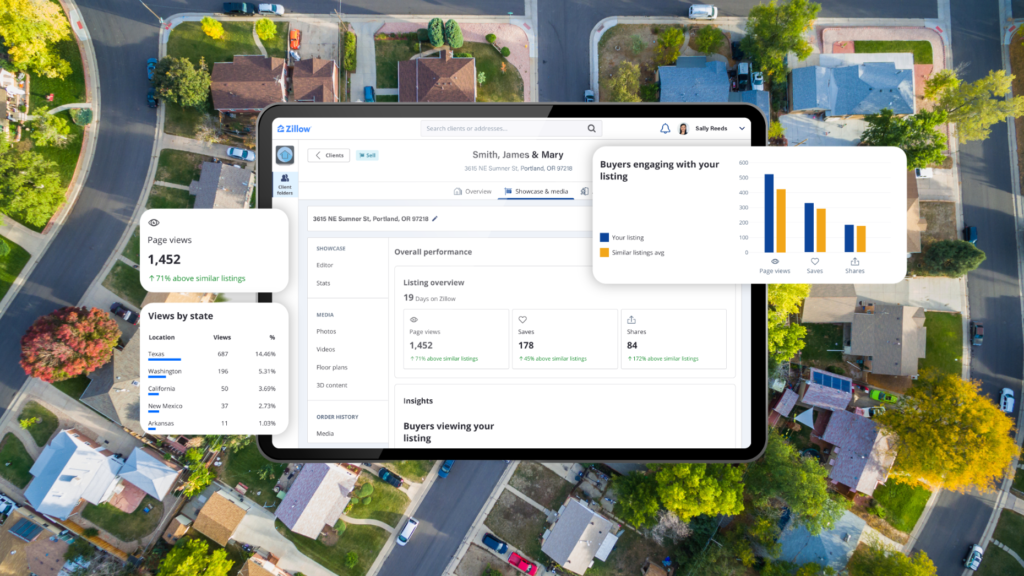
Available to agents whose sellers’ properties are leveraging Showcase, the insights dashboard is designed with transparency in mind, allowing agents to unravel which home features may be leading to more online attention.

Bigger. Better. Bolder. Inman Connect is heading to San Diego. Join thousands of real estate pros, connect with the power of the Inman Community, and gain insights from hundreds of leading minds shaping the industry. If you’re ready to grow your business and invest in yourself, this is where you need to be. Go BIG in San Diego!

Zillow is giving Listing Showcase an update that will provide users with a series of metrics for determining a property’s performance on the portal, an April 15 statement from the portal said.

Available to agents whose sellers’ properties are leveraging Showcase, the insights dashboard is designed with transparency in mind, allowing agents to unravel what home features may be leading to more online attention specific to location, for greater market-by-market accuracy.

“Now, agents have a clear picture of how their Showcase listing is performing over time with detailed insights, including page views, saves and shares, compared to similar non-Showcase listings on Zillow located in the same area,” Zillow said.

Showcase is an advanced service offered by Zillow that includes a suite of elevated marketing features, such as high-end photography and digital tours, interactive floor plans, prominent listing agent branding and other agency-grade benefits. The service was announced in 2023 in limited markets under the ShowingTime+ wing of Zillow, the consolidated offspring of its many marketing-focused acquisitions, including ShowingTime.

Upon its rollout, Mike Lane, vice president of ShowingTime+, described the tool in a statement as creating an “unmatched listing experience for agents and sellers.”

Zillow said it’s found listings enriched with Showcase sell for more money, to the tune of 2 percent. Its data also found that agents who use it in pitches to win business land the listing 20 percent more often than non-users.

Todd Chapman is a licensed real estate agent and the chief operating officer with Delhougne Realty Group in St. Louis, Missouri. He said in the Zillow statement that clients “love” seeing the statistics associated with their listing.

“We have more than a marketing tool,” Chapman said. “We have a way to bring more traffic to the home, which for us is turning into more showings, more offers and better outcomes for our sellers, and that is winning us more business.”

Website traffic statistics are powerful drivers of marketing decisions when used correctly. Most website content management systems (CMS) offer them down to the page level, and countless third-party software providers can do the same. It’s a big part of search engine marketing and website optimization. However, implementing such tools is commonly an afterthought, and a lot of sellers don’t think to ask about it, either.

Zillow’s advantage in this case is its vertical integration, not specifically the innovation. The fact that it’s included with what agents buy under the Showcase brand means a user can benchmark hard numbers against their marketing investment and also use the insights when working with stubborn or anxious sellers, as reports are downloadable.

“Showcase is all about helping agents deliver exceptional experiences to sellers and buyers. In doing so, agents build their own brand — which leads to winning more listings and growing their businesses,” said Cynthia Taylor, Zillow’s senior vice president of Agent Software & Advertising, in the release. “We’re integrating more insights and solutions into the tools agents use every day to make agents more efficient and ultimately more successful.”

Zillow’s impact on how listings are marketed is the industry’s hottest topic. The company has thrust itself into the now industry-wide Clear Cooperation melee by stating it will withhold properties from its website unless they are publicly marketed from the outset.

The decision, considered a gamble by many and a strong show of support by others, has been part of an inferno of hot takes, commentary and related moves, such as Washington-based Northwest MLS temporarily shutting down its IDX feed to Compass amid an ongoing conflict over private listings.

Email Craig Rowe

This post was originally published on this site