by Lillian Dickerson | Apr 22, 2025 | Industry, News Feed
Blaylock’s move to Sotheby’s International Realty comes about one week after Gino Blefari retired as CEO at HomeServices, and Chris Kelly stepped into the role. Blaylock will lead company-owned brokerage operations at the luxury brand.
Bigger. Better. Bolder. Inman Connect is heading to San Diego. Join thousands of real estate pros, connect with the power of the Inman Community, and gain insights from hundreds of leading minds shaping the industry. If you’re ready to grow your business and invest in yourself, this is where you need to be. Go BIG in San Diego!
Another leadership shakeup at HomeServices of America, Inc. has a new executive in at Sotheby’s International Realty.
Mary Lee Baylock, previous senior vice president at Berkshire Hathaway affiliate HomeServices of America, has been named president of brokerage at Sotheby’s International Realty, the firm announced on Monday.
TAKE THE INMAN INTEL SURVEY FOR APRIL
Blaylock will lead the luxury brand’s company-owned brokerage operations, which include overseeing 48 U.S. offices that encompass more than 2,300 affiliated agents who represented $20 billion in annual sales volume in 2024. At Sotheby’s Realty, she will work to enhance local market positioning and drive long-term growth.
“At every step in my career, I have admired Sotheby’s International Realty,” Blaylock said in a statement. “The brand has set the standard for client representation and marketing luxury homes worldwide. The reputation of the advisors affiliated with Sotheby’s International Realty is peerless, and I look forward to leveraging my expertise and passion to serve them.”
Sotheby’s International Realty President and CEO Philip White added that Blaylock’s track record would help propel the firm forward.
“Mary Lee’s extensive industry knowledge, proven leadership track record … and genuine ability to build strong relationships will undoubtedly drive our company-owned brokerage operations to new heights,” White said. “Our agents will benefit from her strategic vision, hands-on approach, and commitment to our extraordinarily high standards that will further equip our advisors to deliver unparalleled service and transact for their clients.”
HomeServices of America did not immediately respond to a request for comment on Blaylock’s move.
Blaylock has more than 30 years of residential real estate experience. Before serving as HomeServices of America’s senior vice president, she was president and CEO of Berkshire Hathaway HomeServices California Properties. While there, she helped spearhead the launch of the brand’s National Luxury Division and was in charge of 56 offices, 350 employees and 3,000 agents.
About a week ago, Gino Blefari, HomeServices’ previous president and CEO, announced his retirement into an advisory role at the company. Chris Kelly, who had been serving as executive vice president, has now stepped into the CEO role. The move occurred about a month after rumors swirled that Compass was potentially in talks to buy Berkshire Hathaway HomeServices. HomeServices of America denied the claims.
Blaylock has been named one of the 100 most powerful leaders in residential real estate by the Swanepoel Power 200 and was inducted into the RISMedia Hall of Fame in 2023.
Get Inman’s Luxury Lens Newsletter delivered right to your inbox. A weekly deep dive into the biggest news in the world of high-end real estate delivered every Friday. Click here to subscribe.
Email Lillian Dickerson
This post was originally published on this site
by Richelle Hammiel | Apr 22, 2025 | Industry, News Feed
In the first quarter of the year, 44.4 percent of homesellers included concessions in their deals, just shy of the record 45.1 percent seen at the start of 2023, according to new data released Monday by Redfin.
Bigger. Better. Bolder. Inman Connect is heading to San Diego. Join thousands of real estate pros, connect with the Inman Community and gain insights from hundreds of leading minds shaping the industry. If you’re ready to grow your business and invest in yourself, this is where you need to be. Go BIG in San Diego!
With mortgage rates elevated and economic uncertainty hanging in the air, homebuyer demand has taken a hit. But sellers are getting creative by offering concessions at near-record levels, according to data issued Monday by Redfin.
In the first quarter of 2025, a whopping 44.4 percent of homesellers offered concessions, short of a record 45.1 percent at the start of 2023, data shows. The concessions range from covering repairs to helping buyers with mortgage-rate buydowns — financial reprieves that can make a difference for first-time buyers.
TAKE THE INMAN INTEL SURVEY FOR APRIL
“Buyers used to ask for concessions to cover little things like repairs,” Redfin agent Chaley McVay said. “Now they’re negotiating concessions so they can afford to buy a home. A lot of sellers are offering money for mortgage-rate buydowns, and I had one seller cover seven months of HOA fees for the buyer.”
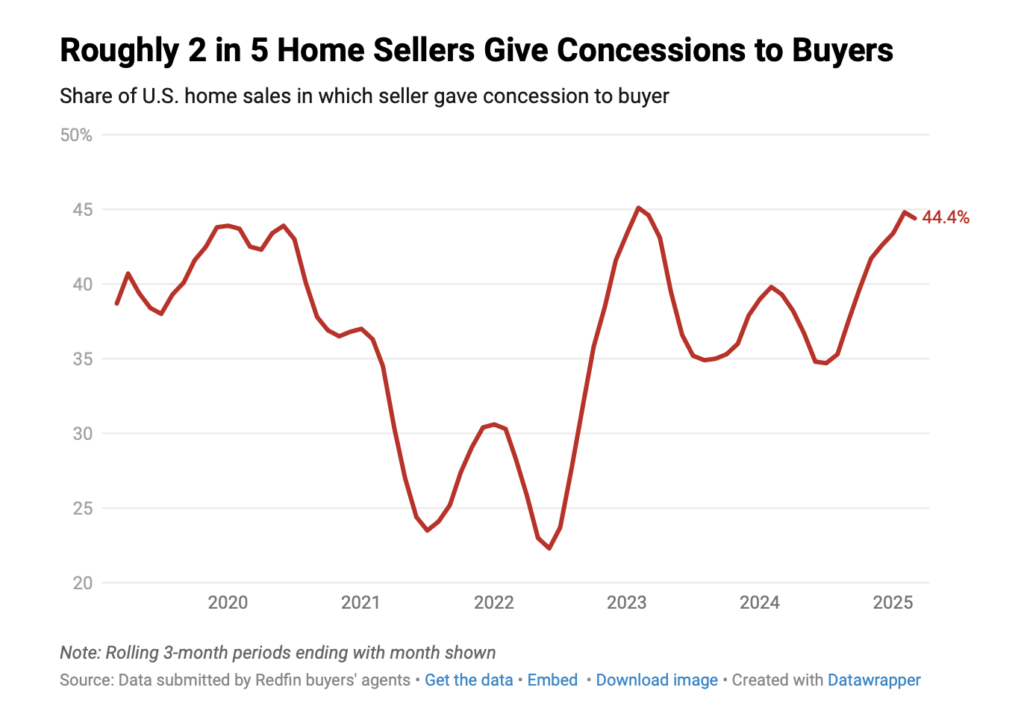
Data submitted by Redfin buyers’ agents
The rise in concessions isn’t merely about cautious buyers; it’s also a result of growing competition among sellers. Housing supply hit a five-year high in the first quarter, and with more inventory on the market, sellers are rushing to stand out without lowering listing prices. That’s where concessions come in.
Redfin’s data suggests that many of those homes are lingering unsold because they are overpriced. Instead of cutting the listing price outright, some sellers are using concessions to sweeten the deal, while protecting their asking price.
“Sellers are feeling nervous because a lot of them bought at the top of the market in 2021 and 2022, and will now be re-buying at a higher mortgage rate,” McVay added. “They’re worried about net proceeds. That’s why I recommend my buyers ask for concessions instead of a lower sale price—it can be a win-win because then the buyer is catching a break and the seller doesn’t have to go below the price they had in their head.”
This strategy has been especially prevalent in Seattle and Portland. In Seattle, concessions were offered in 71.3 percent of transactions in Q1, nearly double the 36.4 percent seen the year before. After those two cities, the highest concession rates were found in Atlanta, San Diego and Denver.
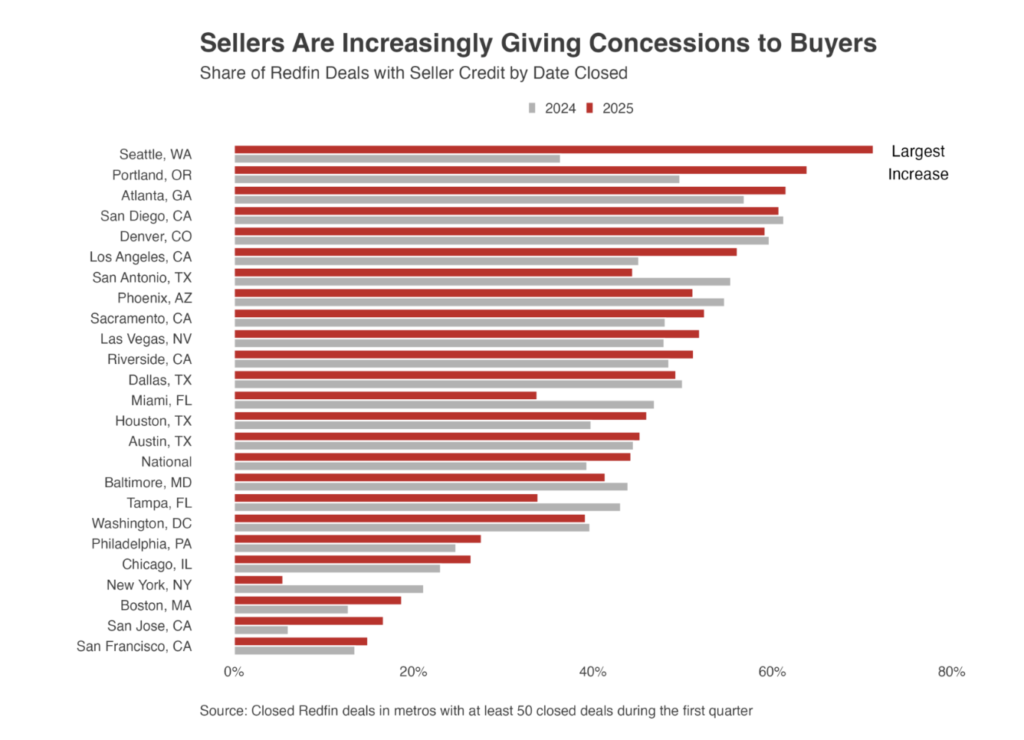
Closed Redfin deals in metros with at least 50 closed deals during the first quarter

Stephanie Kastner | Redfin Premier agent in Seattle
“It’s super common to see seller concessions for condos and new-construction townhomes, but less so for single-family homes—unless the single-family home has been sitting on the market for a while,” Stephanie Kastner, a Redfin Premier real estate agent in Seattle, said. “Condos have become a tougher sell because of skyrocketing HOA fees and insurance. And builders are offering concessions because it’s in their best interest to keep sale prices high; they’re willing to pay buyers’ closing costs and maybe provide a free washer-dryer if it means they don’t have to drop the listing price.”
On the other hand, some areas saw a sharp drop in concessions. New York had the lowest share in Q1, with just 5.5 percent of home sales including concessions — down nearly 16 percent in percentage points from the previous year. Miami (-13.1 ppts to 33.8 percent), San Antonio (-10.9 ppts to 44.4 percent), Tampa, Florida (-9.2 ppts to 33.9 percent) and Phoenix (-3.5 ppts to 51.2 percent) also saw noticeable declines.
Meanwhile, some sellers are deploying a combination of strategies. In the first quarter, aproximately 21.5 percent of homes sold below asking price and included a concession. About 16 percent of sales involved both a price cut and a concession, while 9.9 percent included a concession, price cut and a final sales price below the original listing price.
Still, not all buyers are biting. Economic uncertainty continues to loom, and many are walking away from deals.
Redfin reports that 13 percent of pending home sales were canceled in March, marking the third-highest March cancellation rate on record since 2017, behind only March 2020 during the early days of the pandemic.
Email Richelle Hammiel
This post was originally published on this site
by Kate Hulbert | Apr 22, 2025 | Industry, News Feed
Focus on being helpful, real and a little bit creative in your social media content, Kate Hulbert writes, and the engagement (and leads) will follow.
Bigger. Better. Bolder. Inman Connect is heading to San Diego. Join thousands of real estate pros, connect with the power of the Inman Community, and gain insights from hundreds of leading minds shaping the industry. If you’re ready to grow your business and invest in yourself, this is where you need to be. Go BIG in San Diego!
Let’s be honest — there’s a lot of real estate content out there, and not all of it is what you’d call scroll-stopping. But when done right, Instagram Reels can help you stand out, connect with your audience and show off your expertise (without feeling like a walking sales pitch).
TAKE THE INMAN INTEL SURVEY FOR APRIL
Whether you’re just dipping your toes into Reels or ready to level up your content game, here are five ideas to get those views — and clients — rolling in.
1. A day in the life (Yes, it’s more interesting than you think)
Let’s face it — people love peeking behind the curtain. “Day in the Life” Reels are a tried-and-true way to show off the real (and really busy) world of real estate.
From early morning coffee runs to afternoon showings and late-night paperwork, these Reels give your audience a glimpse into the hustle and heart behind your business.
Don’t be afraid to show the messy middle — missed calls, spilled coffee or a deal that almost fell through. It makes you human, and that builds trust.
Inspiration: This agent does a great job of weaving both her personal and professional life together on her Instagram page.
2. What you get for [insert price point]
Instead of another “Just Listed” post that disappears into the scroll void, try a Reel that shows what buyers can actually get at different price points. Whether it’s a cozy condo under $400,000 or a million-dollar mountain view, this format is endlessly clickable — and super helpful.
Break it down by budget, neighborhood or property type. Just make sure to get the listing agent’s permission if the property isn’t yours.
Inspiration: We threw together this “What You Get For” Reel without leaving our desk, and it got a ton of shares and sends.
3. What’s happening around town? (Hint: You probably already know)
You’re already in the know when it comes to local happenings — use that to your advantage. Whether it’s a new restaurant opening, a development breaking ground or a community event you’re excited about, share it.
Not only do these Reels show that you’re dialed into the local scene, but they also reach people who may not be following you for real estate but end up following you because of your local expertise.
These Reels often perform better than listing content. People want to know what it’s like to live in a place — not just what the houses look like.
Inspiration: Reels like this one are consistently the highest performing for our office. They help us reach a whole new audience, just by getting shared.
4. Neighborhood spotlights (because people don’t just buy homes — they buy a lifestyle)
Think of this like the highlight reel of your favorite parts of town. What’s the vibe? Where’s the best happy hour? What’s the trail that locals actually use?
Use Reels to spotlight neighborhoods, parks, schools, coffee shops — anything that gives potential buyers a feel for the community. Keep it real, and include things locals actually care about — walkability, dog-friendly spots and the best place to get a strong cup of coffee.
You’re not just selling square footage — you’re selling a lifestyle.
5. Real estate tips (that aren’t boring)
Short, punchy, and packed with value — that’s the secret sauce for educational Reels. Teach your audience something — how to make a stronger offer, the biggest mistakes first-time buyers make or what in the world an appraisal gap is.
The more people learn from you, the more likely they are to trust you when it’s time to make a move. Don’t be afraid to grab viewers’ attention with a hook. Try titles like: “Please don’t buy a house until you hear this,” “How to not overpay in this market,” and “3 mistakes buyers make (and how to avoid them).”
Inspiration: This agent is consistently putting out educational-style Reels with unique and catchy topics.
Instagram Reels don’t have to be complicated — they just need to be you. Focus on being helpful, real and a little bit creative, and the engagement (and leads) will follow. Whether you’re showing off listings, sharing your expertise, or simply introducing your favorite local spot, remember: your personality is your brand.
Kate Hulbert is the marketing director at Bozeman Real Estate Group in Bozeman, Montana. Follow her on Instagram or Facebook.
This post was originally published on this site
by Summer Goralik | Apr 22, 2025 | Industry, News Feed
Bigger. Better. Bolder. Inman Connect is heading to San Diego. Join thousands of real estate pros, connect with the power of the Inman Community, and gain insights from hundreds of leading minds shaping the industry. If you’re ready to grow your business and invest in yourself, this is where you need to be. Go BIG in San Diego!
Right now, the real estate industry is duking it out — in courtrooms, in op-eds, in comment sections and behind closed doors. Everyone seems to be talking about market access, control and consumer choice.
But there’s another group in the room. One that isn’t yelling or scrambling to win the argument. They’re listening. They’re observing. And they’re preparing.
TAKE THE INMAN INTEL SURVEY FOR APRIL
I just returned from the Arello mid-year meeting, where I had the opportunity to deliver a keynote to state regulators from across the country. It was a wonderful departure for me because I am usually teaching an audience full of agents about the value of compliance and how to execute it.
By contrast, these distinguished state regulators didn’t just receive the memo — they wrote it, lived it and enforced it.
Notably, these officials aren’t caught up in the drama of residential real estate. They’re focused on the fundamentals: compliance, consumer protection and how to evolve their oversight in a fast-changing industry landscape.
They sat in sessions about the Clear Cooperation Policy (CCP), Private Listing Networks (PLNs), seller discretion, and potential buyer disadvantage. They explored the National Association of Realtors’ (NAR) new Delayed Marketing Exempt Listing status, as well as Zillow’s recent policy: a listing available to any consumer should be available to all consumers.
In fact, these regulators even heard arguments on both sides, some invoking “seller choice,” others advocating for complete transparency and access. But regulators don’t need to get bogged down in the fight. Their role is quite different.
They’re here to protect the public. They don’t just say their north star is the consumer, they have laws to enforce that mandate it. And listen: They’re paying close attention to how these issues are unfolding.
READ INMAN’S PORTAL LISTING BAN FAQ
In my talk, I urged regulators to focus on what I refer to as the common denominators that still govern this business, regardless of policy shifts and new practice rules: fiduciary duty, disclosure and broker supervision.
These aren’t just buzzwords. They are the legal pillars that support every licensee’s practice and bestow upon it a badge of requisite duty and care that must be worn throughout every client engagement. And if brokers lose or misplace that badge, or if their agents do, that’s when liability enters the picture.
Who’s behind door No. 3?
Here’s the deal: All this time, we’ve been focused on Door No. 1, where the NAR sits, hoping they’ll solve the industry’s transparency problem by either strengthening or repealing the Clear Cooperation Policy. Then there’s Door No. 2, the Department of Justice, with its sweeping statements and antitrust scrutiny, capturing headlines and rattling cages.
But almost no one’s been looking behind Door No. 3: the state regulators.
Quietly and methodically, they’ve been watching. And unlike the others, they don’t need a new lawsuit or a policy overhaul to take action. They’re already empowered by statute. They have the authority, the access, and in many cases, the will to act. To hold bad actors accountable. To educate the public. Not through lobbying, but through enforcement.
Sometimes, it only takes one investigation to spark a fire. One that spotlights unlawful conduct, consumer harm, fair housing concerns, or breaches of fiduciary duty. In other words, the moments when an agent’s or broker’s financial incentives were put ahead of their clients’ best interests.
Imagine a DRE investigation
I have written a piece about the line of questioning that might arise during a regulatory review of an off–multiple listing service listing, commonly referred to as an off-MLS listing. I even curated an imaginary courtroom scene to make a point.
But after having spent some valuable time with regulators, I was reminded that their enforcement teams are the ones on the street, learning in real-time how this is all playing out — or where agents are failing.
Here’s a potential scenario to consider: An investigator walks into a broker’s office, without warning, and speaks to the Broker of Record or office manager.
Even simple questions like these could cause a light sweat from whoever’s being asked:
1. Office policies and business strategy
- Do you have any policy covering off-MLS listings? If so, please provide a copy.
- Can you explain your brokerage’s off-MLS policies in detail?
- Please provide all advertising materials, scripts, and listing presentations used by your agents that reference or promote off-MLS listing strategies.
- The Department is informed that you recommend sellers engage in a pre-marketing strategy that may not result in the property being listed on the MLS at all. Is that accurate? Please explain.
- What is the rationale behind your pre-marketing strategies?
- Do your seller clients request or direct that their listings be kept off the broader market, or are your off-MLS listings the result of a broader brokerage strategy? Please explain.
- How does your brokerage supervise off-MLS listings and sales? Please provide a copy of any established policies, procedures, rules, and systems used to oversee and manage the firm’s real estate activities and overall brokerage compliance.
2. File review and listing data
- How many listings have been marketed off the MLS so far this year? Please provide a copy of all listing files where properties were initially marketed off the MLS, along with contact information for all parties involved.
- Do your off-MLS listings include listing data such as days on market (DOM) or price change history?
- Do you represent buyers in connection with off-MLS listings held by your brokerage?
- Do you disclose to these buyers that DOM and price change history are not available?
- Do the buyers you work with understand that key listing data has been withheld?
3. Disclosures and dual agency practices
- Please provide a copy of the disclosures you provide to sellers regarding off-MLS listings.
- How many off-MLS listing sales have resulted in dual agency this year? Please provide a copy of all completed sales files where your brokerage acted as a dual agent.
- Do you have any written policy on dual agency? If so, please provide a copy.
- Do you train your agents on dual agency practices? If so, please provide a copy of your training materials.
- When the brokerage acts as a dual agent, can you explain, in compliance terms, how disclosure was provided and informed consent obtained? What was done for both sides?
These aren’t abstract hypotheticals. These are the kinds of questions that surface when regulators start looking closely.
Of course, not every off-MLS listing is problematic.
If the strategy was truly driven by a seller’s individual preference or need, not pushed or packaged as a default, then the evidence will set the brokerage free. The disclosures will reflect informed decision-making. The file will speak for itself.
And when that happens, regulators can see that the brokerage upheld its fiduciary duty, prioritized the client’s best interest and did not sacrifice transparency for the sake of convenience, control or financial self-interest.
But when that narrative doesn’t hold, when the rationale for avoiding the MLS looks more like a business strategy than a client-specific need, that’s when real trouble begins.
Brokers and agents, don’t mistake business creativity for legal immunity. The strategies you adopt now may look sharp on a listing pitch deck or boost your company’s bottom line, but they can just as easily look suspect in a regulatory file.
A good rule of thumb in the regulatory world is this: One consumer complaint might be a “one-off,” a hiccup or a random fly in the ointment (something that can be explained away or defended). But when those complaints start to multiply and full-scale marketing plans clearly show that off-MLS listings have become the company norm rather than the client exception, patterns of unlawful conduct begin to emerge.
Regulators love a good pattern. It makes their job much easier and significantly weakens any brokerage’s ability to mount a credible defense.
And here’s the thing: Consumers don’t know what they’re not being told. But regulators do. And maybe — just maybe — they’ll be the ones who ultimately decide this debate about the CCP and PLNs.
Let’s be clear. It’s state regulators who can educate the public en masse on how these off-MLS tactics undermine trust, reduce access and favor the few over the many. More importantly, they have the power to act — not through noise, but through enforcement.
And that kind of action speaks louder than any industry talking point ever could.
Step back and see the whole board
It’s easy for some to get swept up in one side of the argument, to wave the flag of seller empowerment or champion transparency and consumer choice. But state regulators aren’t interested in which side you choose; they’re not caught up in the chaos. They care about whether both sides of a transaction are properly represented by licensees who understand and uphold their fiduciary duties.
So step away from the brokerage strategy for a moment. Put down the marketing plans, compensation models, policy debates and form revisions. Go back to the basics, back to what you learned when you first entered this profession. What does it really mean to be a fiduciary? (And no, reading about it in a LinkedIn thread doesn’t count.)
Brokers and agents must have a full command of the facts, the law and their obligations — not just for their own protection, but to truly serve the clients who’ve entrusted them as advocates and advisors.
That’s the big picture. Don’t lose sight of it.
The tell at the table
This industry feels more and more like a high-stakes poker game. The second one player lays down their hand, another is “calling it,” then revealing a monster.
Brokers, agents, tech platforms, portals, advocacy groups — everyone’s at the table. But there’s a new presence pulling up a chair: state regulators. Truthfully, they’ve been there the whole time, quietly observing, studying the players and their moves. Now, they’re learning the new game that is the evolving real estate landscape.
There’s a line in the film Rounders (a must-watch, if you haven’t seen it) that fits this moment perfectly. In a voiceover, Matt Damon’s character, Mike McDermott, narrates the rhythm of high-stakes poker:
“Listen, here’s the thing. If you can’t spot the sucker in your first half hour at the table, then you are the sucker.”
It’s not just a clever line. It’s a brutal truth that cuts across industries. And in real estate, the “sucker” could easily be the misguided agent or broker who doesn’t realize they’re holding a losing hand, the one who misreads the room, doubles down on a risky strategy or underestimates the role of the regulator.
Because the stakes aren’t just money. The stakes are consumer protection, public trust and the reputations — even the licenses — of those involved.
Some may think they’re too slick to get caught. They hedge. They dodge. They bet big on words like “choice” and “freedom.” They build models that rely on consumers not knowing what they’re missing, not seeing the full picture — which, by the way, is the textbook definition of non-disclosure. And all the while, perhaps they’re betting on regulators not asking the right questions, not exposing what’s really happening behind off-MLS listings.
But here’s the reality: Regulators are asking the right questions. They’re spotting the tells. They’re not here to play, they’re here to protect. Just as easily as licenses are issued by the state, they can be taken away.
It’s worth noting that for brokerages licensed in multiple states, a single enforcement action in one jurisdiction can trigger a cascade of consequences across others. In short, the power of enforcement has a snowball effect. What begins as a local issue can quickly escalate into a multistate liability.
So before you go all in on that off-MLS listing pitch or commit to a dual agency arrangement involving an office exclusive, ask yourself:
- Are you truly acting as a fiduciary?
- Is this brokerage strategy or the consumer’s best interest?
Or put another way:
- Are you just hoping no one calls your bluff?
The next round is underway, and it’s become increasingly clear to me that agents must do more than just play smart and play honest — they must play the fiduciary, always, and especially in times of industry change.
The DOJ may have a dog in the fight, but don’t underestimate state regulators. They’ve been in it all along, and the industry seems to have forgotten that they’re closer to the action than anyone.
These are the officials tasked with overseeing licensees, upholding the law and protecting consumers in every transaction. Investigators are on the ground right now, watching how all of this is playing out. They’re interacting with consumers and learning how the push to stay off the MLS was driven, whether by client need or brokerage strategy.
Don’t believe it? That’s your bet, but the odds may not be in your favor. Last week, I had a front-row seat to the regulator perspective, and I can tell you — the writing is already on the wall. Why? Because that writing isn’t just a warning. It’s the law. And state regulators are ready to hold the line.
NOTE: The opinions, suggestions, and recommendations contained in this discussion are based on Summer Goralik’s experience working for the California Department of Real Estate and as a real estate compliance consultant. They should not be considered legal advice or relied upon as such. You should consult with your brokerage and/or appropriate legal counsel in your jurisdiction for further clarification.
This post was originally published on this site
by Jessica Souza | Apr 22, 2025 | Industry, News Feed
Bigger. Better. Bolder. Inman Connect is heading to San Diego. Join thousands of real estate pros, connect with the power of the Inman Community, and gain insights from hundreds of leading minds shaping the industry. If you’re ready to grow your business and invest in yourself, this is where you need to be. Go BIG in San Diego!
Let’s be real: real estate is more than just showing pretty homes and snapping cute closing-day photos. It’s building a business from scratch—and not just any business, but one that’s sustainable, scalable and dare I say … enjoyable?
TAKE THE INMAN INTEL SURVEY FOR APRIL
But here’s the kicker: Most agents, whether they’re just getting started or sitting comfortably at top-producer status, never actually take the time to build the foundation that allows for any of that. I coach agents at all stages, and let me tell you — burnout doesn’t discriminate. Even the high performers hit a wall eventually.
And honestly? Some of my favorite transformations come from those very agents. The ones who think they’ve peaked, but come to realize that they’ve been operating at full speed on shaky systems. When they take the time to pause, double back and finally set up what they should’ve set up from the beginning, that’s when the magic happens. That’s when they stop spinning and start scaling.
So what’s the solution? It’s not a reinvention. It’s a reset.
Not a burn-it-all-down kind of moment, but a return to the business basics — the kind that make everything else easier, lighter and more profitable.
If you’re ready to future-proof your real estate business (and finally give your peace of mind a seat at the table), here are five essentials to get you started.
1. Create a repeatable client experience
You don’t need to be fancy. You just need to be consistent.
Whether a client is buying their first home or selling their fifth, they deserve the same white-glove service, and you deserve a process that doesn’t keep you up at night wondering what step you forgot.
Here’s the secret: checklists. Yep, we’re starting there. Because if your workflow is living in your head or scribbled on random Post-its, things will fall through the cracks—and usually at the worst possible moment.
Build checklists for:
- Buyer onboarding
- Seller prep
- Contract-to-close
- Post-closing follow-up
- & everything in between!
Use tools like Asana, ClickUp or a real estate CRM like BoldTrail to keep things clean, clear and collaborative. When you create a rinse-and-repeat client experience, you free yourself up to focus on the relationship — and that’s what creates referrals and repeat clients.
2. Templatize your communication
Let’s stop romanticizing writing every email from scratch.
Templating is not impersonal; it’s efficient. It’s how you show up professionally, consistently and sanely without sacrificing your voice.
Take your most-used emails and systematize them:
- Welcome emails for buyers/sellers
- Contract milestone updates
- Inspection and appraisal guidance
- Final walkthrough instructions
- Closing day celebrations
Save them in your CRM or even a shared Google Doc. Add a few customizable fields so you can sprinkle in the personal touch (hello, merge tags), but the heavy lifting is done.
Now your team can send on your behalf, or you can hit send in under 30 seconds. Your future self, who’d rather be sipping coffee than retyping inspection tips for the sixth time this week, will thank you.
3. Systematize so someone else can step in (or so you can step out)
I say this with love: You can’t be the only system in your business.
If everything depends on your brain, your hands or your availability, you’re not building a business — you’re building a bottleneck.
Instead, set up your operations so someone else can jump in without skipping a beat. Whether you’re onboarding an assistant, hiring a transaction coordinator or dreaming of a sabbatical (yes, it’s possible), your systems should be documented and easy to follow.
Start here:
- Centralized cloud storage (Google Drive, Dropbox, etc.)
- Clearly labeled folders and files
- Shared calendars with transaction timelines
- Standard operating procedures (SOPs) for everything from listing launch to under-contract workflows
Think of your business like a relay race. The baton (AKA transaction) should be able to pass smoothly from person to person. That’s how you create a business that doesn’t crumble when you finally take that vacation you keep postponing.
4. Plan your marketing like the CEO you are
Raise your hand if you’ve ever posted on social media just because it had been “too long.”
Yeah, we’ve all been there. Reactive marketing is exhausting and ineffective.
Here’s what future-proofing looks like: planning ahead. You don’t need a 37-tab spreadsheet, but you do need to know what your marketing is doing month to month.
Block out a few hours each quarter to map out:
- Open house plans
- Listing pipeline and promotional timelines
- Monthly content themes (think: market insights, neighborhood highlights, behind-the-scenes)
- Client touchpoints, pop-bys and events
Batch your content. Schedule it in advance with tools like Later or Canva. This allows your brand to show up even when life gets busy, or the market throws you a curveball.
You’ll feel like a real CEO, not just someone scrambling to stay visible.
5. Reconnect with your ‘why’
I’m going to get a little “woo” here for a minute. But, here’s what no checklist or CRM can fix: building a business that looks great on paper but doesn’t light you up.
When you’ve been running on autopilot, saying yes to everything and checking all the boxes, it’s easy to wake up one day and think, Wait… do I even like this anymore?
That’s when it’s time to come back to your why.
Ask yourself:
- Why did I start this business?
- What kind of life do I want it to support?
- Am I aligned with the people I want to serve?
Your “why” should be more than a motivational poster. It should be your business compass — guiding decisions about your marketing, your systems, your boundaries and your time.
Write it down. Say it out loud. Recommit to it. When your business supports your life (not the other way around), that’s when the magic happens.
This is your permission slip to reset.
You don’t need a full rebrand, a new website or another certification to move forward. What you need is space to pause, zoom out and get intentional about the business you’re building.
These five steps may not be the flashiest, but they are foundational. They’re how you shift from reactive to proactive. From chaos to clarity. From survival mode to CEO energy.
So here’s your invitation to reset — and if it happens to feel a little more fun and a lot less stressful along the way? Even better.
Jessica Souza is a broker-owner and author. Connect with her on LinkedIn and Instagram.
This post was originally published on this site
by Taylor Anderson | Apr 21, 2025 | Industry, News Feed
Judge Stephen Bough refused to recuse himself from a case involving Hanna Holdings, saying their attorneys already had a chance to flag an apparent conflict. Hanna attorneys say it’s not true.
Bigger. Better. Bolder. Inman Connect is heading to San Diego. Join thousands of real estate pros, connect with the Inman Community and gain insights from hundreds of leading minds shaping the industry. If you’re ready to grow your business and invest in yourself, this is where you need to be. Go BIG in San Diego!
Attorneys for Hanna Holdings, the parent company of Howard Hanna Real Estate Services, are doubling down on efforts to remove Judge Stephen R. Bough from the Gibson commission lawsuit, according to legal papers filed Friday.
The latest missive — filed in the Western District of Missouri, where Bough is overseeing settlment talks with defendants Hanna Holdings, Berkshire Hathaway Energy and Crye-Leike — calls into question a claim made earlier this month in which Bough reminded the attorneys that he had already offered an opportunity to call for his recusal in May 2024.
Hanna attorneys, however, insist they weren’t in the room.
“Hanna Holdings writes to clarify that its local counsel was not in the courtroom for the final settlement hearing on May 9, 2024,” David Z. Gringer, a Hanna Holdings attorney, wrote in the filing, adding that he also checked with staff to determine if any attorney attended the meeting and found none who had.
The letter is the latest in a legal back-and-forth between the largest remaining real estate defendants still battling plaintiffs in court over the Gibson antitrust allegations.
At a hearing in May 2024 that included attorneys for real estate defendants and homeseller plaintiffs who filed the antitrust lawsuit, Bough went around the room and asked lawyers in the case if they wanted him to recuse himself over donations that attorneys in the case made to his wife’s city council campaigns.
Earlier this month, Bough cited his recollection of that hearing in an order denying the request by defendants that he step aside as a result of the campaign contributions.
In response, Hanna Holdings attorneys wrote in a letter on Friday that they have no evidence that anyone representing the Pennsylvania-based brokerage was at the hearing. Additionally, the law firm didn’t submit any time entries to Hanna Holdings for work done in May 2024, and Hanna Holdings wasn’t a named defendant in the case.
“In sum, Hanna Holdings is confident that no attorney of any law firm representing Hanna Holdings in this litigation attended the final settlement hearing in [Sitzer | Burnett]. And it is likewise confident that the representations in the sworn declarations submitted alongside its motion for recusal were accurate.”
Hanna Holdings attorneys have maintained that they only recently discovered the potential conflict of interest and demanded that Bough recuse himself shortly after the discovery.
They have pointed out that Bough recused himself in a separate, unrelated case in Missouri after defendants in that case also raised the apparent conflict of interest.
In his order denying the recusal demand, Bough speculated Hanna Holdings wasn’t as concerned about ethics as it was about a string of recent court denials in the Gibson case.
“The timing of Hanna Holding’s motion is noteworthy as it occurred after the court denied its motion to dismiss in December 2024 and motion to certify an interlocutory appeal in February 2025. Based on this timing, it appears Hanna Holdings’ motivations may have been driven more by ‘litigation strateg[y] than by ethical concerns.’”
The three real estate companies are also seeking to have the case transferred to courts in their home states. Bough has yet to rule on those requests.
Email Taylor Anderson
This post was originally published on this site