From 2020 to 2025, the number of cities with million-dollar starter homes has grown from 85 to 233. Twenty five states had these cities, with California and New York having the highest concentration.
Bigger. Better. Bolder. Inman Connect is heading to San Diego. Join thousands of real estate pros, connect with the Inman Community and gain insights from hundreds of leading minds shaping the industry. If you’re ready to grow your business and invest in yourself, this is where you need to be. Go BIG in San Diego!
Although the pandemic buying boom is over, it continues to impact consumer expectations and pricing trends throughout the country. Although the typical starter home is still below $200,000, there are a growing number of cities with starter homes priced at $1 million or more — a steep price for a first-time buyer.
According to Zillow’s latest market report, the number of cities with $1 million starter homes has grown from 85 in 2020 to 233 in 2025, representing a 174 percent increase. California (113), New York (32), New Jersey (20), Massachusetts (11) and Florida (11) lead the way in the number of cities with seven-figure starter homes, with the remaining 20 states having at least one city where the median starter home clocks in at $1 million.
Kara Ng | Credit: LinkedIn
On a metro level, the New York City metro area, which includes parts of New Jersey and Pennsylvania, has 48 cities with $1 million starter homes. The San Francisco metro has the next-highest count at 43, Zillow said, followed by Los Angeles (34), San Jose (16), Miami (8) and Seattle (8).
Zillow Senior Economist Kara Ng said the report underpins the volatility of today’s market, which has led would-be homebuyers to delay their homeownership dreams. First-time homebuyer activity dropped to a new low in 2024, with the National Association of Realtors reporting this demographic only accounted for 24 percent of sales. The median age for first-time buyers also increased from 25 to 38, a new high since NAR began tracking sales.
“First-time buyers are facing a market where prices that once seemed unimaginable have become reality,” Ng said in a prepared statement.
Despite the growth in $1 million starter homes, Ng said there’s still plenty of opportunities for buyers to thrive.
The latest slate of existing-home and new-home sales data shows increasing inventory levels, which led to softening home price growth for existing stock and price declines for new builds.
“The encouraging news for buyers is that starter homes remain well below $1 million in most of the country,” Ng said. “With more homes hitting the market, listings lingering longer, and sellers cutting prices at record rates, buyers are starting to regain some negotiating power.”
From 2020 to 2025, the number of cities with million-dollar starter homes has grown from 85 to 233. Twenty five states had these cities, with California and New York having the highest concentration.
Bigger. Better. Bolder. Inman Connect is heading to San Diego. Join thousands of real estate pros, connect with the Inman Community and gain insights from hundreds of leading minds shaping the industry. If you’re ready to grow your business and invest in yourself, this is where you need to be. Go BIG in San Diego!
Although the pandemic buying boom is over, it continues to impact consumer expectations and pricing trends throughout the country. Although the typical starter home is still below $200,000, there are a growing number of cities with starter homes priced at $1 million or more — a steep price for a first-time buyer.
According to Zillow’s latest market report, the number of cities with $1 million starter homes has grown from 85 in 2020 to 233 in 2025, representing a 174 percent increase. California (113), New York (32), New Jersey (20), Massachusetts (11) and Florida (11) lead the way in the number of cities with seven-figure starter homes, with the remaining 20 states having at least one city where the median starter home clocks in at $1 million.
Kara Ng | Credit: LinkedIn
On a metro level, the New York City metro area, which includes parts of New Jersey and Pennsylvania, has 48 cities with $1 million starter homes. The San Francisco metro has the next-highest count at 43, Zillow said, followed by Los Angeles (34), San Jose (16), Miami (8) and Seattle (8).
Zillow Senior Economist Kara Ng said the report underpins the volatility of today’s market, which has led would-be homebuyers to delay their homeownership dreams. First-time homebuyer activity dropped to a new low in 2024, with the National Association of Realtors reporting this demographic only accounted for 24 percent of sales. The median age for first-time buyers also increased from 25 to 38, a new high since NAR began tracking sales.
“First-time buyers are facing a market where prices that once seemed unimaginable have become reality,” Ng said in a prepared statement.
Despite the growth in $1 million starter homes, Ng said there’s still plenty of opportunities for buyers to thrive.
The latest slate of existing-home and new-home sales data shows increasing inventory levels, which led to softening home price growth for existing stock and price declines for new builds.
“The encouraging news for buyers is that starter homes remain well below $1 million in most of the country,” Ng said. “With more homes hitting the market, listings lingering longer, and sellers cutting prices at record rates, buyers are starting to regain some negotiating power.”
Attorney General Matthew Platkin is the latest to narrow in on the apartment data giant, alleging it operated as a ‘cartel’ along with some of the nation’s largest property management firms.
Bigger. Better. Bolder. Inman Connect is heading to San Diego. Join thousands of real estate pros, connect with the Inman Community and gain insights from hundreds of leading minds shaping the industry. If you’re ready to grow your business and invest in yourself, this is where you need to be. Go BIG in San Diego!
The apartment data firm RealPage is facing yet another legal challenge over its rent-setting technology. This time, New Jersey has the firm in its crosshairs.
New Jersey Attorney General Matthew Platkin on Wednesday filed a lawsuit against Texas-based RealPage and 12 property management and development firms, including some of the nation’s largest. The suit alleges RealPage colluded with the firms to unfairly raise rent prices, violating state and federal antitrust laws as well as consumer protection laws.
“The defendants in this case unlawfully lined their pockets at the expense of New Jersey renters who struggled to pay the increasingly unlivable price levels imposed by this cartel,” Platkin said in a statement. “Today we’re holding them accountable for unlawful conduct that fueled the state’s affordable housing crisis and deprived New Jerseyans of their fundamental right to shelter.”
The complaint largely makes similar allegations against RealPage and the property management firms that have been made by a handful of other lawsuits filed in other states.
Platkin’s lawsuit takes aim at price-setting algorithms RealPage created and licensed to its clients, who in the past agreed to share data and receive guidance on rent increases to optimize occupancy of their buildings.
“Stated simply, these products employ statistical models that use data—including proprietary, non-public data—to estimate supply and demand for multifamily housing that is specific to particular geographic areas and unit types, and then generate a price to charge for renting those units that maximizes the landlord’s revenue,” Platkin’s office said in a statement.
“The complaint asserts the RealPage software is anticompetitive by design because it restricts meaningful price reductions and facilitates collective action to push rents higher,” it continued.
Among the companies listed as defendants are three of the largest property management firms in the country, along with large landlord companies in New Jersey.
Morgan Properties Management Company
AvalonBay Communities
Kamson Corp
LeFrak Estates
Realty Operations Group
Greystar Management Services
Aion Management
Cammeby’s Management
Veris Residential
Russo Property Management
Bozzuto Management Company
Greystar manages 946,742 units as of 2025, according to the National Multifamily Housing Council. Bozzuto manages 121,232 units, and AvalonBay manages 86,753 units.
The other defendants aren’t within the top 50 among property managers in the U.S., according to the NMHC.
The company is facing lawsuits in Washington D.C., as well as with a handful of states that filed a lawsuit against the company.
Each of the suits takes aim at the company’s rent-pricing algorithms and also names large landlords as defendants.
RealPage and other defendants have filed motions to dismiss the U.S. vs. RealPage case this month. The judge in that case has yet to rule on the motion.
RealPage also filed a lawsuit of its own earlier this month, challenging Berkeley, California’s ban on rent-setting algorithms.
RealPage responds
In response to the lawsuit, RealPage said that it was “disappointed” by Platkin’s lawsuit, which a spokeswoman for the company said was “recycling the inaccuracies of predecessor cases to blame RealPage for New Jersey’s housing affordability challenges.”
“Today’s action against RealPage was a surprise, as there were no efforts by them to engage with RealPage prior to filing the lawsuit, further underscoring the problem with this process and the politics in play,” RealPage spokeswoman Jennifer Bowcock told Inman in a statement.
Throughout numerous lawsuits and class action complaints across the country, RealPage has maintained that its software was designed to be legally compliant.
“RealPage’s revenue management software helps housing providers comply with Fair Housing laws, rent control laws and state of emergency price gouging laws, and does not use any personal or demographic data to generate rent price recommendations,” Bowcock said. “New Jersey residents deserve real solutions to increase access to affordable housing.”
She called on the state to focus on policy reforms that would increase housing supply to drive down prices.
Existing-home sales decreased by 5.9 percent from February and by 2.4 percent from March 2024 as homebuyers continued to deal with affordability challenges, said NAR Chief Economist Lawrence Yun.
Bigger. Better. Bolder. Inman Connect is heading to San Diego. Join thousands of real estate pros, connect with the Inman Community and gain insights from hundreds of leading minds shaping the industry. If you’re ready to grow your business and invest in yourself, this is where you need to be. Go BIG in San Diego!
Existing-home sales fell in March to their slowest pace since the subprime mortgage crisis in 2009 as high home prices and mortgage rates continued to impede buyers, data released Thursday by the National Association of Realtors shows.
Sales dropped in all four major regions month over month, with total existing-home sales decreasing by 5.9 percent from February to a seasonally adjusted annual rate of 4.02 million in March. On an annual basis, sales dropped by 2.4 percent from March 2024’s rate of 4.12 million.
Economists had pegged March 2025’s existing-home sales to hit closer to 4.13 million units.
“Homebuying and selling remained sluggish in March due to the affordability challenges associated with high mortgage rates,” NAR Chief Economist Lawrence Yun said in a statement. “Residential housing mobility, currently at historical lows, signals the troublesome possibility of less economic mobility for society.”
Total inventory hit 1.33 million units in March, which was up 8.1 percent month over month, and up 19.8 percent year over year. At the current sales rate, unsold inventory is at a 4 month supply, which is up from 3.5 months in February 2025 and up from 3.2 months in March 2024.
The median existing-home sale price across all housing types rose 2.7 percent year over year to $403,700.
“In a stark contrast to the stock and bond markets, household wealth in residential real estate continues to reach new heights,” Yun added.
“With mortgage delinquencies at near-historical lows, the housing market is on solid footing. A small deceleration in home price gains, which was slightly below wage-growth increases in March, would be a welcome improvement for affordability. With real estate asset valuation at $52 trillion, according to the Federal Reserve Flow of Funds, each percentage point gain in home prices adds more than $500 billion to the household balance sheet.”
Homes typically stayed on the market for 36 days in March, according to the Realtors Confidence Index, down from 42 days in February and up from 33 days the year prior.
First-time homebuyers made up 32 percent of March home sales, up slightly from 31 percent in February and equal to March 2024.
Cash deals represented 26 percent of transactions, down from 32 percent in February and 28 percent in March 2024. Individual investors and second homebuyers (who represent many cash sales) bought 15 percent of homes in March, which was nearly equal to February 2025 and March 2024 figures.
Single-family sales declined 6.4 percent from February to a seasonally adjusted annual rate of 3.64 million, which was down from 2.2 percent in March 2024. Existing condo and co-op sales stayed flat month over month at a seasonally adjusted annual rate of 380,000 units, down 5 percent from the previous year.
By region
In the Northeast, existing-home sales dropped 2 percent from February to an annual rate of 490,000. The median price rose 7.7 percent annually to $468,000.
In the Midwest, existing-home sales dropped 5 percent from February to an annual rate of 950,000. The median price rose 3.5 percent annually to $302,100.
In the South, existing-home sales declined 5.7 percent from February to an annual rate of 1.81 million. The median price ticked up 0.6 percent on an annual basis to $360,400.
In the West, existing-home sales tanked 9.4 percent from February to an annual rate of 770,000. The median price increased 2.6 percent on an annual basis to $621,200.
The best administrative assistants don’t just keep things running — they elevate the entire team’s performance, coach Verl Workman writes.
Bigger. Better. Bolder. Inman Connect is heading to San Diego. Join thousands of real estate pros, connect with the power of the Inman Community, and gain insights from hundreds of leading minds shaping the industry. If you’re ready to grow your business and invest in yourself, this is where you need to be. Go BIG in San Diego!
Stepping into the role of an admin on a real estate team can be both exciting and overwhelming. You are the backbone of the operation, ensuring transactions run smoothly. You need to understand the importance of transaction management, including automating processes, coordinating with clients, and ensuring all contract documents are tracked and managed systematically.
Your role is to ensure communication stays clear and everything stays organized. While agents focus on closing deals, your role is just as critical — keeping the team efficient, supporting clients and maintaining systems that ensure success.
Our philosophy is that if you do anything three times, you must have a system in place for it. Systems first; assistants running those systems second. Often, a great assistant can make the difference in an agent’s ability to double their production and profitability.
The number of systems you’ll be involved in can often seem overwhelming. However, just remember, the most important aspect of being a successful admin or client care coordinator is having the right attitude. Attitude is considered more important than aptitude, meaning that a positive attitude toward learning and growing will enhance your ability to perform the job effectively.
A great attitude, combined with characteristics such as being organized, detail-oriented, an excellent communicator and a team player, is essential for success in the role. Aim for progress rather than perfection.
Next to a great attitude is skills development. Many programs, systems and companies used in real estate offer amazing training and development programs that agents often never see.
As the superhero of systems and growth, if you master the tech, systems and tools your team uses, you will become invaluable. The era of spreadsheets and checklists is over, and it’s time to up our tech skills and adopt the incredible tech that is available to teams and brokerages today.
More than just support
The title “admin” might suggest a behind-the-scenes role, but your contributions directly impact the team’s success. “Superhero of systems” is a much better description for the role of a team support superstar. You manage transactions, coordinate communication and ensure deadlines are met. Whether it’s tracking contracts, keeping schedules organized or handling client interactions, your role is vital.
One of the best things you can do is understand the systems already in place. Many teams have established workflows, and your job is to optimize and maintain them rather than reinvent the wheel. Gain skills in evaluating and setting up the CRM system correctly, enabling agents to track and manage clients, leads and transactions efficiently.
Mastering organization, efficiency and deadlines
Real estate moves fast, and keeping up with multiple deals at different stages requires strong organizational skills. Learning how to prioritize and streamline your workflow makes all the difference. As previously stated, we believe that any task you perform three or more times should be systematized.
Real estate deadlines are non-negotiable. Missing an inspection contingency, loan approval or closing date can create significant issues.
To stay on track:
Use digital calendars to track key dates and set reminders
Follow checklists for each transaction to ensure no steps are overlooked
Keep files organized and easily accessible
Managing multiple tasks
Balancing multiple deals simultaneously requires a structured approach.
Try these methods:
Batch similar tasks together instead of switching between them constantly
Identify three top priorities each morning, and focus on those first
Utilize transaction management software to automate reminders and workflows
Building strong relationships
Your job isn’t just about processes — it’s about people. The better you communicate and collaborate, the smoother everything runs. This applies to both clients and agents.
Agents are focused on sales and client relationships, often relying on you for organization.
To best support them:
Learn each agent’s preferred communication style — some may like emails, others prefer quick calls
Anticipate their needs — if an agent struggles with deadlines, set up automated reminders
Encourage open communication and check in regularly to provide the support they need
Client interactions matter
While you may not be the face of the transaction, clients will interact with you throughout the process.
How you communicate can make a big difference:
Be professional and responsive when answering client questions
Keep clients informed about the status of their transactions
Maintain a calm and reassuring presence, especially when challenges arise
Your ability to anticipate what the leader needs and provide it separates you from the average. Review the week in advance to ensure nothing falls through the cracks
Leveraging AI and technology
Technology can make your job easier by automating manual tasks and enhancing efficiency.
Use AI-powered platforms to manage documents and deadlines
Set up workflows in tools to keep deals moving
Use AI email assistants to craft professional responses
Automate scheduling to reduce back-and-forth
Organizing data
A few quick tips:
Utilize CRM systems to track client interactions
Analyze lead flow and follow-up and provide feedback to the team leader on the performance of the team
Keep digital files structured in Google Drive or Dropbox for easy access
Overcoming challenges as a new admin
Every new admin faces challenges, but preparation can make the transition smoother.
Feeling overwhelmed? Break large tasks into smaller, manageable steps
Struggling with industry jargon? Study transaction flow and contracts, and ask questions when needed
Balancing multiple agents’ needs? Set clear priorities and boundaries to manage your workload effectively
Your role is invaluable. You are the superhero of our teams
As a real estate admin, you are the glue that holds the team together. Your ability to stay organized, proactive and efficient has a direct impact on the team’s success. By mastering organization, communication and technology, you can turn this role into a powerful career path with long-term growth opportunities.
The best admins don’t just keep things running — they elevate the entire team’s performance. Stay adaptable, take ownership of your role, and you’ll quickly become an indispensable part of your team’s success.
For team leaders, empower your superheroes to make the necessary changes and keep your systems running smoothly and growing. Most assistants succeed and fail as a result of the leader’s ability to let go, delegate and trust.
Verl Workman is founder and CEO of Workman Success Systems. Connect with him on LinkedIn or Instagram.
Bigger. Better. Bolder. Inman Connect is heading to San Diego. Join thousands of real estate pros, connect with the power of the Inman Community, and gain insights from hundreds of leading minds shaping the industry. If you’re ready to grow your business and invest in yourself, this is where you need to be. Go BIG in San Diego!
Leads from YouTube may be the most overlooked opportunity in real estate today. Leads that come from an agent’s YouTube page have found the agent through specific searches, and they’ve gotten a feel for the agent through watching them on video.
Noah Escobar, servicing the 30A market in Northwest Florida, has generated over $16 million in sales directly from YouTube over the past 12 months, and his average time from the prospect first reaching out to him until they go under contract is only 17 days.
Escobar has built his business with YouTube as his foundational lead generation strategy, and in this article, I will break down the three main types of videos he utilizes to dominate the neighborhoods and areas he covers.
The process of success with search
Escobar focuses on new neighborhoods where there will be new construction homes for sale with three main videos to establish himself as the resource for this neighborhood.
The first video is an infrastructure video that provides an overview of the community as it is being developed. The second is a community overview video that comes as construction has begun for homes in the neighborhood. The third is listing tour videos of homes in the neighborhood.
Infrastructure videos
The infrastructure video comes early in the development process. Usually, once dirt is being moved and people begin wondering what is coming to the property, Escobar records and publishes these first-glimpse videos of what is to come.
The initial video often covers multiple developments, and he shares the details for each of these developments. Not only does he cover the details about what the development will be, but he also highlights how this new development will impact the home values of properties near the development.
These videos begin with an introduction used to capture the attention of the viewer by providing details about these developments that most viewers are unaware of. He starts each video with an on-camera introduction, then records a voiceover for the main content. This provides the videographer with the ability to layer in drone shots and additional B-roll footage of the neighborhood matching the script he has prepared.
The outro then provides a call to action for the viewer to reach out for additional information or to subscribe to his channel for the latest details about new developments for the areas he serves.
He will often follow up his initial video that covers multiple developments with a specific infrastructure update for the specific neighborhood. He also does infrastructure updates on new phases as they are being developed in the targeted subdivision as well.
By being the first person to provide details about these developments, Escobar positions himself as the neighborhood expert early in the development process. Because he is early, he also gains a jump start on the organic search rankings for the neighborhood on YouTube. This positions him at the top of the search for many of the neighborhoods he covers.
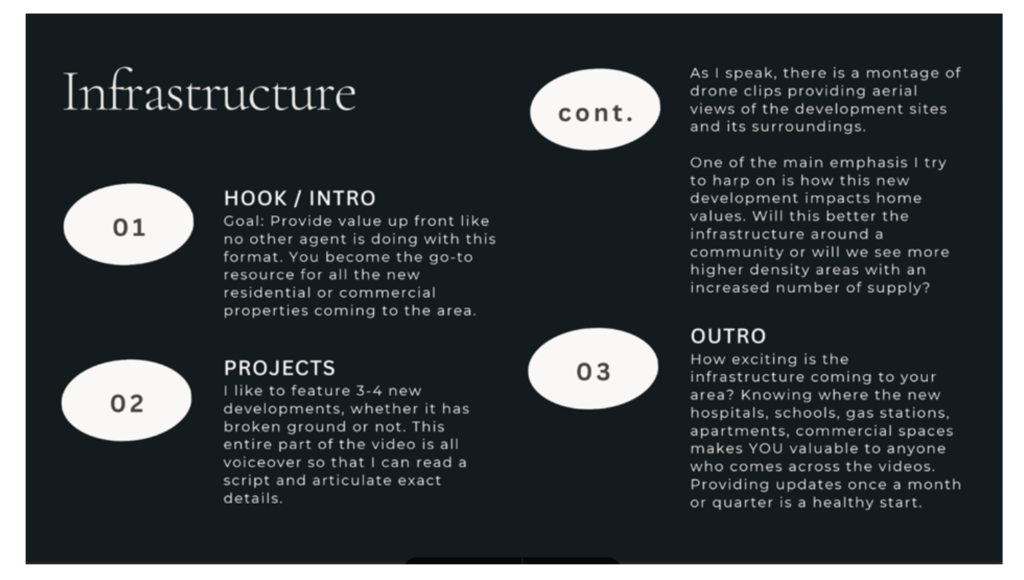
Escobar provided the following breakdown for the structure he uses for these infrastructure videos.
This is an example of an infrastructure video showcasing multiple developments and commercial infrastructure additions for an area:
This is an example of a specific phase update for a community:
Community videos
As mentioned before, Escobar is typically the first agent to post a video about a new subdivision, often positioning his videos at the top of searches for the new subdivision. The second step in dominating search for the community is to record and publish a series of community overview videos.
These videos highlight the amenities of the development, the characteristics that make this community unique and an overview of the homes available in the community. These community videos not only provide additional details for potential buyers, but they also showcase Escobar’s expertise in the neighborhood to the current homeowners and future prospective listings.
They also provide additional information to the algorithm that Escobar’s YouTube channel is a go-to resource for that neighborhood. While most agents stop after just one video about the neighborhood, the more videos he publishes about that particular neighborhood, the more the algorithm sees his channel as the best resource for people searching for details about that neighborhood.
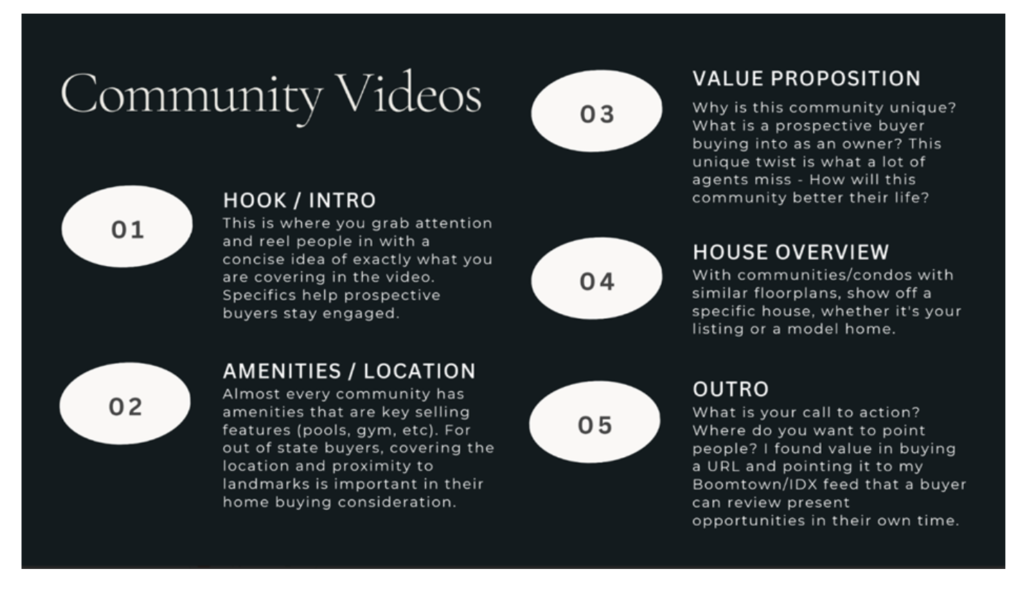
This is the framework Escobar provided for the structure of his community videos.
This is an example of a community overview video:
This is another example of a community overview video for the WaterSound Origins community:
Listing tour videos
The third type of video Escobar utilizes is listing tour videos of homes in the neighborhood. These videos showcase Escobar’s listings, model homes and builder spec homes in the neighborhood. These videos are used not only to market and sell his listings, but also to showcase his marketing skills to other homeowners.
All of these are benefits to Escobar’s business, but these videos also continue to show the algorithm that he is the expert for this neighborhood, leading to his videos showing up at the top of the page for search terms in these neighborhoods.
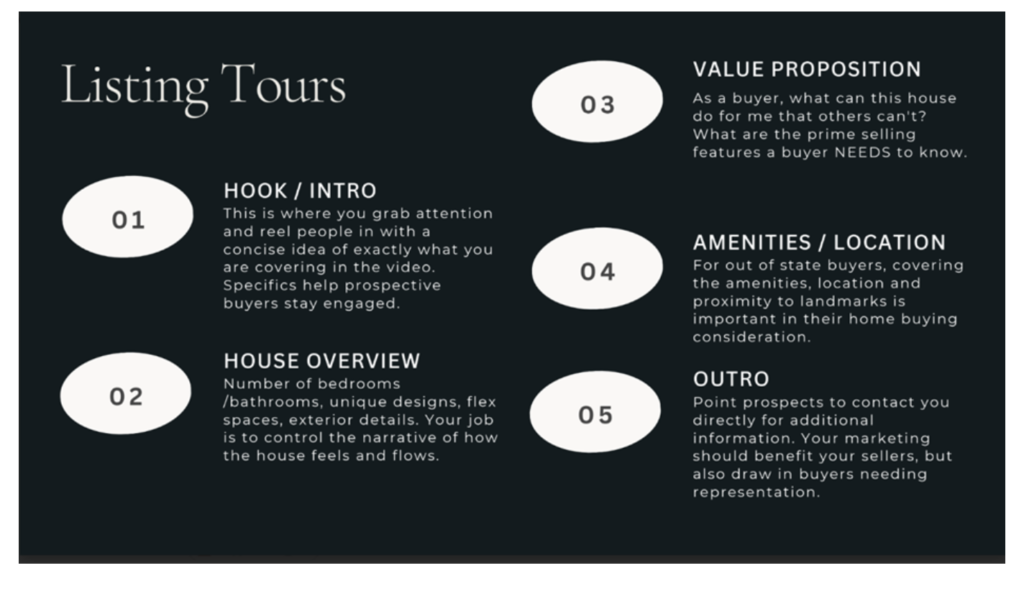
This is the framework Escobar shared that he utilizes when creating his listing tour videos.
This is an example of a listing tour video for Escobar:
This is an example of another listing tour video with a builder in the targeted community:
By utilizing YouTube, Escobar eliminates one of the biggest issues many agents have, which is consistent lead generation. During my interview, he stated he had five leads come in one day last month, and two of them went under contract within three days of them first reaching out to him from a video they saw.
YouTube also solves the issue many agents have of not prospecting enough each day. Escobar’s average watch time each day last month was over 13 hours. This means his videos were being watched, and he was passively prospecting, on average 13 hours a day every day last month.
Finally, YouTube has accelerated his prospect nurturing process. While watching his videos, the prospects get to know him, and the videos actually nurture his prospects before he ever meets them or has them in a CRM.
This leads to the incredible average of only 17 days from the first time the clients reach out to him until they are under contract. That stat alone hopefully motivates you to take action on building a YouTube channel for your business.
Jimmy Burgess is a real estate agent and national team builder with Real Brokerage in northwest Florida, serving the 30A, Destin, and Panama City Beach markets. Connect with him on Instagram and LinkedIn.