Silver, Sovereign Debt, Venezuela, and the Signals Beneath the Surface

Silver, Sovereign Debt, Venezuela, and the Signals Beneath the Surface

If you spend enough time watching markets, you eventually stop focusing on day-to-day price moves and start paying attention to longer patterns and what tends to move first. For me, silver has long been one of those assets — not because it’s a prediction machine but because it often reacts early when deeper pressures begin building in the system.

Right now, several of those pressures appear to be converging.


Key Takeaways:

  • Silver has surged ~150% as supply deficits enter fifth consecutive year
  • Bank of America outlines scenarios where silver could reach $135-$309/oz
  • Extreme paper-to-physical ratios amplify price volatility, especially when markets demand physical delivery
  • Real estate and precious metals respond to similar monetary forces


Why Silver Is Worth Watching

Silver occupies a unique position in global markets. It isn’t purely a monetary metal like gold, and it isn’t purely an industrial input like copper. It sits somewhere in between.

That dual role makes silver especially sensitive to:

  • Changes in monetary policy
  • Industrial demand cycles
  • Physical supply constraints
  • Shifts in investor confidence

When silver moves sharply, it’s often responding to multiple forces at once. That’s what makes it useful as a signal — particularly during periods when the broader macro environment is unsettled.

Recent Price Action as a Signal, Not the Story

Silver’s recent price surge has been substantial, moving from roughly the $30 range in early 2025 to highs in the $80s – representing gains of ~150% before pulling back modestly later in the year. Moves of that magnitude are unusual and rarely occur without broader macro stress in the background (see recent silver price data on Trading Economics: https://tradingeconomics.com/commodity/silver).

This doesn’t mean silver prices themselves are the story. More often, sharp repricing reflects rising concern around:

  • Liquidity conditions
  • Currency stability
  • Debt sustainability
  • Demand for assets outside purely financial systems

Silver tends to respond quickly because it sits at the intersection of all four.

The Structure of the Silver Market

Another reason silver behaves the way it does has to do with how it’s priced.

Most silver price discovery occurs in futures and derivatives markets, where “paper” claims on silver trade in volumes far exceeding the amount of physical metal that changes hands (some estimates suggesting ratios exceeding 100:1 or even 300:1). This structure is standard in modern commodities markets, and I believe it may be a lever to moderate pricing. The paper instruments can expand and contract on a dime, and flow in to meet sudden ebbs and flows that happen.

In some ways, the paper silver market functions like financial leverage; it enables liquidity and efficient price discovery, but when fundamentals shift sharply, the same structure that provided stability can amplify moves in both directions. Price moves become sharper, and markets adjust faster than many participants expect, that’s where the leverage analogy becomes most visible.

That dynamic often makes silver one of the first places stress shows up.

Debt, Monetary Policy, and the Search for Stability

Zooming out, it’s difficult to ignore the broader backdrop.

Sovereign debt levels — particularly in developed economies — are historically high. Monetary policy has oscillated between tightening and easing in relatively short order, and confidence in long-term currency stability has become less absolute than it once was.

In response, some countries have explored ways to reduce reliance on the U.S. dollar for trade and reserves. This trend toward diversification doesn’t mean the dollar is disappearing, but it does suggest a world where capital is more actively searching for alternatives when uncertainty rises. Compared to literally any other countries’ offerings, U.S treasuries are STILL the best available in that category.

Hard assets — especially those with limited supply — tend to benefit in that environment.

Supply Constraints Are Not Theoretical

Unlike financial assets, silver supply cannot be expanded quickly.

Global mine production has hovered around relatively stable levels while demand has continued to grow. Industry reporting indicates that silver markets have experienced persistent supply deficits of 100+ million ounces for multiple consecutive years, driven by both industrial use and investment demand (see analysis at CarbonCredits.com: https://carboncredits.com/silver-price-hits-64-as-supply-deficit-enters-fifth-year-prices-may-reach-100-oz/).

For a long time, industrial consumption absorbed much of that imbalance quietly. What’s different now is that investment demand has increasingly layered on top of already tight fundamentals — an environment that tends to produce volatility rather than gradual price adjustment.


What Institutional Analysts Are Saying

While extreme price targets should always be treated cautiously, it’s notable that some mainstream analysts have begun outlining scenarios where silver could reprice substantially under certain macro conditions.

Bank of America’s Head of Metals Research stated that while gold may act as the primary hedge, silver could, under specific ratio-based and macroeconomic scenarios, top out as high as $309 per ounce (reported at Kitco: https://www.kitco.com/news/article/2026-01-05/gold-will-be-primary-hedge-and-performance-driver-2026-silver-could-top-out).

This isn’t a forecast — it’s a conditional scenario. But its existence matters because it shows that discussions about higher silver prices are no longer confined to fringe commentary.

Resources, Processing Capacity, and Geopolitics

Geopolitical decisions are rarely driven by a single variable. Energy security, trade routes, domestic politics, and strategic competition all play roles.

That said, access to resource processing infrastructure still matters.

Venezuela is widely known for its oil reserves, but it is also rich in mineral resources. According to reporting by the International Business Times, JPMorgan Chase underwrote approximately £6 billion in financing for a U.S.-based metals smelter plant within hours of U.S. legal actions targeting Venezuelan metal assets, highlighting how control over processing infrastructure can move quickly alongside geopolitical developments (International Business Times: https://www.ibtimes.co.uk/jpmorgan-funds-6-billion-smelter-plant-hours-after-us-seizes-venezuela-metal-wealth-1768359).

This doesn’t prove that precious metals were the primary motivation behind any specific action. But it does illustrate how metals, refining capacity, and strategic resources remain part of the broader calculus — especially during periods of global uncertainty.

A Historical Lens

The closest modern parallel may be the inflationary period of the 1970s and early 1980s.

That era was defined by rising debt, delayed policy responses, and a long process of restoring confidence through tough monetary decisions. Even then, stabilization took years — not months.

Today’s circumstances are different in many ways, but the lesson remains: monetary shifts unfold over long timelines, and early signals often appear in places most people aren’t watching closely.

What This Could Mean for Real Estate

Real estate doesn’t exist in isolation from these forces.

Loose monetary policy tends to increase liquidity and aggregate demand over time. Unlike the pandemic period, builders have had time to catch up on supply, reducing the likelihood of another extreme shortage-driven price spike.

Still, periods of economic uncertainty often reinforce interest in tangible assets. That can show up as sustained demand and increased transaction volume — even if price appreciation is more measured than in prior cycles.

In that sense, real estate shares more in common with precious metals than many assume. Both respond to the same monetary forces, both have supply constraints, and both attract capital during periods of currency uncertainty. The main difference is liquidity and transaction costs, but the underlying dynamics are remarkably similar.

Final Thought

None of this is a prediction carved in stone. Markets are adaptive, and policy decisions can change trajectories quickly.

But when multiple indicators — silver price action, supply constraints, debt expansion, institutional commentary, and strategic resource developments — begin pointing in the same general direction, it’s worth paying attention.

Silver isn’t the destination.
It’s one of the earliest signals.

And in complex systems, early signals tend to matter.

The Popsicle Place Program in Seattle Helps Families in Need

It’s tough to afford housing in many cities across the U.S., but in Seattle, it’s a particularly competitive market.

Living in an urban area with such a high cost of living can break a family when emergencies arise, but luckily for the people of Seattle, Mary’s Place has been relieving housing burdens since 1999.

Initially established as a women’s day center, Mary’s Place has evolved and expanded into a housing facility. It now provides a warm bed for 680 family members every night of the year.

As the shelter’s website states, “The Mary’s Place model is simple – partner with anyone and everyone who can help to address the issue of family homelessness: congregations, individuals, cities and counties, and businesses of all sizes.”

It seems to be a phenomenally successful model – and it only continues to grow. The Popsicle Place program, formed in 2018, is a Mary’s Place program focused on assisting families who are simultaneously experiencing homelessness and caring for medically complex or critically ill children.

A devastating statistic says that 1 in every 285 children in the U.S. alone will be diagnosed with cancer before the age of 20, and many more will be hospitalized for serious illness and injury. Additionally, 60 percent of people with the highest rent burden can’t cover three months of expenses.

Serious illness can put many families in financial crisis, and the stress of caring for children in need of medical intervention as well as maintaining livelihood for the whole family can be debilitating.

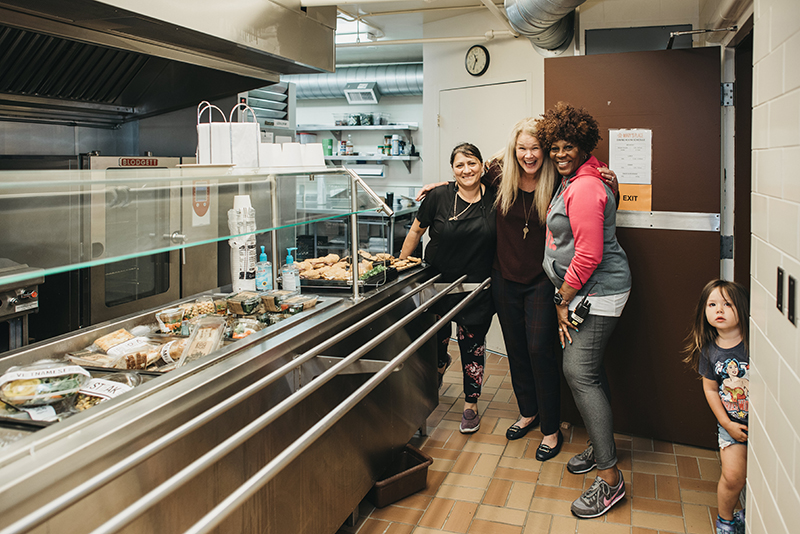
But at Popsicle Place, families don’t have to worry about costly emergency housing options, like motels, or choosing between having a place to live and having a healthy child. They also don’t have to worry about spending the night apart, since the Popsicle Place has a medical staff and volunteers on hand so that every member of the family can rest comfortably, in private rooms, all under one roof – regardless of health status.

While a small housing operation can’t alleviate every concern for families in medical and financial distress, simply having a bit of support can provide immense relief – relief that those families need to take their next step.

“Not only do they have their own private rooms,” says Marty Hartman, executive director of Mary’s Place, “but they also have access to our healthcare clinic. They have a Popsicle Place lounge, where if their children aren’t feeling so well or if they have immunocompromised conditions, they can go in there and relax. [We] just want to set them all up for success.”

And that they do, with excellent results.

The Mary’s Place blog recently shared the story of a single mother of three named Nycolle. When she found black mold in her apartment, she was forced to immediately leave with her children, each of them with their own unique and demanding healthcare requirements, leaving them in need of emergency housing. That’s where the Popsicle Place program came in.

“Being at Mary’s Place gave me peace of mind,” says Nycolle in the article, “knowing we had electricity for Karlah’s treatments and refrigeration for Krystoffer’s medications. It let me focus on keeping them well!”

With their basic needs managed, the family members soon found a large, affordable 3-bedroom house in Spokane and happily relocated. They now enjoy a large yard, as well as a home to call their own.

That’s exactly what the program is all about, according to Hartman. “Let’s get you the housing options that you need and then move you forward.”

Related:

An Up-Close Look at Housing Insecurity (and How to Help!)

Five years ago, Timothy C. Acena was living – and sleeping – in his wheelchair behind a busy fast-food restaurant. At night, he’d park himself on a fresh piece of cardboard near the restaurant’s dumpster and clip together a makeshift awning of eight umbrellas to protect him and the five backpacks full of his belongings from the elements.

During the day, he’d sit in front of the restaurant and ask customers to buy him a meal, which they always did, he says. He used the restaurant’s bathrooms and traveled for showers and laundry. All the while, he waited for an affordable apartment to open up.

Today, Acena, 52, has his own bed and a roof over his head. The former construction worker, who lost the ability to walk when he was 40, lives in a studio apartment in West Seattle in a building that provides affordable, stable housing and mental health and addiction treatment services to him and 65 other people who had been sleeping in shelters or out in the cold.

In the building’s lobby, letters cut from beige construction paper hang over the mail slots on the wall, spelling out the season’s message: “Be thankful.” Acena says he lives those words every day. He knows he would probably be dead or still homeless had other people not cared enough to build and manage a place where he could afford to live – and where he could very well spend the rest of his life.

More than a half a million Americans were homeless in 2017, a number that increased for the first time since 2010, according to a one-night count by the U.S. Department of Housing and Urban Development. Experts agree the count doesn’t capture all the people sleeping outside and say the number is likely to be much higher.

In some cities, homelessness has reached crisis levels as the economy continues to expand and people flock to urban areas for jobs, driving up rents that were once affordable for people earning low and middle incomes.

Many people are one emergency away from a missed rent payment. Today, only 52 percent of renters say they would be able to cover an unexpected expense of $1,000 if they had to, according to the Zillow Group Consumer Housing Trends Report 2018. Gen X renters, who are between the ages of 39 and 53, are the most vulnerable: Only 44 percent say they could weather a $1,000 hit to their budget.

In some cities, the share of median income spent on rent exceeds 40 percent, according to Zillow economists, whose research also ties rent increases to moves and even homelessness. In Los Angeles, for instance, a 5 percent increase in rent would add 1,993 people to the ranks of the homeless.

Colin Maloney, project manager for Cottage Grove Commons, the Downtown Emergency Services Center building where Acena lives in West Seattle, said homelessness affects a broad swath of humanity: families, people with advanced degrees, people with mental and physical disabilities, and people with job skills no longer in demand.

Some residents of the Grove apartments grew up in homelessness or bounced through the foster care system only to end up alone when they turned 18. Others, like Acena, have struggled with addictions or remain yoked to criminal records that keep them from jobs and homes. At times, it’s hard to for them to see a path back to home, Maloney says.

But, he adds, “We have to believe that a better future is possible.”

Acena is proof of that. Before he became homeless, he lived in a $60 a night motel room, paid for with a combination of his Social Security disability check and funds from a church youth group. When the group’s subsidy stopped, Acena made a temporary home behind the restaurant rather than return to shelter living.

Acena smiles recalling the day he moved into his current home. He could finally sleep lying down. “It was like somebody took a Tyrannosaurus rex off my shoulders,” he says.

His apartment costs him $215 a month, about 30 percent of his $720 monthly Social Security income. He spends his days there building plastic models, watching TV, indulging in pancakes with peanut butter and staying healthy.

“I don’t think it’s unsolvable,” he says of homelessness. “It’s just difficult. Anything difficult has got to have something good in the end if you go through it.”

This holiday season, you can help these organizations that are working to bring housing security to communities across the country. Their success brings hope to all of us.

Alabama Hawaii Massachusetts New Mexico South Dakota
Alaska Idaho Michigan New York Tennessee
Arizona Illinois Minnesota North Carolina Texas
Arkansas Indiana Mississippi North Dakota Utah
California Iowa Missouri Ohio Vermont
Colorado Kansas Montana Oklahoma Virginia
Connecticut Kentucky Nebraska Oregon Washington
Delaware Louisiana Nevada Pennsylvania Washington, D.C.
Florida Maine New Hampshire Rhode Island West Virginia
Georgia Maryland New Jersey South Carolina Wisconsin
Wyoming

Related: