by Lillian Dickerson | May 7, 2025 | Industry, News Feed
Corcoran is letting go of her dream penthouse of 10 years, which boasts stunning Central Park views, because she and husband Bill Higgins need a one-story apartment as they grow older.
Bigger. Better. Bolder. Inman Connect is heading to San Diego. Join thousands of real estate pros, connect with the Inman Community, and gain insights from hundreds of leading minds shaping the industry. If you’re ready to grow your business and invest in yourself, this is where you need to be. Go BIG in San Diego!
Shark Tank star and Corcoran Group founder Barbara Corcoran is letting go of the dream penthouse that became her home 10 years ago.
Back in 1992 when Corcoran was still working side hustles to make her living, she was delivering letters for a messenger service to a building at Fifth Avenue and 97th Street when she saw the terrace that took her breath away. As she stepped out of the elevator on the building’s top floor, Corcoran saw beyond a pair of French doors an inviting outdoor space with stunning Central Park views.
“I thought, my god, I’ve never seen anything as beautiful in my life,” Corcoran told The New York Times.
There was no sign then that the homeowner would ever want to move, but Corcoran knew that no one stays in the same house forever — and she was playing the long game. As the now well-known story goes, Corcoran gave the homeowner an envelope and asked her to call her if she ever decided to put the home on the market.
It took more than 20 years, but Corcoran got the call. The year was 2015, and she paid $10 million for the 4,600-square-foot duplex.
The home has five bedrooms, five full baths and two half baths. After Corcoran bought the penthouse, she decided to flip the upstairs and downstairs, moving the kitchen to the upper level just off of that show-stopper terrace. She also transformed a greenhouse area into an indoor/outdoor dining room. For a year-and-a-half, the renovation continued, during which time Corcoran and her then-10-year-old daughter Kate would sometimes take sleeping bags up to the terrace and fall asleep under the stars, Corcoran told The NYT.
The only original feature of the duplex that remained after the renovation was the curved staircase, which has become the reason for Corcoran’s selling the property, as she and her husband, retired Navy captain and octogenarian Bill Higgins, grow older. The stairs have become too much for Higgins, Corcoran told The NYT, “and I’m not running those stairs anymore, either.”
In 2022, viewers on TikTok got a glimpse into Corcoran’s apartment when she gave a tour to influencer Caleb Simpson, who is known for his videos asking New Yorkers how much they pay for rent.
Scott Stewart and Carrie Chiang of Corcoran Group are co-listing the apartment with an ask of $12 million, which Corcoran said is less than what she spent buying and renovating it. But, she’s hoping at that price, she’ll receive multiple bids. Monthly maintenance on the property is about $11,000.
When Corcoran learned in December that Paul Newman and Joanne Woodward’s long-time pied-à-terre, which was only a few blocks away, was listed at $9.95 million, she put in an offer. But the single-story apartment, which also had a knockout view of Central Park, received a higher offer, and Corcoran missed the opportunity.
Corcoran also faced a blow when she learned in January that her mobile home in LA was destroyed by the Palisades Fire.
Chiang kept her ears to the ground for other opportunities, though, and shortly thereafter found a one-story penthouse also located in Carnegie Hill. Corcoran quickly made an offer, and it was accepted.
“I never thought I would ever leave,” Corcoran said of the duplex. “It’s easy to spend money when you’re building a lifelong dream. For me, real estate is emotional.”
Get Inman’s Luxury Lens Newsletter delivered right to your inbox. A weekly deep dive into the biggest news in the world of high-end real estate delivered every Friday. Click here to subscribe.
Email Lillian Dickerson
This post was originally published on this site
by Jim Dalrymple II | May 7, 2025 | Industry, News Feed
Bigger. Better. Bolder. Inman Connect is heading to San Diego. Join thousands of real estate pros, connect with the Inman Community and gain insights from hundreds of leading minds shaping the industry. If you’re ready to grow your business and invest in yourself, this is where you need to be. Go BIG in San Diego!
A slow real estate market couldn’t keep America’s biggest portal down, with new data showing that in Q1, Zillow managed to grow revenue and — for the first time in years — turn a profit.
In total, Zillow brought in $598 million in revenue between January and March, earnings data released Wednesday reveals. That number represents a 13 percent jump compared to the same time in 2024. On top of that, Zillow managed to make $8 million in profit — a significant improvement over the $23 million it lost during last year’s first quarter.
Indeed, a review of past Zillow earnings reports shows that the last time Zillow turned a profit, rather than reporting a net loss, was in 2022.

Jeremy Wacksman
In a conversation with Inman Wednesday, CEO Jeremy Wacksman said Zillow managed to thrive in Q1 “despite a pretty challenged” and “depressed housing market.”
“We’re not expecting to see a lot of improvement in the macro for the year,” Wacksman added.
Zillow’s report also includes a number of other bright spots for the company. Among other things, it shows that revenue from rentals rose 33 percent year over year to $129 million — an all time high for that segment. Wacksman called rentals “a bright spot” while speaking with Inman.
“We now have the most listings, 2 million active rental listings on Zillow’s rental network,” Wacksman continued. “And that’s what drives the audience. We actually have the largest rental audience in the country, 37 million unique visitors come to Zillow Rentals. It’s the number one brand preference because it has the most inventory. No one has them all, but we’re trying to get to as many as possible.”
During a call with analysts Wednesday afternoon, Wacksman noted that there has never historically been a place where renters can see all rental listings, but that Zillow is “rapidly becoming that one-stop marketplace.”
“The opportunity in rentals is significant,” he also said during the call, adding that the company expects multifamily to be the main driver of revenue in the future.
According to Wacksman, Zillow had 40,000 multifamily buildings in its rental network as of a year ago, but that number increased to about 55,000 by the end of March. Since then, the network as expanded further to 60,000 multifamily buildings, Wacksman added, with inventory driving the rental segment’s revenue growth and directing consumers to Zillow’s funnel before they might ever buy a home.
Zillow Chief Financial Officer Jeremy Hoffman added during the call that Zillow expects its rental business to grow 40 percent over the course of 2025.
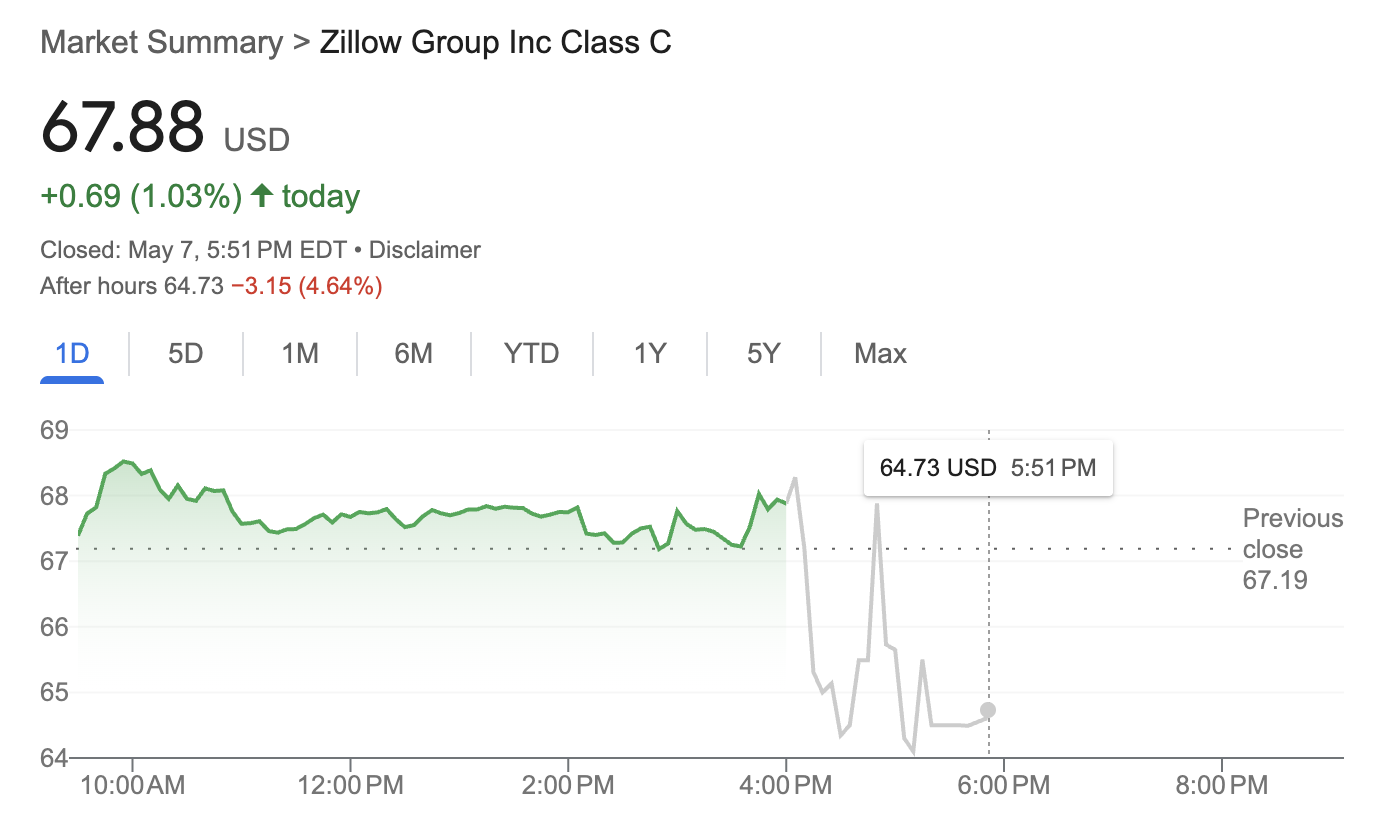
Heading into Wednesday’s earnings report, shares in Zillow were trading for around $67. That was up for the day and basically flat for the week. A year ago, Zillow shares were trading in the low $40 range.
Zillow shares fluctuated, but trended down, in after hours trading following the publication of the company’s earnings report.
Credit: Google
The portal had a market cap of about $16.3 billion as of Wednesday afternoon.
Aside from turning a profit and growing revenue generally, Zillow’s earnings report reveals that revenue from Zillow’s residential segment hit $417 million in Q1, up 6 percent year over year. The company’s residential segment includes the Premier Agent program through which agents pay the company for leads.
Additionally, revenue from Zillow’s mortgage business grew 31 percent to $41 million in the first quarter.
During Wednesday’s analyst call, Wacksman was asked about Rocket’s recent announcement that it is acquiring Redfin and Mr. Cooper. Wacksman replied that “there’s going to be multiple winners here,” but that the deals prove Zillow’s thesis.
“Rocket announcing their acquisition of Redfin is about a recognition that the future of real estate is this integrated transaction,” he said. “The great news for us is that’s been our strategy for a while.”
Zillow’s latest earnings come against the backdrop of a raging debate in the real estate industry over private listings, or homes that are marketed privately between agents but not added to the local multiple listing service. Zillow has come out against private listings and, last month, banned such properties from its platform. The move prompted intense debate and thrust the portal into the center of the issue.
On Wednesday’s analyst call, Wacksman said that most of the real estate industry already agrees with Zillow’s position on listings, and that the response from brokerages, MLSs and other organizations has been positive. While speaking with Inman, he further defended the move, saying it’s “about protecting consumer transparency.”
“What makes this market so beneficial for buyers and sellers,” Wacksman said, “and beneficial for agents as well, is buyers have access to all the listings, sellers understand the risks of not marketing publicly, and most importantly, agents can do their job effectively.”
Update: This story was updated after publication with additional details from Zillow’s earnings report, and with remarks from the company’s analyst call.
Email Jim Dalrymple II
This post was originally published on this site
by Marian McPherson | May 7, 2025 | Industry, News Feed
Two months after naming a new CEO, Keller Williams has chosen Tim Dieffenbacher and Stacie Herron to lead the franchisor’s financial and operations teams.
Bigger. Better. Bolder. Inman Connect is heading to San Diego. Join thousands of real estate pros, connect with the Inman Community and gain insights from hundreds of leading minds shaping the industry. If you’re ready to grow your business and invest in yourself, this is where you need to be. Go BIG in San Diego!
Two months after naming a new CEO, Keller Williams has added a new chief operating officer and chief financial officer to its executive team.
Former Broadstone Real Estate executive Tim Dieffenbacher will serve as the Texas-based franchisor’s CFO, while Herron will take on dual roles as chief legal officer and chief operating officer.

Chris Czarnecki
“As we continue to grow, we’re excited to announce Tim and Stacie into these key leadership roles,” Keller Williams CEO and President Chris Czarnecki said in a written statement. “Tim and Stacie embody the leadership that will drive our next chapter of growth, as we continue to enable KW-affiliated agents and market center leaders to thrive.”
“Tim brings proven financial leadership and a strong track record of collaboration,” he added. “Stacie has already delivered meaningful impact as our chief legal officer and interim COO, and her official appointment as COO reflects our confidence in her continued leadership.”

Tim Dieffenbacher
Dieffenbacher, a corporate finance veteran and certified public accountant, comes to Keller Williams from Dallas-based real estate investment trust FrontView REIT.
Before his CFO role at FrontView REIT, Dieffenbacher worked alongside Czarnecki at Broadstone Net Lease (BNL) and Broadstone Real Estate (BRE). During his seven-year tenure, Dieffenbacher served as BNL and BRE’s senior vice president, chief accounting officer and treasurer.
“What drew me to Keller Williams was the people, the culture, and the opportunity to work with Chris again,” he said in a prepared statement. “There’s a genuine sense of shared purpose and entrepreneurial spirit here that’s hard to find. I’ve always been motivated by the chance to work with good people, solve challenging problems, and build something meaningful — and that’s exactly what I see at Keller Williams.”

Stacie Herron
Meanwhile, Herron has been with Keller Williams since 2021 as the company’s chief legal officer. Since then, Herron has juggled her CLO role with roles as chief people officer, chief administrative officer and interim chief operating officer.
Before joining KW, Herron spent 12 years at Brookfield Properties and GGP, where she served as executive vice president, general counsel and corporate secretary.
“Keller Williams is a remarkable organization, fueled by passionate, purpose-driven people,” she said. “I’m grateful for this opportunity to collaborate with the many talented teams across the business. Together, we will continue to strengthen the systems and strategies that empower our market center leaders and KW-affiliated agents to thrive in this dynamic industry.”
Czarnecki, Dieffenbacher and Herron’s appointments come after Keller Williams sold an undisclosed investment stake to Stone Point Capital after years of IPO rumors. Czarnecki has also made an undisclosed “coinvestment” in the company, according to a previous Inman article.
Keller Williams co-founder and Executive Chairman Gary Keller said in March that the deal is “an exciting milestone” and will enable the company to supercharge its investments in “agents’ personal development and their continual sales growth.”
Email Marian McPherson
This post was originally published on this site
by Richelle Hammiel | May 7, 2025 | Industry, News Feed
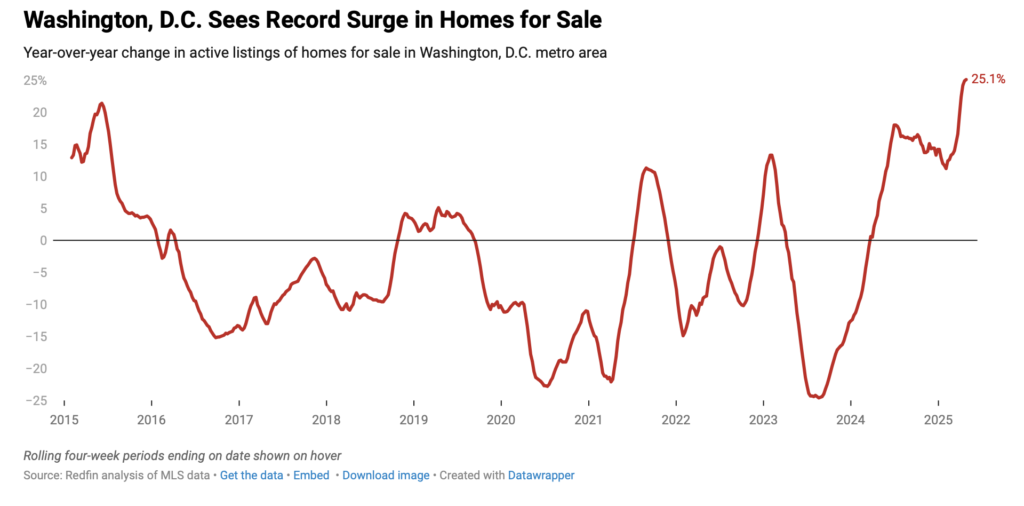
Active listings in Washington, D.C., have surged 25.1 percent year over year, the largest jump on record and nearly double the national increase of 14.2 percent, new Redfin data released Wednesday shows.
Bigger. Better. Bolder. Inman Connect is heading to San Diego. Join thousands of real estate pros, connect with the Inman Community and gain insights from hundreds of leading minds shaping the industry. If you’re ready to grow your business and invest in yourself, this is where you need to be. Go BIG in San Diego!
The swamp is being drained.
Back in February, real estate insiders pushed back on headlines declaring a collapse in the Washington, D.C. housing market under the Trump administration’s federal downsizing. At the time, market data showed little signs of crisis. But just a few months later, a new Redfin report reveals a sharp shift.
As of April 27, active listings in Washington, D.C. have surged 25.1 percent year over year, the largest jump on record and nearly double the national increase of 14.2 percent. New listings are also up 11.4 percent, compared to the nationwide gain of just 5.8 percent. It’s the highest level of inventory D.C. has seen since 2022.
Redfin attributes this spike in inventory to sweeping layoffs of federal workers in efforts to reduce federal spending, led by President Donald Trump’s administration and Elon Musk’s Department of Government Efficiency (DOGE). According to CNN, at least 121,000 federal workers have been laid off or targeted for layoffs. Given that federal jobs make up 11.1 percent of all employment in the District — more than any other metro analyzed by the APM Research Lab — the impact is particularly acute.

Mary Bazargan | Redfin Premier Agent
“Quite a few people in D.C. are selling their homes because they’re losing their jobs,” Mary Bazargan, a local Redfin Premier real estate agent, said in the report. “Many of those people are planning to leave the area because the cost of living is high, and they want a new job that allows them to work remotely and be closer to family.”
Bazargan recalled a recent transaction in which a buyer waived contingencies and bid above asking, but still lost out to an all-cash offer — proof, she said, that sellers are growing cautious amid economic uncertainty.
Though some early 2025 reports suggested listings were holding steady, the April data shows a different story. State-level data from the U.S. Department of Labor reveals that initial unemployment claims in D.C. peaked in February. With more layoffs expected this spring, Bazargan has been fielding a surge in calls from potential seller bracing for pink slips.
Despite the turmoil, D.C.’s housing market remains a hot commodity, with homes selling quickly and sale prices rising 4.1 percent year over year to $600,964 as of April 27.

Asad Khan | Redfin Senior Economist
“What’s happening with housing inventory in Washington, D.C. could be a sign of what’s to come in other U.S. housing markets,” Redfin Senior Economist Asad Khan said. “And while strong housing demand is buoying prices in D.C., the rest of the country isn’t so hot. Other markets may not be able to absorb further inventory growth without prices softening.”
The suburbs surrounding D.C. are seeing the steepest inventory gains, including Alexandria, Virginia (up 40.9 percent), Montgomery County, Maryland (up 38.5 percent) and Loudoun County, Virginia (up 36.8 percent).
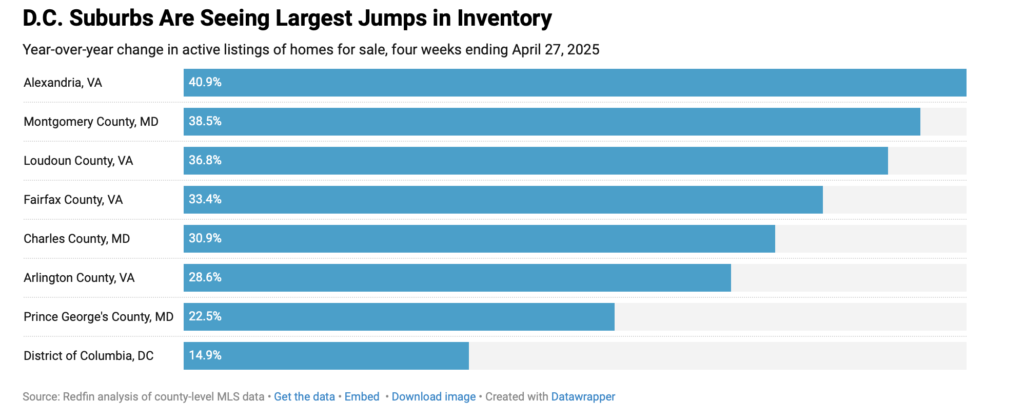
Overall, nine of the 47 major metros Redfin analyzed had bigger inventory gains, led by Denver, while four metros, led by Phoenix, had higher increases in new listings.
To ensure the trend wasn’t the usual post-inauguration shuffle, Redfin reviewed historical data. While there was a brief uptick in listings after Trump’s 2017 inauguration, it quickly faded. This time, the surge is persisting, a sign that widespread federal layoffs are likely fueling and reshaping the region’s housing landscape.
Email Richelle Hammiel
This post was originally published on this site
by Annette DeCicco | May 7, 2025 | Industry, News Feed
Bigger. Better. Bolder. Inman Connect is heading to San Diego. Join thousands of real estate pros, connect with the Inman Community, and gain insights from hundreds of leading minds shaping the industry. If you’re ready to grow your business and invest in yourself, this is where you need to be. Go BIG in San Diego!
Any challenge to winning over buyers starts with competent conversations and an information process that highlights your value, instills trust and steadily moves you to a client relationship. When an agent routinely controls an informational process, it enables the buyer with newfound confidence to take critical steps toward decision-making.
The conversations below do more than get you started. They are lessons in buyer conversion, and above all, in effective information communication.
1. Know the buyers’ whats and whys
An example will help them zero in on why:
Agent to buyer: “Most buyers shop their whats but buy their whys. Without a ‘what and why list,‘ you could be missing out. Whats are physical; whys are benefits. For example, ‘What’ I want is a house on a golf course; ‘Why’ I want it may not be to play golf; it may be for privacy or a view. If I find a property to fit your ‘why’ — something you can get really excited about that’s not on your ‘what’ list — would you want to know about it?”
2. Know the market. Be the expert
A metaphor will help buyers understand:
Agent to buyer: “When we track a town’s supply and demand, we know when the market shifts, and we know how to leverage it in your favor. A two-month supply of homes for sale in [name of town] translates to a swift seller’s market. Simply put, it takes only ‘two months to empty the shelf.’ Let’s discuss those leverage strategies …”
For a simple calculation of months’ supply of inventory, divide the supply (number of homes for sale) by the current demand (the last 30 days of under contract / pending sales) to accurately measure market shifts. Do it monthly to track shifts.
For example, if there are 100 homes for sale, and 50 under contract in the past 30 days, it takes two months to empty the shelf.
3. Provide a 3-pronged plan
Buyers don’t want to miss out. Show them how you’ll find listings hiding in plain sight.
Agent to buyer – “When supplies are low, it’s easy to overlook listings that aren’t new to the market, the hidden gems. Let’s make sure you don’t miss out on anything with these three strategies to uncover and secure the property you want!”
The hidden bargain: These are a chance to bid alone on the overpriced house that has been on the market a month or more. Offer less than asking but reflect the home’s value.
Lower your sights: To have a chance at winning in multiple offer situations, leave room to make a higher bid on a home listed for less than what you planned on spending.
For-sale-by-owner: In a less competitive environment, FSBOs usually cooperate with buyer-agents, especially when the buyer pays the fee.
4. Help buyers with a practice contract
Practicing relieves decision-making anxiety.
Agent to buyer: “A think-it-through strategy works better than a think-it-over strategy, and avoids losing a house in a fast market. We can sketch out a draft of an offer with five decision points: price, terms, dates, inclusions/exclusions and contingencies. You can always make changes after I call the listing agent. Then it’s your choice to act now if there are offers, or see the house again tomorrow if there’s a low risk of losing the house tonight.”
5. When it comes to making an offer, advise, don’t provide
Figuring out your buyer’s walk value will help relieve regret and remorse.
Agent to buyer: “How much should I offer is the most commonly asked question, especially in a sealed bid scenario. When you predetermine your walk value, it relieves the should-haves because you set the highest price you would pay or ‘walk away.’ It signals the end. If you win the bid, a walk value relieves the shouldn’t-haves because you set the price high, despite access to what else was on the table.”
6. Help buyers search with a solutions sheet
A dream home is only in buyers’ dreams, so it’s crucial to help them get realistic.
Agent to buyer: “When a home doesn’t check all the boxes, it’s because no home is perfect. It’s easy to pass up on the right one, especially when the housing supply is limited. A solutions sheet can help. Give each home a ranking based on most and least desirable features; add in reasonable cost-solutions. Then, reconsider the rank. If reasonable solutions allow you to check more boxes, you may have found your home.”
7. Help buyers rank their choices
Buyer motivation is relative. The universally accepted 1 to 10 rating scale will help.
Agent to buyer: “Seeing the big picture helps to gauge when you’re ready, willing and able to act on the right house when you find it. On a big picture scale of 1 to 10, where do you see yourself in the homebuying process? One means you are new to this; 10 means you are highly ready to buy now. What would have to happen to make it a 10? I can help. Here are the steps you can take … ”
8. Lay out options to help buyers figure out their next move
Buy before sell? Sell before buy? The best advice is to provide choices, not answers.
Agent to buyer: “There are 5 options when selling and buying, each with consequences:”
-
- Put your house on the market; sell it with a 60-day Use and Occupancy Agreement, giving you about 120 days, or more, for a home search, relieving some of the pressure to find a home.
- Find the house first; make an offer contingent on selling your home, an ideal option for you, except for the weak negotiating position.
- Put your house on the market, close, then find temporary housing, a short-term option to decide your next move, and the best negotiating position, but it’s inconvenient to move twice.
- Secure a bridge loan to buy a home with the equity from your existing home, repaid with proceeds from the sale of your house, another option to relieve pressure when buying before selling.
- Keep your house, and rent it as part of an investment plan.
9. Carpe diem! Help buyers seize the house by pushing through boundaries
Don’t let your buyers miss out on opportunities that are right for them.
Agent to buyer: “When the open house is swarming with potential buyers, opportunity knocks quickly and fades just as fast. Some buyers hold their offer because of an artificial deadline set to amass offers. Other buyers feel their best shot is to break from the crowd, submit an early offer, wow the seller, knowing that the first offer is the best offer, demonstrating urgency and aligning fast action to commitment.”
10. Show your buyers the best path for getting results
The seller’s wish list is the buyer’s clear path. Provide buyers with a visual.
Agent to buyer: “Compelling terms in an offer is the surest strategy besides price to win over the seller, especially in multiple offers. The sampling below is what some listing agents present to buyer agents”:
-
- Highest price with best terms and fewest contingencies
- 60-day closing with 60-day Use and Occupancy
- Appraisal waiver for offers above list with proof of funds for deposit and appraisal gap
- Total deposit due on Day 1 after all parties have signed the contract
- Limit home inspection to major structural, environmental and mechanical issues
- Consider waiving a specific dollar amount towards inspection concessions
- Home inspection within three to five days after all parties have signed the contract
- Add to contract (example) chimney, fireplace, flue in as-is condition
- Add the following personal property items excluded from sale: _____
- Sellers will look favorably on a pre-approval from a preferred lender
- Provide the buyer’s attorney information upon submission of offer
Winning over buyers is a misnomer. Earning buyers is what practiced agents do when they’ve mastered the art of information communication. Buyers desperately want to know what they do not know.
When coached by an agent with an information process, buyers become holders of the information. It seals a bond between buyer and agent, leads to effective decisions and promotes referrals.
Annette DeCicco is a real estate broker and director of growth and development at Berkshire Hathaway HomeServices Jordan Baris Realty in Northern New Jersey.
This post was originally published on this site
by Nick Schlekeway | May 7, 2025 | Industry, News Feed
Bigger. Better. Bolder. Inman Connect is heading to San Diego. Join thousands of real estate pros, connect with the Inman Community, and gain insights from hundreds of leading minds shaping the industry. If you’re ready to grow your business and invest in yourself, this is where you need to be. Go BIG in San Diego!
When you first get into real estate, your business is built on hustle. You say yes to every opportunity, every client, every ZIP code and every transaction that comes your way.
And honestly? That’s exactly what you should do when you’re starting out. You don’t have the luxury of being picky. At that stage, the name of the game is momentum. But once you’ve established a foundation, it’s time to shift gears.
At some point, if you want your business to grow and your brand to mean something, you need to stop being everything to everyone and start being something to someone. That’s where defining your target audience comes in.
And no, it doesn’t mean you have to turn away the clients who got you here.
Why picking a niche isn’t a limitation — it’s leverage
When agents hear the words “target audience,” many flinch. The first fear is usually: But I don’t want to lose all my business now. I get it. You’ve worked hard to build relationships, to serve your sphere and to become known as someone who can help anyone, anywhere. But here’s the truth: Defining a target audience doesn’t mean walking away from those opportunities.
It means getting laser-focused on your marketing, branding and outbound efforts without abandoning the systems that are already working for you.
Let me say that again: You can still work your sphere, follow up with referrals and answer the phone when past clients reach out. But in the market? In your messaging? You want to be known for something.
Because when you try to speak to everyone, you reach no one. The agent who specializes in a specific lifestyle, property type or community will be remembered long after the generalist is forgotten.
And when your business is aligned with your passion, your energy is different. Your conversations are easier. Your content flows. You show up more consistently and more authentically. And over time? That consistency builds trust and authority that a generalist brand can’t replicate.
Build a business that feeds your strengths
Let’s be real for a second — none of us got into this industry to “get by.” We came here because we wanted freedom. Freedom of time, freedom of income and freedom to build something we enjoy.
So let me ask: What part of the business gives you energy? What kinds of homes or clients light you up? What communities do you naturally gravitate toward? What lifestyle do you know like the back of your hand?
If you’re a golf fanatic, why aren’t you the go-to agent for golf course communities in your area? If you love the mountains, why not specialize in cabins, view properties or homes with acreage? When your passion matches your positioning, everything in your business becomes easier — and more enjoyable.
This doesn’t mean you stop working with other clients. It means you build a foundation that feeds your energy and attracts people who see you as the expert in something specific. And when you’re known for something? You’re not just getting more leads — you’re getting better leads.
You don’t have to choose between growth and loyalty
This is where I see agents get stuck. They know they need to specialize. They want to define a niche. But they’re afraid it means giving up the clients and relationships they’ve spent years building.
Let me clear this up right now: You don’t have to choose.
You can still send mailers to your sphere. You can still follow up on referrals. You can still serve past clients when they reach out. The difference is in where you direct your energy and how you present yourself to the market.
Think of your niche as the tip of the spear: It’s what leads your marketing, your content and your brand identity. It’s what helps people remember you, refer you and reach out to you. But everything behind that spear? That’s still your foundation. That’s your systems, your sphere, your database. You’re not replacing it. You’re focusing it.
In fact, the more specific your message becomes, the stronger your brand gets — and the easier it becomes to generate referrals, build trust and scale without burning out.
Average is invisible
In business, there’s one thing that’s clear: Average is invisible. If you’re blending in with the crowd, you’re not being noticed. You could be the most talented, hardworking person out there, but if you’re just like everyone else, your efforts will go unnoticed. This is why being “different” is so powerful.
The most successful businesses and leaders didn’t get there by being average. They stood out. Whether it’s a product, service or personal brand, it’s the unique, bold moves that get remembered. Think about it — when’s the last time you chose the average option over the standout one?
In real estate, this means carving out a niche, focusing on what you do best and bringing value in a way that nobody else can. When you’re different, people notice. When you’re average, they don’t even see you.
Embrace the truth
The truth is, the agents who grow the fastest and build the most meaningful businesses aren’t the ones chasing everything — they’re the ones who are clear on who they serve and why it matters.
So take a look at your business:
- Are you speaking to a specific audience?
- Are you building a brand that people can describe in a sentence?
- Or are you still trying to be all things to all people — and burning out in the process?
Start small. Pick a community, a property type or a lifestyle you’re passionate about. Build your brand around that. You’ll be shocked at how much easier everything becomes when your energy and your audience are aligned.
Nick Schlekeway is the founder of Amherst Madison, a Boise, Idaho-based real estate brokerage. Connect with him on LinkedIn.
This post was originally published on this site