by Marian McPherson | Jun 13, 2025 | Industry, News Feed
Bigger. Better. Bolder. Inman Connect is heading to San Diego. Join thousands of real estate pros, connect with the Inman Community and gain insights from hundreds of leading minds shaping the industry. If you’re ready to grow your business and invest in yourself, this is where you need to be. Go BIG in San Diego!
Compass CEO Robert Reffkin is ending the week the same way he began it: lambasting Zillow for its “hypocrisy” regarding off-market listings.
“Between 2018-2021, Zillow’s iBuying business bought more than 20,000 homes, convincing homeowners to sell directly to them without using the [multiple listing service],” the Instagram post read. “Now, Zillow research claims homeowners lose money if they don’t use the MLS.”
“When Zillow was making money buying homes off the MLS, it supported off-MLS sales,” he added. “Now that it can’t profit from leads on those off-MLS listings, they say it’s bad for homeowners to list off the MLS. Either Zillow’s ‘research’ that homes sell for less off the MLS is flawed, or they spent 3.5 years taking advantage of homesellers. Only one can be true.”
The post garnered 1,775 likes and 106 comments from brokers, 105 of whom supported Reffkin’s view on Zillow’s business model.
“So glad you are pushing against Zillow! They can’t survive without our inventory,” read one comment.
“Zillow took advantage of sellers and lost money. Now they’re back to trying to protect their revenue via control of others’ access to listings,” read another comment. “Sounds about right for corporate greed.”
READ INMAN’S ZILLOW LISTING BAN FAQ
A sole commenter backed Zillow and its now-defunct Zillow Offers segment, saying it’s unfair to compare iBuying to private listing networks. All homebuyers, they said, had access to Zillow Offers listings after Zillow purchased the home, remodeled and repaired it, and placed it back on the open market. Meanwhile, listings circulated within private listing networks usually never make it to the wider public, unless the homeseller changes their mind.
“Everyone has access to Zillow as opposed to Compass, which has a database only for their agents and homebuyers so they can double-end deals,” the comment read. “[That] makes shareholders happy while disenfranchising agents and customers that don’t want to work for Compass.”
A company spokesperson pushed back on that response, saying Compass doesn’t agree with those saying the company “is just doing this to double-end more deals.”
“In the world of signed buyer representation agreements, Compass is going to make the exact same amount of money if a buyer buys a private exclusive or a listing from a different brokerage,” they said. “The agreement says they have six to nine months. It doesn’t matter. It seems like ‘organized real estate’ is using the same arguments for control that worked before the settlement required buyer rep agreements last Aug. 17 and didn’t realize that the world changed to a point where the argument no longer makes sense.”
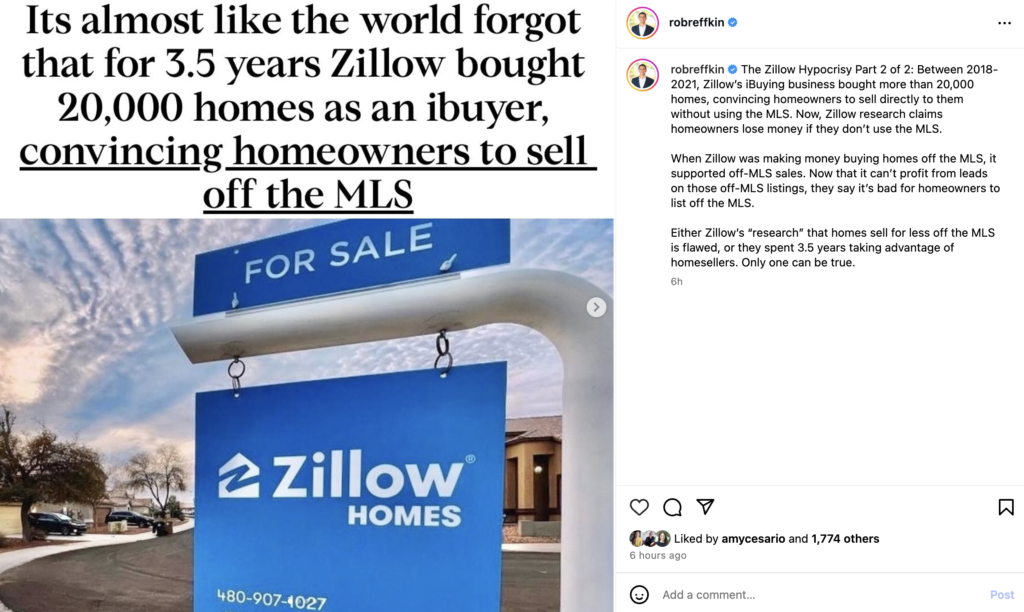
Reffkin’s Instagram post on Friday, June 13.
Reffkin’s Instagram post follows a post on LinkedIn from Monday, where the CEO attacked Zillow’s 2014 Coming Soon search function, which enabled homebuyers to view “coming soon” listings and contact a Zillow Premier Agent for more information on that listing.
Reffkin said Zillow is planning to ban “coming soon” listings — which Zillow has told Inman is not true — and said the move is hypocritical.
“Zillow now claims pre-marketed ‘Coming Soon’ listings harm consumers in an effort to ban them; however, when Zillow launched their ‘Coming Soon’ listings, they outlined many benefits to agents and consumers in their press release, stating: ‘Similar to a Coming Soon sign in the yard of the physical property, displaying a home as Coming Soon on Zillow helps agents and their sellers gauge buyer interest and test the list price against current market conditions, and can help reduce the total time a home is on the market. Knowledge about homes that will soon be on the market gives buyers a leg up,” the post read.
“Clearly it’s ok to ‘gauge buyer interest,’ ‘test the list price,’ ‘help reduce the total time a home is on the market’ and ‘give buyers a leg up’ if it’s on the Zillow platform but now that agents are doing it off the Zillow platform, Zillow wants to stop it,” it added. “Zillow isn’t protecting the consumer, Zillow is protecting the dominance of their platform.”
The LinkedIn post garnered a similar reaction to Reffkin’s Instagram post, with 25 commenters praising the CEO’s push against Zillow ahead of the portal’s listing ban, which will impact thousands of Compass homesellers and listing agents using the brokerage’s three-phase marketing strategy, which involves launching listings as private exclusives, then “coming soon” properties and, ultimately, on public listing portals.
“Such a revealing contrast, when it served them, Zillow praised ‘Coming Soon’ listings as innovative,” a commenter said. “Now that agents use it independently, it’s suddenly harmful? This isn’t about consumer protection, it’s about platform control.”
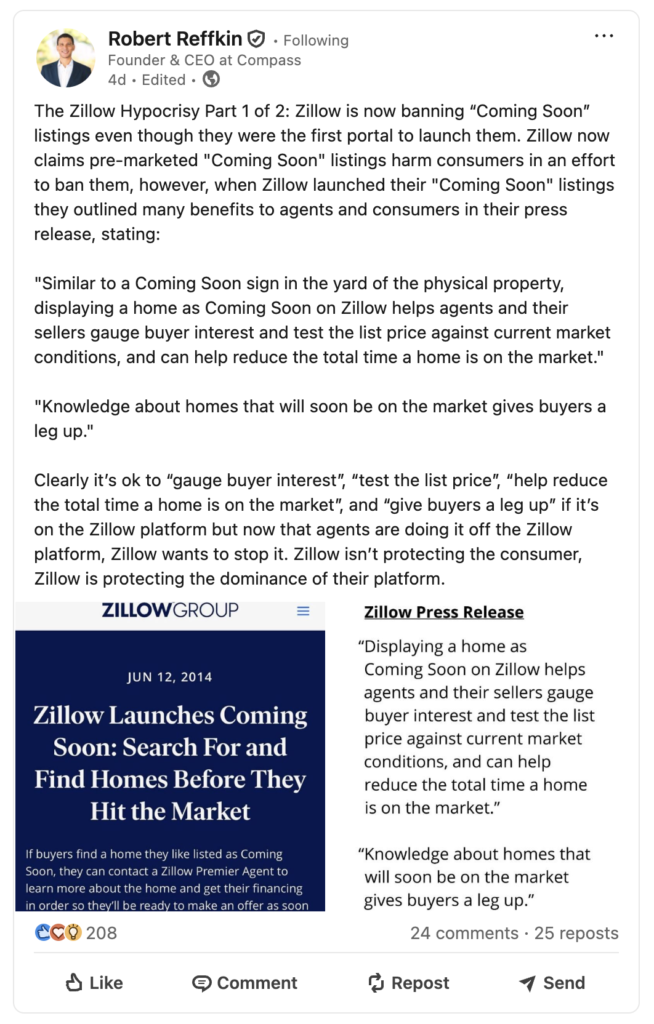
Reffkin’s Instagram post on Monday, June 9.
Reffkin’s posts come as Zillow finishes the second week of sending non-compliance notices for listings that aren’t added to the multiple listing service (MLS) within 24 hours of being publicly marketed.
Zillow Group has taken a “three-strikes” approach in which brokers will receive warnings for their first two non-compliant listings before having their third non-compliant listing banned from Zillow, Trulia and StreetEasy on June 30.
The ban doesn’t impact “coming soon,” office exclusives or Delayed Marketing Exempt Listings (DMEL) as long as brokers are adhering to NAR’s guidance for each listing status, Inman’s ban FAQ explained. For sale by owner (FSBO) listings and rental listings won’t be impacted by the ban. New construction listings sold by the builder are also exempt, unless they are listed with a broker under an exclusive listing agreement, in which case, they’ll also be held to the new standards.
Zillow declined to comment for this article.
Email Marian McPherson
by Matt Carter | Jun 13, 2025 | Industry, News Feed
Experts polled by Fannie Mae expect national home prices to keep climbing, but see Austin, Tampa, Dallas, Denver, Houston, Miami and Phoenix as markets most likely to see price declines.
Bigger. Better. Bolder. Inman Connect is heading to San Diego. Join thousands of real estate pros, connect with the Inman Community, and gain insights from hundreds of leading minds shaping the industry. If you’re ready to grow your business and invest in yourself, this is where you need to be. Go BIG in San Diego!
Housing and mortgage experts polled by Fannie Mae have dialed back their expectations for home price appreciation this year and next, but most don’t expect national home prices to fall. Some markets, however, are looking vulnerable to price declines.
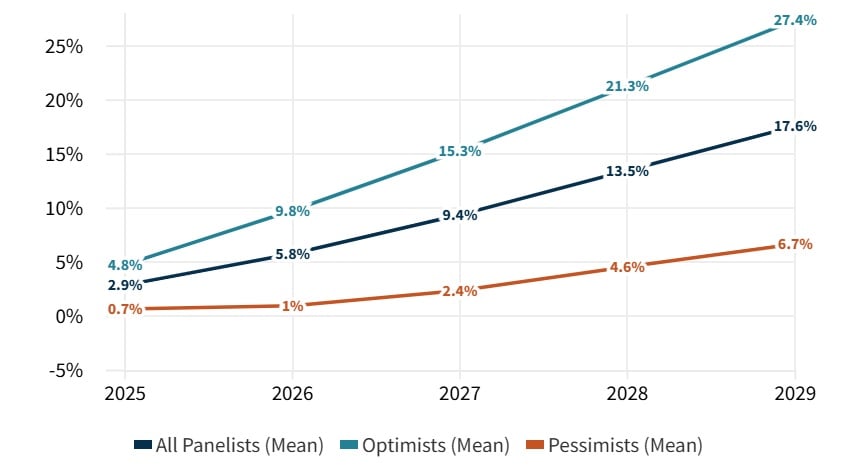
Fannie Mae’s quarterly Home Price Expectations Survey (HPES), released Friday, showed panelists surveyed in May now expect national home prices to rise by an average of 2.9 percent this year, down from their previous forecast of 3.4 percent.
Similarly, the survey’s housing, mortgage industry and academic experts now expect 2.8 percent home price appreciation in 2026, down from the 3.3 percent envisioned in February.
U.S. home price scenarios
Pessimists on the panel think national home price appreciation could cool from 5.3 percent in 2024 to less than 1 percent this year and next. A small minority — 15 percent — say the odds are better than even that national home prices will turn negative by the end of next year.
As national home price appreciation cools, some markets could see prices fall. The latest S&P CoreLogic Case-Shiller Indices showed home prices in Tampa were down 2.2 percent from a year ago in March.
While Tampa was the only top 20 metro to post a decline, price appreciation “barely stayed positive” in Dallas at 0.2 percent, S&P Dow Jones Indices analyst Nicholas Godec said in a statement.
Most of the largest housing markets tracked by Case-Shiller — 14 out of 20 — posted seasonally-adjusted price declines from February to March.

Nicholas Godec
“These results underscored how markets that experienced sharp run-ups earlier in the cycle — particularly in the Sun Belt — continued to adjust under the weight of higher mortgage rates and strained affordability,” Godec said.
Mortgage rates aren’t coming down, but improving inventory in many markets helped drive up homebuyer demand for purchase loans to the second highest level of the year last week, the Mortgage Bankers Association reported Wednesday.
Only one in five Americans (21 percent) polled by Fannie Mae in May said they expect home prices to come down over the next 12 months, with 45 percent expecting prices to go up and 34 percent expecting that they’ll stay the same. While only 26 percent said May was a good time to buy, that’s up from an all-time survey low of 14 percent a year ago.
Housing and mortgage experts polled by Fannie Mae in May saw Austin, Tampa, Dallas, Denver, Houston, Miami, Phoenix, Washington, D.C., and Atlanta as markets where home prices are most likely to underperform national home price appreciation over the next 12 months.
Among the 20 largest U.S. housing markets, Boston, New York, Philadelphia, Nashville and San Diego were viewed as places where prices are most likely to go up faster than the national average.
Fannie Mae economists update their home price appreciation forecast four times a year, in the first month of each quarter.
In their April forecast, Fannie Mae economists predicted that home prices will rise 4.1 percent this year before appreciation cools to 2 percent by Q4 2026.
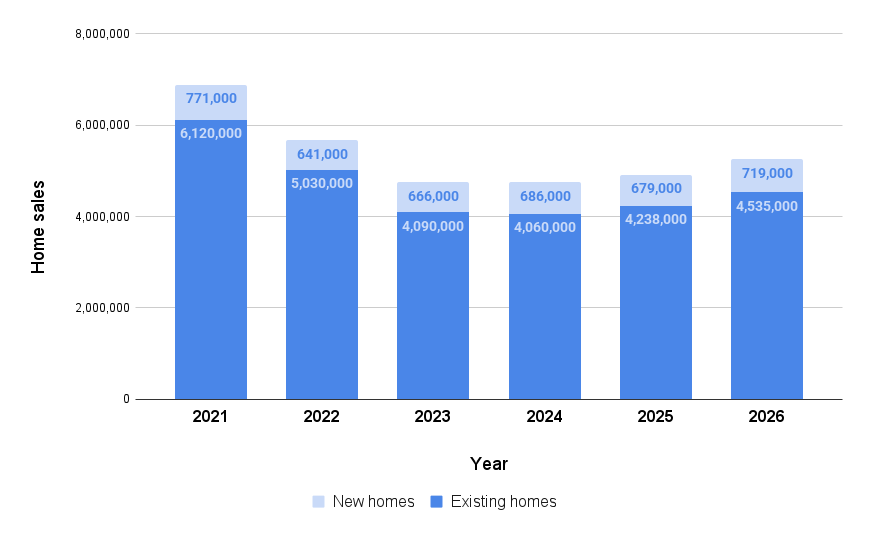
Fannie Mae economists think home sales bottomed at 4.75 million last year and will grow by 3.6 percent this year and 6.8 percent in 2026.
Home sales expected to bounce back
If Fannie Mae’s forecast of 5.25 million 2026 home sales pans out, it would be the first time since 2022 that sales of new and existing homes surpassed five million.
Get Inman’s Mortgage Brief Newsletter delivered right to your inbox. A weekly roundup of all the biggest news in the world of mortgages and closings delivered every Wednesday. Click here to subscribe.
Email Matt Carter
by Inman | Jun 13, 2025 | Industry, News Feed
Bigger. Better. Bolder. Inman Connect is heading to San Diego. Join thousands of real estate pros, connect with the power of the Inman Community, and gain insights from hundreds of leading minds shaping the industry. If you’re ready to grow your business and invest in yourself, this is where you need to be. Go BIG in San Diego!
Want to level up your business? Inman Access offers expert-led tutorials with insights, advice and ideas designed to help you build your skills every day.
Was your agent website built for looks or performance? Whether you’ve had your site for a while or just launched one, what matters most is that it creates connection, builds trust and guides people to take real action. Epique Realty’s Alyssa Stalker breaks down the five elements that turn a real estate website into a marketing tool with intention that actually works for you, not against you.
Elevate your skills and set yourself up for success in 2025. Watch the session above, plus get fresh content added weekly, with Inman Access.
Watch now.

by Marian McPherson | Jun 13, 2025 | Industry, News Feed
Bigger. Better. Bolder. Inman Connect is heading to San Diego. Join thousands of real estate pros, connect with the Inman Community and gain insights from hundreds of leading minds shaping the industry. If you’re ready to grow your business and invest in yourself, this is where you need to be. Go BIG in San Diego!
It’s been a week since the National Association of Realtors changed its Realtor Code of Ethics’ Standard of Practice 10-5, which no longer includes the terms “hate speech, epithets, or slurs” and now only applies to “Realtors’ actions in their capacity as real estate professionals.”
Although NAR has defended the changes — with NAR director Matt Difanis saying the adjustments don’t impact “the spirit” of the policy — several affinity group and inclusion leaders say the shift on which activities the policy applies will complicate brokerage leaders’ ability to hold their agents accountable for what they say or do outside of the office.

Gary Acosta
“I’m just gonna speak openly with you, and this is my own sort of speculation, to a certain degree, that NAR is doing the types of things that many corporations are doing right now,” the National Association of Hispanic Real Estate Professionals (NAHREP) Co-founder and CEO Gary Acosta said.
“They’re looking for ways to reduce potential liability, and I think they’re looking for circumstances where they may be viewed as maybe prioritizing one community over the other too much,” he added. “Whether it’s true or not, I do think that’s what all companies are sort of dealing with right now.”
The NAHREP CEO’s speculation appears to ring true, with NAR Professional Standards Committee Chair Todd Beckstrom saying on the day of the vote that the policy changes not only “provide much needed clarity to members,” but also “reduce risk to state and local associations and their volunteer leadership who administer and enforce Article 10.”
Even if the policy changes mitigate risk for state and local associations, Acosta said there could be an opposite impact for brokerage leaders looking to uphold NAR or their company code of ethics.
“I think what NAR is doing is pushing that responsibility from themselves to the individual employers who are members of their organization,” he said. “It becomes up to the local real estate brokerage and the real estate offices out there to ensure that their employees aren’t engaging in behavior that would expose the company to liability or a negative image in those communities. I think that’s the net result of the policy change.”
“I’m an employer, and if I have an employee who is engaging in hate speech, or, let’s just say, racist behavior online or somewhere else, does that give me the right to terminate that employee if it violates some code of conduct that we have within our company? I think it does,” he added. “Also, as the head of an organization, can I deny someone engaging in that kind of behavior membership in our organization? I think we can.”

Brooks Glenn | Credit: LinkedIn
Windermere Director of Inclusion and Community Engagement Brooks Glenn said he agrees with Acosta that brokerages will have a bigger responsibility in holding Realtors accountable for violations of 10-5. However, he’s concerned with brokers’ ability to manage ethics complaints and make decisions in their offices regarding discriminatory behavior, now that the policy only applies to Realtors “in their capacity as real estate professionals.”
“That limitation is an issue. It’s an issue because Realtors are public-facing professionals, and our influence extends well beyond contracts and closings,” he said. “So if a Realtor, for example, posts hate speech on social media or behaves in a discriminatory way in public, yet outside of a real estate transaction, it’s no longer considered a violation. I think that will create space for harmful behavior that could impact the communities we say we want to serve.”
In light of the policy change, Glenn said brokerages will have to strengthen their code of ethics to address all forms of discrimination and bias, which includes blatant hate speech to more nuanced situations, like microaggressions. Alongside stronger codes of ethics, Glenn also said brokerages will need to invest in diversity, equity, and inclusion training that helps agents and team members understand how to navigate racial, gender, sexual, etc. differences with respect.
“At Windermere, we’ve reaffirmed our commitment to diversity, equity, and inclusion in the space of real estate, we’ve looked at the historical harms, and what’s our role in correcting those harms,” he said. “The term DEI has been politicized, hence why my title is the director of inclusion and community engagement.”
“Community engagement is the heart of all of this — how can we position ourselves to provide access to homeownership for all? Again, this change has the potential to hurt this goal, which honestly, we should all have,” he added. “It makes us focus solely on the result, the transaction, and not the everyday abuse that happens and erodes community trust in us.”
LGBTQ+ Real Estate Alliance President Justin Ziegler said his members are worried about the change, especially given the Alliance’s latest annual report that revealed a concerning rise in anti-LGBTQ+ sentiments among agents.
“I can’t speak for everyone, but I can tell that a lot of our members feel that this is going to ultimately water down the code of ethics,” he said. “I have heard absolutely nothing that [the change] would, anyway, impede people from continuing to file a complaint. But we do worry that it will reduce Realtor organizations’ ability to ultimately rule on these types of complaints.”
Ziegler echoed Glenn’s concerns about the attempted separation between a Realtor’s actions inside and outside of a transaction or real estate activity, saying that Realtors often leverage their non-real-estate interests to build their businesses. In an attempt to make things more clear-cut, he said, NAR may have made the process of upholding Article 10 more difficult.
“Think about your typical real estate agent, unless they’re a secret agent, they probably have the fact that they are a Realtor all over their Instagram profile, all over the header on their Facebook,” he said. “And so when you think about that, if the Realtor or brokerage header remains constant at the top of the page and they’re spouting really hateful things in their posts, can you say that there is a separation between what they do in business and everyday life? I don’t think so.”
For brokers who are concerned about hiring discriminatory agents, and for agents who are concerned about hitching their license to a discriminatory broker, Ziegler said the best line of defense is having open, honest, and direct conversations about fair housing and the obligation to maintain a non-discriminatory culture.
“When you are interviewing where you’re going to ultimately hold your license, I think that it’s important to ask very hard-hitting questions about what that broker does to represent you, how they’re taking care of you, and how they run their business,” he said. “Ask them, outright, that if you were discriminated against, would they be willing to file an ethics complaint on your behalf, if you were worried about retaliation. Their answer will let you know if you’re in a safe working environment.”
“On the other side of this, for broker owners, it’s their company, right? They have built a reputation in their community, and it’s critically important to them that every agent represents that broker-owner, the company and the brand well,” he added. “If you’re a broker-owner interviewing agents, you really need to articulate the values of that company and the repercussions if you don’t uphold those values.”
All three leaders said the consequences of the policy change have yet to be seen, and it’s a toss-up on whether NAR’s intended outcome will be what happens. In the meantime, they said brokers and agents should be focused on sharpening their ethical compass and doing the work of clearly defining how an equitable and inclusive industry behaves.
“Discrimination in all forms is still illegal. I think the desire to create a meritocracy in the housing industry and other industries is something everybody shares,” Acosta said. “And I think everybody strives towards creating equality of opportunity for ourselves and the communities we serve.”
“I think this environment — the debates about DEI and NAR’s policy change — will force us to define our goals for equity and inclusion a little bit better,” he added. “And I’m not sure that that’s entirely bad.”
Email Marian McPherson

by Justin Ziegler | Jun 13, 2025 | Industry, News Feed
No one in the real estate industry has the right to discriminate against or disparage a group of people, LGBTQ+ Real Estate Alliance President Justin “JZ” Ziegler writes.
Bigger. Better. Bolder. Inman Connect is heading to San Diego. Join thousands of real estate pros, connect with the Inman Community, and gain insights from hundreds of leading minds shaping the industry. If you’re ready to grow your business and invest in yourself, this is where you need to be. Go BIG in San Diego!
I was in Washington, D.C., for the National Association of Realtors’ midyear meetings along with the LGBTQ+ Real Estate Alliance’s Housing Policy Symposium. I met with so many Realtors and NAR leaders and was continuously reminded of how great the people in our industry are.
I participated in numerous discussions about Article 10-5 of the Realtor Code of Ethics. I even had the opportunity to speak at the open session of NAR’s Professional Standards Committee. During my time at the microphone, I shared several points, including reminders that:
- Many people in the LGBTQ+ community are fearful that their government and peers do not support their basic right to exist.
- Our members have recently indicated in a survey that real estate professionals are now the leading offenders regarding discrimination in real estate transactions.
- “Freedom of speech” is granted by the First Amendment and protects Americans from the government restricting their ability to speak freely but does not apply to private trade organizations like NAR.
While there were several people who had dissenting views — and some of them were flat-out bigoted and homophobic — the overwhelming sense I got, inside and outside the room, was that no one was in favor of allowing discrimination to rear its ugly head anywhere near our industry, including the buying and selling process.
Almost everyone agreed that Realtors have a unique role in the markets they serve, where they routinely engage with members of the public and generate business in almost every aspect of their lives. This includes visits to the supermarket, social media, philanthropy work and even their kids’ youth sports events. The list goes on.
Just about everyone agreed that it is nearly impossible to distinguish how a person’s discriminatory actions wouldn’t continue to be a violation of the Code of Ethics, no matter how the Board of Directors voted. Our “real estate-related” activities are woven into all facets of our lives.
Yet, after many hours of debate, NAR’s Board of Directors easily passed the new language in Article 10-5:
“Realtors, in their capacity as real estate professionals, in association with their real estate businesses, or in their real estate-related activities, shall not harass any person or persons based on race, color, religion, sex, disability, familial status, national origin, sexual orientation, or gender identity.
“As used in this Code of Ethics, harassment is unwelcome behavior directed at an individual or group based on one or more of the above protected characteristics where the purpose or effect of the behavior is to create a hostile, abusive, or intimidating environment which adversely affects their ability to access equal professional services or employment opportunity.
NAR’s Board passed the amendment knowing that the National Fair Housing Alliance has reported record-high levels of housing discrimination. The Alliance’s LGBTQ+ Real Estate Report just showed that housing discrimination against the LGBTQ+ community is on the rise as real estate professionals are once again the leading culprit of how such discrimination shows itself in the buying and selling process.
Many members of the LGBTQ+ Real Estate Alliance are upset. They wonder why NAR saw fit to make a change when even tighter standards are needed.
I agree with them. All I could do was share the rationale I’ve heard from those who voted in favor of the amendment.
Thankfully, several NAR leaders are joining our members this Friday afternoon for a town hall with Alliance members to address the changes in Article 10.5.
Alliance members won’t back down when confronted with anti-LGBTQ+ rhetoric. Nor do we believe that our estimates of 80,000 Realtors with an LGBTQ+ child will stand for any kind of bias. When we see it, we will say something. We will work with local, regional and state associations to ensure that offending Realtors are known.
The overwhelming number of Realtor-instances of discrimination against the LGBTQ+ community have been “unconscious bias,” and so many, including the 2,500 who have taken our Alliance Certified Ally Course, want to learn and get better. Those who have been intentional have been identified by our members and dealt with at the local level as appropriate.
No one in our industry has the right to discriminate against or disparage a group of people. If you need a reason why I believe that, look at the second column of page 1 of NAR’s Code of Ethics:
“Realtors can take no safer guide than that which has been handed down through the centuries, embodied in the Golden Rule, ‘Whatsoever ye would that others should do to you, do ye even so to them.’”
It really is that simple.
Justin “JZ” Ziegler is a real estate broker and serves as the 2025 national president of the LGBTQ+ Real Estate Alliance. Connect with him on Instagram and LinkedIn.

by Dani Vanderboegh | Jun 13, 2025 | Industry, News Feed
Turn up the volume on your real estate success at Inman On Tour: Nashville! Connect with industry trailblazers and top-tier speakers to gain powerful insights, cutting-edge strategies, and invaluable connections. Elevate your business and achieve your boldest goals — all with Music City magic. Register now.
Every Friday, Inman Service Editor Dani Vanderboegh rounds up the most popular, most read, most critical stories of the week to give you a quick catchup on the big headlines you might have missed in the hustle and bustle of the workweek. Here’s this week’s Top 5 as chosen by our readers.
P.S. Don’t miss The Download, our weekly column that breaks down one of the week’s top stories and equips you with what you’ll need to meet next Monday head-on.
The $3.95 million settlement in the Nosalek case removes the option to display compensation to buyer brokers via the MLS and goes up for final approval in September.

Whether you’re a new agent or a seasoned pro needing to regain momentum, geographic farming isn’t just a marketing tactic — it’s a foundation, Jimmy Burgess writes.

Don’t go silent this summer. Reach out to past clients, and show them you care with these strategies from coach Darryl Davis.

Credit: Canva
In 2024, investors drove 11 percent of all U.S. home sales — the highest share in more than two decades. That translates to nearly 509,000 properties sold, according to data released Tuesday by Realtor.com.
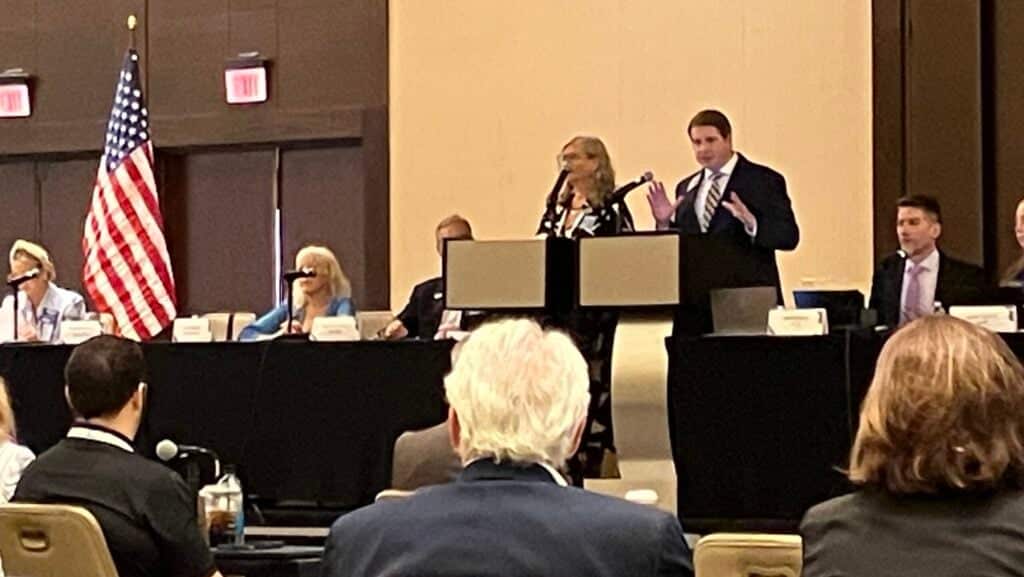
NAR Senior Counsel Matt Troiani addresses NAR’s Professional Standards Forum at the Realtors Legislative Meetings in Washington D.C. on June 3, 2025
The concept of who brings the buyer that completes a real estate sale will remain, though it may come up less frequently in commission disputes, according to the trade group.
Email Editorial