
by Terry LeClair | Jun 17, 2025 | Industry, News Feed
Bigger. Better. Bolder. Inman Connect is heading to San Diego. Join thousands of real estate pros, connect with the Inman Community, and gain insights from hundreds of leading minds shaping the industry. If you’re ready to grow your business and invest in yourself, this is where you need to be. Go BIG in San Diego!
Artificial intelligence (AI) and tools like ChatGPT are here, and they are revolutionizing the real estate industry. This isn’t a passing trend — it’s a transformational opportunity. AI is not about replacing agents but empowering them with tools to streamline their businesses, amplify productivity and elevate client service.
Why AI matters in real estate today
Let’s put things into perspective:
- ChatGPT-3.5 was introduced just last year and is free to use.
- ChatGPT-4, released a few months later, is 10 times smarter and available for just $20 per month.
- This AI powerhouse has already passed:
- For context, Einstein had an IQ of 160. ChatGPT-4 ranks at 155, and GPT-4.5 is predicted to surpass this exponentially.
AI isn’t a replacement for agents; it’s a tool. The local expertise, emotional intelligence and relationships agents bring are irreplaceable. However, agents who embrace AI now will gain an unbeatable advantage over competitors who hesitate.
Practical applications of AI in real estate (with full prompts)
Here’s an in-depth breakdown of how AI can be integrated into your business with prompts you can use immediately:
1. Business planning
Creating a 12-month business plan can feel daunting, but AI can simplify the process in seconds.
Prompt:
I am a Realtor. I would like you to write me a one-year business plan. I would like to sell 12 houses this year. My preferred methods of prospecting are hosting open houses, door-knocking the neighborhood of 1,200 homes in the Port Streets of Newport Beach, and communicating with my sphere of influence, which includes my friends, family and former business associates. Create a business plan that outlines my activities above on a monthly basis. Include dropping off postcards, sending emails and phone calling people.
2. Real-time coaching and negotiations
AI can act as your personal negotiation coach, providing you with scripts for tricky situations.
Prompt:
I want to act as a real estate coach and provide scripts for the following scenario to a Realtor from the selling side. The Realtor is representing two sellers. The house has just been listed for two days, and they have received a full asking price offer of $879,000 with only a home inspection clause. The deposit from the buyers is also $70,000, showing their commitment to buying the property. The sellers were talking to their neighbor, and he said they could easily get $900,000 for their property. The sellers are now getting cold feet about the offer and thinking they might want to hold out for a better offer since this was the first offer and they have only been on the market for two days. Provide three different scripts on the approach for the selling Realtor in encouraging them of the benefits of this strong offer, and three possible rebuttals from the selling clients thinking they can get more money. Then provide three different ways to respond to those rebuttals.
3. Newsletter creation
Creating valuable newsletters for your sphere of influence has never been easier. AI can generate content, titles and additional articles.
Prompt 1:
I want you to be a creative real estate copywriter who needs to create newsletters. I first want you to give me five newsletter titles for a real estate newsletter to engage first-time home buyers. The goal of the newsletter is to show that I have strong knowledge in the process of homebuying, and I focus on education, guidance, and communication to reduce the stress and emotional rollercoaster of buying a home.
Prompt 2:
I want you to be a creative real estate copywriter who needs to create newsletters. The title of the newsletter is “The First-Time Home Buyer’s Guide: From Dream to Reality.” I want you to create an opening, body and conclusion for this newsletter. The focus is on engaging first-time homebuyers and providing a guide on the process. For example:
- First reach out to a reputable and knowledgeable Realtor.
- The Realtor will then guide you in getting a mortgage broker.
- The Realtor will discuss the real estate market.
- The Realtor will educate you on the buying process.
- The Realtor will talk about the negotiation process.
Prompt 3:
Add another page to this newsletter highlighting the benefits of buying a home now rather than waiting for mortgage rates to drop, which will bring more buyers and competition to the marketplace.
4. Simplifying legal language
Complex contract language can confuse clients. AI simplifies these clauses.
Prompt:
I want you to simplify the following statement to a grade 8 level of understanding:
The Seller hereby appoints the Listing Brokerage as agent for the Seller for the purpose of giving and receiving notices pursuant to this Agreement. Where a Brokerage (Buyer’s Brokerage) has entered into a representation agreement with the Buyer, the Buyer hereby appoints the Buyer’s Brokerage as agent for the purpose of giving and receiving notices pursuant to this Agreement.
5. Social media content creation
Hyper-targeted social media posts resonate better with specific audiences.
Prompt 1:
Create a persona for a 65-year-old empty-nester female who wants to downsize her home in Newport Beach, California.
Prompt 2:
Create three Facebook ads for the persona above with emojis and hashtags.
6. Blog creation
AI can also fuel your website content strategy.
Prompt 1:
Create six real estate blog ideas for my website blog. My market is Orange County, California.
Here are six engaging blog ideas tailored for your Orange County, California real estate audience. These topics provide value, establish your authority, and resonate with local buyers, sellers, and homeowners.
1. ‘Orange County market update: What’s happening in local real estate?’
- Why it works: Stay ahead of the curve by providing monthly or quarterly updates on trends in OC. Include home values, average days on market and market inventory.
- Key highlights: Newport Beach, Laguna Beach and other top-performing cities.
- Target audience: Buyers, sellers and investors curious about market conditions.
2. ‘5 things you need to know before selling your Orange County home’
- Why it works: Orange County sellers want actionable tips to maximize their home value. Offer advice on pricing, staging, marketing and timing.
- Key highlights: Discuss buyer demand, why homes sit on the market and unique OC property trends.
- Target audience: Homeowners considering listing their homes.
3. ‘Hidden gem neighborhoods in Orange County you need to know about’
- Why it works: Showcase your local expertise by highlighting lesser-known neighborhoods in OC with strong growth potential, beautiful properties or unique lifestyle perks.
- Key highlights: Spotlight neighborhoods like Eastside Costa Mesa, Corona Del Mar or Dana Point’s Lantern District.
- Target audience: Relocating buyers and investors.
4. ‘How much does it really cost to live in Orange County? A complete breakdown’
- Why it works: Buyers relocating from outside the area often have questions about living costs. Provide transparency on housing, utilities, taxes and lifestyle expenses.
- Key highlights: Compare coastal cities (Newport Beach) to inland areas (Irvine) to show options for different budgets.
- Target audience: Out-of-area buyers and relocation clients.
5. ‘Luxury living in Orange County: What buyers are looking for in 2024’
- Why it works: OC’s luxury market is a major draw. Highlight current trends in high-end real estate like smart homes, outdoor living spaces and sustainable luxury features.
- Key highlights: Showcase examples of local luxury listings and their standout features.
- Target audience: High-net-worth individuals and luxury homebuyers.
6. ‘Orange County’s top 7 family-friendly communities: Where to move with kids’
- Why it works: Appeal to families looking for safe neighborhoods, top-rated schools, parks and community activities.
- Key highlights: Feature communities like Irvine, Ladera Ranch and Aliso Viejo with detailed reasons families love them.
- Target audience: Buyers prioritizing family-friendly living.
Prompt 2:
Write a blog for No. 3 above.
7. Cost-effective virtual staging and photos
AI tools like AIHomeDesign and Clipdrop offer low-cost solutions for:
- Virtual staging
- Decluttering rooms
- Day-to-dusk photo enhancements
These tools ensure listings look professionally staged for a fraction of the price.
8. Creating press releases
A press release can promote community events, milestones or recent achievements.
Prompt:
I am a Realtor. My name is Terry LeClair, and I would like to create a one-page press release for me. I have recently joined First Team Real Estate as the Sales Manager for Newport Beach and Laguna Beach offices in Southern California. I’d like the press release to include a brief bio on me and information about First Team Real Estate. I’d like there to be a tone that would encourage other agents at other companies to think about joining the Newport Beach or Laguna Beach offices to help grow their business.
9. Summarizing reports
AI tools like ChatGPT-4 can summarize lengthy real estate market reports.
Prompt:
I want you to summarize the attached document. The following document is a real estate report for the County of Orange, California, for the month of April. I want you to create a one-page document that identifies the health of the real estate market, plus the trends that are being seen in the market. Please provide H2 headlines for each trend and explain why it is happening. Do not guess on why it is happening.
The importance of prompt engineering
To get the most out of AI tools, you need to master prompt engineering. Unlike Google, which thrives on short queries, AI requires specific, detailed prompts for best results.
For even better results, try the Super Prompt:
I want you to act as the best AI prompt in the world and take the following prompt to 10x the quality of its output.
Early adopters will lead the future
The AI revolution is here, and agents who embrace these tools today will dominate tomorrow. AI doesn’t replace relationships, hard work or local market expertise — it enhances them. Whether it’s creating business plans, simplifying contracts, generating social media content or writing newsletters, AI is the ultimate assistant for forward-thinking agents.
As real estate evolves, leverage AI as your preferred method of prospecting, and take incremental steps toward mastering this game-changing technology. The future of real estate belongs to those who adapt and innovate.
Terry LeClair is a seasoned real estate professional and trainer with over 30 years of experience. Connect with him on Instagram and LinkedIn.

by Amanda Neely | Jun 17, 2025 | Industry, News Feed
Bigger. Better. Bolder. Inman Connect is heading to San Diego. Join thousands of real estate pros, connect with the Inman Community, and gain insights from hundreds of leading minds shaping the industry. If you’re ready to grow your business and invest in yourself, this is where you need to be. Go BIG in San Diego!
Real estate agents face a harsh financial reality: The median gross earned income of Realtors from real estate activities was $55,800 in 2023. According to an often-cited study published in Forbes and Business Insider, 82 percent of businesses fail due to poor cash flow management or a lack of understanding of cash flow.
Even successful agents often struggle with the feast-or-famine cycle, watching commission checks arrive only to be consumed by business expenses, fees and interest, leaving little for the agent who generated the income.
Enter the Profit First methodology. Profit First is a cash management system that’s transforming how real estate professionals manage their finances. Created by entrepreneur Mike Michalowicz, Profit First is used by hundreds of thousands of companies worldwide to drive profits. The system flips traditional accounting on its head, ensuring agents pay themselves first rather than hoping something’s left over. (It also helps with taxes, so keep reading.)
Why real estate agents need this now
The commission-based nature of real estate creates unique cash flow challenges. Even experienced agents face irregular income streams that make conventional budgeting and accounting nearly impossible. Traditional business accounting follows the formula:
Sales – Expenses = Profit
This leaves profit as an afterthought. Profit becomes whatever remains after covering all business costs, which is often $0 and sometimes even negative.
The Profit First formula takes a different approach, inverting the standard profit calculation. Instead of seeing profit as what’s left over, the Profit First formula allocates revenue to profit and then uses the remaining funds to cover expenses. The Profit First formula is
Sales – Profit = Expenses
The 5-account system that changes everything
The Profit First system requires opening five separate bank accounts and allocating percentages of each commission check as follows:
- Revenue account: Where all commission checks initially land before being distributed.
- Profit account: Your reward for being a business owner. This is never touched except for quarterly distributions to yourself.
- Owner’s pay: Your regular salary, the money you live on. Use the baseline described below to establish a steady income and achieve greater financial stability in your personal life.
- Tax account: Funds set aside for tax payments. Be sure you’re not scrambling at tax time.
- Operating expenses: Money for marketing, technology, transportation, staff and other business costs
For each full-time employee, your company should generate real revenue of $150,000 to $250,000 (ideally more, but this is the minimum). For solo agents, this benchmark helps determine if your business model is sustainable.
Also, don’t let your bookkeeper fool you. The extra time to input five bank accounts is minimal (less than five minutes per month usually), but the time and money saved knowing your numbers easily is priceless.
Implementing profit 1st in your real estate business
Start small, think big: Begin by allocating just 1 percent to your Profit Account.“If you get a $1,000 deposit, transfer $10 into your PROFIT account…You’ll never miss that 1 percent,” Michalowicz writes. Gradually increase percentages as you optimize expenses.
Calculate your baseline: Look at your slowest three months, and average them out. “That is the lowest your revenue will likely ever go,” Michalowicz explains. Once you know this, you can use that as a baseline for calculating your owner’s pay. This becomes your steady paycheck, even during slow periods.
Automate the process: Set up automatic transfers, or block your calendar twice monthly on the 10th and 25th of each month. Transfer the funds in your revenue account to your remaining accounts according to their respective percentages.
The psychology behind the system
The beauty of Profit First lies in its behavioral approach to money management. When you see a smaller balance in your operating expense account, you naturally become more creative and efficient with spending. This constraint forces you to question every expense: Is this marketing campaign essential? Is there a more cost-effective technology solution available?
Sixty percent of SMBs cite ineffective cash flow management as a major challenge, yet many agents have never implemented a systematic approach to managing their finances. The Profit First system provides that framework.
Real-world results
Agents implementing Profit First report several benefits:
- Consistent income: Regular owners’ pay eliminates the stress of irregular commission cycles.
- Tax preparedness: No more scrambling to find tax money at year-end.
- Business growth: Forced efficiency in operating expenses often leads to higher profit margins.
- Peace of mind: Knowing money is allocated for specific purposes reduces financial anxiety.
Common pitfalls to avoid
Don’t rob Peter to pay Paul: Resist the temptation to “borrow” from your Profit or Tax accounts during slow months. This defeats the system’s purpose. One of the beauties of Profit First is its adaptability to unique businesses.
For example, real estate agents could consider seasonal adjustments. Adjust allocations according to your market’s seasonal trends. During the winter, you could have more allocated to owners’ compensation, and during the summer, you could have more allocated to taxes and operating expenses.
Intentionally implementing seasonal adjustments is very different than robbing Peter to pay Paul when you’re in a pinch. The former is a creative solution. The latter shortcuts your creativity.
Start where you are: Don’t wait until you’re earning more to implement the system. Small businesses that monitor cash flow monthly have an 80 percent survival rate. Even a 1 percent allocation to profit or taxes can be life-changing.
As you see results, adjust your allocations by 1 percent to 3 percent per quarter until you reach your target. Additionally, implementing Profit First has just become easier with the recent release of the Profit First app.
Your path to financial freedom
The Profit First system isn’t just about managing money; it’s about managing your finances effectively. It’s about changing your relationship with business finances. By paying yourself first, you ensure that your hard work translates into personal wealth, not just business revenue.
Take action today: Open your five accounts this week. Start with conservative allocation percentages, and adjust as you gain experience. Your future self will thank you for taking this crucial step toward financial stability and wealth building.
The real estate industry will always have its ups and downs, but with Profit First, you’ll have a system that ensures you profit regardless of market conditions. Stop leaving your financial future to chance. Implement Profit First and start building the wealth you deserve.

by Richelle Hammiel | Jun 16, 2025 | Industry, News Feed
The first home that late American architect Frank Lloyd Wright ever built in Indiana, near the beginning of his storied career — and one of just two in South Bend — has just hit the market for $1.175 million.
Bigger. Better. Bolder. Inman Connect is heading to San Diego. Join thousands of real estate pros, connect with the Inman Community and gain insights from hundreds of leading minds shaping the industry. If you’re ready to grow your business and invest in yourself, this is where you need to be. Go BIG in San Diego!
The first home late American architect Frank Lloyd Wright ever built in Indiana and one of just two he designed in South Bend has just hit the market for $1.175 million.
The K.C. DeRhodes House residence, built in 1906, is hailed as “the only true Prairie residence in the state” and represents Wright’s early architectural vision. That vision included Wright’s signature horizontal lines, overhanging eaves and a symmetrical layout, according to the property’s listing description.
Listing agents Steve Bizzaro and Gabrielle Iams of Howard Hanna SB Real Estate are representing the property.
Although named for local industrialist K.C. DeRhodes, it was his wife Laura DeRhodes, who championed the project in the beginning of Wright’s career.
“It was at the beginning of his career,” Bizzaro told Realtor.com. “At the time, his office was in Chicago, so he would ride the train down here during the construction. It wasn’t just a design. It was hands-on for Mr. Wright.”
Inside, the 3,000-square-foot home contains five bedrooms and 3.5 bedrooms, including a primary suite with art glass windows wrapped around the room. A welcoming reception hall, living room, formal dining room and updated kitchen grace the main hall.
Notably, the home features 65 original art glass window, Wright-designed built-ins and lighting and meticulously restored woodwork. Much of that restoration is thanks to previous stewards Suzanne and Tom Miller, who purchased the home in 1978.
According to the Frank Lloyd Wright Foundation, they used blueprints found in the attic, historical photos and physical evidence discovered during the restoration to renovate the home to Wright’s original vision. In 2021, those efforts earned the Millers the Wright Spirit Award from the Frank Lloyd Wright Building Conservancy — an award that recognizes individuals who preserve Wright’s legacy.
“They did all the work in re-creating and putting the house back into its original condition,” Bizzaro told Realtor.com. “The woodwork had been painted [over], so they painstakingly stripped the paint.”
The current owners, who purchased the home in 2022, invested $400,000 in updates, including renovated bathrooms, a new kitchen and an electric vehicle charger.
To preserve its legacy, prospective buyers must review and acknowledge the Frank Lloyd Wright Building Conservancy Preservation & Conservation Easement, Furniture Preservation Lease, and License to Encroach, before any showings.
“This is more than just a home — it’s a living piece of art, history, and design legacy,” Bizzaro said.
Email Richelle Hammiel

by Taylor Anderson | Jun 16, 2025 | Industry, News Feed
The company offered thousands of quick cash loans in exchange for 40-year exclusive listing agreements that a judge found violated the law and issued an injunction stopping the practice.
Bigger. Better. Bolder. Inman Connect is heading to San Diego. Join thousands of real estate pros, connect with the Inman Community and gain insights from hundreds of leading minds shaping the industry. If you’re ready to grow your business and invest in yourself, this is where you need to be. Go BIG in San Diego.
Months after a judge ordered MV Realty to terminate long-term contracts with homeowners, the South Florida real estate brokerage has begun letting its clients out of the fraudulent contracts.
According to a report by the Tampa Bay Times, MV Realty has terminated thousands of its contracts, which trapped the firm’s clients into 40-year exclusive listing agreements with the brokerage.
Under the terms of the so-called “homeowner benefit agreements,” if clients listed their homes with another brokerage, MV Realty would place liens on their properties and charge them 3 percent of the property’s value to let them out of the contract.
The state of Florida sued the company in November 2022. In February, a judge ordered the firm to cancel its contracts within two weeks.
The state later said the company failed to comply with the court’s injunction until it recently began terminating the contracts, according to the Times.
MV Realty would work with homeowners who were in need of a quick cash loan. In exchange for money up front, MV Realty would lock its clients into the long-term contracts.
The state said the company violated the Florida Deceptive and Unfair Trade Practices Act through the enforcement of its contracts, and that more than 9,300 homeowners were affected.
“In my almost six and a half years with the office, this was one of the worst abuses that crossed my desk,” former acting attorney general John Guard said in a statement earlier this year. “The 9,303 Floridians who were subject to MV Realty’s unconscionable practices will have their properties unencumbered by this injunction and we will continue to hold MV Realty responsible for its abuses.”
The brokerage began facing legal trouble throughout the country as its notoriety spread and states began filing their own lawsuits to stop its conduct.
MV Realty lost its ability to transact real estate in Colorado. California blocked the company from enforcing its long-term contracts late last year.
Amid the mounting legal battles, the company initially filed for chapter 11 bankruptcy protection before withdrawing that request.
Email Taylor Anderson

by Jason Waugh | Jun 16, 2025 | Industry, News Feed
Your next professional move should be driven by vision and intention, not pressure, as you continue to develop your career, Coldwell Banker Affiliates’ Jason Waugh writes.
Bigger. Better. Bolder. Inman Connect is heading to San Diego. Join thousands of real estate pros, connect with the Inman Community, and gain insights from hundreds of leading minds shaping the industry. If you’re ready to grow your business and invest in yourself, this is where you need to be. Go BIG in San Diego!
During a career, there often comes a moment — not marked by burnout or dissatisfaction, but by a quieter, more persistent realization: You may be ready for something new. Perhaps your current role no longer challenges you, or the work that once felt fulfilling now feels routine. Maybe the industry is evolving faster than your current environment can accommodate.
These signals can be subtle. According to a recent Career.io study, real estate professionals report high job satisfaction, rating their job a 4.24 out of 5. Yet, paradoxically, the industry also ranks among the top three for burnout, with professionals changing roles approximately every 3.91 years, according to 2024 research published by PsychologyJobs.com.
This duality underscores the complexity of career decisions — you can be passionate about your work and still recognize the need for change.
So, how do you know when it’s time to make a move? I spent 30 years affiliated with my previous company before joining Coldwell Banker. Three decades. That transition wasn’t driven by dissatisfaction — it was the result of thoughtful reflection and strategic consideration.
In today’s dynamic real estate landscape — characterized by market recalibration, economic volatility and uncertainty, industry consolidation and rapid technological advancement — proactive decision-making is not just advantageous; it’s imperative.
Recently, I had the pleasure of meeting with Anywhere Real Estate’s Rising Star award winners. We discussed ways to advance their careers and navigate changes that may be inevitable. Here’s my framework of eight key questions to help guide career decisions.
Whether you’re contemplating a move or simply reassessing your path, these questions can provide clarity:
1. Are you clear on your purpose?
Time is one of our most valuable and limited resources. In your professional journey, it is essential to have a well-defined vision of how you allocate your time and with whom you choose to invest it.
Consider focusing not only on what you wish to achieve or acquire, but more importantly, on who you aspire to become. Aligning your actions with a clear sense of purpose will drive more meaningful and impactful outcomes.
2. What are your core strengths — and where do you need to grow?
Conduct an honest self-assessment. Identify your key competencies and areas for development. Too often, individuals change their external circumstances without first addressing the internal changes necessary for meaningful progress.
Then ask: Do you want to deepen your expertise or broaden your skill set? And, consider whether your current organization provides the environment and resources to support that development.
3. Have you engaged in meaningful career conversations within your company?
Before looking outward, look inward. Speak with your manager and cross-functional leaders. Explore potential opportunities within your current organization that align with your goals.
4. Do you understand your financials?
Evaluate the true cost of each transaction — both in time and money. Without a clear understanding of your financial metrics, it’s difficult to assess whether a new opportunity offers real value or just better marketing.
5. Are you speaking with the right people?
Don’t rely solely on recruiters. Engage with individuals across all levels of the organization you’re considering. Culture fit is critical — without it, even the most attractive compensation package can feel restrictive.
6. What’s holding you back?
Change is emotional. When I made my move, it felt like choosing between loyalty and betrayal. Acknowledge those feelings, but don’t let them paralyze your progress. Often, your peers will support your growth more than you expect.
7. Who will support you through the transition?
Transitions involve many moving parts — branding, licensing and onboarding. Have you met the team that will guide you through this process, or are you relying on promises from leadership?
8. Is this about FOMO?
With so much movement in the industry, it’s natural to feel as though you might be missing out. However, not every opportunity is the right one. The key is to evaluate alignment in timing and opportunity. If the timing is right but the opportunity is not, the outcome may be unfulfilling.
Conversely, if the opportunity is compelling, but the timing is not, it may still lead to disappointment. Sometimes, the wisest decision is to stay the course. After all, the grass tends to be greenest where we consistently water it.
Recruiting efforts will continue. The industry will keep evolving. But your next move should be driven by vision and intention, not pressure.
Take the time to reflect on where you want to be in two, five or 10 years. Whether you choose to stay, pivot internally or make a bold leap, ensure your decision is strategic, intentional and aligned with the professional you aspire to become.
Jason Waugh serves as president of Coldwell Banker Affiliates for Coldwell Banker Real Estate LLC.
by Lillian Dickerson | Jun 16, 2025 | Industry, News Feed
Down payments are declining even as home prices are rising because buyers are facing affordability challenges or opting to reserve more of their cash because of economic uncertainty, Redfin said.
Bigger. Better. Bolder. Inman Connect is heading to San Diego. Join thousands of real estate pros, connect with the Inman Community and gain insights from hundreds of leading minds shaping the industry. If you’re ready to grow your business and invest in yourself, this is where you need to be. Go BIG in San Diego!
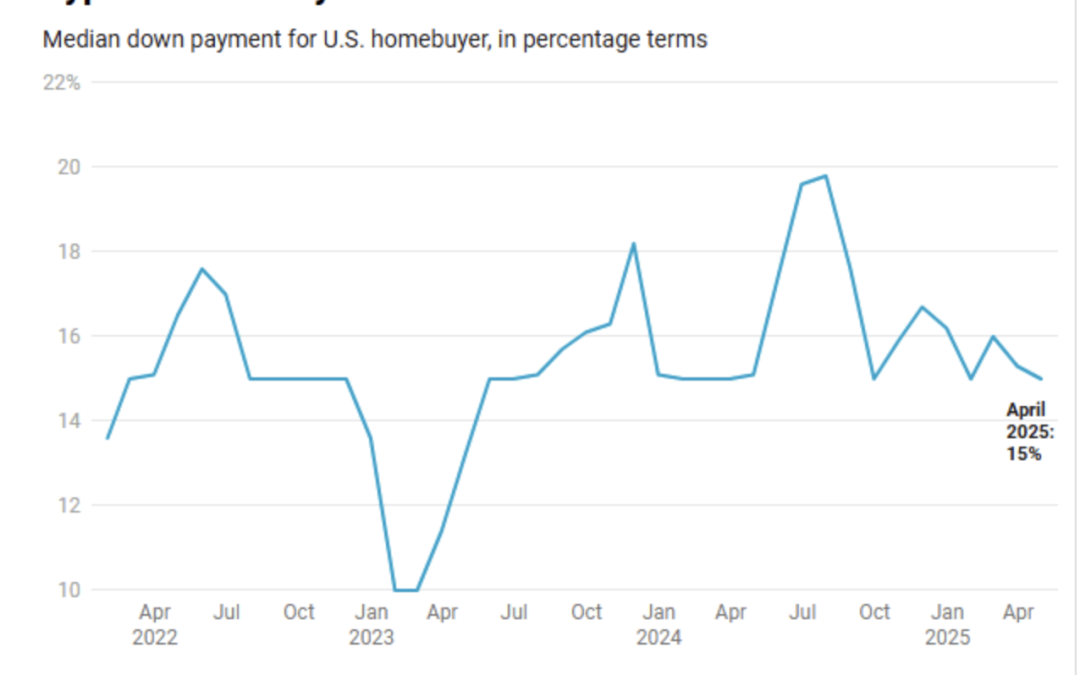
The median U.S. homebuyer’s down payment has fallen for the first time in nearly two years, according to data released Monday by Redfin.
The 1 percent drop, to $62,468, is subtle but significant, according to the report, which tracked county records in the 40 most populous metro areas in the U.S.
“The buyers who are moving forward today are being very careful with their finances because with housing costs near record highs, they’re typically spending a big portion of their paycheck to buy a home,” Redfin Premier agent Fernanda Kriese, who is based in Las Vegas, said in the report.
“I’m seeing an uptick in first-time buyers looking for starter homes,” Kriese added. “Combine that with concerns about layoffs and a potential recession, and people are doing things like cross-comparing mortgage origination fees, shopping around for lenders and looking into down-payment assistance.”
In terms of percentage, the typical homebuyer today puts down 15 percent of the purchase price, nearly equal to the 15.1 percent they put down at this time last year, Redfin’s report noted. And the median down payment for American homebuyers has hovered around that number for about the last four years, briefly dipping around 10 percent in early 2023. Pre-pandemic, a 10 percent down payment was more frequent.
But dollar-amount down payments have not fallen on an annual basis since the summer of 2023 when home-sales prices were also falling, according to Redfin. During that period, down payments were declining because of falling home prices.
Now, home prices are rising, although they are doing so more slowly. As of April, home prices were up 1.4 percent year over year, compared to the 4 percent they were up by during the same period in 2024.
The reason down payments are falling by dollar amount is because not all homebuyers make a down payment — one-third pay in all cash. And those that are financing a home are most likely buying less expensive homes, which also means a smaller down payment in terms of dollars, but not necessarily percentage terms.
Redfin said that a higher share of homebuyers are also using FHA and VA loans, which allow for smaller down payments, somewhere between 0 percent to 3.5 percent. In April, 15.3 percent of mortgage home sales used an FHA loan, up from 14.2 percent the year before. The share of mortgage home sales using a VA loan was 7.2 percent in April, up from 6.4 percent the year before and the highest April level seen since 2020.
With homebuyer affordability remaining difficult because of roughly 7 percent mortgage rates, many buyers may be purchasing lower-priced homes than they might otherwise. Economic uncertainty in the U.S. right now may also be driving buyers to reserve more of their money in their bank accounts for extenuating circumstances.
Meanwhile, there are now more homesellers than homebuyers in the U.S., tipping the market to favor buyers, which has meant concessions and sellers willing to accept lower down payments. Unfortunately, lower down payments might also be a sign of a buyer with less secure financial standing, and a deal that’s more likely to fall through.
Email Lillian Dickerson
