by Bernice Ross | Jun 18, 2025 | Industry, News Feed
Since the NAR commission suit settlement, buyer agents have faced new rules, new documents and a new normal. This month, Inman drills down on Today’s Buyers Agent with the fresh marketing strategies, skills and tools buyer agents are using to prosper in changing times.
Even if you have errors and omissions insurance, being a defendant in a lawsuit can have a huge negative impact on both you and your business. Being deposed by a superstar litigator is your worst nightmare. Everything you say can be twisted and, in many cases, turned against you.
Hopefully, you have never been or will be in any real estate litigation. If you want to keep the attorneys at bay, here is a list of behaviors to avoid as well as best practices that can keep you out of trouble.
Wrong place, wrong time
What’s really upsetting is that you can do everything right and still end up in litigation. Sometimes you’re just in the wrong place at the wrong time.
For example, there was one case where the seller failed to make a major disclosure about the property. The seller went bankrupt, so the plaintiff’s attorney turned to the agents and the other people involved in the transaction.
When the attorney discovered that the painting contractor had errors and omissions insurance, he was named as a defendant as well, along with the agents and brokerage because they also had E&O insurance.
6 best practices to avoid litigation
Below you will find six common sources of real estate litigation as well as six strategies to avoid being sued.
1. ‘What’s that spot on the ceiling?’
Even if you are a roofing expert, never answer this question. I had two listings where the brown spot on the ceiling turned out to be a beehive with over 100 pounds of pounds of honey.
Best practice: Avoid diagnosing any issue regarding the condition of the property. Instead say:
“I don’t know what caused the stain on the ceiling. If you are interested in the property, then you should hire a competent roofer and conduct a thorough physical inspection to thoroughly investigate the condition of the property.”
In terms of what you put on your mandated written disclosure documents, avoid diagnosing there as well. Instead, describe what you see: “Brown stain noted on living room ceiling.” Or, “Buckled sidewalk noted adjacent to Ficus tree in front yard.”
2. We aren’t going to disclose that old inspection report
Sellers often don’t want to disclose previous inspection reports, especially if the report caused their transaction to be canceled. Failure to disclose is always a poor idea. Here’s why.
A geological inspection on a house revealed that it could collapse during an earthquake. The first set of buyers walked away from the property.
The listing agent failed to disclose the geological report to the second set of buyers. The house collapsed during the Northridge Earthquake and two people died. Needless to say, the settlement was several million dollars.
Best practice: When you have a transaction that falls apart due to the physical inspection, it’s smart to disclose it to the buyer. If the seller won’t disclose the report, walk away from the listing. It’s simply not worth the risk.
3. Where’s the property line?
While the seller may swear under oath that they know exactly where the property line is, don’t believe it. In a case where the sellers said the fence was the property line, they were actually off by 1 foot. That mistake cost them over $200,000.
Best practice: When a buyer asks about where the property line is say:
“I don’t know. If you want the exact location of the property lines, hire a surveyor.”
4. How much will the seller really take for the property?
A luxury agent had a listing that was priced at $2.4 million. When a journalist asked her where she thought the property would sell, she said $1.8 million. When the seller read this in the paper a few days later, he filed a lawsuit for an unauthorized price reduction. The judgment against her and her brokerage was over $2 million.
Best practice: When a buyer asks you how much a seller will take for the property, there’s only one correct answer:
“The only way to know for sure is to write an offer.”
In fact, you can’t even represent that the seller will sell for the asking price because in a multiple-offer situation the property could sell for over asking.
5. Is this a good family neighborhood that has a low crime rate?
You may believe that a property is located in a great neighborhood; however, that can all change if the wrong tenant or owner moves into just one house.
Best practice: When a buyer asks you about the characteristics of the neighborhood, including crime statistics, ethnic composition of the residents, or “families” that live in the area, you cannot comment. If you do, you run the risk of violating the fair housing laws. Instead, provide them with links to census, crime and school data where they can search out this information for themselves.
6. It’s a new property — do I really need a physical inspection?
If there was ever a time to have a thorough physical inspection, it’s when a buyer purchases a new property. For example, in one of the new homes that we purchased, the plumbers hooked up the hot water to one of the toilets — talk about being steamed.
Best practice: On all new properties, make sure that the buyer does a thorough physical inspection and walk-through prior to closing. The buyer has leverage before the transaction closes. Afterward, some builders aren’t very good at following up on post-close problems.
Ultimately, your first line of defense is always to follow the Golden Rule. Never say anything negative about anyone, never represent what your buyer or seller will do, and never diagnose the condition of the property.
Instead, have your clients use trained professionals to evaluate the property. Also, for additional peace of mind, order a home warranty policy as well.
Bernice Ross, president and CEO of BrokerageUP and RealEstateCoach.com, the founder of Profit.RealEstate and a national speaker, author and trainer with over 1,500 published articles.
by Kristine Milkovich | Jun 18, 2025 | Industry, News Feed
Preparation and precision matter when you’re trying to set a booked interview or consultation, broker-owner Kristine Milkovich writes. Here are six steps to book the appointment.
Since the NAR commission suit settlement, buyer agents have faced new rules, new documents and a new normal. This month, Inman drills down on Today’s Buyers Agent with the fresh marketing strategies, skills and tools buyer agents are using to prosper in changing times.
To convert prospects, an essential skill is to book consultations. Agents cannot begin the sales process without a proper evaluation of the consumer’s needs and goals. The ability to schedule appointments quickly helps keep your pipeline flush and creates structure in your schedule.
6 steps for getting prospects to commit
When you’re looking to set a booked client interview or consultation, preparation and precision matter. Here are seven strategic steps to help you get that “yes” and turn a prospect into a booked client.
1. Do your research
Know who they are, their recent work and their interests. Use this insight to make your outreach personal and compelling. Thoughtful touches and relevance in your outreach can immediately set you apart.
2. Make it brief
Start with a 15-minute or less icebreaker. Reach out professionally and clearly — whether by email, DM or a warm introduction. Keep it short, clear and action-driven.
Set your mindset first: Preparation and precision are the gatekeepers to getting the “hire” when you actually meet for the consultation or interview.
Be clear on your purpose:
- Why are you requesting the call?
- What will the client gain?
- Why is a 60-90 minute consultation valuable to them?
Include in your outreach:
- The purpose of the meeting
- The standards this meeting sets for client success
- Time commitment
- Flexible date options or scheduling link
Use tools like Calendly to eliminate back-and-forth. Let them choose a convenient time.
Pro tip: If you don’t use a scheduling tool, offer two or three specific time slots.
Help them see the value in locking in a set day and time so the consultation aligns with their schedule.
Example:
“Let’s get you in my calendar. I know you have a heavy travel schedule, and I want to make sure we set a time that suits your needs!”
3. Educate, guide, reassure
Clarify what will be covered in the actual consultation or presentation.
Example:
“Our booked time together will be an opportunity for both of us to set expectations, build trust and ensure you feel confident hiring me as your go-to expert for buying in Seattle.”
This is your consultation — own it. Give it a name, and position it as a standard part of your process.
Example:
“Our team’s listing presentation overview is a step we facilitate to ensure we’re aligned to achieve accuracy, efficiency and exceed your expectations.”
Once they book, send a confirmation that includes:
- Date and time
- Format (Zoom, phone, in-person)
- Brief agenda or talking points
Also, ask if there’s anything they’d like to add or focus on.
Bonus: Send a calendar invite to lock it in.
4. Teach people how to treat you
Guide the prospect to follow your lead. Let them know you’ll be sending a presentation outline ahead of time for review.
Example:
“I’ll email over a quick outline so we can make the most of our consultation on Wednesday at 3 p.m.”
This prep email reinforces your professionalism and demonstrates your commitment to a smooth, efficient experience in a dynamic market.
Make sure to:
- Take the lead
- Be the expert
- Show preparedness
And don’t forget to make the client the hero, and thank the person who referred them. Express gratitude for their trust and time.
After your initial icebreaker call, the ultimate goal is to book the formal buyer or listing consultation. Always ask their preferred method of communication moving forward.
5. Honored to be considered – a quick look at my experience
Let prospects know why you’re the right fit for the job.
Example:
“Thank you again for the opportunity to connect—I’m truly honored to be considered as your real estate partner. Choosing the right person is a big decision, so here’s a brief overview of my experience and credentials to help you feel confident moving forward.”
-
- Top Producer – Seattle Real Estate Alliance, 2024
- Seattle Times Best in Luxury Team, 2024
- Certified Relocation Specialist
- LGBTQ+ Real Estate Alliance National Delegate Leader, Region 3
- 12 years of experience with over $480 million in home sales
“Beyond the accolades, what truly matters is building trust, delivering results, and making the process seamless. Looking forward to learning more about your goals and how I can help bring them to life. Include: Website, testimonials, or portfolio links if available.”
6. Confirm, recap, prepare
You have one chance to show your point of difference — and it begins with the initial icebreaker that leads to a booked consultation. Be clear. Be intentional. Set the tone. And most importantly, book the meeting.
Let’s do a better job
It’s our responsibility to lead and guide the narrative around how we prepare clients. Most professions require:
- Questionnaires
- Early arrival
- Fact-finding
- Q&A
- A review of “rules of engagement”
Real estate should be no different. Think and act like the professionals you hire, respect and learn from.
Kristine Milkovich is a broker-owner of The Milkovich Team. Connect with Kristine on LinkedIn and Instagram.
by Dani Vanderboegh | Jun 18, 2025 | Industry, News Feed
Since the NAR commission suit settlement, buyer agents have faced new rules, new documents and a new normal. This month, Inman drills down on Today’s Buyers Agent with the fresh marketing strategies, skills and tools buyer agents are using to prosper in changing times.
Pulse is a recurring column where we ask for readers’ takes on varying topics in a weekly survey and report back with our findings.
This past year has seen no shortage of changes. Just since last August: The National Association of Realtors landmark settlement changes went into effect, and rules around working with buyers changed, along with the way real estate had been done for decades.
Just when you thought the industry was moving forward, the Clear Cooperation Policy debate heated up, resulting in a rule change and an industrywide feud over private listing networks.
Meanwhile, artificial intelligence and technology are evolving at a breakneck pace, with new tools and applications emerging constantly. Add to that the current presidential administration’s policy changes and tariffs — it’s a lot to keep up with.
via GIPHY
This week, we’re asking: What do you want to know more about? Is it more training? On what topics? Do you need more marketing ideas, tips and tricks for leveling up your listing skills, or how-tos to help you through a tough market? Are you looking for more market and economy intel? Do you want more news roundups or expert insights so you can cut through the noise? Whatever it is you need, please sound off below.
We’ll compile a list of the top responses and post them on Inman next Tuesday.

by Jeff Tucker | Jun 18, 2025 | Industry, News Feed
Bigger. Better. Bolder. Inman Connect is heading to San Diego. Join thousands of real estate pros, connect with the power of the Inman Community, and gain insights from hundreds of leading minds shaping the industry. If you’re ready to grow your business and invest in yourself, this is where you need to be. Go BIG in San Diego!
There has been a lot of discussion in recent weeks about the practice of marketing homes through private listing networks before — or instead of — listing them on the multiple listing service (MLS).
As an economist, my job is to strip the emotion out of the equation and simply analyze the data — and the data is clear: Privately marketing homes usually leaves sellers worse off financially. It also creates a fractured, less equitable housing market.
Through a pair of recent studies — one by Bright MLS, the nation’s largest multiple listing service, and another from Zillow — compelling evidence shows that private listing networks and private listings, as a whole, ultimately harm sellers, buyers and the integrity of the real estate industry. (Compass has made contrary claims, but unlike Zillow and Bright MLS, has not made its data available for review.)
The data underscores that homeowners who opt to sell privately are, on average, leaving money on the table and taking longer to close on the sales of their homes.
A comprehensive report by Bright MLS analyzed more than 100,000 home sales and found that residences marketed privately as “office exclusives” took significantly longer to sell. These homes sat on the market for a median of 37 days, compared to just 20 days for homes that started on the MLS.
Furthermore, claims that homes sell for more through private networks are largely a myth. The Bright MLS study found no statistical evidence that office exclusives commanded higher prices. In fact, almost 90 percent of these privately marketed properties eventually ended up on the MLS after failing to secure an acceptable offer, leaving sellers right back where they could have started (on the MLS), and potentially weeks behind schedule.
Although some brokerages may position private listing networks as a premium service, the numbers do not align with such a narrative, and if the numbers are incongruent with the concept, one must concur that, in a majority of cases, sellers are not better off.
At a loss
The financial disadvantage for sellers who do accept an offer before marketing their homes publicly is tallied up in a recent Zillow report.
The research, which analyzed 10 million transactions over the past two years, revealed that homes not listed on the MLS sold for a median of 1.5 percent less than their publicly marketed counterparts, after controlling for all the available property and market-level data impacting expected sale prices. That translates to a significant loss for the typical American homeowner, amounting to an average of nearly $5,000 per seller — or $1 billion collectively.
Advocates for private listing networks base their argument on the principle of “seller’s choice” and assert that such platforms provide greater financial advantages for consumers. However, the data shows that sellers are actually settling for a lower selling price.
What’s more, the loudest cries in support of private listing networks come from the brokerages themselves. When a brokerage is able to keep a listing “in-house,” representing both sides of the transaction, they are, of course, able to secure a more substantial commission.
In a recent article, real estate analyst Mike DelPrete estimated the kind of sizable profits brokerages could extract using private listing networks by double-ending deals and leveraging their control of hidden listings to entice more buyers, essentially profiting by gatekeeping access to those private listings.
A fragmented and inequitable market
Beyond the direct financial harm to sellers, the proliferation of private listing networks creates a host of problems for homebuyers and the overall health of the market. Buyers today expect and deserve a transparent marketplace where all available homes can easily be viewed online without having to sign up to work with a specific agent or give a brokerage their personal information as the price of access.
The practice of agents withholding listings from the open market creates a fragmented and frustrating experience for buyers, who are left to wonder if they are truly seeing all their options, and an equally frustrating transaction for sellers, who, statistically, may be realizing significantly less proceeds than selling in the “open market.”
The breakdown of transparency also leads to a shortage of critical market data. When homes are sold off-market, crucial information about sale prices and Days on Market is not widely available. This information deficit makes it harder for both buyers and sellers to make informed decisions.
A seller won’t have enough data to price their home accurately, and a buyer is, in essence, blindly entering into the transaction. And both may be missing information critical to assessing the skill of a prospective agent, as a private portal can easily obscure trends that may otherwise reveal deficiencies in an agent’s ability to price, market or negotiate the sale of a home.
In other words, as brokerages quietly leach more and more data out of consumers, consumers will get less and less data back.
Most troubling, however, are the fair housing implications of private listings. By limiting the marketing of a home to a select network of agents and their clients, the practice can (even if inadvertently) result in excluding buyers from underrepresented communities from learning about all available homes for sale.
Publicly accessible real estate portals and websites, by contrast, ensure that every potential buyer has an equal opportunity to see a new listing and submit an offer, fostering a more equitable and inclusive housing market.
Another recent Zillow study furthers this point, finding that the negative financial impact of off-MLS sales is more than double for sellers in communities of color compared to those in predominantly white neighborhoods.
Facts over assumptions
The evidence is overwhelming: For the vast majority of sellers, the most effective and profitable way to sell a home is to list it publicly on the MLS, ensuring maximum exposure to the widest possible pool of potential buyers. This tried-and-true method not only benefits individual sellers, but also contributes to a more transparent, efficient and balanced housing market for all.
Jeff Tucker is the Principal Economist for Windermere Real Estate in Seattle, Washington. Connect with him on X or Facebook.

by Taylor Anderson | Jun 17, 2025 | Industry, News Feed
A New York homeowner claims text messages sent by an associate broker at Keller Williams amounted to an “invasion of her privacy” and a violation of the Telephone Consumer Protection Act.
Bigger. Better. Bolder. Inman Connect is heading to San Diego. Join thousands of real estate pros, connect with the Inman Community and gain insights from hundreds of leading minds shaping the industry. If you’re ready to grow your business and invest in yourself, this is where you need to be. Go BIG in San Diego!
A New York homeowner is suing Keller Williams after one of its agents sent unsolicited text messages advertising her services, according to a new lawsuit filed last week.
Sydney Thayer filed her class action lawsuit against the franchiser in the U.S. District Court for the Western District of New York on June 12, saying the texts were a violation of the Telephone Consumer Protection Act.
Thayer, who lives in Rochester, New York, said she received texts on her phone between April 2024 and March despite her number being on the National Do Not Call Registry.
Screenshots included in the complaint show that an associate broker told Thayer she received her information from Zillow and asked if Thayer was interested in her real estate services.
“Defendant’s unsolicited text messages caused Plaintiff actual harm, including invasion of her privacy, aggravation, annoyance, intrusion on seclusion, trespass, and conversion,” Thayer wrote in her complaint. “Defendant’s text messages also inconvenienced Plaintiff and caused disruption to her daily life.”
The New York resident is seeking $1,500 in damages for each call that is found to have violated the TCPA, as well as an injunction preventing the practice.
A spokesman for Keller Williams acknowledged the lawsuit and said it was looking into the matter.
“We’re aware of the lawsuit alleging a TCPA violation by a real estate agent affiliated with one of our independently owned franchisees, and we are reviewing the matter,” said Darryl Frost, a Keller Williams spokesperson.
The new lawsuit is only the latest in a series of complaints targeting the company’s telemarketing tactics.
In January 2023, Keller Williams Realty agreed to pay $40 million to settle a class action lawsuit that alleged the franchisor’s agents made unsolicited, pre-recorded calls to consumers without their consent, including calls to consumers on the National Do Not Call Registry.
Months after that settlement, Keller Williams was hit with another, similar class action suit filed by a Las Vegas resident.
A slate of attorneys sued the company in 2019 for similar conduct.
Email Taylor Anderson
by Taylor Anderson | Jun 17, 2025 | Industry, News Feed
The company now expects to earn as much as 10 percent less this quarter than it expected in April, according to a new SEC filing. The company’s stock price fell sharply in early trading hours.
Bigger. Better. Bolder. Inman Connect is heading to San Diego. Join thousands of real estate pros, connect with the Inman Community and gain insights from hundreds of leading minds shaping the industry. If you’re ready to grow your business and invest in yourself, this is where you need to be. Go BIG in San Diego!
The slow real estate market is weighing on Anywhere Real Estate.
The company told investors in a filing with the Securities and Exchange Commission on Tuesday that it projects earnings to be as much as 10 percent lower in the second quarter than it expected in late April.
Six weeks ago, Anywhere told investors it expected its earnings before interest, taxes, depreciation and amortization (EBITDA) to be approximately the same as it was a year ago.
This week, however, the company revised that estimate downward and said it expected earnings from its brokerage and franchise businesses to fall between 3-10 percent.
The company said the downward revision was “largely due to softer homesale transaction volume than expected in the second quarter of 2025, driven by market and macroeconomic volatility,” according to the filing from Chief Financial Officer Charlotte Simonelli.
Anywhere Real Estate includes Better Homes and Gardens Real Estate, Century 21, Coldwell Banker, Corcoran, ERA Real Estate and Sotheby’s International Realty.
According to the National Association of Realtors, home sales in April were on pace for an annualized rate of 4 million homes sold this year.
The company reported a net loss of $78 million during the first quarter of the year.
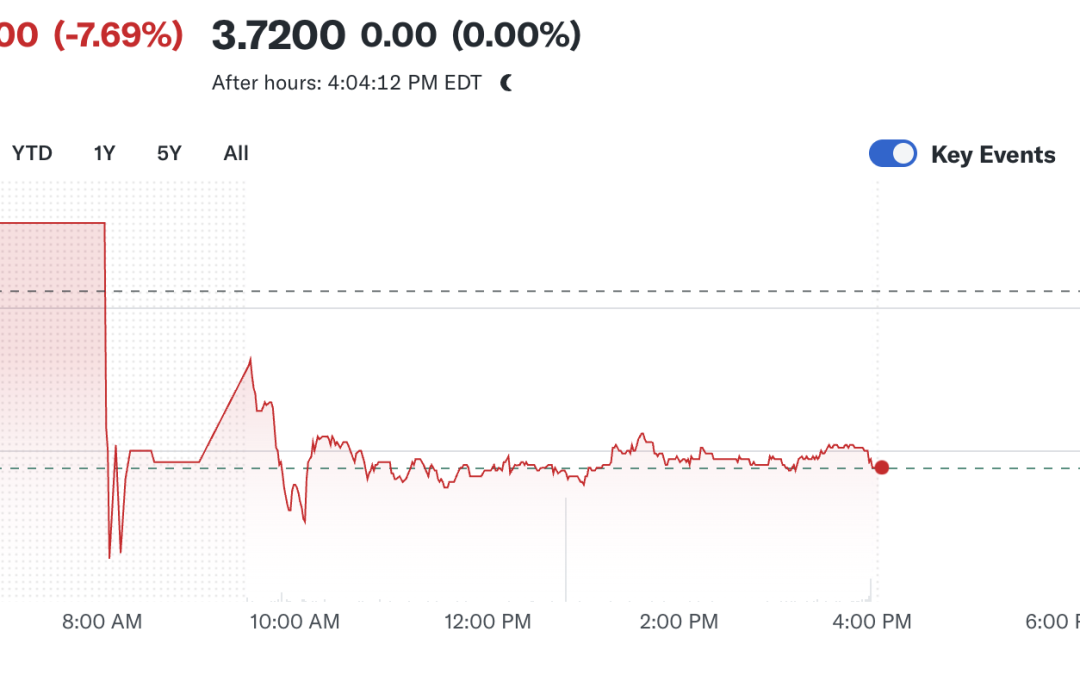
Anywhere stock after the markets closed.
The revision led to a 7 percent drop in Anywhere’s stock value during early trading hours on Tuesday despite the company expressing a hint of optimism for a sales rebound.
While revenue is lagging in the second quarter, Anywhere said in the filing that it expects its earnings for the full year to be the same as it reported earlier this year.
That’s “based primarily upon our expectations for improving homesale transaction volume in the second half of 2025,” the company said.
Some of that second half performance is due to ongoing cost-cutting measures, which the company said were more heavily weighted toward the second half of the year.
The company said that it had cut costs by $14 million in the first quarter, and that it expected to cut costs by $100 million throughout the year.
Other savings would come from “additional cost management actions we intend to take.”
“Despite a historically challenging housing market, we continue to demonstrate strong financial performance and strategically invest in the business to propel us for future success faster,” CEO Ryan Schneider said at the time.
Email Taylor Anderson
