Renovations don’t just apply to your home, the Better Homes and Gardens Real Estate president writes. They can also apply to your professiona and personal endeavors.
Whether it’s refining your business model, mastering new technologies, or discovering strategies to capitalize on the next market surge, Inman Connect New York will prepare you to take bold steps forward. The Next Chapter is about to begin. Be part of it. Join us and thousands of real estate leaders Jan. 22-24, 2025.
Growing up in the real estate industry, I’ve always viewed the world through the lens of “home.” My childhood home wasn’t just a place — it was where I learned about the business, strategized open houses with my mom who was a Realtor and celebrated my real estate successes once I ventured into the industry. Home served as both a hub and a haven, laying the foundation for my career.
The concept of home also beautifully parallels the idea of resilience. As the last two years have shown us in no uncertain terms, resiliency is a must in our ever-evolving business landscape.
Just as we renovate our homes to adapt and improve, we can draw parallels to evolving our businesses. Here are four key similarities:
Have a plan, but be prepared to change it
Home renovations often require flexibility. As I work on restoring a 100-year-old house, I’ve learned to adapt my original vision, consider alternative solutions and handle unexpected challenges. The same applies to your business plan.
Whether you’re a new real estate agent or an experienced professional, recognize that business plans are dynamic — they need constant adjustment. Adaptability ensures resilience.
Evaluate the structure; fortify the foundation
Sometimes a house’s bones are solid, but the attached elements need updating. In real estate, relationships matter most. Your expertise forms the weight-bearing walls of your business foundation. Clients trust you to guide them through significant financial and emotional transactions. Strengthen these bonds by maintaining transparent communication and frequent connections.
Sometimes you can’t DIY it, and that’s OK
Just as not all home improvements are DIY projects, some business challenges demand professional expertise. Recognize when to seek help — whether refining your marketing strategy, exploring new lead generation methods or embracing technology.
Lean on the resources and expertise from your brand, broker and fellow agents. In times of change, drawing on the strength and stability of your network can help guide you through turbulent times. Regardless of market conditions, tap into the broad array of resources available to you.
Your business is an investment. It grows over time
Renovating a house is an investment that takes time to yield returns. Similarly, as a real estate agent, you are your business. Investing in yourself is crucial for sustainable success. Enhance your skill set, stay informed about industry trends, and maintain a growth mindset.
Strategic decision-making, guided by continuous self-improvement, leads to greater returns. Adaptability and resilience remain your greatest assets.
Wishing you success in your personal and professional renovation projects!
Ginger Wilcox is the President of Better Homes and Gardens Real Estate.
President and CEO of Anywhere Brands Sue Yannaccone offers advice and perspective for the professional changes ahead.
Days before the Aug. 17 practice changes go into effect, President and CEO of Anywhere Brands and Anywhere Advisors Sue Yannaccone writes how the industry can get ready for what’s next
As we approach the Aug. 17 practice changes deadline as part of NAR’s commission-related legal settlement, it is clear to me that our industry is all over the map (in some cases, literally) on how we are viewing and preparing for what’s next.
At Anywhere, we have been focused on ensuring our agents, affiliates, and employees are educated and ready, but I have read and heard from others everything from nothing to see here to the sky is falling — and many reactions of confusion, doubt and frustration in between.
I don’t have a crystal ball on how every NAR-affiliated MLS or state association will interpret the legal language in NAR’s settlement. But what I do know is that we all have a choice: You can either seize this moment, or you can be a witness to it.
I encourage you to choose the former.
I truly believe the more prepared, informed and committed we all are to serve our clients during this time of industry change, the more we will be viewed as the trusted advisors they have sought to help them successfully reach the closing table.
We’re not playing defense, but it’s never been more important to authentically and transparently own the value that we provide to our clients.
Here are a few tips my brokerage and brand leaders have been sharing with our affiliated agents and franchisees to help them get ready for August 17:
1. Tap into your brokerage resources
If you haven’t already, ensure you’re making the time to review and fully digest any forms, educational resources and guidance surrounding industry change from your brokerage.
2. Bolster your network
Ensure you know who to contact with questions or challenges. Foster discussion with your colleagues, and form relationships at your local association, MLS, and yes, even with competitors.
3. Embrace the buyer agreement
Many organizations have begun releasing their buyer agreements to comply with the NAR practice change. Familiarize yourself, and ask questions now to avoid business interruption.
4. Hone your pitch
It’s not about scripting yourself — it’s about knowing how to simply and succinctly articulate what you do. We’re providing our brokers and agents with training on their pitch, but some local associations have rolled out helpful materials as well.
5. Understand offers of compensation
Offers can’t be displayed on the MLS, so it’s important to work with your company and/or legal counsel to know how this information can be shared in your market and make the appropriate technological changes to your website.
And 1 bonus tip: Zoom out
We are steeped in uncertainty and fast-moving waters, but our purpose as professionals and stewards of homeownership hasn’t changed. Even if there are some initial bumps, questions you can’t immediately answer or additional complexity to figure out, we are in this together — as an industry — and this is our time to do what we do best: help homebuyers and sellers achieve their dreams.
Sue Yannaccone is president and CEO at Anywhere Brands.
Inman Connect is moving from Las Vegas to San Diego in 2025 and it’ll be bigger, better and bolder than ever before. Join us for Inman Connect San Diego on July 30-Aug. 1, 2025, with the brightest minds in real estate to shape the future of the industry. Reserve your spot today for an exclusive discount.
There’s a lot of confusion around the particulars of the National Association of Realtors (NAR) commission lawsuit settlement and the resulting business practice changes. Compliance expert Summer Goralik is here to help clear up some of the looming questions so that we can move forward together as an industry.
This week’s question
Are we allowed, or not allowed, to let clients know upfront if there is not a concession offered (California here, and messaging is very unclear if this is a good practice or considered steering)?
Compliance expert answer
This question highlights the uneasiness some licensed professionals are feeling as they attempt to understand the new practice rules. As a real estate compliance consultant and former investigator for the California Department of Real Estate, I recognize the importance of clarity on this issue, especially during this time of significant industry change.
Of course, apprehension is just one response to the recent shifts in industry practices that differ from the traditional real estate environment agents and brokers have long known. Additionally, some state associations have introduced new versions of representation agreements, and certain multiple listing service (MLS) portals have been modified to reflect these changes — only to be unexpectedly revised again, as seen in California. This evolving situation has created a challenging environment for licensed real estate professionals.
Adding to this complexity, multiple entities are overseeing the adoption of these new rules, including MLSs (which, according to NAR, will enforce buyer representation agreements), certain state governments (depending on their jurisdiction and regulations), consumers, whistleblowers, private attorneys and even the Department of Justice (DOJ).
Regarding the question about disclosing concessions, it’s essential to revisit the fundamentals of real estate transactions. Seller concessions are a common aspect of real estate contracts and can be negotiated at the onset of the offer process or often after the buyer’s inspections reveal more about the property’s condition.
Fortunately, the new rules taking effect on Aug. 17 do not fundamentally change this aspect of the purchase process. Buyers will still be able to request concessions, and these terms will be negotiated and agreed upon by the involved parties. In turn, real estate agents will remain responsible for representing their clients’ interests in negotiating concessions between the parties.
As for concerns about the “S” word, or steering, NAR’s frequently asked questions (FAQs) published on their website specifically reassure licensed members that the new practice rules actually help mitigate the risk of such unlawful activity.
Namely, written buyer agreements will outline brokerage compensation terms upfront; MLS participants may not receive compensation for brokerage services from any source that exceeds the amount or rate agreed upon in the agreement with the buyer; and a broker working with a buyer cannot receive more compensation than what was agreed upon in that agreement. This makes the amount of any offer of compensation irrelevant to the buyer-broker’s compensation.
Collectively, according to NAR, these practice changes have eliminated any theoretical steering; a real estate broker will not make more compensation by steering a buyer to a particular listing because it has a higher offer of compensation.
When it comes to the advertisement of concessions on the MLS, NAR’s FAQs confirm that there is no specific policy regarding this practice. Local MLSs have the discretion to display or omit information about seller concessions in listings, except where concessions are contingent upon payment to any cooperating broker, buyer broker or other buyer representative. As a result, depending on the MLS, real estate listings may or may not include details about a seller’s willingness to offer concessions.
It’s important to note that “willingness” is the key term here. Any concession information displayed in the MLS is not binding. Concessions must be explicitly negotiated and agreed upon in the fully executed contract.
Moreover, to alleviate some of the anxiety surrounding this topic, and perhaps to best address the question, consider the reverse scenario: What if an agent failed to inform their client of known concession information related to a property listing?
In my view, this would constitute a failure to fulfill their statutory duties as a real estate licensee. After all, this issue falls under the umbrella of disclosure, and licensed real estate professionals should be well aware of the importance of honest and open communication with their clients.
As a fiduciary, an agent’s role is to convey all pertinent information to their clients, act in their best interests and faithfully execute their instructions. If I were a homebuyer, I would want to know about any potential concessions associated with a property I was interested in. While this information might not influence my final decision, it’s crucial to have it during the home-search process.
Ultimately, if a property listing does not include details about concessions and the listing agent does not provide any specifics in this area, buyers are still free to request concessions in their offers — this remains a standard practice.
In fact, some experts and experienced real estate agents argue that the safest time to offer or negotiate concessions, including any payment of buyer-broker compensation, is during the contract process. Furthermore, it’s the agent’s responsibility to guide buyers through this process and ensure they understand their options and can make informed decisions when preparing a purchase offer.
In summary, real estate agents should inform their clients about seller concessions if this information is available. Doing so aligns with their fiduciary duty to act in the best interest of their clients. Given the rapidly evolving nature of real estate practices, an agent’s communication, honesty, and transparency are integral to maintaining compliance and client trust.
Editor’s note: Licensed real estate agents should always check with their responsible brokers for guidance, direction and policy regarding the new practice changes, and licensed real estate brokers would be wise to consult with a licensed attorney for legal clarification and support.
The opinions, suggestions or recommendations contained in this discussion are based on Summer Goralik’s experience working for, and knowledge of the laws enforced by, the California Department of Real Estate and must not be considered legal advice or relied upon as legal advice. You should consult with your brokerage, and/or appropriate legal counsel in your jurisdiction, for further clarification.
Olympic gold medalist Simone Biles isn’t sitting back and relaxing after a successful run at the 2024 Paris Olympic Games. Now that the gymnast is back in Texas, she is returning to the ongoing construction of her dream mansion.
Whether it’s refining your business model, mastering new technologies, or discovering strategies to capitalize on the next market surge, Inman Connect New York will prepare you to take bold steps forward. The Next Chapter is about to begin. Be part of it. Join us and thousands of real estate leaders Jan. 22-24, 2025.
Olympic gold medalist Simone Biles isn’t just sitting back and relaxing after a successful run at the 2024 Paris Olympic Games. Now that the gymnast is back in Texas, she is turning her attention to the next big challenge: the ongoing construction of her dream mansion.
On her Instagram stories, the Olympian shared updates to the construction of the Texas house she is building with husband, Chicago Bears safety Jonathan Owens, People reported. The couple first started sharing photos of the project on Instagram in September 2023, five months after they married.
Biles seems pretty pumped about the home-in-progress, showing off photos of rooms with new finishes, complete with lots of eyes emojis.
The home seems to be taking on a clean, modern design heavy on white and black themes as well as gold accents.
The kitchen features black and white marble countertops with matching backsplash. A light bronze light fixture hanging from a tray ceiling matches the faucet fixtures in the sink.
Black and white themes continue in the shower where lighter black and white marble slabs cover the walls and small white and gray tiles line the floor.
A photo of the walk-in closet reveals a center island with pristine white drawers and bronze finishes, and glass door-enclosed shelves with space for hanging clothes.
The scale of the home’s living spaces seems grand, even when not compared to Biles’ own petite size.
Simone Biles / Instagram
A two-story space features sliding glass doors that open up to lake views and a wall that looks to be prepared for a fireplace installation.
Previously, Biles said that the new-build will include a second level with a game room, home theater and wet bar, as well as a balcony overlooking the lake.
Biles won three gold medals and one silver medal at the 2024 Paris Olympics.
Get Inman’s Luxury Lens Newsletter delivered right to your inbox. A weekly deep dive into the biggest news in the world of high-end real estate delivered every Friday. Click here to subscribe.
Whether it’s refining your business model, mastering new technologies, or discovering strategies to capitalize on the next market surge, Inman Connect New York will prepare you to take bold steps forward. The Next Chapter is about to begin. Be part of it. Join us and thousands of real estate leaders Jan. 22-24, 2025.
Nykia Wright, interim CEO of the National Association of Realtors, may not have direct experience in real estate. During her entire career, however, she has been focused on constant disruption.
That made her a good pick for the moment to lead staff at NAR through the most tumultuous time in the industry’s modern history, she said during a recent podcast interview.
Wright recently sat down with a team of friendly interviewers from the Real Estate Insiders Unfiltered podcast, including NextHome CEO James Dwiggins and NextHome CSO Keith Robinson. Dwiggins has been a vocal ally of NAR through the past year, offering critiques while also calling for support of the organization.
Wright has declined through NAR to sit for an interview during her roughly eight months as the organization’s CEO, so the podcast offered a rare glimpse into the staff leader of the organization at a critical time for NAR and the industry at large.
Whereas NAR President Kevin Sears has granted multiple interviews and appeared before large crowds during his time as head of leadership, including appearing on stage at Inman Connect Las Vegas last month, Wright has worked to lead staff behind the scenes.
Dwiggins asked Wright whether NAR’s brokering of a settlement, which will include paying $418 million in the coming years and making sweeping business practice changes that take effect on Saturday, was the right decision.
“Absolutely, unequivocally,” Wright said. “We have to understand what we were faced with. It’s not like we had an entire option set. Of the options that we were given, this was the path that made the most sense for us. Now, that said, we are not resting on our laurels.”
She acknowledged that members were upset about changes that have engulfed the organization and the real estate industry.
“Some people will take a while and some people may never come back,” Wright said, “but we are not going to count the day before evening and assume that that’s true.”
She repeatedly urged NAR members to “lean in” and engage with the organization.
Wright didn’t mention any NAR detractors by name, including the American Real Estate Association, a new real estate organization formed by Compass agent Jason Haber and The Agency CEO Mauricio Umansky.
“There’s a saying, ‘listen to the whispers so you don’t have to hear the screams,’” Wright said. “So the whispers of people wanting to leave is where we put our head on a swivel, get out there and start figuring out how we can bring those people back into the fold.”
“When people are leaning out right now, it concerns me a little bit because their voice is not part of a future solution,” Wright said. “Being in business for yourself but not by yourself, when you leave the association, I consider [leaning out] going into the ‘by yourself’ type of box. And I think that we are truly stronger together, and we just have to continue to prove that.”
Wright also didn’t mention a new class action lawsuit filed earlier this week by agents and brokers in Michigan against NAR, but she did appear to address critics more broadly.
“I understand that people are frustrated with things, but bring those frustrations in house so that we can be the best organization that we can be,” Wright said. “Because we’re confusing consumers, we’re confusing plaintiffs’ attorneys, we’re confusing the Department of Justice, we’re confusing all of these people based on how many followers we have and how many users we have.”
The interview also gave the public and NAR’s 1.5 million members perhaps their most thorough insight into Wright’s background and allowed them to hear from her about why it’s what the organization needed for this moment in time.
“I probably was not built for yesterday and who knows what I’m built for in the future,” Wright said. “But right now, it makes sense based upon my background.”
Wright’s background
Wright is from Atlanta and studied finance at Carnegie Mellon University before moving to Europe and studying international business at the University of Cambridge. She returned home and eventually got her Master of Business Administration degree at Dartmouth.
She called herself a “business doctor,” working as a consultant for private and public companies, including unnamed real estate companies. That consulting work, and a later position as CEO of the Chicago Sun-Times, gave her experience in industries that are constantly being disrupted, Wright said.
“The last consulting firm that I was part of, there was a sign at the front door; it was six feet tall by about three feet wide,” Wright said. “The sign said, ‘While you are reading this, your business model is being disrupted.’ That helped us understand and develop a discipline for when we were helping our clients.”
Wright also said an immediate focus when she joined NAR as its interim CEO was on the organization’s communications strategy, saying real estate was facing its “Y2K moment.”
“Making sure that we are able to speak to all of those audiences and companies at the same time is a very, very difficult task,” Wright said. “That’s not an excuse. But that was one of the primary challenges that we had to face.”
Wright pointed out that while she didn’t have direct experience as a real estate operator, her skills and business background are complementary to those of Kevin Sears, a long-time broker from Massachusetts.
“One additional person having a real estate background is not going to move the needle,” Wright said. “But if you’ve got someone with decades of real estate experience and someone with decades of experience … outside of the real estate industry but having adjacent experience, that is a really, really powerful thing.”
When asked whether she hoped to stay on past the end of the year, Wright was somewhat reticent.
“I will say that I will not change anything as it relates to how my life has been designed,” Wright said. “I bloom where I’ve been planted, and I let the universe take care of the rest of the details.”
The team that founded EasyKnock-acquired power buyer Ribbon has launched Indigo, an artificial intelligence-powered transaction management and home search platform. The platform is only available in Charlotte and is free to use until Oct. 1.
Whether it’s refining your business model, mastering new technologies, or discovering strategies to capitalize on the next market surge, Inman Connect New York will prepare you to take bold steps forward. The Next Chapter is about to begin. Be part of it. Join us and thousands of real estate leaders Jan. 22-24, 2025.
The team that founded EasyKnock-acquired power buyer Ribbon is back with a new artificial intelligence-powered home transaction platform, Indigo, executives revealed to Inman exclusively on Thursday.
The platform centralizes agent-to-agent communications, contract and disclosure signings, buyer offers and negotiations for a more transparent buying and selling experience, said Indigo CEO and co-founder Shaival Shah.
Shaival Shah
“As an independent platform, we help all market participants – real estate agents, buyers, and sellers – by facilitating an open, transparent home transaction,” Shah said in a statement. “We believe this will be the new industry model. As the industry shifts from a search-centric to transaction-centric model, consumers and agents will demand a more accessible and intuitive experience.”
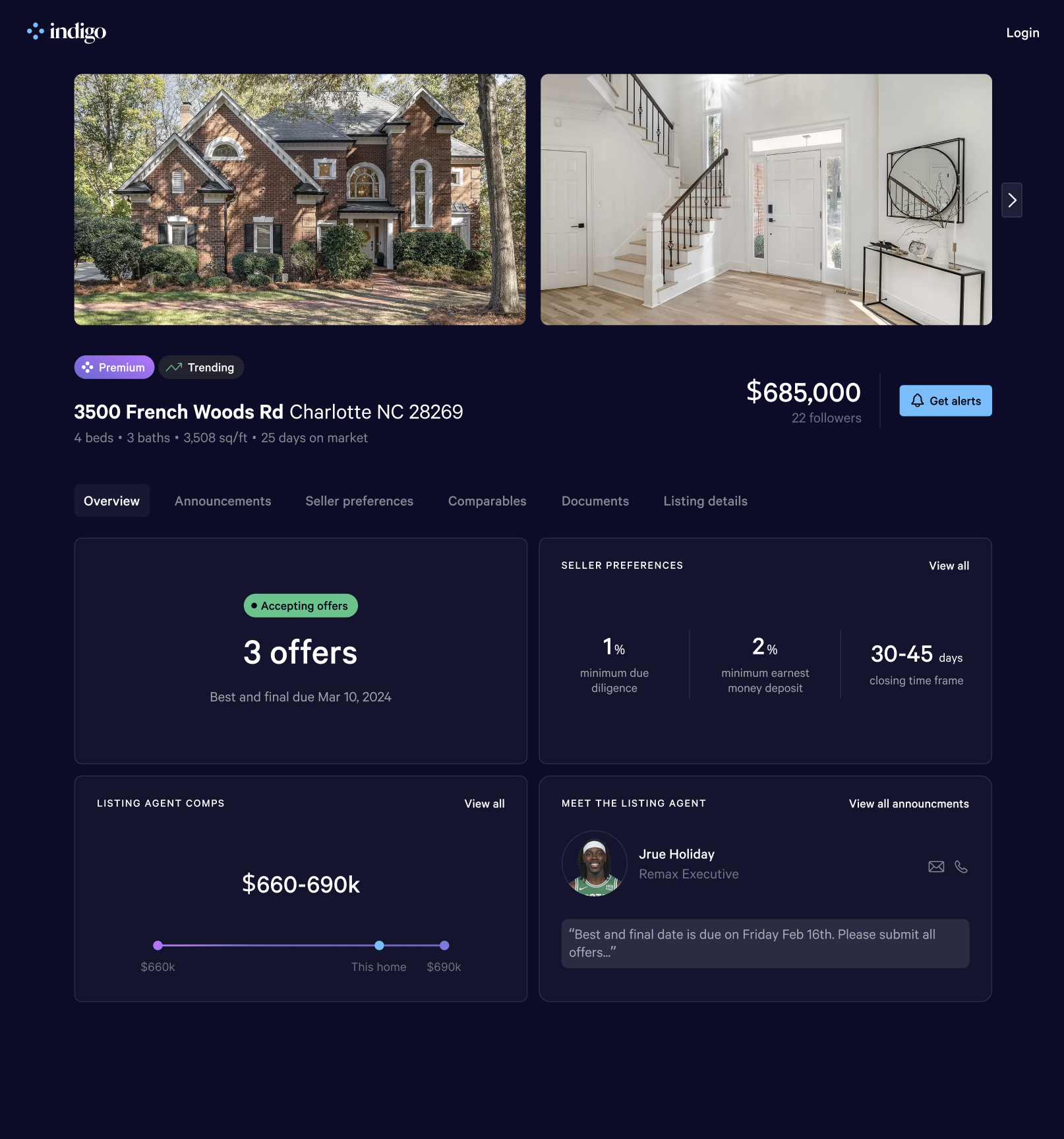
On the sell side, listing agents can create Storefronts for their listings. The storefronts pull listing information from multiple listing services and allow agents to add additional announcements, comparables and seller preferences on earnest money deposits, due diligence fees, due diligence end dates and preferred closing timelines. Storefronts take less than 10 minutes to set up.
Indigo Storefront
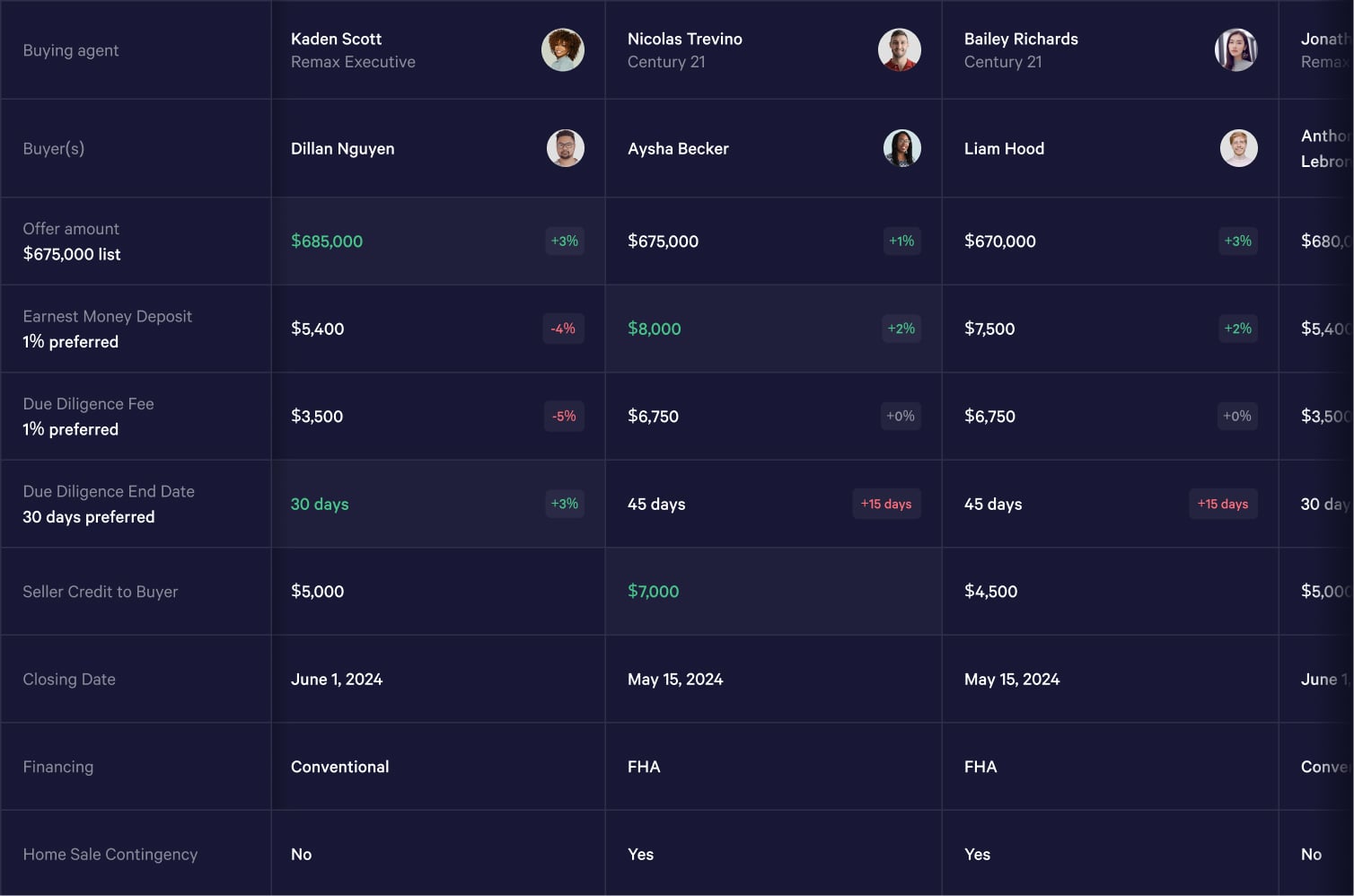
On the buy side, agents can use the platform to generate exclusive or non-exclusive written buyer agreements and craft offers that are automatically sent to the listing agent. As buyers’ agents make offers, Indigo organizes them into a streamlined dashboard so listing agents and clients can easily compare offers.
Indigo’s proprietary artificial intelligence model cuts the chaos associated with paperwork by generating contracts, disclosure forms, and addendums and organizing them into a workflow for listing and buyer agents. Indigo AI also auto-fills paperwork throughout each stage of the transaction, enabling agents to focus on other tasks for their clients.
Indigo Offer Dashboard
“To bring the new industry model to market, the information, real-time intelligence and decision-making capabilities must improve to facilitate the transparency the market deserves,” Shah said. “It requires great technical firepower to reimagine the new experience and workflow infrastructure.”
“Indigo’s proprietary AI models do just that – solving new and existing problems that were previously impossible,” he added. “In service of a more modern, transparent experience, we’re confident this is where we should be doubling down.”
In an interview with Inman, Shah said Indigo’s launch is perfect timing as the industry draws closer to the deadline for enforcing cooperative compensation policy changes per the National Association of Realtors’ buyer-broker commission settlement. The changes, he said, heighten the need for platforms that reduce friction and increase transparency while ensuring agents stay in compliance with the new rules.
“You know, we’ve spent a good five or six years operating and building products for agents and for buyers and for sellers in the past,” Shah said in reference to Ribbon. “We learned a lot of things from that. One of the things that we learned was just how complex the transaction process is. At one point, we were processing almost 5,000 offers a month.”
“Over the past year, we’ve been really focused on trying to address fundamental problems with the transaction process and how we could use really advanced technology to fix those problems,” he added. “When the lawsuit information started coming out, and we started to see the changes [happening], the platform and the technology that we were looking to build was very much aligned to the changes.”
Although Indigo is primarily a transaction management platform, he also sees the company as a portal since consumers can use Indigo as a home search platform. He said Indigo’s Storefront enables listing agents to “have a lot more control” than they would have with other portal incumbents, and curate a home search experience for consumers.
“It allows the listing agent to have a lot more control over that portal dynamic, right versus being run by a third party,” he said. “And so that way, the listing agent is able to present information that they think is appropriate that has been verified by their seller, versus a business automatically pulled in by third parties, and allows the listing agent and have more direct communication with anyone that’s interested. That’s how it’s different than a traditional search portal.”
Shah said a handful of leading real estate agents and teams from Compass, Keller Williams, eXp Realty, and RE/MAX have joined the platform, which launched in Charlotte, N.C. on Thursday. Indigo will be free to use until Oct. 1 and then introduce a “nominal fee” for listing and buyer agents who use the site.
Indigo will expand to several more markets by year’s end.