
by Taylor Anderson | Jun 30, 2025 | Industry, News Feed
Zillow attorneys pushed back at Compass’ request for a broad and expedited discovery, and on the brokerage’s private listing network. ‘Compass would erect new barriers for buyers by making listings exclusive to each broker.’
Real estate is changing fast, and so must you. Inman Connect San Diego is where you turn uncertainty into strategy — with real talk, real tools and the connections that matter. If you’re serious about staying ahead of the game, this is where you need to be. Register now!
Compass faces no real harm from Zillow’s updated policy banning publicly marketed private listings from its platform, the portal said in a new legal filing on Monday.
In response to filings in Compass’ antitrust lawsuit challenging Zillow’s private listings policy, the nation’s largest real estate portal said that Compass waited until near the deadline to go to court and was seeking to “turn back the industry-wide status quo of transparency and liquidity.”
TAKE THE INMAN INTEL SURVEY FOR JUNE
“Zillow provides maximum transparency and has become a trusted resource for millions of users, who are able to use Zillow to find buyer agents who represent their best interests rather than relying on listing agents whose duty is to the seller,” the company wrote in its filing.
It was Zillow’s first response in court to the lawsuit Compass filed a week ago. On Friday, Compass also asked the judge overseeing the case to file a preliminary injunction on Zillow’s updated listing access standards, which require listings to be filed on the MLS and therefore on Zillow within one business day of any public marketing.
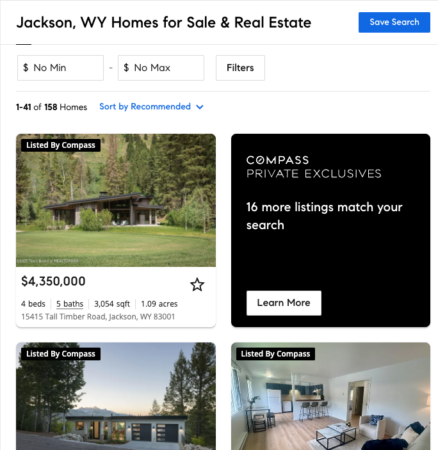
The policy seemed to take aim at Compass’ 3-Phased Marketing Strategy, the first of which includes putting a listing on the brokerage’s private listing network without going onto the MLS. The first phase of a Compass listing under the strategy is known as a Private Exclusive.
“Put plainly,” Compass wrote in its complaint, “Zillow has granted itself the power to ban every Compass Private Exclusive listing from going to Zillow because of the way in which Compass markets and executes its Private Exclusive listing strategy internally and externally.”
In its lawsuit, Compass argued that its Private Exclusives were considered “office exclusives,” or exempt listings where the seller directs their agent not to widely disseminate a listing publicly.
According to NAR: “The office exclusive listing shall be filed with the MLS but not disseminated to other MLS Participants and Subscribers.”
A spokesperson for NAR declined to comment on whether Compass’ Private Exclusives were considered office exclusives under that definition.
“NAR is not a party to this lawsuit and has no comment,” the spokesperson said.
According to Zillow’s updated policy, a listing within a brokerage’s private listings network would violate the policy if that network is itself publicly marketed on the brokerage’s website.
“Compass would erect new barriers for buyers by making listings exclusive to each broker — resulting in reduced transparency, less market liquidity, and a more frustrating and less efficient experience for buyers and sellers,” Zillow wrote in its filing.
“Likewise, other entities that display for-sale listings to prospective buyers, including Compass, remain free to display such listings from any source, including the MLS, regardless of whether Zillow would display them,” it continued.
The legal filing was made in opposition to Compass’ request for expedited discovery.
Compass attorneys are hoping to receive from Zillow any communication between Zillow, Redfin, eXp and other brokerages, along with unspecified documents about what it calls the Zillow Ban, documents outlining Zillow’s interactions with certain MLSs, and more.
It also wants data about Zillow’s users and traffic, and documents related to competition in the real estate portal market.
In its filing, Zillow wrote that the request was unreasonable.
“Compass’s requests seek potentially hundreds of thousands of documents (if not more) and terabytes of highly confidential data,” the attorneys wrote. “Compass, without seeking leave, has also indicated that it will seek fact depositions and expert discovery.”
Email Taylor Anderson
by Taylor Anderson | Jun 30, 2025 | Industry, News Feed
The nation’s largest real estate portal began enforcing its ban on private listings on Monday, 10 weeks after announcing its new standards. Here’s what you need to know now.
Real estate is changing fast, and so must you. Inman Connect San Diego is where you turn uncertainty into strategy — with real talk, real tools and the connections that matter. If you’re serious about staying ahead of the game, this is where you need to be. Register now!
Zillow’s ban on private listings took effect on Monday, the latest development in an ongoing battle that will determine the future landscape for marketing and home search in the U.S.
The ban set up a test for sellers: You can market your home off the multiple listing service as long as you’re comfortable with your listing also not showing up on the biggest real estate portal in the country.
TAKE THE INMAN INTEL SURVEY FOR JUNE
Zillow Group, which, along with subsidiaries like Trulia, collectively attract 227 million users each month, took the latest step toward its stated goal of providing consumers with broad and transparent access to as many listings as possible.
The months leading up to the day of reckoning were filled with legal battles and questions about the definition of private listings themselves as agents, brokers and their clients continued to navigate a tumultuous time in the industry.
Here’s what you need to know about the new state of affairs on Zillow.
What listings are impacted?
The updated policy bans listings that aren’t added to the MLS within 24 hours of being publicly marketed.
“What’s not allowed under the listing access standards,” Zillow wrote, is “publicly marketing that off-MLS listings are available if a buyer is willing to work with an agent or brokerage.”
The portal also clarified that listings within a brokerage’s private listing network would be prohibited if the network itself is marketed to consumers on a public-facing website.
Zillow Group said the ban does not apply to Delayed Marketing Exempt Listings — a type of listing status created via recent changes to the National Association of Realtors’ Clear Cooperation Policy — as long as they’re submitted to an MLS within one day of public marketing.
“Coming soon” and office exclusives also comply with Zillow’s listing access standard as long as listing brokers are adhering to NAR’s guidance for each listing status. That guidance says that office exclusives are required to be submitted to the MLS, but aren’t widely distributed to other subscribers.
Zillow said that for sale by owner (FSBO) listings, rental listings and new construction listings sold by the builder are also permitted.
The ban arrives amid growing industry focus on private listings, with Compass leading the charge in creating a network of such properties.
Though different industry players have debated just exactly which listings might ultimately fall under the terms of the ban, Zillow has already begun warning agents that their listings are not in compliance.
Compass Private Exclusives
Zillow and Compass are also currently locked in a lawsuit over the nature of the ban. In its complaint that initiated the suit, Compass argues that Private Exclusives — or listings marketed exclusively via Compass’ platform — “that are referenced in advertisements on Compass.com mentioning the number of Private Exclusive listings available in a city or specific geography, or similarly returned in response to a search result on Compass.com, will trigger the Zillow Ban.”
“Put plainly,” the complaint adds, “Zillow has granted itself the power to ban every Compass Private Exclusive listing from going to Zillow because of the way in which Compass markets and executes its Private Exclusive listing strategy internally and externally.”
Zillow didn’t respond to a request for comment about whether Compass’ Private Exclusive network is specifically banned by its updated policy.
How many listings are impacted?
Compass notes on its website and seller disclosure form that Private Exclusives aren’t initially listed on the MLS, which it says could reduce the number of potential buyers who see the listing, reduce the number of showings, reduce the number of offers and reduce the final sale price for the property.
Still, the company says, nearly half of its clients in the first three months of this year chose to start with a private listing. Most of them, 94 percent, ultimately moved on to list the home on the MLS, the company says.
For Compass, the first three months of 2025 included 19,393 listings that started as Private Exclusives.
Compass’ Private Exclusives network was an expansion of existing options for more tailored private home sales for celebrities, judges or politicians, for example.
That was before Zillow announced the update to its listing access policy.
It’s difficult to say how many listings throughout the country would be in violation of Zillow’s updated policy, though the number would likely represent only a small percentage of all listings.
‘The life of the listing’
Zillow said that listings that violate its policy are banned for the “life of the listing.” That refers to the time a home is being sold by a broker who did not follow Zillow Group’s listing access standard, resulting in that listing being banned from Zillow and Trulia’s sites.
However, if the seller terminates the listing agreement with that broker and signs a new agreement with a broker who follows the listing access standard, Zillow and Trulia will lift the ban and display the listing.
What else?
Compass filed a federal antitrust lawsuit against Zillow last week and later asked the judge in the case to stop Zillow from enforcing its updated policy.
A ruling on that latter request isn’t expected until later this summer or in the fall, putting in place a question about how many sellers will ultimately decide to go with a private listing.
Meanwhile, Homes.com has said it would continue to show all listings despite the moves by Redfin and Zillow. Realtor.com hasn’t revealed any plans for a ban.
Email Taylor Anderson
by Taylor Anderson | Jun 27, 2025 | Industry, News Feed
In a motion filed on Friday morning, Compass said that it seeks to “dent” Zillow’s dominance in the home search space and asked the court to stop Zillow’s ban on publicly marketed private listings, which takes effect on Monday
Real estate is changing fast, and so must you. Inman Connect San Diego is where you turn uncertainty into strategy — with real talk, real tools and the connections that matter. If you’re serious about staying ahead of the game, this is where you need to be. Register now!
Compass asked a court to temporarily block Zillow’s ban on publicly marketed private listings on Friday, the final business day before the ban is set to take effect.
The nation’s largest brokerage by volume is on the verge of potentially seeing thousands of its listings go dark on the nation’s largest real estate search portal unless the judge agrees to at least temporarily pause the ban while Compass makes its case in court.
Compass filed a motion for a preliminary injunction that, if granted, would allow the company to continue privately marketing listings on its own site and still have them end up on Zillow. If the motion is denied, Compass would be forced to decide between pausing one of its key business efforts or see if its clients are comfortable with listings that aren’t shown on Zillow.
“Zillow owns the dominant home search platform in the United States. Compass…seeks to dent this dominance through an innovative selling approach and cutting-edge technological tools,” the company wrote in its filing. “Zillow has taken notice. But instead of meeting this competitive threat with a better product or increased investments, Zillow and its market rivals have conspired to strangle Compass’s market innovations.”
Nearly half of Compass’ listings (48.2 percent) started in what the company calls its 3-Phased Marketing Strategy (3PS), which involves a period when the listing is marketed privately on Compass’ own site and not on the relevant multiple listing service.
The brokerage says its 3PS strategy allows sellers to generate early interest and gain insights about pricing and the house itself without the listing accruing a history of days on market and potential price changes. Most listings that start with private marketing ultimately (94 percent) end up on the MLS and therefore on Zillow.
In addition to what the company says are benefits to its agents and clients, the strategy is an attempt to differentiate Compass from Zillow as a place for consumers to look for listings.
It filed its antitrust lawsuit against Zillow on Monday in U.S. District Court in the Southern District of New York. Judge Jeannette A. Vargas isn’t expected to rule on the request for an injunction until later this summer or early fall.
In the meantime, Compass CEO Robert Reffkin said that come Monday, consumers should look for listings anywhere other than Zillow.

Robert Reffkin at Inman Connect New York.
“Starting June 30, buyers should know that Zillow no longer displays all MLS listings,” Reffkin said in a statement shared with Inman. “Buyers should search elsewhere or contact a real estate professional who will be able to show them what Zillow does not have.”
While the lawsuit and statement both focus on Zillow, Redfin has also enacted a ban that is similar to Zillow’s.
In its request to temporarily block the Zillow ban, Compass shared new details about an April conversation between Reffkin and Redfin CEO Glenn Kelman just hours after Zillow announced its new policy.
Kelman told Reffkin “that Redfin had agreed to adopt virtually the same policy as the Zillow Ban,” Compass said. “During that call, Redfin’s CEO acknowledged that the Zillow Ban would harm Compass, but pushed Compass to negotiate with Zillow, implying that Zillow and Redfin could find a way to negate that harm if Compass did not fight the new rules. Compass refused.”
Redfin didn’t immediately respond to a request for comment or to verify the allegations about a call between Kelman and Reffkin.
Compass didn’t name Redfin as a defendant in the lawsuit. But it alleged that Redfin and eXp, the nation’s largest brokerage by transactions, conspired with Zillow when enacting or agreeing to comply with Zillow’s policy.

Zillow CEO Jeremy Wacksman speaks at Inman Connect.
Zillow didn’t directly comment on the new legal filing. It has said that it would “vigorously defend” itself from the lawsuit.
“Hiding listings creates a fragmented market, limits consumer choice and creates barriers to homeownership, which is bad for buyers, sellers, and the industry at large, especially in this inventory and affordability-constrained environment,” a Zillow spokesperson said in a statement.
“Our listing access standards are designed to ensure transparency, equal opportunity, and broad visibility for everyone so sellers can maximize price and time to sell and so buyers have access to all available inventory,” the company said.
Compass attorneys are hoping to receive from Zillow any communication between Zillow, Redfin, eXp and other brokerages, along with unspecified documents about what it calls the Zillow Ban, documents outlining Zillow’s interactions with certain MLSs, and more.
It also wants data about Zillow’s users and traffic, and documents related to competition in the real estate portal market.
Email Taylor Anderson

by Taylor Anderson | Jun 26, 2025 | Industry, News Feed
New numbers from the National Association of Realtors show that pending sales rose 1.1 percent year over year in May.
Real estate is changing fast, and so must you. Inman Connect San Diego is where you turn uncertainty into strategy — with real talk, real tools and the connections that matter. If you’re serious about staying ahead of the game, this is where you need to be. Register now!
Mortgage rates may still be higher than anyone wants, but new numbers from the National Association of Realtors show that strong job and wage growth helped push pending home sales higher in May.
The numbers, out Thursday, show that pending sales rose 1.1 percent year over year last month. Compared to April, pending sales rose 1.8 percent. The increases are small, but NAR framed them as a positive sign anyway and attributed them to other positive economic progress.
“Consistent job gains and rising wages are modestly helping the housing market,” NAR Chief Economist Lawrence Yun said in a statement. “Hourly wages are increasing faster than home prices. However, mortgage rate fluctuations are the primary driver of homebuying decisions and impact housing affordability more than wage gains.”
NAR’s pending home sales report is considered a leading indicator for the housing market at large. It tracks pending sales of existing homes. NAR reported that all four regions that it tracks experienced increases in pending home sales in May, according to the new data.
The uptick also coincided with a string of signs that home prices were declining in some regions while booming elsewhere.
The Federal Housing Finance Agency reported this week that home prices fell 0.4 percent from March to April in the U.S., with price declines more pronounced in some regions and gains more pronounced in others.
Pending sales were down 0.5 percent in the Northeast compared to May 2024. Still, they were up 2.1 percent compared to April 2025.
The FHFA report found that home prices in New England were 5.5 percent higher in April 2025 than a year earlier. Home prices were up 7.4 percent this year in the Middle Atlantic, which includes New York, Pennsylvania and Delaware.
“The Northeast’s housing shortage is boosting home prices, with more than a quarter of homes selling above list price,” Yun said. “Conversely, more inventory in the South gives homebuyers greater negotiation power. Price declines in the South should be considered temporary given the region’s strong job creation.”
Pending home sales rose 6 percent in the West compared to a month earlier, NAR said, the strongest growth among the four regions.
NAR’s pending sales report stood in stark contrast to a separate report, also released this week, which found that sales of newly constructed single-family homes dropped 13.7 percent in May 2025 from the previous month.
The seasonally adjusted annual rate of sales hit 623,000 in May, which was 6.3 percent below the May 2024 rate of 665,000, the Census Bureau and Department of Housing and Urban Development reported on Wednesday.
Email Taylor Anderson
by Taylor Anderson | Jun 26, 2025 | Industry, News Feed
Real estate is changing fast, and so must you. Inman Connect San Diego is where you turn uncertainty into strategy — with real talk, real tools and the connections that matter. If you’re serious about staying ahead of the game, this is where you need to be. Register now!
EXp founder Glenn Sanford fired back at Compass on Wednesday, two days after being mentioned in a lawsuit Compass filed against Zillow, as the battle between brokerages continues to roil.
Sanford blasted recent consolidation moves, and the push for private listings that has become a flashpoint in the industry.

Glenn Sanford | eXp Realty
“This isn’t about any single company’s business model,” Sanford wrote on LinkedIn. “It’s about whether real estate maintains a competitive landscape where innovation can emerge from anywhere, or becomes dominated by a handful of capital-intensive players controlling listing access.”
Compass has used both consolidation and private listings to sustain its growth as the No. 1 brokerage in the nation by sales volume.
But as the founder of the No. 1 brokerage in the nation by total transactions, Sanford used his LinkedIn post to distinguish eXp from Compass and call for continued support of broad access to listings via multiple listing services.
“EXp handles more transactions than any other brokerage in the United States,” Sanford, who today serves as CEO of eXp parent eXp World Holdings, wrote. “We’re now large enough that we could create our own private marketplace and walled gardens. But we choose not to.”

Robert Reffkin
The post was eXp’s first public response after Compass mentioned it in a lawsuit filed against Zillow on Monday over the portal’s new policy banning listings if they’re marketed off-MLS for more than 24 hours.
When Zillow announced the policy in April, eXp was quick to come out in support of it. Compass said that support amounted to conspiracy between Zillow and eXp. (EXp was not named as a defendant in the lawsuit.)
Compass is working to uphold its “3-Phased Marketing Strategy,” which includes a Compass Private Exclusive period where sellers privately market a property without listing it on an MLS.
In its suit, Compass revealed that nearly half of all the brokerage’s homeseller clients outside Washington state (48.2 percent) opted to start by marketing their homes as private exclusives during the first three months of the year, though most (94 percent) eventually list their homes on the MLS as well. The suit also argued that Zillow is a monopoly, forcing consumers to market their homes in a way that the portal wants so it can monetize the listing.
As part of its ban, Zillow has said public marketing includes yard signs, social media posts and brokerage private listing networks (PLN) where consumers must log into a site to see listings.
Compass CEO Robert Reffkin said his company sued Zillow to protect consumer choice.
“This lawsuit is about protecting consumer choice. No one company should have the power to ban agents or listings simply because they don’t follow that company’s business model,” Reffkin said in a statement. “That’s not competition. It’s coercion. Imagine if Amazon banned a seller for offering a product on their own website first. That’s what Zillow is doing in real estate. Consumers should have the right to choose how they sell their homes.”
The battle for private listings
The battle between Compass, Zillow and eXp, among others, gets to a key dividing line in the industry around when, where and how real estate listings are marketed.
Supporters of policies that have maintained broad public access to listings, including via Zillow and other real estate portals, say that it is unique and fosters competition among real estate companies.
In an exclusive interview on Wednesday, eXp Realty CEO Leo Pareja, speaking by phone from Barcelona, Spain, said broad access to listings via public portals and other websites made the industry in the U.S. far more streamlined than in most other countries.

Leo Pareja
“We as Americans take for granted the beauty of the efficient market that we enjoy in the U.S. and Canada,” Pareja said. Without access to listings via the MLS and other sources, Pareja added, “The process would be very difficult. It would take you six to 10 websites to maybe have an idea of what the inventory looks like. And months and months of hunting and pecking — no transparent market.”
Alternatively, Compass has argued that its three-phased plan allows consumers to test the market for pricing, gain insights into aspects about the home and drum up buyer interest. The second phase involves marketing the listing on Compass.com as a “Coming Soon” listing, a status that doesn’t show price history or days on market. The final stage is listing the home on the MLS.
In response to Sanford’s LinkedIn post, a Compass spokesperson pointed out that eXp previously launched its own exclusive listing system.
“Compass is confused by eXp Founder’s statement that they ‘choose not to’ launch an off-MLS listing system because in 2023 eXp launched an off-MLS listing system called eXp Exclusives,” the spokesperson told Inman.
In October 2023, Pareja said eXp believed marketing on the MLS was the “highest and best form” of marketing a home for sale, but that there were “situations where sellers may not want to enter the property into an MLS due to restrictions on showing it and many other unique scenarios.”
He specifically mentioned new-builds that aren’t yet finished, tenant-occupied rentals, or “properties whose sellers are just not comfortable entering into the MLS but would sell if they received an offer that satisfied their needs and worked with their requirements.”
Taking on Zillow
Asked about Compass’ battle with Zillow, one industry insider noted that Zillow became a behemoth that now generates substantial revenue selling consumer leads to agents via listings it gets through the MLS.

Victor Lund
“What I see happening as a result of Compass picking a fight with Zillow is that more agents join Compass, because Compass is standing up for agents,” said Victor Lund, a managing partner of Wav Group.
On Sanford’s post, Lund said that the entrepreneur was “spinning a narrative.”
“Which by the way is what all of them are doing,” Lund said. “These are all public companies that are spinning a narrative that is capturing the capital markets as well as their agents.”
NextHome CEO James Dwiggins, who has been critical of Compass’ private listings push, said that if another major brokerage and franchiser followed Compass’ lead and launched its own private listings network where it had almost 50 percent of its inventory off MLS, it could have a domino effect on the industry.

James Dwiggins | NextHome
“What ends up happening is that everybody has to respond in kind in order to keep their people so they don’t lose their agents,” Dwiggins said. “And all of the big companies launch their private listing networks, which is what you saw with Douglas Elliman and Corcoran.”
“It would be catastrophic,” he added, “and be so harmful to consumers.”
Email Taylor Anderson
