Home-sale prices dipped in 11 metros as buyers show caution

As of April 20, home-sale prices fell across 11 U.S. metro areas, marking the first time this many markets have seen year-over-year declines since September 2023, data released Thursday by Redfin found.

Bigger. Better. Bolder. Inman Connect is heading to San Diego. Join thousands of real estate pros, connect with the Inman Community and gain insights from hundreds of leading minds shaping the industry. If you’re ready to grow your business and invest in yourself, this is where you need to be. Go BIG in San Diego!

As of April 20, home-sale prices fell across 11 U.S. metro areas, marking the first time this many markets have seen year-over-year declines since September 2023, data released Thursday by Redfin found.

TAKE THE INMAN INTEL SURVEY FOR APRIL

The steepest price drops were seen in San Antonio (-3.7 percent); Oakland, California (-3.5 percent); Jacksonville, Florida (-2.2 percent); and Phoenix (-2.0 percent). Meanwhile, nationwide, the median home-sale price rose just 2.1 percent year-over-year — the slowest pace of growth since July 2023.
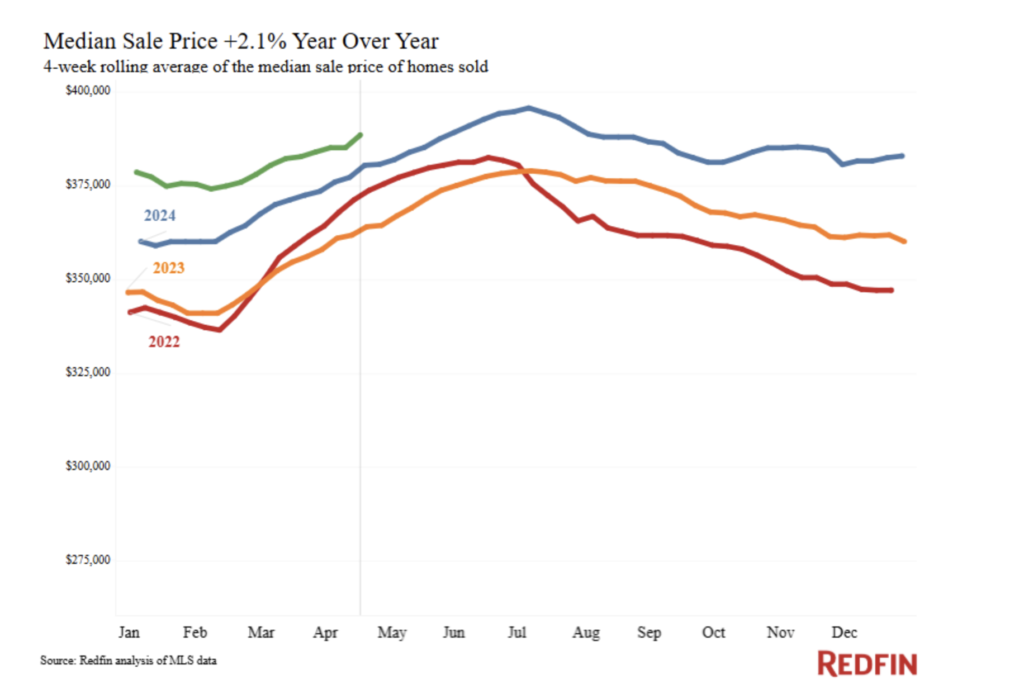
Redfin analysis of MLS data

Redfin agents point to ongoing economic uncertainty as a cooling factor. High housing costs, elevated mortgage rates and concerns about a potential recession are making both buyers and sellers more hesitant.

Chen Zhao |  Economic Research Lead

“There are always people who need to buy homes or sell homes, no matter what’s going on in the world,” Redfin’s Economic Research Lead Chen Zhao said in a statement. “But with so much uncertainty in the economy, now is a time for those buyers and sellers to be more strategic than ever.”

While prices may be slipping in some metros, that hasn’t exactly translated into faster sales. Homes are sitting on the market for an average of 40 days — up five days compared to a year ago.

And though new listings are up 9.6 percent year over year, much of the current market activity is being driven by sellers, while buyer activity is clearly slowing.

Redfin reports that mortgage-purchase applications are declining, home tours are down, per home touring tech company ShowingTime, and pending home sales have dropped 0.3 percent nationwide.

The biggest slowdowns in pending sales occurred in Miami, Fort Lauderdale and West Palm Beach, Florida; and Las Vegas.

Adding to the strain, mortgage rates continue to climb. The average weekly mortgage rate jumped to 6.83 percent from 6.62 percent the week before, putting the typical U.S. monthly housing payment at $2,848 — $8 short of the all-time high. These rate hikes are also fueled by fears of recession, driven in party by new tariffs and economic instability.

Experts say that in today’s shifting market, strategy is everything.

“My advice to sellers is to price your home fairly for the shifting market; you may need to price lower than your initial instinct to sell quickly and avoid giving concessions,” Zhao said. “On the flip side, buyers should negotiate on price and terms and shop around even more than usual for the best mortgage rates.”

Email Richelle Hammiel

This post was originally published on this site

Ex-First American CEO entitled to $18M following cruise ship brawl

First American Financial Corp. terminated CEO Kenneth DeGiorgio “without cause” on April 10 after authorities charged the title insurance veteran with misdemeanor assault aboard a cruise.

Bigger. Better. Bolder. Inman Connect is heading to San Diego. Join thousands of real estate pros, connect with the Inman Community and gain insights from hundreds of leading minds shaping the industry. If you’re ready to grow your business and invest in yourself, this is where you need to be. Go BIG in San Diego!

Ousted First American Financial Corp. CEO Kenneth DeGiorgio is set to receive $18.6 million in severance and other pay after being accused of choking a passenger on a cruise ship in March, according to a revised proxy statement.

First American terminated DeGiorgio “without cause,” effective April 10, after the two-decade veteran of the title insurance firm was arrested and charged with misdemeanor assault. Despite the altercation, the former CEO is entitled to $7.24 million in severance and $11.34 million in accelerated vesting of stocks and retirement plan benefits, according to the amended proxy statement.

TAKE THE INMAN INTEL SURVEY FOR APRIL

The altercation aboard a Virgin Voyages cruise ship on March 31 began after DeGiorgio’s wife, Nichol, asked an unidentified passenger to put his shoes on after the man had been dancing barefoot inside the ship’s “On The Rocks Bar.” When the passenger — referred to as “M.A.” in the complaint — refused, DeGirgio threatened the man at a bar before choking him, according to an affidavit filed in the U.S. District Court in Puerto Rico.

“Look, we are all adults here. Can you put your shoes on?” Nichol reportedly asked as the cruise waded approximately 70 miles west of Fort-de-France, Martinique. The passenger allegedly responded with an obscenity, calling her a derogatory name before flipping her off.

Although DeGiorgio’s legal team contends he acted in defense of his wife and will be cleared of wrongdoing, First American opted to part ways with the former CEO.

If DeGiorgio had been terminated due to a change in control — such as a merger or sale — his payout would have totaled nearly $27 million, the proxy statement shows. It also reflects a correction: an earlier version listed DeGiorgio’s payout as $16.4 million, excluding additional elements incorrectly categorized under “Disability,” according to Fortune.

Amid the fallout, First American swiftly announced a series of executive changes on April 15, with longtime executive Mark E. Seaton replacing DeGiorgio as CEO and Matt Wajner promoted to Chief Financial Officer. Dennis Gilmore, meanwhile, was named executive chairman.

The salaries of several executives, including DeGiorgio, were also recently adjusted, according to the proxy statement, with the former CEO’s base salary rising from $925,000 to $1 million annually through the end of 2027. Seaton and Wajner also saw salary adjustments.

Georgetown University professor and corporate governance expert Jason Schloetzer told Fortune that boards occasionally terminate CEOs without cause when facing misconduct allegations — even without conviction — to protect the company’s reputation, maintain stability and avoid legal battles.

“Terminating without cause reduces the risk of a wrongful termination lawsuit,” Schloetzer told Fortune, “especially when the charges haven’t yet resulted in a conviction and the board cannot prove the CEO’s involvement in the misconduct.”

This post was originally published on this site

Concessions surge as homesellers offer sweeter deals in sour markets

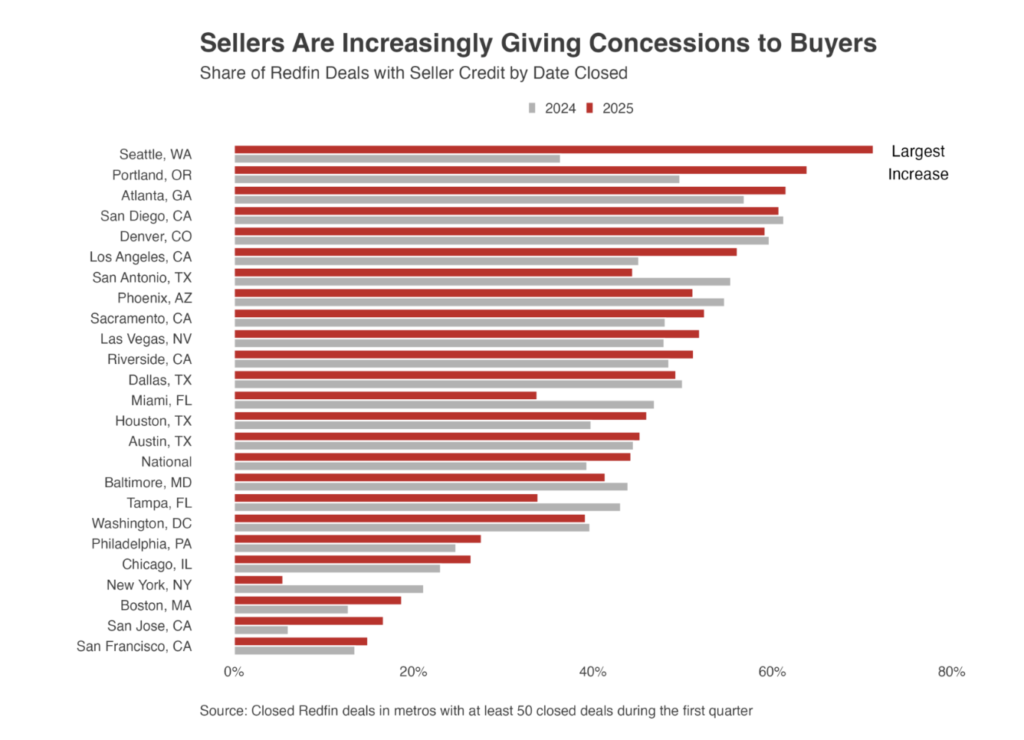
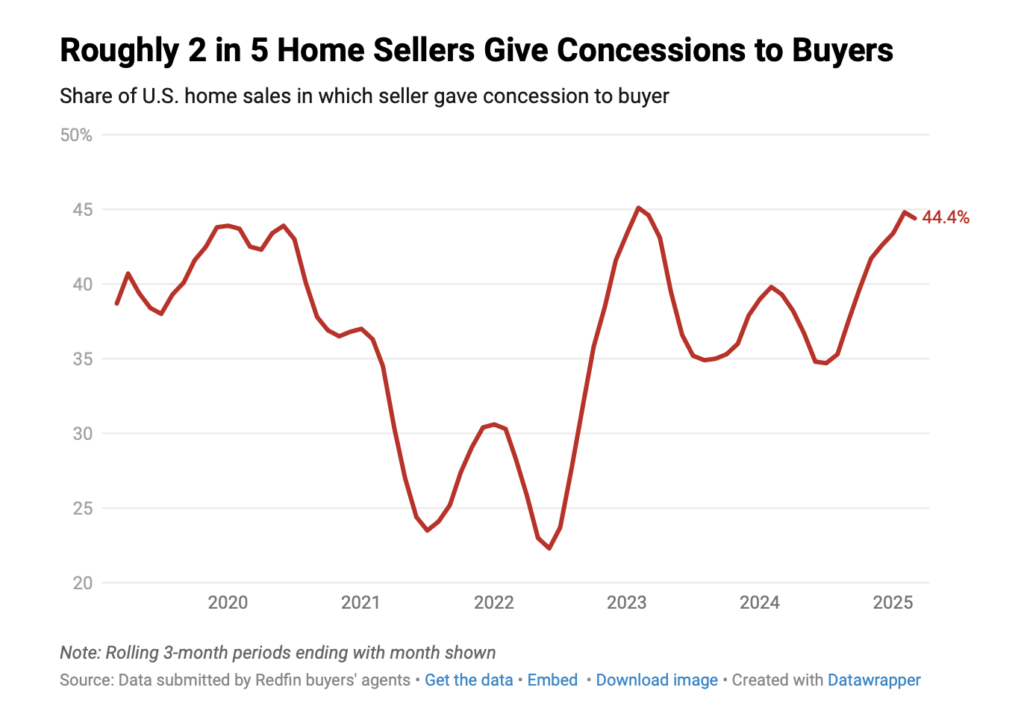
In the first quarter of the year, 44.4 percent of homesellers included concessions in their deals, just shy of the record 45.1 percent seen at the start of 2023, according to new data released Monday by Redfin.

Bigger. Better. Bolder. Inman Connect is heading to San Diego. Join thousands of real estate pros, connect with the Inman Community and gain insights from hundreds of leading minds shaping the industry. If you’re ready to grow your business and invest in yourself, this is where you need to be. Go BIG in San Diego!

With mortgage rates elevated and economic uncertainty hanging in the air, homebuyer demand has taken a hit. But sellers are getting creative by offering concessions at near-record levels, according to data issued Monday by Redfin.

In the first quarter of 2025, a whopping 44.4 percent of homesellers offered concessions, short of a record 45.1 percent at the start of 2023, data shows. The concessions range from covering repairs to helping buyers with mortgage-rate buydowns — financial reprieves that can make a difference for first-time buyers.

TAKE THE INMAN INTEL SURVEY FOR APRIL

“Buyers used to ask for concessions to cover little things like repairs,” Redfin agent Chaley McVay said. “Now they’re negotiating concessions so they can afford to buy a home. A lot of sellers are offering money for mortgage-rate buydowns, and I had one seller cover seven months of HOA fees for the buyer.”

Data submitted by Redfin buyers’ agents

The rise in concessions isn’t merely about cautious buyers; it’s also a result of growing competition among sellers. Housing supply hit a five-year high in the first quarter, and with more inventory on the market, sellers are rushing to stand out without lowering listing prices. That’s where concessions come in.

Redfin’s data suggests that many of those homes are lingering unsold because they are overpriced. Instead of cutting the listing price outright, some sellers are using concessions to sweeten the deal, while protecting their asking price.

“Sellers are feeling nervous because a lot of them bought at the top of the market in 2021 and 2022, and will now be re-buying at a higher mortgage rate,” McVay added. “They’re worried about net proceeds. That’s why I recommend my buyers ask for concessions instead of a lower sale price—it can be a win-win because then the buyer is catching a break and the seller doesn’t have to go below the price they had in their head.”

This strategy has been especially prevalent in Seattle and Portland. In Seattle, concessions were offered in 71.3 percent of transactions in Q1, nearly double the 36.4 percent seen the year before. After those two cities, the highest concession rates were found in Atlanta, San Diego and Denver.

Closed Redfin deals in metros with at least 50 closed deals during the first quarter

Stephanie Kastner | Redfin Premier agent in Seattle

“It’s super common to see seller concessions for condos and new-construction townhomes, but less so for single-family homes—unless the single-family home has been sitting on the market for a while,” Stephanie Kastner, a Redfin Premier real estate agent in Seattle, said. “Condos have become a tougher sell because of skyrocketing HOA fees and insurance. And builders are offering concessions because it’s in their best interest to keep sale prices high; they’re willing to pay buyers’ closing costs and maybe provide a free washer-dryer if it means they don’t have to drop the listing price.”

On the other hand, some areas saw a sharp drop in concessions. New York had the lowest share in Q1, with just 5.5 percent of home sales including concessions — down nearly 16 percent in percentage points from the previous year. Miami (-13.1 ppts to 33.8 percent), San Antonio (-10.9 ppts to 44.4 percent), Tampa, Florida (-9.2 ppts to 33.9 percent) and Phoenix (-3.5 ppts to 51.2 percent) also saw noticeable declines.

Meanwhile, some sellers are deploying a combination of strategies. In the first quarter, aproximately 21.5 percent of homes sold below asking price and included a concession. About 16 percent of sales involved both a price cut and a concession, while 9.9 percent included a concession, price cut and a final sales price below the original listing price.

Still, not all buyers are biting. Economic uncertainty continues to loom, and many are walking away from deals.

Redfin reports that 13 percent of pending home sales were canceled in March, marking the third-highest March cancellation rate on record since 2017, behind only March 2020 during the early days of the pandemic.

Email Richelle Hammiel

This post was originally published on this site

Holly Parker sues Douglas Elliman over $1.5M clawback dispute

Parker alleges the brokerage, which she departed in February after 25 years, is demanding $1.5 million in clawbacks while refusing to pay commissions on deals that closed after her move to Compass.

Bigger. Better. Bolder. Inman Connect is heading to San Diego. Join thousands of real estate pros, connect with the Inman Community and gain insights from hundreds of leading minds shaping the industry. If you’re ready to grow your business and invest in yourself, this is where you need to be. Go BIG in San Diego!

After 25 years with Douglas Elliman, top-producing real estate veteran Holly Parker is suing the brokerage, alleging it’s incorrectly demanding $1.5 million in clawbacks and refusing to pay her commissions on deals that closed after her move to Compass, The Real Deal reported Friday.

Parker, the founder and CEO of The Holly Parker Team, filed the lawsuit seeking release from the clawback demands, as well as approximately $385,000 in damages — double the amount of withheld commissions — along with attorneys’ fees and related costs.

TAKE THE INMAN INTEL SURVEY FOR APRIL

Parker made the switch to Compass in February after a long career with Elliman, where she ranked among the firm’s top 10 agents for more than 15 years and served as a leading producer in new development sales.

At the time of her exit, Parker had 16 deals under contract. According to the lawsuit, she was entitled to a 40 percent commission split on any of those transactions that closed after her departure, per the terms of a 2020 independent contractor agreement (ICA) with Elliman. That agreement stated commissions were to be paid within 30 days of closing.

However, Parker claims that 10 of those deals have since closed, all more than 30 days ago — and that Elliman has withheld nearly $193,000 in commissions.

Beyond the ICA, Parker argues that side letters signed during her time at Elliman should override the original contract. One letter, signed in 2020, increased her commission split to 70 percent. Another, signed in 2022, provided up to $205,000 in reimbursements for assistant and receptionist costs as well as a performance bonus tied to her team’s transactions.

The clawback clause in those letters allowed Elliman to recoup those funds only if Parker left before Dec. 31, 2024, a threshold she crossed before leaving the firm earlier this year. Nonetheless, on Feb. 28, Elliman issued a letter demanding $1.6 million in clawbacks, including $1.1 million in bonuses, $394,000 in assistant funding, $85,000 in advertising and $92 in StreetEasy fees.

A key point of contention is a policy manual Elliman is allegedly relying on to justify its claims. According to the complaint, Elliman refused to provide the full manual, offering only two partial excerpts after Parker agreed to sign a nondisclosure agreement that included a liquidated damages clause.

In the complaint, Parker’s attorney, Michael Rakower of Rakower Law, described Elliman’s legal position as “unsustainable.”

“The limits of its clawback rights are evident in the agreements it signed with Parker,” as stated in the lawsuit. “Elliman is willfully ignoring those limits and wrongfully withholding money owed to Parker as punishment for her departure.”

Inman has reached out to Douglas Elliman, as well as Holly Parker and her legal team, for comment but did not receive an immediate response Friday.

Email Richelle Hammiel

This post was originally published on this site

Homes are sitting longer and not just because of mortgage rates

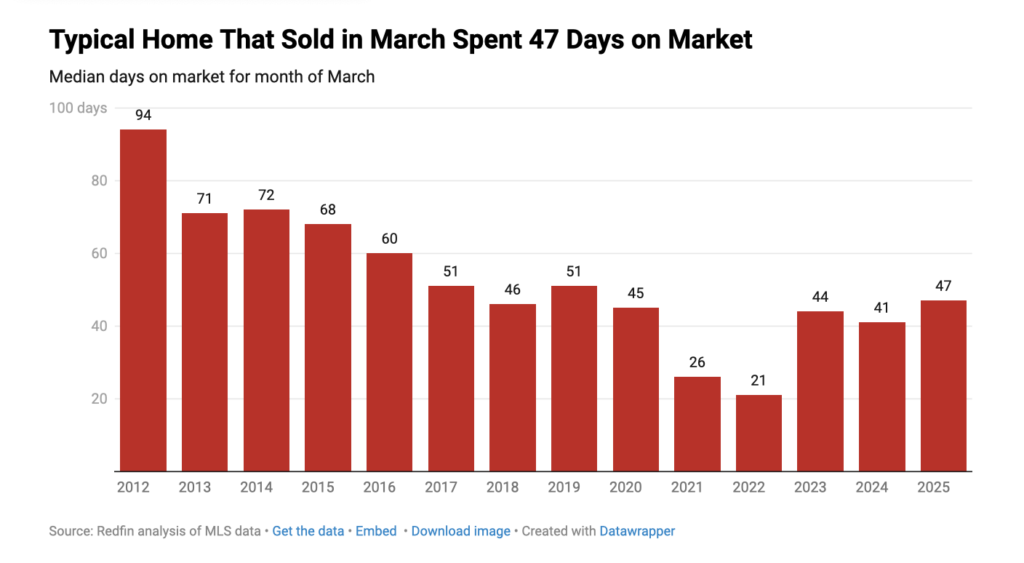
According to a new Redfin report, concerns over affordability, economic uncertainty and tariff fears under a second Trump administration are giving buyers serious pause. As of March, the typical U.S. home took 47 days to sell, the longest stretch in six years.

Bigger. Better. Bolder. Inman Connect is heading to San Diego. Join thousands of real estate pros, connect with the Inman Community and gain insights from hundreds of leading minds shaping the industry. If you’re ready to grow your business and invest in yourself, this is where you need to be. Go BIG in San Diego!

Homes are sitting on the market longer than they have in years, and it’s not just high mortgage rates that are to blame. According to a new Redfin report, concerns over affordability, economic uncertainty and tariff threats under a second Trump administration are giving buyers serious pause.

TAKE THE INMAN INTEL SURVEY FOR APRIL

As of March, the typical U.S. home took 47 days to sell, the longest stretch in six years. Those longer stretches on the market tend to discourage competition, often signaling buyers to either wait or negotiate.

Redfin analysis of MLS data

Redfin Senior Economist Elijah de la Campa says that sellers must lower their expectations to adapt to today’s market.

Elijah de la Campa | Redfin Senior Economist

“There’s a growing disconnect between what sellers think they can get for their homes and the direction the market is actually moving,” Redfin Senior Economist Elijah de la Campa said in a statement. “Tariff fears and widespread economic uncertainty are making homebuyers nervous, so if sellers don’t lower their price expectations, home sales may slow in the coming months.”

The hesitation is showing up most sharply in Fort Lauderdale, Florida, where homes spent 88 days on the market, up 24 days from the previous year. Miami and West Palm Beach, Florida, followed with increases of 19 days each on the market. San Francisco was the only metro where Days on Market decreased — though only by one day.

Even as demand slows, inventory is climbing, which could cool price growth in the months ahead. Active listings in March rose 0.1 percent month over month and 14.1 percent year over year, reaching the highest level in five years. New listings also climbed 0.7 percent month over month and 6 percent year over year.

The largest inventory gains were seen in Oakland, California (38.4 percent), Denver (37.7 percent) and Las Vegas (32 percent), while new listings grew fastest in Los Angeles (23.5 percent), Boston (23.4 percent) and Anaheim, California (23.3 percent).

Houston-based Redfin Premier agent Alicia Grifaldo has noticed the shift firsthand as many pandemic-era homebuyers re-enter the market.

“Many people who bought homes in 2021 and 2022 are selling now, some of them because they can’t afford their property taxes and insurance payments. Because they bought at the peak of the market, they’re overpricing their homes to try to recoup their investment,” she said. “Sellers are competing with one another, and buyers are sparse, so pricing your listing reasonably is everything right now.”

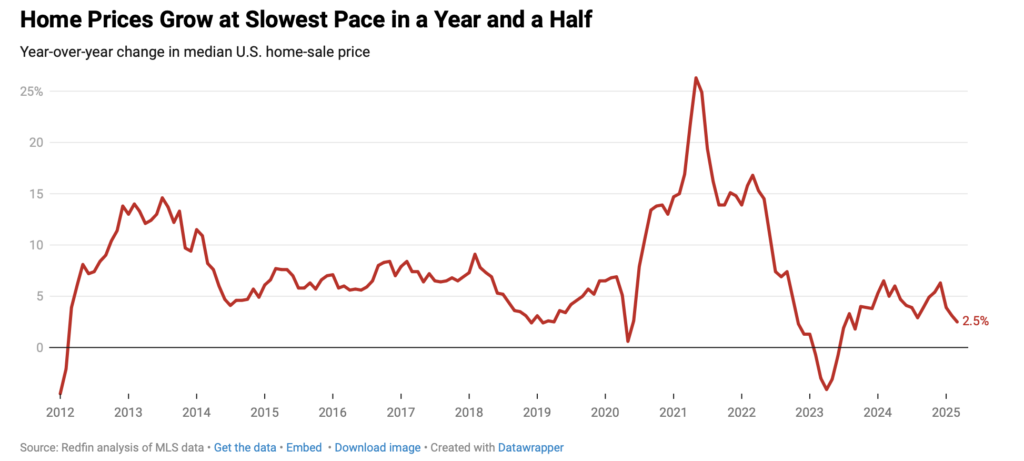
That pricing mismatch is reflected in the numbers. In March, the median home-sale price was $431,057, a modest 2.5 percent increase from the previous year and the slowest pace of price growth since September 2023. However, list prices are rising faster than sale prices, which is a sign that sellers are still hoping to push for more than the market is willing to give.

Redfin analysis of MLS data

However, the market is pushing back. The typical home that sold in March closed for about 1 percent below its list price.

Price trends varied widely by region, with the biggest increases in Cleveland (11.8 percent), Nassau County, New York (9.8 percent) and Newark, New Jersey (9.5 percent). The largest decreases were seen in Jacksonville, Florida (-3.8 percent), San Francisco (-2.6 percent) and Austin (-1.6 percent).

Sales activity also sent mixed signals. Pending home sales rose 1.7 percent month over month in March, but closed sales and existing sales fell by roughly 1 percent, remaining below pre-pandemic levels.

Pending sales grew the most in Montgomery County, Pennsylvania (13.7 percent), Denver (6.9 percent) and Sacramento, California (5.7 percent). Closed sales rose most in San Francisco (13 percent), Oakland (11.7 percent) and New York (5.3 percent).

One major headwind remains: mortgage rates. While the average 30-year-fixed mortgage rate dipped 6.65 percent in March, it’s still more than double the record lows seen during the pandemic, and that is keeping many buyers on the sidelines.

Email Richelle Hammiel

This post was originally published on this site