by Richelle Hammiel | May 20, 2025 | Industry, News Feed
Bigger. Better. Bolder. Inman Connect is heading to San Diego. Join thousands of real estate pros, connect with the Inman Community and gain insights from hundreds of leading minds shaping the industry. If you’re ready to grow your business and invest in yourself, this is where you need to be. Go BIG in San Diego!
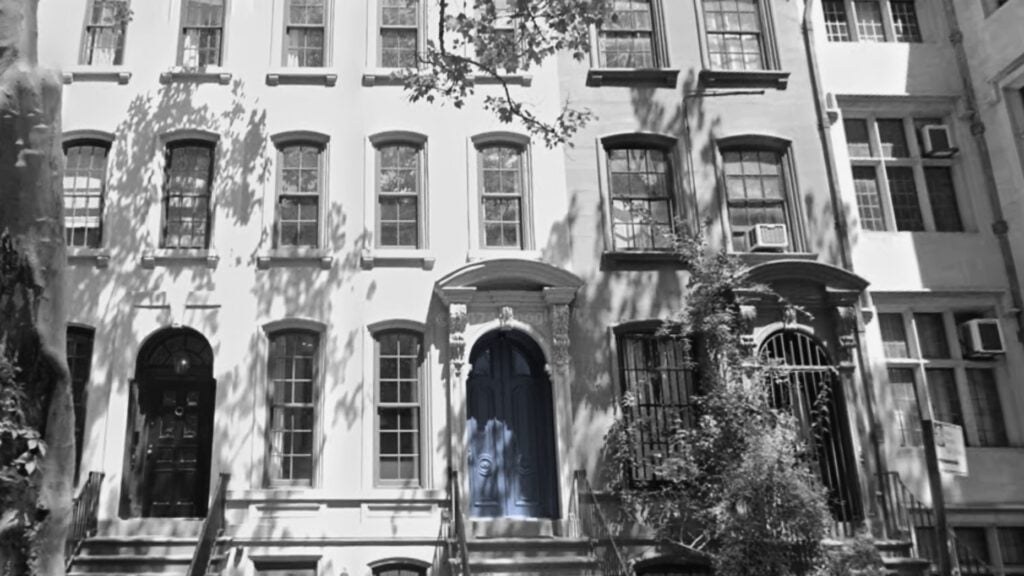
The black dress, the effortless glamour and that signature blue door became timeless symbols thanks to Audrey Hepburn’s unforgettable turn in the 1961 classic Breakfast at Tiffany’s.
Now, the storied Upper East Side townhouse that served as the famous backdrop is on the market for $15 million, offering more than just a prestigious address, but a rare piece of cinematic history.
TAKE THE INMAN INTEL SURVEY FOR MAY
This landmarked residence, located at 169 East 71st Street in New York’s Upper East Side, has been meticulously reimagined to blend old Hollywood glamour with contemporary elegance.
Caroline Bass of The Corcoran Group is representing the property listing.

(Photo by Donaldson Collection / Michael Ochs Archives / Getty Images)
Loosely based on a Truman Capote novella, Breakfast at Tiffany’s follows the young socialite Holly Golightly as she navigates love and life in Manhattan. While the film’s interiors were shot on Hollywood sets, it’s this townhouse’s classic brick facade and signature blue door that drew people in and turned the property into a style icon in its own right.

(Photo by Paramount / Getty Images)
The iconic townhouse spans 4,465 square feet, encompassing five floors.
The parlor floor welcomes guests into a formal reception area, adorned with antique chandeliers and designer fixtures from Porta Romana. This level also houses an elegant living room and an intimate dining area.
The parlor floor features a gourmet kitchen, including a center island topped with Calcutta Gold marble.
The third floor offers two spacious bedrooms with spa-style baths, while the fourth floor is dedicated to the primary suite, complete with a custom dressing room and makeup vanity. At the top, a full-floor den boasts a wet bar, wine fridge and a Juliet balcony.
A garden unit at street level offers its own private entrance, built-in bookshelves, a den and a large bedroom. Its open kitchen leads directly to a 466-square-foot landscaped garden framed by custom Walpole lattice fencing.
The fully excavated basement adds another dimension to the home with nearly 8-foot ceilings, a powder room, a wine cellar and cold storage.
Canva / Google Maps
In total, the two-family residence includes four bedrooms, four full bathrooms, three powder rooms and a full-sized elevator servicing every level.
The home’s renovation was led by current owner Joseph Harkins, a retired beverage executive and entrepreneur, who purchased the home for $7.4 million in 2015, the New York Post reported.
The landmarked townhouse “doesn’t just sit on one of the Upper East Side’s most enchanting blocks; it defines it, Bass said. “There are homes. And then, there are icons.”
Email Richelle Hammiel
This post was originally published on this site
by Richelle Hammiel | May 16, 2025 | Industry, News Feed
April’s housing data underscores a challenging landscape for new construction, particularly in the single-family segment, and the privately-owned segment isn’t far behind.
Bigger. Better. Bolder. Inman Connect is heading to San Diego. Join thousands of real estate pros, connect with the Inman Community and gain insights from hundreds of leading minds shaping the industry. If you’re ready to grow your business and invest in yourself, this is where you need to be. Go BIG in San Diego!
April’s housing data underscores a challenging landscape for new construction, particularly in the single-family segment, and the privately-owned segment isn’t far behind.
Builders are navigating a complex mix of elevated costs, rising mortgage rates and waning consumer confidence, which is weighing heavily on the market.

Odeta Kushi | First American Deputy Chief Economist
“Builders’ growing pessimism is partially driven by the increase in mortgage rates in April, which impacts both builder and buyer financing costs,” First American Deputy Chief Economist Odeta Kushi said in a statement. “Residential construction costs are still more than 40 percent higher compared to pre-pandemic levels and skilled labor shortages persist.”
Policy instability is another source of strain. “Policy uncertainty also weighs heavily on builder sentiment, with 78 percent of builders reporting difficulties pricing their homes recently due to uncertainty around material prices,” Kushi noted, citing NAHB data. “The recent announcement that the United States and China will reduce tariffs for 90 days may offer temporary relief and brighten the outlook.”
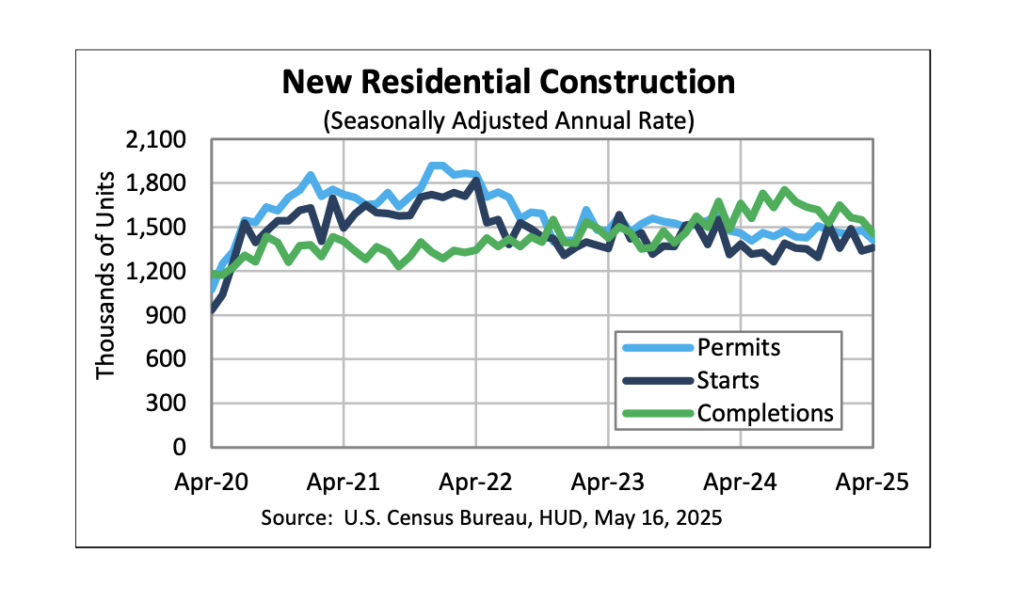
This backdrop of uncertainty is reflected in the numbers, a new data report from the U.S. Census Bureau and the Department of Housing and Urban Development (HUD) indicated.
Source: U.S. Census Bureau and the Department of Housing and Urban Development (HUD)
Privately-owned housing starts in April rose modestly, up 1.6 percent from March to a seasonally adjusted annual rate of 1,361,000, though they remain 1.7 percent below the April 2024 level. Single-family starts dropped 2.1 percent to 927,000. Meanwhile, multifamily activity climbed from 371,000 to 420,000 from March to April.
Completions followed a similar pattern. Privately-owned housing completions fell 5.9 percent from the previous month to 1,458,000 and 12.3 percent year over year. Single-family completions declined 8 percent to 943,000, while multifamily completions edged up from 503,000 in March to 507,000 in April.
Permits — a forward-looking indicator of new builds — also declined. Permits for privately-owned housing units dropped 4.7 percent to 1,412,000, while single-family permits fell 5.1 percent to 922,000. Multifamily permits decreased from 445,000 units to 431,000.
“The April report was not a great one for single-family housing, with single-family starts, permits and completions all declining,” Kushi said. “The slower pace of single-family permits suggests a reduced rate of single-family groundbreaking in the upcoming months, due to higher inventory levels in key markets and ongoing challenges with costs and affordability.”
Builder sentiment has dropped accordingly. In May, it fell to the same level seen in November 2023, matching a trough not seen since December 2022. “This growing pessimism was broad-based across all NAHB Housing Market Index (HMI) components,” Kushi added.
Still, there may be some relief on the horizon. Kushi remains cautiously optimistic.
“The long-term housing shortage, builders’ ability to offer incentives, and potentially less restrictive monetary policy could be tailwinds,” she said.
Email Richelle Hammiel
This post was originally published on this site
by Richelle Hammiel | May 13, 2025 | Industry, News Feed
Bigger. Better. Bolder. Inman Connect is heading to San Diego. Join thousands of real estate pros, connect with the Inman Community and gain insights from hundreds of leading minds shaping the industry. If you’re ready to grow your business and invest in yourself, this is where you need to be. Go BIG in San Diego!
After the Los Angeles wildfires destroyed more than 16,000 structures, thousands of families were left without homes and with few clear paths forward.
Labor shortages, high material costs and permitting delays have stretched rebuilding timelines into years. In response, a wave of prefab and modular housing companies is stepping in with solutions to meet the urgency of the moment. Plant Prefab, Azure Printed Homes and Ark Container Homes are answering the call.
Their models range from compact, recycled container units to fully customized modular homes — all designed to get displaced families into safe, livable spaces as soon as possible. Unlike traditional construction, which can take a year or more, prefab and modular structures are built in controlled factory environments and then delivered to the homesite for final setup, which cuts down on timelines, costs and logistical hurdles.
Plant Prefab
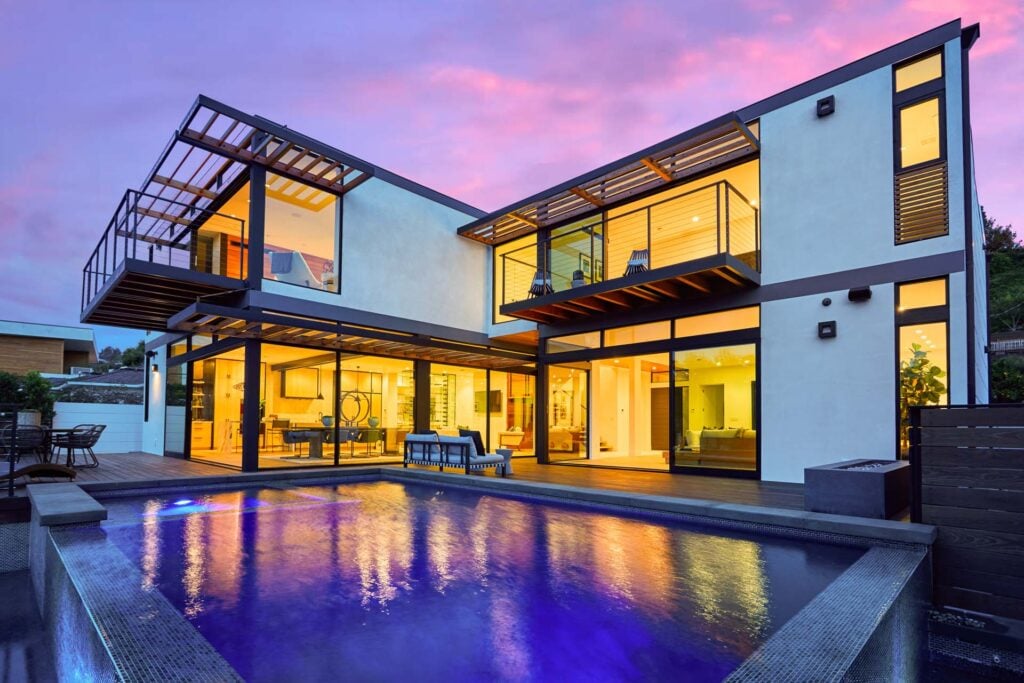
A spec home in the Pacific Palisades designed by Ray Kappe and fabricated by Plant Prefab | Plant Prefab
With a 270,000-square-foot facility in Teton Ranch, California, Plant Prefab is built for scale and speed, boasting the ability to produce up to 2,000 homes per year. The company has deep experience in post-disaster housing and is now responding to the Los Angeles wildfires with new modular housing options that will meet the zoning, aesthetic and climate needs of both Altadena and Pacific Palisades.

Steve Glenn | Founder and CEO of Plant Prefab
“Our mission as a company is to make the process of constructing customized, high-quality, sustainable and climate-resilient single- and multifamily housing as timely and cost-efficient as possible,” Steve Glenn, founder and CEO of Plant Prefab, told Inman. “Victims of the wildfires want to get back to their homes and communities as fast as possible, so our services are important to them.”
Plant Prefab homes offer a wide range of customization options, allowing homeowners to tailor everything from layout and design to the level of fire resiliency. Homes come complete with floor plans and a curated selection of fixtures, finishes and appliances.
“The level of fire resiliency is up to our clients,” Glenn said. “But we understand how to make these homes extremely fire resilient.”
Plant Prefab modules also come with all mechanical, plumbing and electrical systems installed.
Glenn also noted that the cost of Plant Prefab homes is often significantly lower than traditional construction, depending on location and labor rates, and people are showing interest. So far, Plant Prefab has had nearly 300 requests for site reviews and estimates, and a number of project designs are already underway.
Azure Printed Homes

Azure Printed Homes | YouTube
Azure Printed Homes is taking a high-tech approach to housing recovery, using 3D printing technology, recycled plastic materials and fiberglass to build homes in a matter of days from its Los Angeles factory.
In response to the wildfires, the company launched a $4.2 million crowdfunding campaign to scale production and meet the rising demand for temporary housing, especially on fire-damaged properties.

Ross Maguire | Co-Founder and CEO of Azure Printed Homes
“The recent LA wildfires have left thousands of families without homes, and Azure is committed to being part of the solution,” Ross Maguire, co-founder and CEO of Azure Printed Homes, said in a statement. “This new funding campaign underscores our commitment to rapidly scale our capacity and to bring affordable, climate-resilient homes to all buyers, and most especially, to those who need them most.”
Azure’s units are watertight, highly insulated and engineered to withstand extreme weather conditions. They are also 70 percent faster to produce and up to 30 percent more cost-effective than traditional construction, according to Azure.
Most 3D structures can be built in just 24 hours. Final touches — plumbing, electrical and insulation — are completed in about two weeks. Units come equipped for utilities, including electricity, water, sewer, and HVAC or underfloor heating, depending on the unit size. Azure also plans to enhance its fire resistance with improved composite materials and exterior fire-rated panels, the Los Angeles Times reported.
Ark Container Homes
Ark Container Homes | Vimeo
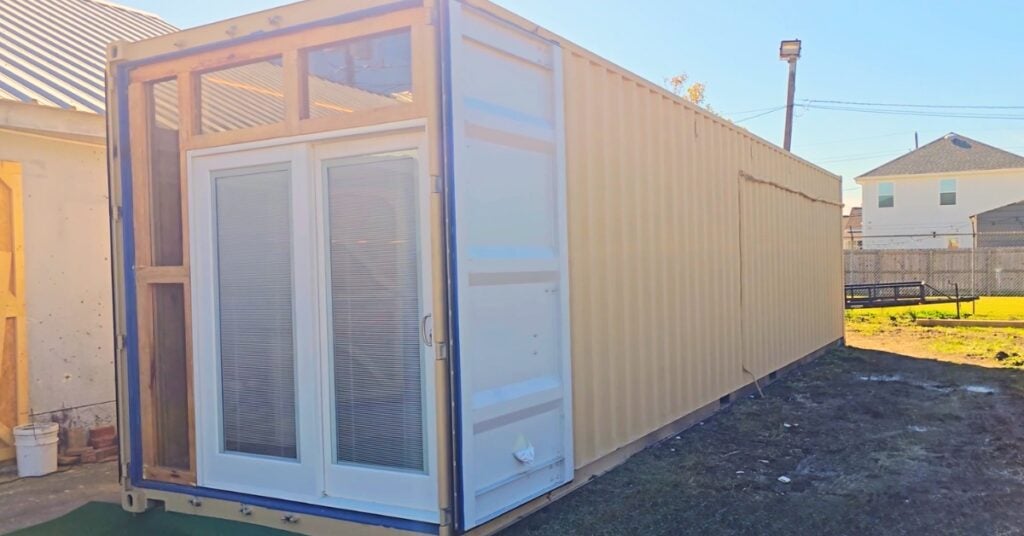
Ark Container Homes is tackling post-fire housing needs by repurposing recycled shipping containers into ready-to-move-in homes. Manufactured in the company’s Harvey, Louisiana, facility, each unit is designed for durability, sustainability, recycling and efficiency, and can be built in less than two weeks.
Ark Container Homes focuses on offering the most structurally sound and low-maintenance product possible. That durability comes with a design philosophy: Less is more. Ark limits customizations, including omitting windows, to preserve the container’s integrity.
“With added windows and doors, containers become like RVs or campers, and you need to check and reseal the windows on a continual basis,” the company explains on its website. “If you don’t, they can crack, rain gets in, and you come back to find the structure destroyed.”
Units come in two sizes: a 20-foot model (160 square feet) for $39,000 and a 40-foot model (320 square feet) for $69,000. Both can be used as either temporary or permanent residences.
Although Ark is new to the prefab housing scene, launching production in November 2024, the company has already delivered its first post-fire residence to Malibu last month, and Ark Container Homes co-founder Joshua Clark told the Los Angeles Business Journal that demand has been ramping up.
The news brings relief not just to wildfire survivors, but to the county as well. Ark Container Homes will donate a portion of its sales to LA community fire brigades.
Email Richelle Hammiel
This post was originally published on this site
by Richelle Hammiel | May 8, 2025 | Industry, News Feed
To bring the vision of The Investor Scoop to life, Ross has assembled a growing team of industry pros, longtime colleagues and fresh thinkers. This lineup will deliver a wide range of content, from tax tips and tech tools to credit strategies to legal know-how.
Bigger. Better. Bolder. Inman Connect is heading to San Diego. Join thousands of real estate pros, connect with the Inman Community and gain insights from hundreds of leading minds shaping the industry. If you’re ready to grow your business and invest in yourself, this is where you need to be. Go BIG in San Diego!
Real estate investing is finally getting a glow-up — and not the kind that requires granite countertops.
Industry veteran and CEO Bernice L. Ross will launch Profit.RealEstate, a new educational platform, aimed at demystifying investing for the everyday buyer, on Thursday, May 8. Alongside it comes “The Investor Scoop,” its daily newsletter packed with bite-sized insights that make smart investing feel more like a power move and less like a chore, with a laugh or two along the way, Ross informed Inman.
With over four decades in the industry, seven books and over 1,600 articles under her belt — many of them published with Inman — Ross is on a mission to help others build wealth through strategic, real-world investing.
“Real estate is No. 1. We want to have more people become aware of down payment assistance and know that they can get into a house now,” Ross said in an interview with Inman. “The second thing is, I want to show them a path to becoming a real estate investor.”
“The Investor Scoop” is built for people just starting out, whether it’s first-time buyers exploring down payment assistance, house hackers or agents working with one- to four-unit properties, this resource meets them where they are.
This focus on the one- to four-unit market isn’t accidental; it’s strategic. Ross emphasizes that this niche is one of the most accessible and underutilized markets in the real estate industry.
“Instead of looking at a single-family [unit], look at a duplex, triplex or fourplex, where you can rent out part of it, or look at getting something that has an extra bedroom that you might be able to rent out to help with your payments,” Ross said. “Look at becoming a real estate investor on your first purchase.”
Profit.RealEstate isn’t simply about education; it’s about momentum, Ross said. She views the platform as a launchpad for new investors ready to scale their portfolios and creativity, whether that means flipping, fractional ownership or simply finding new ways to stretch their finances.
“We want to take a look at house hacking and flipping, and it depends on all these mom and pops out there,” she said. “That’s really who we want to reach. We want to show them ways to manage their money and how they can become their own banker.”
To bring the vision of “The Investor Scoop” to life, Ross has assembled a growing team of 25-plus contributors — a mix of industry pros, longtime colleagues and fresh thinkers.
“We’re bringing together this incredible bunch of people who are writing great content,” Ross said. “I’ve got some of my longtime friends, and they’re going to be contributing. We’ve got some real powerhouses, and I’ve got a few more very big ones coming on.”
Together, this lineup will deliver a wide range of content — from tax tips to tech tools, credit strategies to legal know-how — written in plain English and short enough to fit into a reader’s coffee break.
“It’s usually pretty clear, because these people are explaining what they do. A lot of times, they’ll tell stories of what they have experienced,” Ross explained. “Everybody that I’m working with is accustomed to working with people at all levels, from the beginner all the way to the more sophisticated. And I don’t care how sophisticated you are, there’s always more that you can learn.”
Beyond serving individual investors, Ross is especially passionate about helping real estate professionals create long-term financial security.
“I want more Realtors to be able to retire with something to have,” she said. “We want to show them the path.”
For over two decades, Ross has been a regular contributor to Inman, breaking down everything from home strategies and branding techniques to negotiation tactics agents can use daily. Most recently, Ross shared insights in articles on joining a team and marketing listings to other agents, and there’s plenty more advice in the pipeline.
Email Richelle Hammiel
This post was originally published on this site
by Richelle Hammiel | May 7, 2025 | Industry, News Feed
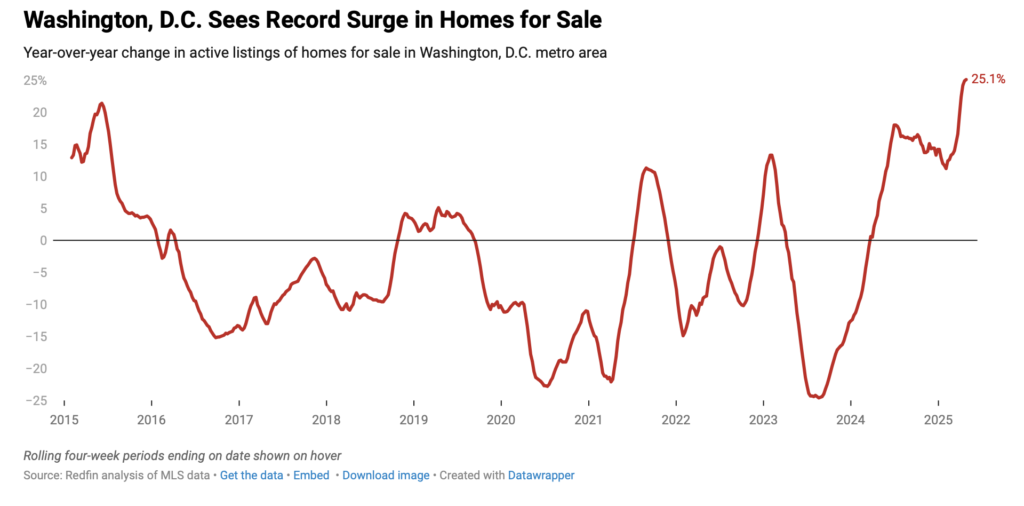
Active listings in Washington, D.C., have surged 25.1 percent year over year, the largest jump on record and nearly double the national increase of 14.2 percent, new Redfin data released Wednesday shows.
Bigger. Better. Bolder. Inman Connect is heading to San Diego. Join thousands of real estate pros, connect with the Inman Community and gain insights from hundreds of leading minds shaping the industry. If you’re ready to grow your business and invest in yourself, this is where you need to be. Go BIG in San Diego!
The swamp is being drained.
Back in February, real estate insiders pushed back on headlines declaring a collapse in the Washington, D.C. housing market under the Trump administration’s federal downsizing. At the time, market data showed little signs of crisis. But just a few months later, a new Redfin report reveals a sharp shift.
As of April 27, active listings in Washington, D.C. have surged 25.1 percent year over year, the largest jump on record and nearly double the national increase of 14.2 percent. New listings are also up 11.4 percent, compared to the nationwide gain of just 5.8 percent. It’s the highest level of inventory D.C. has seen since 2022.
Redfin attributes this spike in inventory to sweeping layoffs of federal workers in efforts to reduce federal spending, led by President Donald Trump’s administration and Elon Musk’s Department of Government Efficiency (DOGE). According to CNN, at least 121,000 federal workers have been laid off or targeted for layoffs. Given that federal jobs make up 11.1 percent of all employment in the District — more than any other metro analyzed by the APM Research Lab — the impact is particularly acute.

Mary Bazargan | Redfin Premier Agent
“Quite a few people in D.C. are selling their homes because they’re losing their jobs,” Mary Bazargan, a local Redfin Premier real estate agent, said in the report. “Many of those people are planning to leave the area because the cost of living is high, and they want a new job that allows them to work remotely and be closer to family.”
Bazargan recalled a recent transaction in which a buyer waived contingencies and bid above asking, but still lost out to an all-cash offer — proof, she said, that sellers are growing cautious amid economic uncertainty.
Though some early 2025 reports suggested listings were holding steady, the April data shows a different story. State-level data from the U.S. Department of Labor reveals that initial unemployment claims in D.C. peaked in February. With more layoffs expected this spring, Bazargan has been fielding a surge in calls from potential seller bracing for pink slips.
Despite the turmoil, D.C.’s housing market remains a hot commodity, with homes selling quickly and sale prices rising 4.1 percent year over year to $600,964 as of April 27.

Asad Khan | Redfin Senior Economist
“What’s happening with housing inventory in Washington, D.C. could be a sign of what’s to come in other U.S. housing markets,” Redfin Senior Economist Asad Khan said. “And while strong housing demand is buoying prices in D.C., the rest of the country isn’t so hot. Other markets may not be able to absorb further inventory growth without prices softening.”
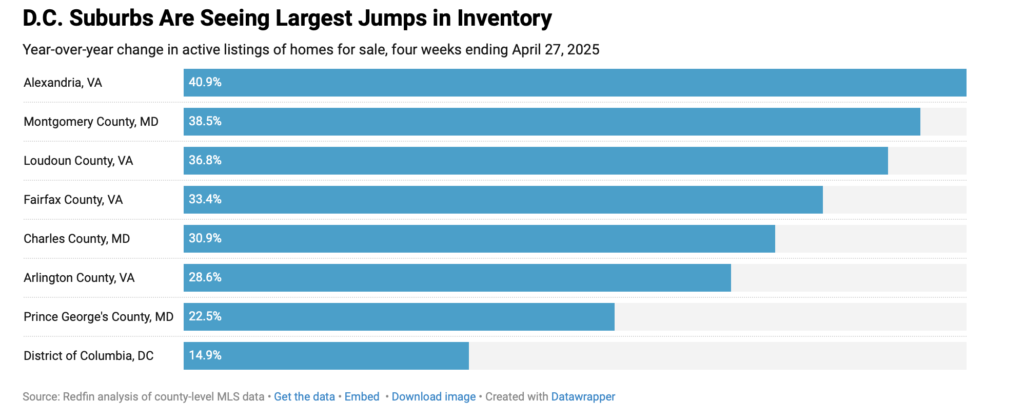
The suburbs surrounding D.C. are seeing the steepest inventory gains, including Alexandria, Virginia (up 40.9 percent), Montgomery County, Maryland (up 38.5 percent) and Loudoun County, Virginia (up 36.8 percent).
Overall, nine of the 47 major metros Redfin analyzed had bigger inventory gains, led by Denver, while four metros, led by Phoenix, had higher increases in new listings.
To ensure the trend wasn’t the usual post-inauguration shuffle, Redfin reviewed historical data. While there was a brief uptick in listings after Trump’s 2017 inauguration, it quickly faded. This time, the surge is persisting, a sign that widespread federal layoffs are likely fueling and reshaping the region’s housing landscape.
Email Richelle Hammiel
This post was originally published on this site