Inman Connect San Diego welcomes Brian Buffini

Bigger. Better. Bolder. Inman Connect is heading to San Diego. Join thousands of real estate pros, connect with the Inman Community, and gain insights from hundreds of leading minds shaping the industry. If you’re ready to grow your business and invest in yourself, this is where you need to be. Go BIG in San Diego!

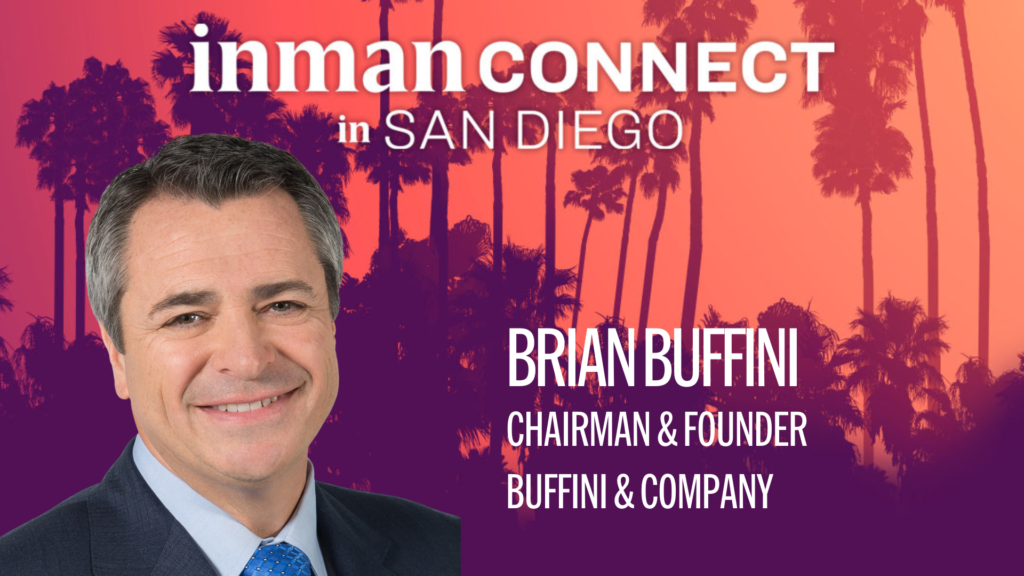
Inman, the leading authority on real estate news and events, is excited to welcome Brian Buffini, chairman and founder of Buffini & Company, to the Inman Connect San Diego stage, taking place July 30 through August 1, 2025. Hosted at the stunning Hilton San Diego Bayfront, this three-day event brings together ambitious real estate professionals seeking actionable strategies, deep connections and the confidence to lead in a challenging market.

As interest rates fluctuate, inventory remains tight and commission structures evolve, you need more than inspiration; you need a concrete playbook. Inman Connect delivers tailored learning tracks, dozens of practical sessions and unparalleled networking opportunities designed to help you thrive.

Speaker Highlight: Brian Buffini

Brian Buffini’s journey began over 30 years ago when he arrived in San Diego from Ireland with little more than a dream and a strong work ethic. Determined to succeed, he built Buffini & Company into North America’s largest real estate coaching firm — entirely on the foundation of personal referrals.

His coaching principles have guided thousands of professionals to sustainable, referral-based success.

At Inman Connect San Diego, Buffini will reveal the client-focused approach highlighted in his coaching:

  • Referral mastery: Learn the authentic conversations and follow-up methods that turn every satisfied client into an ongoing source of new business.
  • Sustainable momentum: Discover how to create long-term growth patterns without cold calling or expensive advertising.
  • Winning strategies: Hear how agents from all backgrounds have transformed their careers by embracing Buffini’s straightforward, relationship-driven process.

Why attend Inman Connect San Diego?

The event is packed with learning and networking moments that will elevate your entire year!

  • Tailored learning tracks: Select from focused tracks such as Agent Connect, Broker Connect, MarTech Innovations, AI Applications, Negotiation Mastery and Next-Gen Technology. Customize your agenda to match your goals.
  • Actionable keynotes and panels: Engage with leading minds on topics like navigating high-rate environments, strengthening your personal brand and leveraging data for smarter decision-making. See who is confirmed to speak. 
  • Elite networking: Connect face-to-face with more than 3,000 peers and industry veterans. Structured networking sessions, roundtable discussions and social events set against San Diego’s vibrant backdrop ensure you forge relationships that last well beyond the conference.
  • Practical takeaways: Return to your office armed with checklists, templates and proven tactics — from creative lead-generation campaigns to refined client-retention plans — that you can activate immediately.

Don’t miss out!

Inman Connect San Diego is the strategic advantage you need for 2025 and beyond. Register today to access Brian Buffini’s referral playbook, all conference sessions, and exclusive networking experiences.

Inman Connect San Diego
Hilton San Diego Bayfront
July 30 – Aug. 1, 2025

This post was originally published on this site

Inman announces the 2025 Inman Connect San Diego Ambassadors

This accomplished group of real estate professionals will provide timely insights, capture key takeaways from the stage and offer a front-row perspective on the most impactful moments unfolding at Inman Connect San Diego on July 30 – Aug. 1.

Inman, the leading voice in real estate news and events, is proud to announce the Inman Ambassadors for Inman Connect San Diego, taking place July 30–Aug. 1, 2025, at the Hilton San Diego Bayfront.

As the real estate landscape continues to evolve at breakneck speed, the value of trusted relationships, shared insights and strategic alliances has never been more critical. That’s where the Inman Ambassadors come in. Led by this year’s Head Ambassador Matt Richling, team lead at New Purveyors, brokered by RE/MAX Hallmark, this standout group of industry leaders plays a vital role in making Inman Connect the definitive gathering place for real estate professionals to grow, adapt, and thrive.

These ambassadors are handpicked for their influence, professional excellence and ability to create meaningful connections that elevate the industry. Their presence helps shape the energy and experience of Inman Connect, both on-site and year-round, by driving engagement, fostering collaboration and creating continuity across the Inman community.

Whether you’re navigating market uncertainty, exploring new tech or scaling your business, the 2025 Ambassadors will be your connection points — ready to welcome you, guide you and introduce you to the right people at the right time.

Meet the 2025 Ambassadors:

  • Matt Richling, New Purveyors Brokered by RE/MAX Hallmark + Inman Head Ambassador
  • Liz Alarcon, eXp Realty
  • Elias Astuto, #TeamFAST by eXp Realty
  • Brandon Blankenship, Keller Williams
  • Toni Carone, Long & Foster Real Estate WV/VA/MD/DC
  • Brad Cook, REAL Brokerage
  • Heather Cook, REAL Brokerage
  • Susan Culverhouse, Sotheby’s International Realty
  • Michael DeVita, Mackey Realty
  • Nikki Taylor Friedman, Douglas Elliman
  • Thalina Garcia, Nan and Company Properties
  • Gabrielle Gilbert, SERHANT.
  • Jeff Goodman, Brown Harris Stevens
  • Alex Guckenberger, Compass
  • Tiare Kabazawa, Coldwell Banker Realty
  • Emilie Levecque, Portside Real Estate Group
  • Kristine Milkovich, The Milkovich Team
  • Crystal Miller, JMG Real Estate
  • Joe Oz Ossichak, Oz Group — eXp Realty
  • Audrey Rozier, Keller Williams
  • Lindsey Schmidt, Fathom Realty
  • Zak Shellhammer, Marketing coach
  • Scott Steadman, Windermere
  • Karen Stone, REAL Brokerage
  • Jasmine Sunkara, eXp Realty
  • Dina Williams, Ladera Realty Group
  • Vernon Williams III, #TeamFAST by eXp Realty

Set against the vibrant backdrop of San Diego, Inman Connect’s premier event promises visionary speakers, unmatched networking moments and strategic opportunities that spark real growth. From transformative insights to connections that last well beyond the event, this is where the next chapter of your real estate journey begins.

Secure your spot at Inman Connect San Diego today and join the leaders and innovators redefining the future of real estate.

This post was originally published on this site

The Problem With Cash for Retirement Planning—And How Real Estate Solves It

“I saved up a million dollars—and all I got was this lousy $40,000 a year.”

That’s the metaphorical T-shirt that the average retiree wears. 

Actually, it’s worse than that. The average retiree aged between 65 and 74 doesn’t have a million dollars saved as a nest egg. They have $609,230, and that’s the mean average, not the median. You can be sure the median is a lot lower. 

Based on the traditional 4% rule, the average retiree takes an annual income of just $24,369 from that nest egg. Don’t blow the party kazoos all at once. 

All this means that the traditional retirement model just doesn’t work well. To put it bluntly, the math sucks. 

I can do better—and so can you. 

The Root of Paper Assets’ Problem: Volatility

Over the long term, stocks perform pretty well as an asset class. The S&P 500 has averaged around a 10% annual return over the last century. 

But “average” doesn’t mean “stable,” “dependable,” or “predictable.” In some years (and decades), it’s performed atrociously, losing massive amounts of money. 

When Bill Bengen first developed the 4% rule back in the 1990s, he did it by looking back at stock and bond returns over every 30-year period in modern history. He honed in on the worst 30-year stretches over that time and calculated how much retirees could have withdrawn in the first year of retirement without draining their nest egg over those bad 30-year stretches. (There was more to it than that, but you don’t want to read a treatise on economic theory.)

The bottom line: He determined that 4% is a safe withdrawal rate based on worst-case scenarios. Retirees who withdraw 4% of their nest egg in the first year of retirement and adjust upward by the inflation amount each year thereafter have almost no risk of running out of money over a 30-year retirement (assuming historical returns continue playing out).  

The Result for Most Retirees: Oversaving

Think about that: Retirees earn an average of 10% each year on their stocks but only withdraw 4%. 

To avoid any risk of running out of money, retirees plan for the absolute worst-case scenario. This means most of them die with far more money than they actually need. 

I don’t want to hustle and scrimp to save up a million dollars just to earn a measly $40,000 on it. I’m guessing you don’t either.

How Real Estate Can Help

In our real estate investment club at SparkRental, we meet and review different passive investments every month. We aim to earn 10% to 12% interest on real estate debt investments and 15%+ annual returns on our equity investments. 

We collect the interest in real-time every month. The returns on real estate equity investments are a combination of income (distributions) and eventual profits upon sale. 

“Yeah, but what about the risk on those investments? Don’t high returns come with high risk?”

Not necessarily. In fact, there’s a term in finance for investments with high returns and low risk: asymmetric returns. Experienced real estate investors know what I’m talking about. 

Ask someone who has flipped 300 homes about the risk in their flipping returns. Actually, I did. The operator responded, “Our win rate for flips is between 93%-95%. Occasionally, one misses because you can’t foresee every problem. But when you do 70-90 flips a year like we do, the profit averages are inevitable.” 

Our Co-Investing Club invested with that operator for a note paying 10% interest. The note is backed by a personal guarantee from a multimillionaire, a corporate guarantee from his company that owns over $15 million in real estate, and a first-position lien under 50% LTV. 

Does that sound like a high-risk investment? 

A retiree could live on that 10% income (as part of a diverse portfolio, of course). And that changes the math for retirement. Instead of saving up $1 million to generate $40,000 in income, you’d only need to save $400,000. 

Avoiding Sequence of Returns Risk

The greatest risk from stocks comes from a market crash right after you retire. If a crash occurs too early in your retirement, you end up selling off too many stocks while prices are low, and then there’s not enough left to recover your portfolio even after stocks start climbing again. 

Finance nerds call this “sequence of returns risk:” The timing of crashes matters just as much as your long-term average returns. 

You can avoid it by simply not selling off stocks if a crash happens early in your retirement. That means you need enough to live on from other sources for the first few years of retirement in the event of a bear market. 

My Approach: Real Estate for Now, Stocks for Late Life and Legacy

You get it: Stocks make for great long-term investments, but you can’t predict what they’ll do in any given year. I can tell you with near certainty that my stock investments will have done great in 30 years from now, but I couldn’t tell you how they’ll do over the next three years. 

I’ll feel comfortable selling off stocks later in my life to cover my living expenses. And they’ll make a straightforward inheritance for my daughter when I kick the bucket. But I also want to build predictable passive income and wealth in the short- and medium term. 

Our Co-Investing Club invests in a mix of private partnerships, notes, debt funds, equity funds, and real estate syndications. Some pay strong income right away, such as the note outlined. We just invested in a land-flipping fund that pays 16% annualized income. 

Most of the syndications pay solid distributions each quarter, with a cash-on-cash return between 4%-8%. Some will sell to cash out our profits over the next few years; others will refinance to return our initial capital while continuing to pay us distributions. A few growth-oriented investments don’t pay distributions for the first year or two. 

The end result: I don’t worry about “safe withdrawal rates” or the 4% rule. I earn higher returns than that now, in real-time. 

And by “now,” that includes the not-so-strong market we’re living in at this moment. The last two years have been a bear for many real estate investors—and we’re still doing well. Imagine how you can do in a decent market. 

The Trick: Avoiding Downside Risk

When we look at investments together as a club, we hone in on downside risk. 

There’s no shortage of real estate investments promising 15%+ returns. But some of them come with high risk, and others with low or moderate risk. 

If you want to build a portfolio that you can live on, seek out that extra downside risk protection. From there, your retirement planning opens up in a way that people following the 4% rule can only envy.

Find the Hottest Deals of 2024!

Uncover prime deals in today’s market with the brand new Deal Finder created just for investors like you! Snag great deals FAST with custom buy boxes, comprehensive property insights, and property projections.

1 6 1

Note By BiggerPockets: These are opinions written by the author and do not necessarily represent the opinions of BiggerPockets.

Average buyer’s agent commission has fallen since NAR settlement

Redfin’s latest report revealed the average buyer’s agent’s commission percentage has declined in 47 of the 50 largest markets since the National Association of Realtors’ March settlement. However, robust home prices have yielded small gains in commission dollar amounts.

Inman Connect is moving from Las Vegas to San Diego in 2025 and it’ll be bigger, better, and bolder than ever before. Join us for Inman Connect San Diego on July 30-Aug. 1, 2025 with the brightest minds in real estate to shape the future of the industry. Reserve your spot today for an exclusive discount.

Although the deadline for enacting the National Association of Realtors commission settlement rules is 15 days away, a Redfin report published on Friday revealed the typical buyers’ agent is already beginning to feel the crunch.

The typical buyer’s agent started the year with a commission of 2.62 percent; however, that average has dropped by 2.67 percent to 2.55 percent as of July. Although the commission percentage has declined, robust home sale prices mean the typical buyers’ agent is earning 1.64 percent more in commission dollar amounts ($15,124 in January vs $15,377 in July).

Redfin said buyer’s agent commissions have been on the decline for years, but it’s not unreasonable to believe that heightened conversations about NAR’s settlement terms — which include removing offers of compensation to buyer’s agents in Realtor-affiliated multiple listing services and requiring buyers’ brokers sign representation agreements with buyers before taking them on a home tour — have led to greater negotiation.

Daryl Fairweather

“Redfin agents are reporting that commissions have been top of mind for clients since the NAR settlement was announced, and some sellers are asking about what it would mean to offer no commission or a relatively low one,” Redfin Chief Economist Daryl Fairweather said in a prepared statement. “Still, even before the blitz of publicity around the class-action lawsuits and NAR settlement, commissions were coming down.”

“That’s partly because of the competitive housing market before and during the pandemic — which motivated some sellers to offer a low commission because they knew they could still attract buyers — and greater fee transparency,” she added.

On a local level, Redfin found that buyer’s agent commissions have dropped in 47 of 50 of the largest U.S. metros.

Commission percentages declined the most in Detroit, with the typical buyers’ agent’s commission declining from 3.18 percent in January to 2.87 percent by July. Cleveland (2.62 percent to 2.39 percent) and Miami (2.84 percent to 2.63 percent) rounded out the top three markets with commission percentage declines of 8.77 percent and 7.39 percent, respectively.

Cincinnati was the only market to experience growth in commission percentages, with the typical buyers’ agent’s commission inching up 0.68 percent from 2.93 percent in January to 2.95 percent in July.

When it comes to commission dollar amounts, California unsurprisingly leads the pack. The typical buyer’s agent in San Francisco ($50,734), San Jose ($43,159), and Anaheim ($39,877) earned double the national average in July. Meanwhile, the typical buyers’ agent working in the Rust Belt region — Cleveland ($5,280), Detroit ($7,054), and Pittsburgh ($7,918) — earned four figures per deal.

Redfin CEO Glenn Kelman addressed the commission crunch at Inman Connect Las Vegas on Wednesday, saying brokerages and portals need to do more to help real estate agents on both sides of the transaction increase their productivity and earn fair wages.

“More than a third of [agents] have to work a second job just to be able to stay in real estate. But I’m not trying to be down about this industry. I’ve been doing it for 18 years. It’s the industry that I love,” he said. “And the thing that I have learned by coming to this conference is where that love comes from: people love being their own boss.”

“People worry about the unpredictability of income, and it’s hard for them to find customers,” he added. “This is the challenge that we have been trying to address. It shouldn’t be so hard to be a real estate agent and make a living.”

Email Marian McPherson

Matterport appeals stock-lock ruling that awarded ex-CEO $79M

Matterport appeals lower court ruling that awarded $79 million to former CEO Bill Brown over rules that prevented him from selling his shares when the company went public.

HAPPENING NOW! At Inman Connect Las Vegas, July 30-Aug. 1, 2024, the noise and misinformation will be banished, all your big questions will be answered, and new business opportunities will be revealed. JOIN US VIRTUALLY.

Matterport on Tuesday appealed a court ruling that found the company’s ex-CEO was entitled to $79 million over an issue stemming from its initial public offering in 2021. 

The leading 3D digital home scanning company filed a notice of appeal on Tuesday with the Delaware Supreme Court in a case that could have implications for an ongoing sale to CoStar.

TAKE THE INMAN INTEL INDEX SURVEY FOR JULY

The appeal comes just days after Matterport’s shareholders voted overwhelmingly to approve the sale to CoStar. It seeks to challenge a lower court ruling that found the company improperly prevented former CEO William Brown from selling his shares before the company went public in 2021.

In late May, Vice Chancellor Lori W. Will ruled that Brown was entitled to collect money from Matterport based on the company’s higher share price when it went public.

Former Matterport CEO Bill Brown is entitled to recoup $79 million from the company he once led. Brown had sought to recoup $141 million from the company, an amount he came to based on the peak value of his shares when Matterport went public.

The opinion came at a sensitive time for Matterport, which CoStar is attempting to buy for $1.6 billion. CoStar CEO Andy Florance told Inman this month that the sale was on track and passing through regulatory review. He didn’t mention the legal issue with Brown. 

“What we know is that a high-quality, easy-to-build, 3D digital twin is the best way to experience real estate online. And it’s been underutilized in commercial real estate, in residential real estate,” Florence said.

Florence has said he has no intention of making Matterport’s features exclusive to real estate professionals using Homes.com.

“We’re going to provide it to anyone. Everybody,” Florance said. “What we’re doing is Homes Pro members, we’ll just Matterport their listings and generate floor plans. But anyone that wants to do Matterport, that’s fantastic. We think we win by jumpstarting demand, by putting Matterport up on homes.” 

Email Taylor Anderson