President Trump to NAR midyear: ‘What you do is very beautiful’

President Trump to NAR midyear: ‘What you do is very beautiful’

Unable to attend NAR midyear in person, President Donald Trump sent a two-minute video lauding Realtors’ work and praising his One Big Beautiful Bill Act.

Bigger. Better. Bolder. Inman Connect is heading to San Diego. Join thousands of real estate pros, connect with the Inman Community, and gain insights from hundreds of leading minds shaping the industry. If you’re ready to grow your business and invest in yourself, this is where you need to be. Go BIG in San Diego!

On the last day of the National Association of Realtors’ midyear Legislative Meetings, President Donald Trump sent a two-minute video lauding Realtors for their work and highlighting federal legislation aimed at helping small business owners and first-time homebuyers.

“A very special hello to everyone at the National Association of Realtors. I love people [who] are in the real estate business. I have a little bit of a proclivity for it,” Trump said while seated behind the Resolute Desk in the Oval Office. “You play a vital role in helping Americans achieve the dream of homeownership, and together we will make the American Dream more attainable than ever before.”

Trump said his Administration is focused on “rapidly defeating” inflation in the hopes it will lead to lower mortgage rates. The Bureau of Economic Analysis’ personal consumption expenditures (PCE) price index, the Federal Reserve’s preferred gauge of inflation, moved down to 2.1 percent in April — 0.1 percent away from the target of 2.0 percent.

Inflation, short-term interest rates and mortgage rate growth trends don’t always move in tandem; however, Trump said inflation improvement and a 0.8 percent growth in personal income might give would-be homebuyers the break they need to enter homeownership.

The president also highlighted the One Big Beautiful Bill Act, which would extend provisions from his 2017 tax bill.

“We’re slashing unnecessary regulations, and we are working to pass the largest tax cuts and reforms in American history, which will turbocharge our economy like never before. Nobody’s seen anything quite like it,” Trump said. “The One Big Beautiful Bill, the most important piece of legislation in many years, will preserve small business tax deductions and so many want and need, so many real estate agents are just demanding.”

The Act, which passed the U.S. House of Representatives in a razor-thin vote of 215-214, includes massive cuts to federal healthcare and nutritional assistance, but protects popular business and housing policies.

NAR and other housing groups lauded the One Big Beautiful Bill Act’s continued deductions for qualified residence interest and business State and Local Tax Deduction (SALT) and Section 1031 like-kind exchanges. The Act also expands deductions for Qualified Business Income under a permanent Section 199A and introduces a new round of Opportunity Zones.

“[The bill] will stop trillions of dollars in tax hikes on American families and put more money in the pockets of homebuyers by raising take-home pay for the typical family by an estimated $13,000,” Trump said. “With your help, a record number of Americans will achieve financial independence and find a home that fits their dreams and aspirations, something very, very beautiful, and what you do is very beautiful.”

Before the video, NAR President Kevin Sears said the Association invites all presidents to speak at midyear. Trump attended the NAR Midyear Conference in 2019, where he received multiple standing ovations during an hour-long speech about tax cuts and housing-related policies.

Political tensions have been thick at this year’s conference, with NAR leadership noting earlier in the week that President Trump’s anti-DEI mandate did not influence moves to change its controversial hate speech policy, formally known as the Realtor Code of Ethics’ Standard of Practice 10-5. The policy change went into effect today and removes references to hate speech, adds a definition of harassment, and makes the policy no longer applicable to all of a Realtor’s activities.

“We invite each president of the United States to address our members directly,” Sears said. “We’ve been honored to host nine sitting presidents … The president was unable to join us in person this week. Just yesterday, he recorded a special message for all of you … it’s a sign of respect and recognition Realtors have here in Washington, D.C.”

Email Marian McPherson

Inman Deputy Editor Andrea V. Brambila contributed reporting for this story.

Zillow begins sending warnings to brokers ahead of private listing ban

Zillow begins sending warnings to brokers ahead of private listing ban

Zillow Group started notifying brokers on May 28 about listings that weren’t aded to the MLS within 24 hours of being publicly marketed. The portal declined to share how many notices have been sent.

Bigger. Better. Bolder. Inman Connect is heading to San Diego. Join thousands of real estate pros, connect with the Inman Community and gain insights from hundreds of leading minds shaping the industry. If you’re ready to grow your business and invest in yourself, this is where you need to be. Go BIG in San Diego!

Zillow Group has finished the first week of sending non-compliance notices for listings that aren’t added to the multiple listing service (MLS) within 24 hours of being publicly marketed.

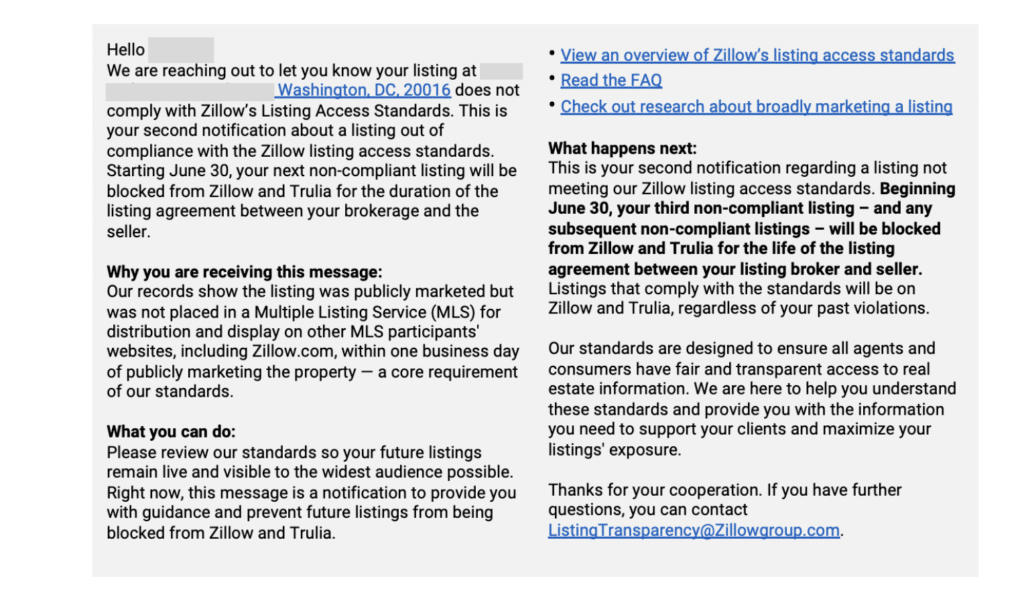
Zillow Group has taken a “three-strikes” approach in which brokers will receive warnings for their first two non-compliant listings before having their third non-compliant listing banned from Zillow, Trulia and StreetEasy on June 30. The portal has been sending warnings through phone calls and emails, which point brokers to Zillow’s FAQ and a dedicated support email.

READ INMAN’S ZILLOW LISTING BAN FAQ

A Zillow spokesperson declined to answer questions on how many non-compliance notices they’ve sent, how many agents have received more than one non-compliance notice, and whether they’ve hired extra staff to send notices and handle inquiries from brokers who need additional guidance. However, the spokesperson did confirm the voicemail and email screenshot in real estate strategist Mike DelPrete’s latest blog post about Zillow Group and Compass’s battle over private listing networks.

Zillow Group’s non-compliance warning | Credit: Mike DelPrete

Zillow Group said its roll-out strategy centers on giving brokers enough time to understand and comply with the ban, which is based on the National Association of Realtors’ Clear Cooperation Policy.

The ban doesn’t impact “coming soon,” office exclusives, or Delayed Marketing Exempt Listings (DMEL) as long as brokers are adhering to NAR’s guidance for each listing status, Inman’s ban FAQ explained. For sale by owner (FSBO) listings and rental listings won’t be impacted by the ban. New construction listings sold by the builder are also exempt, unless they are listed with a broker under an exclusive listing agreement, in which case, they’ll also be held to the new standards.

Zillow Group said it will begin enforcing the ban in phases, going nationwide by the end of the summer. The portal will not retroactively ban listings that received warnings before the June 30 deadline.

“These listing access standards are how we’re implementing NAR’s Clear Cooperation Policy on Zillow sites and reflect our belief in fair access for all,” Zillow Group said in a previous Inman article. “The standards apply to listings regardless of any applicable MLS rule. They apply to all listings subject to an exclusive for-sale listing agreement between a broker and a seller and therefore do not apply to builder inventory represented directly by the builder, rental listings, or for sale by owner listings.”

“This notification period is designed to give agents ample time to understand and ensure they’re complying with the new listing access standards so all publicly marketed listings can reach the broadest audience of home shoppers online,” they added.

The non-compliance warnings have heightened anticipation about the brewing battle between Zillow Group and Compass, which have become fierce rivals in the debate over PLNs and how much control sellers and listing agents should have over disseminating listing data. A few brokers on X, the platform formerly known as Twitter, have even gone so far as to dub the conflict the “Zillow-Compass War.”

“If they don’t have your inventory, it puts their business model at risk,” Compass CEO Robert Reffkin said during the brokerage’s annual conference on Wednesday. “This is the most important moment in real estate history. This is about choice versus control.”

Seattle-based firm Redfin will start banning listings in September, and CoStar Group is readying itself for an influx of listing brokers with banned listings taking advantage of free access to its new marketing product, Boost.

Meanwhile, Realtor.com is still the outlier — a company spokesperson only revealed in April that the portal is giving “thoughtful consideration” on how to handle DMEL.

Email Marian McPherson

Have you received a notice from Zillow or have a comment on the rollout? Let us know in the comments below.

HUD and the FHFA are changing. Here’s everything you need to know

HUD and the FHFA are changing. Here’s everything you need to know

Workforce cuts, the rescission of Fair Housing initiatives and COVID assistance, and multiple pathways for Fannie Mae and Freddie Mac are all under discussion at the federal housing agencies.

Bigger. Better. Bolder. Inman Connect is heading to San Diego. Join thousands of real estate pros, connect with the Inman Community and gain insights from hundreds of leading minds shaping the industry. If you’re ready to grow your business and invest in yourself, this is where you need to be. Go BIG in San Diego!

After passing the U.S. House of Representatives in a razor-thin vote of 215-214, President Trump’s tax bill, the One Big Beautiful Bill Act, will now face the scrutiny of the U.S. Senate, where Republicans are pushing for an additional $500 billion in cuts.

The $1.5 trillion budget cut passed by the House is to offset the costs of making the 2017 Trump tax cuts permanent, NPR explained, and primarily hinges on slicing funding for Medicare, Medicaid, the Affordable Care Act (ACA), and the Supplemental Nutrition and Assistance Program (SNAP), and reducing student loan repayment options to a 10-year and a 25-year plan.

Although healthcare and student loans have gotten the lion’s share of coverage, the One Big Beautiful Bill Act’s passage in the House relied on proposing key cuts to several Department of Housing and Urban Development programs. If passed, the cuts to HUD would be in addition to the $32.9 billion budget cut outlined in Trump’s FY 2026 budget request.

Eighty-one percent of the cuts in HUD’s FY 2026 budget are aimed at limiting federal rental and homelessness assistance programs and eliminating Fair Housing grants and initiatives.

HUD Secretary Scott Turner has already gotten the ball rolling on some cuts, with plans to lay off 40 percent of the Federal Housing Administration (FHA) staff, rescind several Obama- and Biden-era fair housing rules, and reduce funding to the Fair Housing Assistance Program (FHAP), the Fair Housing Initiatives Program (FHIP) and other assistance programs.

These changes not only impact renters, 5 million of whom get housing assistance through Section 8, but they could also impact homebuyers and homeowners who’ve had their fair housing rights violated, have Federal Housing Administration (FHA)-insured loans or still rely on COVID-era assistance options to avoid foreclosure.

Here’s what you need to know about what’s happening at HUD and the Federal Housing Finance Agency (FHFA), and how you can help your clients navigate what’s ahead:

FHA: No loans for non-permanent residents, the end of COVID-era assistance 

The Federal Housing Administration, which is under HUD, is one of the nation’s largest mortgage insurers. The FHA insures loans from HUD-approved lenders who offer lower closing costs, lower down payment requirements and more lenient creditworthiness standards.

  • Twenty-five percent of HUD workers accepted the DOGE deferred resignation plan, which allows them to receive pay and benefits through Sept. 30. Inman reported in February that HUD planned to lay off 40 percent of FHA staff; however, HUD has not confirmed the number.
  • HUD will no longer allow non-permanent residents to apply for FHA-insured loans. The change, which impacts borrowers with teaching, student and other professional visas, goes into effect on May 25. Those borrowers will still have access to conventional loans.
  • HUD also made changes to the Mutual Mortgage Insurance Fund (MMIF) and COVID-19 Recovery Options. The changes limit homeowners to one permanent Loss Mitigation Option every two years versus every 18 months.
  • National Housing Conference President and CEO David Dworkin said it’s anyone’s guess on how many HUD workers will face layoffs. The size of those layoffs and whether HUD decides to update its regulatory structure to operate sufficiently with a smaller staff will determine whether the experience for borrowers declines.

Opportunity Zones: Hitting restart in 2027

A holdover from the first Trump term, the 2017 Opportunity Zones (OZ) program offers developers tax breaks when they invest their realized capital gains in projects across 8,700 designated zones. The program has yielded mixed results, with home values in most OZs struggling to match the national average and developers abusing loopholes to receive tax benefits without making actual long-term investments in the zones.

  • Trump’s FY 2026 budget request proposes that HUD sunset the program in the first set of 8,700 OZs in 2026. Governors will be able to nominate new zones in 2027.
  • The new OZs will favor rural land, with developers getting a 30 percent break, versus a 10 percent break for projects in non-rural zones.
  • Experts anticipate that some of the original zones will have their program status renewed; however, for zones that don’t, developers will no longer get tax breaks.

HOME Investment Partnerships (HOME) program: On the chopping block 

HOME is HUD’s biggest federal block grant and provides funding to preserve and build affordable housing for renters and homebuyers. HOME grants can be used for down payment, closing costs and mortgage assistance.

  • The final rule to update HOME — the first update since 2013 — is expected to offer higher assistance thresholds and streamline homebuyers’ application process.
  • Several housing groups lauded the program updates, saying they’ll strengthen tenant protections and help Community Housing Development Organizations (CHDOs) better serve tenants and homebuyers from low- and middle-income communities.
  • Trump’s FY 2026 budget request proposes to discontinue the $1.25 billion program; however, Dworkin said Congress will likely deny Trump’s plan to discontinue HOME.

Affirmatively Furthering Fair Housing: A partisan talking point

Affirmatively Furthering Fair Housing requires all local, state and public housing officials to use the Affirmatively Furthering Fair Housing Assessment Tool. The tool uses a 96-part questionnaire to help leaders identify patterns of segregation and concentrated poverty along racial lines.

Former HUD Secretary Ben Carson removed the rule in 2016, and the following HUD secretary, Marcia Fudge, outlined plans to reinstate AFFH and make the tool easier to use. However, HUD, under Fudge, never issued the final rule needed to officially bring the AFFH back. 

  • Turner has no interest in crafting a new AFFH policy, saying it was “red tape” that prevented jurisdictions from solving housing issues without federal interference.
  • Representative Maxine Waters (D-CA) and Senator Elizabeth Warren (D-MA) have introduced the “Restoring Fair Housing Protections Eliminated by Trump Act,” which includes legislation to reinstate AFFH.
  • Dworkin said the conversation around AFFH is more of a “rhetorical policy argument than something that’s going to have true, immediate impact” on homebuyers and homesellers from marginalized communities. Proposed cuts to the Fair Housing Assistance Program (FHAP) and the Fair Housing Initiatives Program (FHIP) matter more, he said.

Property Appraisal and Valuation Equity (PAVE) Task Force: A future unknown 

The PAVE Task Force was created in 2021 to address appraisal bias among Black homesellers, who’ve reported receiving lowball appraisals compared to their white counterparts who live in the same area. The task force collected appraisal bias data, set federal enforcement actions for appraisers who discriminated against homesellers and created a rule that allowed homesellers to ask for a reconsideration of value if their appraisal came in too low.

  • HUD deleted the PAVE Task Force homepage in February and has said nothing else about it since.
  • In March, HUD lifted appraisal review procedures enacted last year for FHA lenders to follow to better protect borrowers against discriminatory appraisals.
  • In light of lingering questions about PAVE, experts have advised consumers to be vigilant during the appraisal process and flag potential instances of discrimination.

Privatizing Fannie and Freddie: Multiple options on the table

Fannie Mae and Freddie Mac’s regulator, the Federal Housing Finance Agency (FHFA), is weighing plans to restructure the companies. Both government-sponsored enterprises, whose business model relies on purchasing loans from banks and selling them as mortgage-backed securities, were put under conservatorship during the height of the subprime mortgage crisis.

The timeline for restructuring the mortgage giants is still unclear, with FHFA Director Bill Pulte saying he’s waiting for President Trump’s direction.

  • In past interviews, Trump floated multiple privatization options, including bypassing Congress using the FHA to free the firms from their conservatorship. However, the president pitched a new plan on May 21 via Truth Social, saying he wanted to take Fannie and Freddie public.
  • Pulte later pointed out that Trump “very explicitly says that he wants to take them public. He did not say that he wants to privatize them,” and that the administration is studying whether it could keep the companies in conservatorship.
  • Dworkin said there are “a lot of complex questions that still have to be resolved” when it comes to privatization, and it’s anyone’s guess on what method the Administration will choose. However, they must be careful — brashly pulling the GSEs out of conservatorship could lead to mortgage rates rising anywhere from 43 to 97 basis points or almost 1 percent (100 basis points = 1 percent).
  • In a move to address fears that mortgage rates might go up if Fannie and Freddie are restructured, Trump posted on Truth Social on May 27 that “the U.S. Government will keep its implicit GUARANTEES, and I will stay strong in my position on overseeing them as President.”
  • One theory is that the government could invest its stake in Fannie and Freddie into a sovereign wealth fund and raise cash by issuing preferred shares that pay dividends — an approach Treasury Secretary Scott Bessent says could help put the mortgage giants on sound footing without boosting mortgage rates.

A new credit-scoring system: Double the scores, double the work

The FHFA is seeking a shift from a tri-merge to a bi-merge credit scoring system. The FHFA approved the plan in 2022 with a Q4 2025 implementation deadline, but that timetable has been pushed back. Instead of pulling one score from three credit reporting agencies, Fannie and Freddie will require lenders to pull two scores — FICO 10T and VantageScore 4.0 — from two credit reporting agencies, for a total of four scores.

  • Pulte has said he’s “not happy” about price increases levied by the company behind the FICO score algorithm, Fair Isaac, which an industry trade group, Community Home Lenders of America, claims total 700 percent over the last 30 months.
  • In addition to introducing competition, backers tout the new VantageScore 4.0 and FICO Score 10 T credit scoring models as more inclusive and accurate. VantageScore – a joint of consumer reporting agencies Equifax, Experian, and TransUnion – claims that implementation of VantageScore 4.0 will boost the eligible pool of mortgage applicants by over 2.5 million borrowers.
  • Originators worry that a bi-merge credit scoring system will make it more difficult to assess borrowers’ creditworthiness, as they’ll need to learn the nuances of each system.
  • Borrowers with lower credit scores may have fewer options to get approved. FICO 10 T evaluates two years of credit behavior, meaning borrowers can’t pay off a large chunk of debt before applying for a mortgage to improve their score.

Pulling back on equitable housing programs: A hit to minority homeownership rates

Director Pulte issued a directive on March 25 terminating Fannie and Freddie’s Special Purpose Credit Program, saying, “the current level of support for SPCP is inappropriate for regulated entities in conservatorship.” 

  • Fannie and Freddie had launched SPCPs in select U.S. cities aimed at boosting lending by expanding borrower eligibility criteria, reducing closing costs and providing flexibility in the form of down payment assistance. Lenders can participate in Fannie and Freddie SPCPs or develop their own programs.
  • Dworkin is hopeful that lenders will still utilize SPCPs as long as Fannie and Freddie avoid making “unique underwriting changes” that will hinder service to borrowers with lower creditworthiness.

Pulte also did away with a requirement that Fannie and Freddie adopt Equitable Housing Finance Plans every three years and publish annual reports documenting their performance.

  • Although a final rule requiring the mortgage giants to adopt Equitable Housing Finance Plans was finalized in May 2024, Fannie and Freddie submitted their first plans in 2021 with the goal of providing long-term, equitable housing solutions for homebuyers from underserved groups. The plan required Fannie and Freddie to identify homeownership barriers and create solutions for those barriers, including leveraging SPCPs.
  • “Before the Equitable Housing Finance Plans were created, Fannie Mae and Freddie Mac were doing a horrible job of serving the entirety of the market in an equitable way,” National Fair Housing Alliance (NFHA) Executive Vice President Nikitra Bailey told Inman when Pulte eliminated the requirement.
  • Lastly, Pulte withdrew the FHFA’s participation in monitoring unfair, deceptive and abusive acts and practices (UDAAP) in collecting consumer debts, leaving the Consumer Financial Protection Bureau (CFPB) and the Federal Trade Commission (FTC) to handle the task.

Slimming the workforce: Fewer workers, reduced services

In April, Pulte went to X, the platform formerly known as Twitter, to announce that Fannie and Freddie had cut more than 25 percent of their workforce. Fannie and Freddie had 16,000 employees at the beginning of 2025. A 25 percent cut means about 4,000 employees have been fired or left the company since March.

Email Marian McPherson

NAR warns agents of growing ‘Pig Butchering’ cryptocurrency scam

NAR warns agents of growing ‘Pig Butchering’ cryptocurrency scam

Scammers posing as wealthy homebuyers are roping agents into elaborate crypto investing schemes, resulting in some agents losing their life savings and drawing Secret Service scrutiny.

Bigger. Better. Bolder. Inman Connect is heading to San Diego. Join thousands of real estate pros, connect with the Inman Community and gain insights from hundreds of leading minds shaping the industry. If you’re ready to grow your business and invest in yourself, this is where you need to be. Go BIG in San Diego!

Between debates on hate speech and three-way agreements at its midyear conference, the National Association of Realtors issued a dire warning about the rapid rise of cryptocurrency scams targeting real estate agents.

“Cybercrime — particularly wire fraud — continues to be a top concern in the real estate industry,” the Association’s broker risk reduction homepage read. “The U.S. Secret Service has informed NAR about a new cryptocurrency scam targeting real estate professionals, some of whom have lost a significant amount of money.”

TAKE THE INMAN INTEL SURVEY FOR MAY

In the scam, con artists reach out to real estate agents as an all-cash homebuyer. Con artists may use social media or emails to strike up a conversation, but the most common method is through a text directed to someone else about an important document or deal. When the agent texts back, usually to let the scammer know they’ve texted the wrong number, they’ll strike up a conversation and begin the con.

After building rapport, the con artist explains how they made their fortune through cryptocurrency and encourages the agent to create an account on a legitimate platform, like Coinbase, and convert a small amount of money — $1,000 or less — into cryptocurrency. From there, they direct the agent to download another investment app through a fake App Store or Google Play link. When the link doesn’t work, they’ll send them another link to their fraudulent investment site.

The agent follows through, gets a robust return, and then, at the behest of the con artist, withdraws their funds. The con artist then asks the agent to keep making larger investments through the fraudulent site, which shows false metrics on how much their investment is growing. However, when the agent is ready to make another withdrawal, the con artist shuts down the site, takes their money and disappears.

Zack Schuler | Credit: LinkedIn

NINJIO Founder and CEO Zack Schuler said this tactic, which is known as the Pig Butchering Scam, has been around for several years and coincides with the rise in cryptocurrency. The scam often happens over a few months, with con artists leaning on psychological tactics, artificial intelligence and deep-fake technology to rope in victims.

“Know that even if you meet up with somebody on video, on FaceTime, on whatever, if they look real and they sound real, they aren’t necessarily real,” Schuler, an Inman contributor, said. “It could be somebody in Eastern Europe, it could be somebody in Cambodia that is using AI to make themselves look the same race, gender, etc., to make themselves seem more relatable. They can even disguise their voice. They can do everything.”

“So don’t trust video anymore,” he added. “AI has figured that out.”

Schuler said AI has helped con artists circumvent typical online vetting tactics, so the key way to mitigate risk is by doing in-person investment meetings only.

“Before you do anything with anybody, get together in person and verify that that person is real,” he said.  “And remember, if it’s too good to be true, then it usually is.”

If you’ve been scammed, Schuler said the first step is reporting the incident to local law enforcement. From there, local law enforcement can escalate the incident to the local Federal Bureau of Investigation (FBI) field office, which can connect you with mental health or financial resources.

If you’re still in contact with the scammer, Schuler said it’s important to stay calm and not scare them away with demands to get your funds back. Instead, it’s best to keep the conversation going so authorities have a higher chance of locating the scammer and getting your funds back.

“For most people, once [the money] is gone, it’s gone,” he said, recounting the story of an agent who lost $1.8 million.

The FBI estimates victims lost $16.6 billion last year from cyber investment scams, including the Pig Butchering Scam. If you believe you’ve been scammed, contact the FBI Internet Crime Complaint Center (IC3).

Email Marian McPherson

Redfin says it will begin banning listings in September

Redfin will begin banning listings that aren’t added to the multiple listing service (MLS) within 24 hours of being publicly marketed in September. The announcement comes two days after Zillow Group shared its ban timeline.

Bigger. Better. Bolder. Inman Connect is heading to San Diego. Join thousands of real estate pros, connect with the Inman Community and gain insights from hundreds of leading minds shaping the industry. If you’re ready to grow your business and invest in yourself, this is where you need to be. Go BIG in San Diego.

Seattle-based firm Redfin will start banning listings in September, the same month the National Association of Realtors (NAR) says multiple listing services (MLS) must implement the terms of Delayed Marketing Exempt Listings (DMEL) under the Multiple Listing Options for Sellers (MLOS) policy.

TAKE THE INMAN INTEL SURVEY FOR MAY

“We plan to implement the policy in September, which aligns with the timeline for MLSs to roll out delayed exempt policies,” the spokesperson told Inman in an email.

Like Zillow Group, Redfin’s ban impacts listings that aren’t added to the multiple listing service (MLS) within 24 hours of being publicly marketed. The ban won’t impact DMEL, an option where the seller can have their broker delay the public marketing of their listing through an IDX feed. Brokers will still file delayed marketing listings with the MLS and will be allowed to market the listing in other manners the seller has requested.

“If they’re shared in the MLS and disseminated to sites like Redfin through a Virtual Office Website (VOW), where buyers can access them, those listings can be included on Redfin,” a Redfin spokesperson told Inman in April.

Glenn Kelman | Credit: Redfin

Alongside the listing ban, Redfin CEO Glenn Kelman called on MLSs to create a new “coming soon” designation that bans portals from displaying days on market and price history.

“Because we believe that all buyers should be able to see all listings, Redfin.com will not publish any listings that have been publicly marketed before being shared with all real estate websites via the MLS,” Kelman said in a previous Inman article. “To encourage homesellers to market their listings via the MLS, Redfin is also asking MLSs to create a coming soon designation for listings that precludes search sites from showing how long a home has been for sale and at what prices.”

Redfin’s announcement comes two days after Zillow Group outlined the timeline of its listing ban.

Zillow Group will start sending non-compliance listing notices on May 28. Agents will get two non-compliance listing notices before their listing gets banned on Zillow and Trulia beginning June 30. Zillow Group said it will begin enforcing the ban in phases, going nationwide by the end of the summer.

“These listing access standards are how we’re implementing NAR’s Clear Cooperation Policy on Zillow sites and reflect our belief in fair access for all,” Zillow said in a previous Inman article. “The standards apply to listings regardless of any applicable MLS rule. They apply to all listings subject to an exclusive for-sale listing agreement between a broker and a seller and therefore do not apply to builder inventory represented directly by the builder, rental listings or for sale by owner listings.”

“This notification period is designed to give agents ample time to understand and ensure they’re complying with the new listing access standards so all publicly marketed listings can reach the broadest audience of home shoppers online,” they added.

Zillow Group and Redfin’s listing bans are part of a larger debate over Clear Cooperation, private listing networks (PLN), and how much control sellers and listing agents should have over disseminating listing data.

NAR’s policy changes have also added another layer to an ongoing portal war, with major players taking their stake in the CCP debate.

CoStar Group said Homes.com won’t ban listings that aren’t added to the MLS within 24 hours of being publicly marketed. On May 9, Homes.com upped the ante and said it would give listing agents with banned listings free access to its new marketing product, Boost.

Meanwhile, Realtor.com hasn’t shared a policy stance, with a company spokesperson only revealing in April that the portal is giving “thoughtful consideration” on how to handle DMEL.

Email Marian McPherson

This post was originally published on this site