by Taylor Anderson | May 6, 2025 | Industry, News Feed
The company reported having 81,904 agents at the end of the first quarter amid an ongoing slide in headcount. It also reported its agents sold 2 percent fewer homes in the quarter compared to a year ago.
Bigger. Better. Bolder. Inman Connect is heading to San Diego. Join thousands of real estate pros, connect with the Inman Community and gain insights from hundreds of leading minds shaping the industry. If you’re ready to grow your business and invest in yourself, this is where you need to be. Go BIG in San Diego!
EXp reported an ongoing drop in agent count and an uptick in revenue during the first three months of this year, as the firm saw home sales slow amid a down market.
The virtual brokerage reported pulling in $954.9 million in revenue from 89,643 homes sold in the quarter. The company ended last year with $1.1 billion in total revenue for the fourth quarter, and $943 million during the first quarter of last year.
Net losses ticked up from the fourth quarter, as eXp reported losing $11 million in the first three months of the year compared to $9.5 million in the fourth quarter. The firm trimmed its losses compared to the first quarter of 2024, when eXp reported losing $15.6 million.
EXp leadership highlighted the company’s values as it remained engaged in some of the industry’s most heated policy debates.
“The real estate industry is at a pivotal crossroads, and eXp is proudly leading the charge to protect transparency, consumer choice and healthy competition — values that have defined our marketplace for decades,” eXp CEO Leo Pareja said in a statement. “EXp was built by agents, for agents, and we continue to raise the bar.”
EXp reported $38.6 billion in total sales volume in the quarter, up 4 percent from a year earlier, despite its agents selling 2 percent fewer homes in the quarter compared to a year earlier.
The company reported having 81,904 agents at the end of the first quarter amid an ongoing slide in headcount. At the end of the first quarter of 2024, eXp reported having 85,780 agents. By the end of the year, the total had slid to 82,980 agents — a 5 percent drop compared to the previous year.
The company said most of the agents who left were low producers, with 77 percent of agents who left in the quarter selling 0-2 homes over the past 12 months. Two percent of those who left had sold 21 homes or more over the past 12 months, the company said.
“We continue to retain our most productive agents, which is the metric I’m most focused on,” Pareja said during a call with investors.
EXp CFO Jesse Hill said the company planned to focus on efficiencies to close out the year.
“We as a leadership team are building a plan to have more efficient operations in the back half of 2025,” Hill said.
Email Taylor Anderson
This post was originally published on this site
by Jim Dalrymple II | May 6, 2025 | Industry, News Feed
The iBuyer also revealed Tuesday that it bought 3,609 homes in the first three months of 2025. That number represents a 4 percent year-over-year increase.
Bigger. Better. Bolder. Inman Connect is heading to San Diego. Join thousands of real estate pros, connect with the Inman Community and gain insights from hundreds of leading minds shaping the industry. If you’re ready to grow your business and invest in yourself, this is where you need to be. Go BIG in San Diego!
Against significant market headwinds, Opendoor managed to trim losses in the first quarter of the year, despite seeing a modest drop in revenue, according to earnings data released Tuesday.
In total, the iBuyer brought in $1.2 billion in revenue between January and March, according to a newly published earnings report. That’s a dip of 2 percent compared to the same period in 2024.
The company also lost $85 million during the quarter. However, that figure is an improvement over the $109 million Opendoor lost during the first three months of 2024.

Carrie Wheeler | Opendoor CEO
In the report, CEO Carrie Wheeler said the first quarter results “reflect disciplined execution” on a “plan to drive toward profitability while strengthening our product experience and platform.”
“At the same time, we are investing in our future — evolving Opendoor into a broader selling platform, one that gives every homeowner more choice — whether that’s a cash offer or listing with a trusted agent,” she added.
Tuesday’s report also showed that Opendoor is holding a growing portfolio of homes. The company specifically bought 3,609 houses between January and March, which is up 4 percent year over year. At the same time, the iBuyer ended the quarter with 1,051 homes under contract, which is down 60 percent.
The result of these numbers is that Opendoor had an inventory of 7,080 homes — a year-over-year increase of 24 percent.
During a call with analysts Tuesday afternoon, Wheeler said the company is positioned “for long-term success,” though she added that there is currently an “extremely challenging macroeconomic environment.” Wheeler cited rising rates, tariffs and other factors that have prompted housing consumers to take “a pause.”
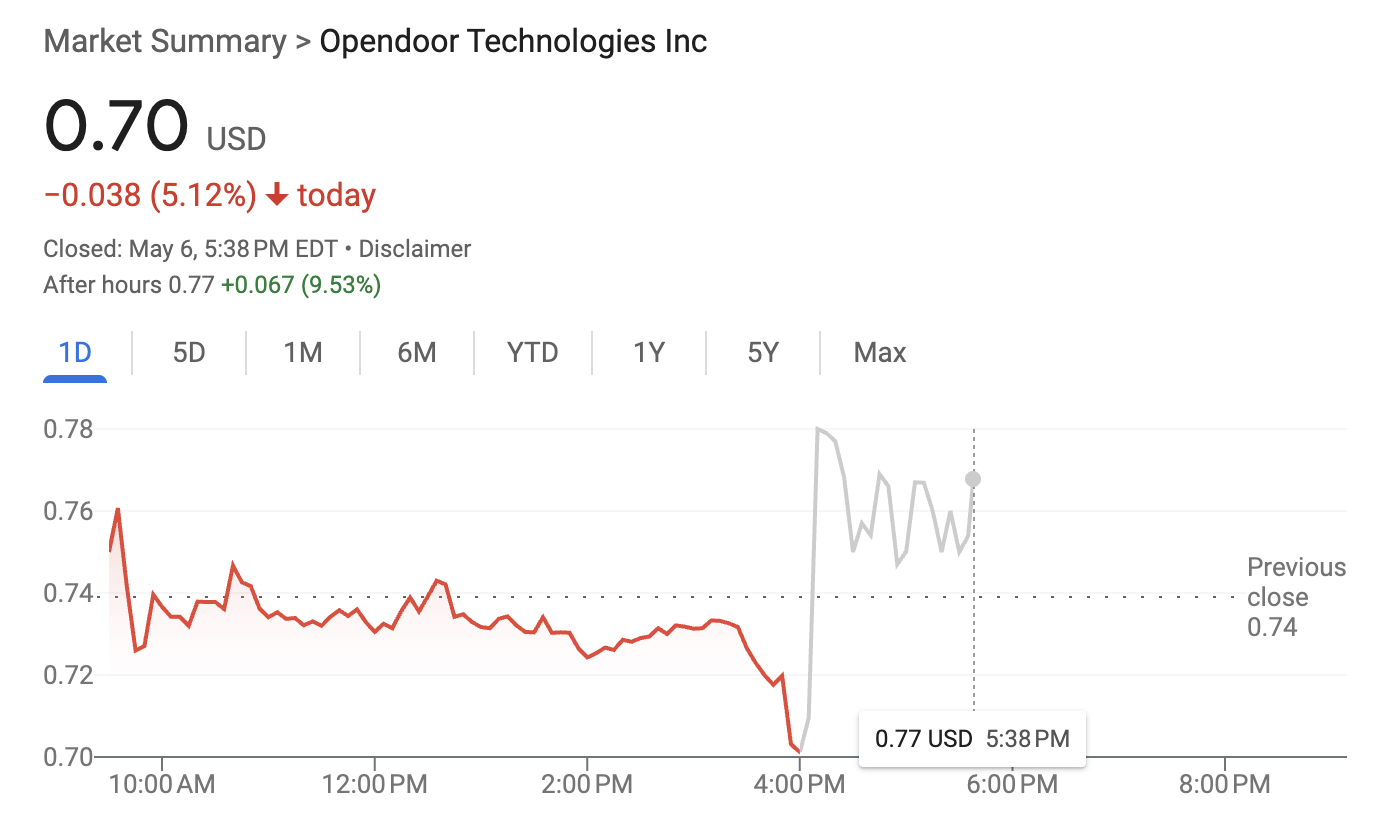
Heading into Tuesday’s earnings, shares in Opendoor were hovering around an all-time low price in the low $0.70 range. That was down for the day, but more significantly, it’s also well below the $1 threshold above which companies have to stay or risk getting booted from the stock market. Opendoor shares first fell below $1 just over a month ago and have continued losing value ever since.
Opendoor shares fluctuated, but generally rose, Tuesday in after hours trading following the publication of the company’s earnings report.
Credit: Google
Opendoor — which had a market cap of about $524.5 million as of Tuesday afternoon — is not unique in facing investor skepticism. Fellow iBuyer Offerpad has also seen shares shed significant value in recent days, and it too faces the threat of delisting.
Offerpad reported earnings on Monday, revealing among other things that both revenue and sales were down. The company’s struggles may have weighed on investors’ minds and helped push down Opendoor shares Tuesday as well.
Either way, both companies are contending with a market that makes it extremely challenging to flip homes. During the pandemic years, rising home prices theoretically made it easier for flippers — including at the institutional level — to turn a profit after buying and renovating homes. However, as rates rose in recent years and home price growth slowed considerably, it became much more difficult to turn a profit using the iBuyer model.
Those conditions have prompted the iBuyers to develop a variety of asset-light offerings and have weighed on balance sheets. In the final quarter of 2024, for example, Opendoor reported that it managed to increase revenue year over year, but also that its losses rose.
During Tuesday’s analyst call, Wheeler emphasized the importance of real estate agents to Opendoor’s business, saying that a “meaningful percentage of our acquisitions come to us” via referrals from industry professionals. Wheeler also said that Opendoor is “evolving into a platform where every seller can explore all their selling options,” and that consumers benefit from having an agent help them navigate those options.
Opendoor is also piloting a program in which it sends referrals to agents. Wheeler said the program, which is being tested in 11 markets, “allows us to drive more asset-light revenue” and increase conversions.
Update: This story was updated after publication with additional details from Opendoor’s earnings report and commentary from the company’s analyst call.
Email Jim Dalrymple II
This post was originally published on this site
by Craig C. Rowe | May 6, 2025 | Industry, News Feed
Care by Upfront is a nationwide health benefits program that can be white-labeled by brokerages on behalf of their agents.
Bigger. Better. Bolder. Inman Connect is heading to San Diego. Join thousands of real estate pros, connect with the power of the Inman Community, and gain insights from hundreds of leading minds shaping the industry. If you’re ready to grow your business and invest in yourself, this is where you need to be. Go BIG in San Diego!
Real estate fintech startup Upfront has launched a nationwide service to provide healthcare for the industry, Inman has learned exclusively.
Care by Upfront will compliment the company’s core product, a capital extension service that allows brokers to provide funds to agents for a range of needs based on pending commissions.
“Care by Upfront will provide national healthcare coverage across all 50 states, competitive group rates for individuals, 1099s, and businesses of all sizes, and supplemental benefits, including critical illness, dental/vision and more,” according to a May 6 statement.
Like its capital resources product, Care by Upfront can be co-branded for the brokerage, which chooses which plans to offer, according to the company. General care providers that brokers can consider include Cigna, Anthem and PHCS, while vision and dental services can be offered through VSP, Delta Dental and Solstice.
Healthcare remains a difficult hurdle for many agents to obtain as they ramp up and evolve their businesses. The majority of practicing sales professionals are 1099 contractors, and only a few brokerages offer suitable health benefits.
The Real Brokerage, a fast-growing technology-forward brand, started providing access to health benefits through a group purchasing plan in 2023.
Anywhere, then Realogy, announced a benefits plan in 2019 called Spark, Inman reported. The company describes its program as a “membership association,” meaning agents — who are typically independent contractors — can opt into and sign up for whichever benefits suit their specific needs.
Upfront was part of the first cohort supported by Equity Angels, a minority-focused entrepreneurship accelerator focused primarily on proptech and real estate-adjacent startups. The organization’s second cohort was introduced in April.
“Healthy and financially secure agents are more focused, productive and successful, which directly translates to increased transactions and revenue for brokerages,” said Mukund Venkatakrishnan, co-founder of Upfront, in the statement. “By providing both financial and healthcare solutions, we’re empowering agents to build successful and fulfilling careers, and we’re enabling brokerages to attract and retain the best talent in the industry.”
Upfront helps agents handle a variety of financial outlays, which can range from marketing commitments and lead generation to association dues and continuing education. Software, clothing, vehicle expenses, conferences, subscriptions and other necessities for business growth are rarely provided by brokers, and an agent’s self-employment status can limit institutional funding options.
Brokers can benefit by working with Upfront as a recruiting appeal, and the company tackles the administrative chores that accompany deploying its offerings.
Email Craig Rowe
This post was originally published on this site
by Inman | May 6, 2025 | Industry, News Feed
Bigger. Better. Bolder. Inman Connect is heading to San Diego. Join thousands of real estate pros, connect with the Inman Community, and gain insights from hundreds of leading minds shaping the industry. If you’re ready to grow your business and invest in yourself, this is where you need to be. Go BIG in San Diego!
Innovation is essential for success in today’s real estate market, even with the abundance of digital tools and advanced technology available to real estate professionals.
For almost 30 years, the Inman Innovator Awards have recognized emerging tech, new ideas, and the people who drive change. That’s why the awards are highly anticipated by leaders and innovators in the real estate industry.
NOMINATE INMAN INNOVATORS BY MAY 16
If you, or someone you know, is an:
- Entrepreneur pushing the old ways aside,
- Marketer reimagining how to showcase properties,
- Agent reinventing how to communicate with clients,
- Company building advanced technologies,
- Brokerage or team creating groundbreaking business models,
- Or other member of the real estate community propelling the industry forward
The Innovator Awards are your opportunity for recognition and honoring those who are transforming the real estate industry by turning their innovative ideas into reality.
Nominations are currently open, and you can nominate yourself — or shine a light on someone else — in the following categories:
- Innovator of the Year (individual or individuals)
- Company of the Year
- Most Innovative Agent
- Most Innovative Team
- Most Innovative Brokerage
- Most Innovative Marketing or Branding Campaign
- Most Innovative Marketing Solution
- Most Innovative Lead Servicing Solution
- Most Innovative Client Experience Solution
- Most Innovative Application of AI
- Most Innovative Use of Video
- Most Innovative Industry Podcast
- Most Innovative Organization (MLS, Association, Industry)
Celebrate the thinkers, creators and leaders redefining what it means to be at the vanguard of real estate. Winners will be honored at Inman Connect San Diego this summer. Join us and cheer on tomorrow’s innovators today.
Submit your nominations here.
This post was originally published on this site
by Darryl Davis | May 6, 2025 | Industry, News Feed
You don’t need 10 years in the business to make an impact this spring, coach Darryl Davis writes. You need 10 moves — done with consistency, creativity and a willingness to learn as you go.
Bigger. Better. Bolder. Inman Connect is heading to San Diego. Join thousands of real estate pros, connect with the Inman Community, and gain insights from hundreds of leading minds shaping the industry. If you’re ready to grow your business and invest in yourself, this is where you need to be. Go BIG in San Diego!
Let’s get one thing straight: Spring isn’t just a season; it’s a massive opportunity.
And if you’re new to real estate? That opportunity is even bigger. Because while seasoned agents might be coasting on last year’s referrals, you’re out here building your brand, making your mark and setting the stage for long-term success.
So how do you do that — without a huge budget, a long track record, or fancy systems?
Start here. Below are 10 proven, doable, confidence-building strategies to help you grab market share, connect with clients and show your community that you’re the agent to watch.
1. Host neighborhood-first open houses
Ask your broker or team leader if you can host open houses for their listings. Then take it a step further — invite the neighbors to a private preview before the public arrives. Hand-deliver invites with a smile and a simple note: “Just wanted to personally invite you to take a sneak peek before the crowd!”
Teachable moment: You don’t need your own listing to build local visibility. Show up and start conversations.
2. Run geo-targeted social ads (Yes, even as a newbie)
Don’t overthink this. A simple Facebook or Instagram ad with your name, face and a message like: “Curious what your home is worth this spring?” can go a long way. Geo-target your ZIP code or neighborhood farm.
Teachable moment: A $10 ad can do more than a $100 postcard — if it’s relevant and localized.
3. Start a spring-cleaning campaign
Offer a free home prep checklist or 10-minute curb appeal consult. It’s a soft entry into the minds of potential sellers. Not pushy — just helpful.
Teachable moment: New agents who give value first earn trust faster. Be useful before you try to be impressive.
4. Reach out to expired listings
Check your MLS for listings that expired unsold. Then call, text, or mail a quick note offering a fresh perspective. Practice saying: “Hey, I saw your home came off the market. I’d love to share a few things that might help it get sold if you’re still open to it.”
Teachable moment: You don’t need to have sold 10 homes to solve problems — just bring ideas, energy and effort.
5. Record short video market updates
Don’t worry about being perfect — just be real. Share a quick 60-second video:
“Here’s what’s happening in [your town] this month: X homes listed, Y sold and what it means for YOU.”
Post it to Instagram, Facebook and email it to your database (yes, even if that’s just 12 people right now).
Teachable moment: You don’t need to know everything — you just need to show that you’re learning and sharing.
6. Partner with local businesses
Introduce yourself to a few small business owners — landscapers, stagers, painters — and see if they’d like to be part of a “preferred vendor list” you share with your clients.
Teachable moment: You’re not just building a career — you’re building a network. And it starts with one conversation.
7. Host a first-time buyer spring session
Invite a local lender and host a free event — online or at a coffee shop — where you walk new buyers through the process. Promote it through social, Eventbrite and your own contacts.
Teachable moment: You’re new, yes — but to your buyer audience, you’re the one who showed up to help them. That’s leadership.
8. Door-knock with purpose (and a smile)
Bring a printed market update, mini home value guide, or even a springy gift like a seed packet. Knock, smile, say Hi and offer value — not pressure.
Teachable moment: You don’t need to sell on the doorstep — you just need to start the relationship.
9. Polish your listing presentation NOW
Even if you don’t have a listing appointment yet, create your presentation. Include your broker’s stats, sample marketing materials, testimonials from your team and a clear plan. Practice it.
Teachable moment: The time to prepare is before the opportunity comes knocking.
10. Reconnect with everyone you know
You may not have a long list of past clients, but you do have a sphere of influence (SOI): friends, family and former coworkers. Reach out. Send a spring card. Offer a free CMA. Invite them to your buyer seminar. Stay visible.
Teachable moment: Relationships are greater than experience. People choose agents they like, know and trust — even if they’re brand new.
You don’t need 10 years in the business to make an impact this spring. You need 10 moves — done with consistency, creativity and a willingness to learn as you go.
So, what are you waiting for?
Pick three strategies from this list. Implement them this week. Then show up again next week. The agents who win in Q2 aren’t waiting for confidence. They’re building it.
This post was originally published on this site
by Christy Murdock | May 6, 2025 | Industry, News Feed
Bigger. Better. Bolder. Inman Connect is heading to San Diego. Join thousands of real estate pros, connect with the Inman Community, and gain insights from hundreds of leading minds shaping the industry. If you’re ready to grow your business and invest in yourself, this is where you need to be. Go BIG in San Diego!
Sixth-generation Fairfield County, Connecticut, resident and two-decade Realtor Libby McKinney-Tritschler knows her market. Her deep roots in the community are informed by her deep involvement in local volunteer efforts, serving on the board of the Pequot Library, the Westport/Weston YMCA, the Bedford Family Social Responsibility Fund and the Stewart B. McKinney Foundation.
A consistent top-producer, McKinney-Tritschler leverages her extensive personal and professional network and strong local reputation to navigate the complexities of the market and make every transaction as seamless as possible. Find out what she’s learned along the way and what advice she’d offer new agents just starting out.
Name: Libby McKinney Tritschler
Title: Sales agent
Experience: 20+ years
Location: Fairfield County, Connecticut
Brokerage name: William Raveis Real Estate
Rankings: Executive Vice President of Sales
Team: On The Harbor
Transaction sides: 400
Sales volume: $727 million
As a child, what did you want to be when you grew up?
I think I wanted to be a politician. When I was young, I loved spending time with my father, who was a congressman. He would spend his weekends canvassing his community and talking to his constituents. He built relationships, understood people’s needs and earned their trust — much like what I do in real estate.
Both require strong communication, a personal touch and the ability to connect with people from all walks of life. In real estate, you must be present, listen and show your clients you genuinely care.
What’s the best advice you ever got from a mentor or colleague?
Without signatures, you have nothing. In real estate conversations, promises and verbal agreements mean nothing without signatures. Nothing is certain until it is in writing.
It’s a reminder to stay proactive, protect everyone’s time and ensure the deal is solid before getting too excited about an opportunity. This is a very important lesson, and if you can learn it early on in life/your career, you’ll be ahead of the game.
What would you tell a new agent before they start out in the business?
I would tell a new agent that real estate isn’t just about selling homes. It’s about building relationships, staying consistent and playing the long game. Success doesn’t happen overnight, so stay patient and persistent, and never stop learning.
Provide value, be reliable and genuinely care about your clients, and in time, the business will come.
What do clients need to know before they begin a real estate transaction?
This is a challenging process, and those who can control their emotions have the best chance of capitalizing on an opportunity.
What do too few agents know that would make their lives easier?
The best agents master what others overlook. Emotional intelligence gives you the ability to read people, adapt and build trust quickly. Real success comes from adaptability — knowing when to pivot based on conversation.
Setting clear expectations with your clients upfront prevents headaches down the road, while wise follow-ups ensure you are adding value, not just checking in. Knowing when something is truly urgent and when to let things breathe keeps both deals and everyone’s sanity intact.
Storytelling is another game changer. Facts inform and stories sell; try to tell the story every time.
What is the best thing you can do for your life and business?
Love what you do and build real connections. Whether it’s with clients, colleagues or in your community, people want to work with someone they trust and enjoy being around. Stay in touch, and be helpful without always expecting something in return.
Most importantly for me is to make your work something you’re excited about. When you love what you do, success follows.
If you could do anything other than real estate, what would it be?
Honestly, I couldn’t imagine doing anything else. Real estate is the perfect blend of relationships, strategy and problem solving; every day is different.
I love the people, the challenge and the ability to make a real impact on someone’s life. Any job I choose would have to involve working closely with people, helping them navigate big decisions and building something meaningful. That being said, nothing excites me the way real estate does.
Tell us a story about your most memorable transaction
Some properties are more than just real estate — they hold stories, legacies and deep historical roots. Selling 66 Beachside Ave in Westport was not just a transaction; it was an honor.
This waterfront estate was a rare gem, the largest parcel available at the time, with a history stretching over a century. Built in the early 1900s, it remained in the same family until 2015, a testament to its significance and the deep connection the owners had to the land.
The indigenous inhabitants once called it “Machamux,” meaning “beautiful land,” a name that still felt fitting as the waves kissed its private shoreline. Later, the family lovingly referred to it as “Banrock,” inspired by the striking rock formations along the beach.
Beyond its natural beauty and history, what made this sale truly special was its purpose. It was part of an estate sale, with proceeds directed to three nonprofit organizations. Knowing that this transaction would help fund meaningful causes added more fulfillment.
Additionally, this was the last piece of land belonging to the Bedford family, marking the end of an era for a lineage that had long been woven into the fabric of Westport. Facilitating this transition was both a privilege and a responsibility, ensuring that the next chapter of this property’s story was handled with care and respect.
Selling homes is often about numbers, negotiations and contracts. But every so often, a sale like this comes along — one that reminds me why I love what I do.
Email Christy Murdock
This post was originally published on this site