by Jim Dalrymple II | May 16, 2025 | Industry, News Feed
A new Redfin report indicates that most consumers are still willing to pay for their real estate agents and that last year’s NAR rules have had minimal impacts on agent pay.
Bigger. Better. Bolder. Inman Connect is heading to San Diego. Join thousands of real estate pros, connect with the Inman Community and gain insights from hundreds of leading minds shaping the industry. If you’re ready to grow your business and invest in yourself, this is where you need to be. Go BIG in San Diego!
More than a year after the National Association of Realtors announced a landmark antitrust settlement, evidence continues to mount that agent commissions are mostly holding steady.
The latest data comes from Redfin, which on Friday reported that during the first quarter of 2025 buyers’ agents averaged commissions of 2.40 percent. Redfin’s report notes that the figure is actually a slight uptick compared to the final three months of 2024, and a bit of a dip from a year prior. But a graph of buyers’ agent commissions that Redfin included in its report illustrates how little commissions have changed over the past two years.
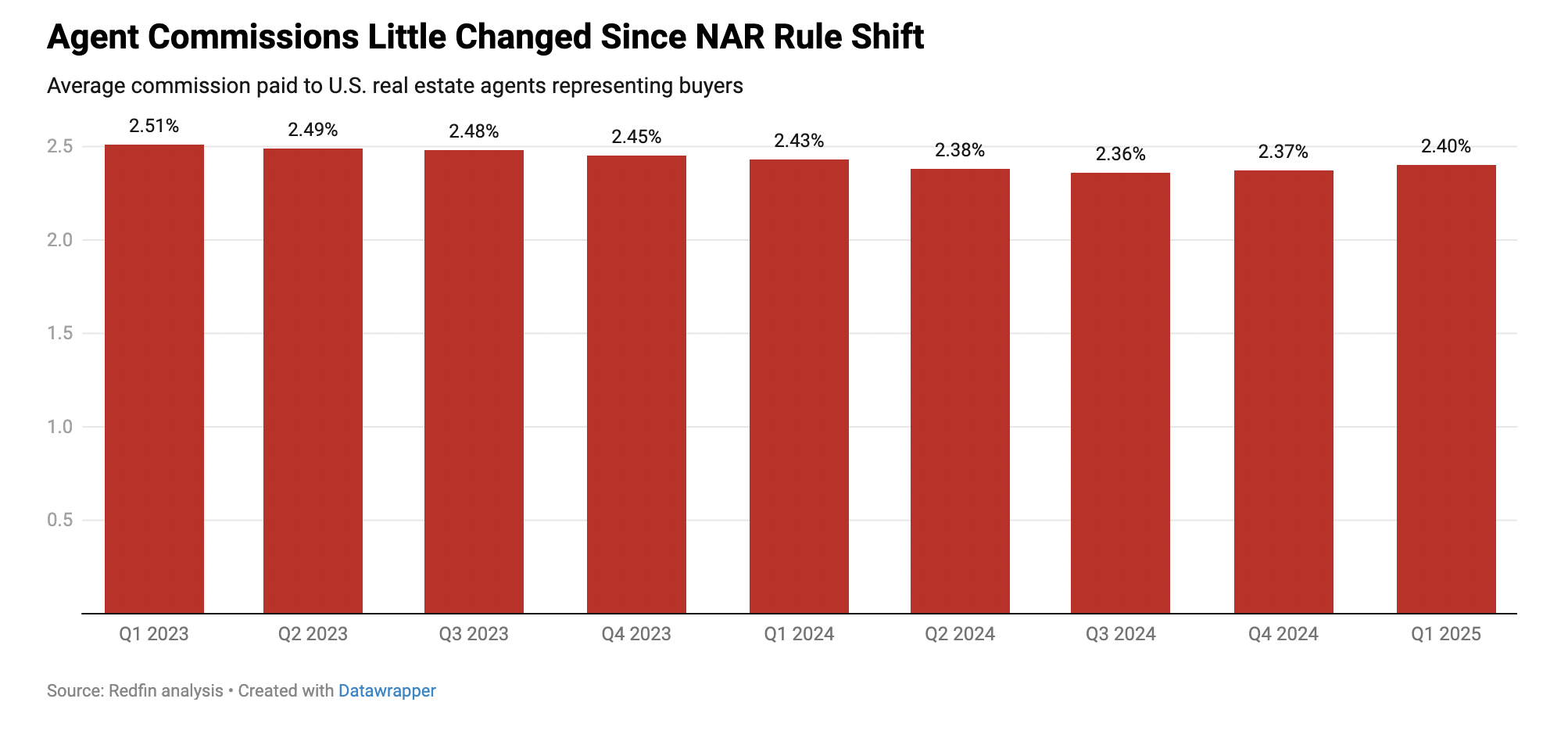
Credit: Redfin
Redfin’s report further notes that commissions have performed differently at different price points. For homes that sold for $1 million or more, buyers’ agent commissions have fallen relative to a year ago. But for homes that sold for less than $500,000, commissions in the first quarter of this year actually went up compared to the same time in 2024.
“Commissions are lower for high-priced homes because agents have more room to reduce their fees and still earn a healthy paycheck,” the report further notes.
The report includes less data on sellers’ agent commissions, but cites anecdotal reports from agents who say that sellers are also still willing to pay commissions.
Redfin ultimately attributes these trends to the fact that the “lion’s share of recent sellers — 45.9 percent — did not try to negotiate.” Additionally, the report found that buyers were less likely to negotiate their agents’ commission than sellers.
The report’s findings fall largely in line with those from recent Inman Intel Index survey data. Earlier this week, for example, Intel reported that 58 percent of agents surveyed in late April said that commission rates have remained unchanged or even increased since the new NAR rules went into effect last August. The rules were part of NAR’s settlement agreement in antitrust commission cases such as Sitzer | Burnett and Gibson. Among other things, they barred sellers’ agents from making offers of compensation to buyers’ agents in their multiple listing services.
Intel also found that only 6 percent of agent respondents in April said more than half of their buyers were trying to negotiate their compensation downward. Additionally, 11 percent of agents told Intel that they have seen an increase in their negotiated compensation rates since the new rules went into effect.
However, there are signs that change is coming, if slowly. Nearly 2 in 5 agent respondents to Intel, for example, said that their rates had declined since August, though only 1 in 20 agents described a “significant” decrease. And 36 percent of agents in April reported working with sellers who have taken a hard-line approach against covering the commission. Notably, this share has climbed from 26 percent in December.
Redfin’s report also comes on the heels of a new analysis from the Federal Reserve that found that requiring buyers’ agent agreements has no effect on commissions. Such agreements are also a component in NAR’s new rules.
All of these findings, however, come against the backdrop of a market that has cooled significantly over the past several years, thanks to higher mortgage rates. But if those market conditions were to change, at least some agents envision commissions evolving as well.
“Sellers don’t seem to have any issue paying a buyer’s agent commission,” Chaley McVay, a Redfin agent in Oregon, is quoted as saying in Redfin’s report. “But if we enter a seller’s market similar to that of 2021 and 2022 — with rampant bidding wars — sellers may be inclined to offer low or no commission to the buyer’s agent, forcing buyers to bridge the gap. And if that happens, first-time buyers will be hit hardest because many of them can already barely afford to buy a home.”
Email Jim Dalrymple II
This post was originally published on this site
by Jim Dalrymple II | May 8, 2025 | Industry, News Feed
Despite a slower housing market, the brokerage’s revenue grew 28.7 percent year over year in the first quarter while transactions rose 27.8 percent.
Bigger. Better. Bolder. Inman Connect is heading to San Diego. Join thousands of real estate pros, connect with the Inman Community, and gain insights from hundreds of leading minds shaping the industry. If you’re ready to grow your business and invest in yourself, this is where you need to be. Go BIG in San Diego!
Compass may regularly polarize the real estate industry, but the company’s assertiveness has apparently not slowed down growth, with a new earnings report showing that it upped revenue, agent count, transactions and various other numbers in the first three months of 2025.
The report, published Thursday, shows that Compass’ revenue in the first quarter grew 28.7 percent year over year to $1.4 billion. The company’s number of principal agents also grew from 14,591 at the end of Q1 in 2024 to 20,656 at the same time this year.
Additionally, Compass agents closed 49,121 transactions during the first three months of 2025, which is up 27.8 percent compared to the first three months of last year.
Compass did still lose money, though the loss of $50.7 million was a significant improvement over the $132.9 million it lost in the first quarter of 2024. The report further notes that Compass was free cash flow positive in Q1, which is important in the brokerage’s case because CEO Robert Reffkin has repeatedly made positive free cash flow a goal.

Robert Reffkin
The report notes several times that Compass’ numbers outperformed the broader market, which saw transactions drop 2.1 percent. Reffkin hit on a similar theme, saying in the report that despite market volatility, his company “continued to widen the gap against the industry.” He also said that Compass has the highest number of top agents and teams.
“Looking ahead, while recent market trends have been somewhat mixed, we remain confident that our playbook and structural advantages position Compass to drive significant upside over time,” Reffkin added.
Compass’ new report further states that the brokerage now has a national market share of 6 percent.
Heading into Thursday’s earnings, shares in Compass were trading in the mid to high $7 range. That was up for the day but down for the week. It also represents a significant improvement over one year ago, when shares in the brokerage were trading in the low $3 range.
Shares trended down slightly in after-hours trading following the publication of Thursday’s report.
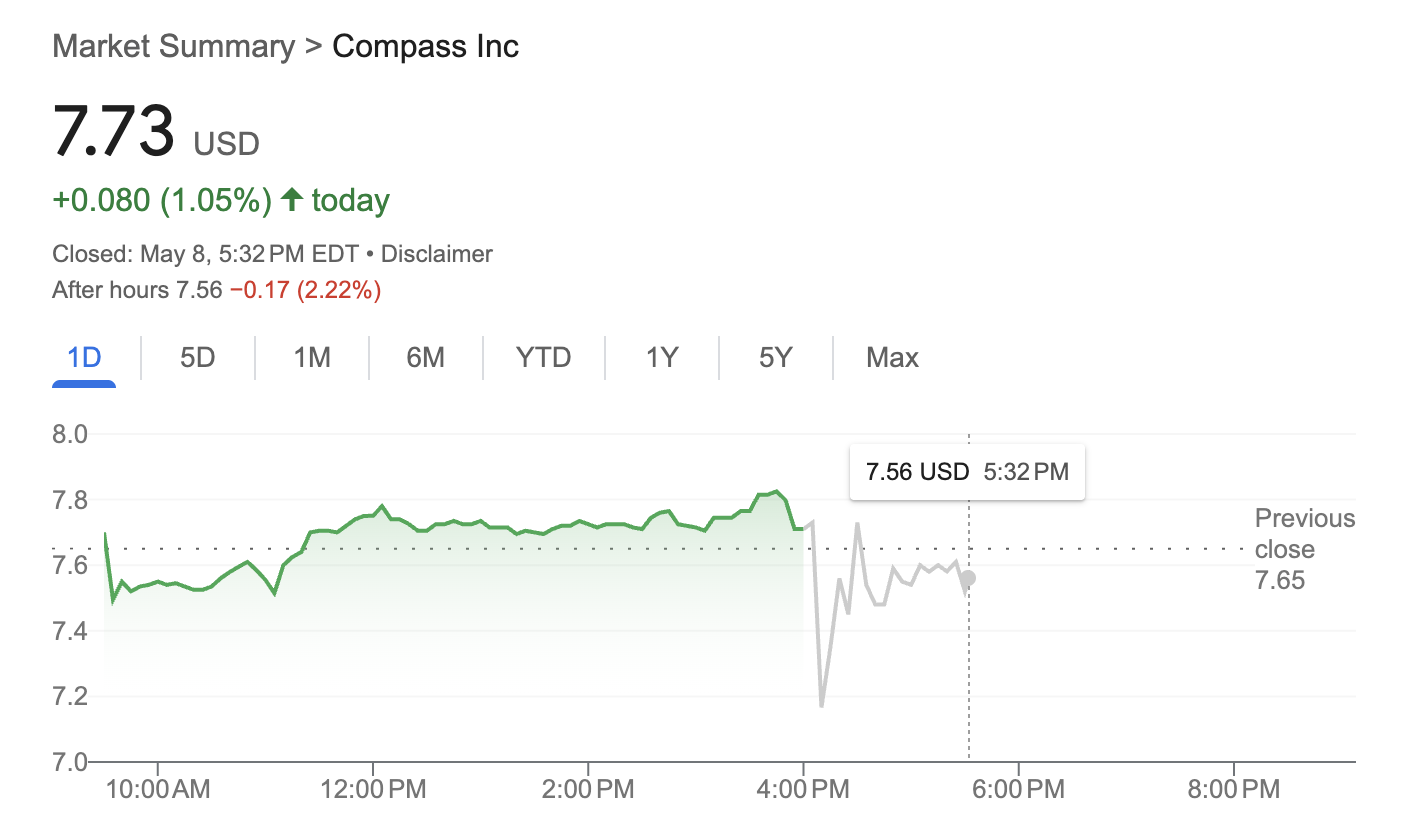
Credit: Google
Compass had a market cap of about $4 billion as of Thursday afternoon.
Thursday’s earnings report arrives against the backdrop of an intense push by Compass in favor of private listings. Such listings are a key part of Compass’ “Three-Phase Marketing Strategy,” which sees properties marketed privately first, then marketed as “coming soon” second, and finally entered into a local multiple listing service in the third and last stage of the process.
Reffkin has vocally touted private listings, arguing among other things that homesellers should be able to market properties how they please. And though Reffkin has been the industry’s most vocal proponent of private listings, other brokerages have rolled out their own private listing networks as well.
At the same time, however, private listings have also drawn intense criticism from figures such as eXp Realty CEO Leo Pareja and NextHome CEO James Dwiggins. Moreover, Compass is currently in the beginning stages of a lawsuit with Northwest MLS in Washington state over the issue.
Heading into Thursday’s earnings, there was thus a question about whether Compass’ prominent role in the private listings debate might have some sort of impact on the brokerage’s bottom line or agent count numbers. So far, however, that does not appear to be the case.
Compass’ new earnings report touts the company’s Three-Phase Marketing Strategy, noting that “48.2 percent of homeowners who listed their home with Compass” outside of Washington used the program. That adds up to a total of 19,393 listings, the report notes.
Reffkin also discussed private listings during a call with analysts, saying that homeowners do not want the National Association of Realtors, MLSs or portals telling them how to market their homes. And he criticized MLSs and portals for increasing “friction” in order to discourage private listings. The comment was an apparent allusion to episodes such as the NWMLS situation and Zillow’s recent ban on private listings.
Reffkin also said that there is no downside for homesellers to use Compass’ Three-Phase Marketing Strategy.
“The worst thing that happens is a homeowner gets an offer and they have an opportunity to turn it down and go to the public sites,” Reffkin said. “That’s the downside, which means there is no downside.”
Reffkin later said that he expects to see private listings grow over the next year, and suggested industry incumbents have resisted private listings out of a sense of self interest.
“Agents aren’t stupid,” Reffkin said during the call. “If you need to fine them and ban them to keep them on your platform, there is something wrong with your platform.”
Update: This story was updated after publication with background, additional details from Compass’ earnings report, and commentary from executives’ call with analysts.
Email Jim Dalrymple II
This post was originally published on this site
by Jim Dalrymple II | May 7, 2025 | Industry, News Feed
Bigger. Better. Bolder. Inman Connect is heading to San Diego. Join thousands of real estate pros, connect with the Inman Community and gain insights from hundreds of leading minds shaping the industry. If you’re ready to grow your business and invest in yourself, this is where you need to be. Go BIG in San Diego!
A slow real estate market couldn’t keep America’s biggest portal down, with new data showing that in Q1, Zillow managed to grow revenue and — for the first time in years — turn a profit.
In total, Zillow brought in $598 million in revenue between January and March, earnings data released Wednesday reveals. That number represents a 13 percent jump compared to the same time in 2024. On top of that, Zillow managed to make $8 million in profit — a significant improvement over the $23 million it lost during last year’s first quarter.
Indeed, a review of past Zillow earnings reports shows that the last time Zillow turned a profit, rather than reporting a net loss, was in 2022.

Jeremy Wacksman
In a conversation with Inman Wednesday, CEO Jeremy Wacksman said Zillow managed to thrive in Q1 “despite a pretty challenged” and “depressed housing market.”
“We’re not expecting to see a lot of improvement in the macro for the year,” Wacksman added.
Zillow’s report also includes a number of other bright spots for the company. Among other things, it shows that revenue from rentals rose 33 percent year over year to $129 million — an all time high for that segment. Wacksman called rentals “a bright spot” while speaking with Inman.
“We now have the most listings, 2 million active rental listings on Zillow’s rental network,” Wacksman continued. “And that’s what drives the audience. We actually have the largest rental audience in the country, 37 million unique visitors come to Zillow Rentals. It’s the number one brand preference because it has the most inventory. No one has them all, but we’re trying to get to as many as possible.”
During a call with analysts Wednesday afternoon, Wacksman noted that there has never historically been a place where renters can see all rental listings, but that Zillow is “rapidly becoming that one-stop marketplace.”
“The opportunity in rentals is significant,” he also said during the call, adding that the company expects multifamily to be the main driver of revenue in the future.
According to Wacksman, Zillow had 40,000 multifamily buildings in its rental network as of a year ago, but that number increased to about 55,000 by the end of March. Since then, the network as expanded further to 60,000 multifamily buildings, Wacksman added, with inventory driving the rental segment’s revenue growth and directing consumers to Zillow’s funnel before they might ever buy a home.
Zillow Chief Financial Officer Jeremy Hoffman added during the call that Zillow expects its rental business to grow 40 percent over the course of 2025.
Heading into Wednesday’s earnings report, shares in Zillow were trading for around $67. That was up for the day and basically flat for the week. A year ago, Zillow shares were trading in the low $40 range.
Zillow shares fluctuated, but trended down, in after hours trading following the publication of the company’s earnings report.
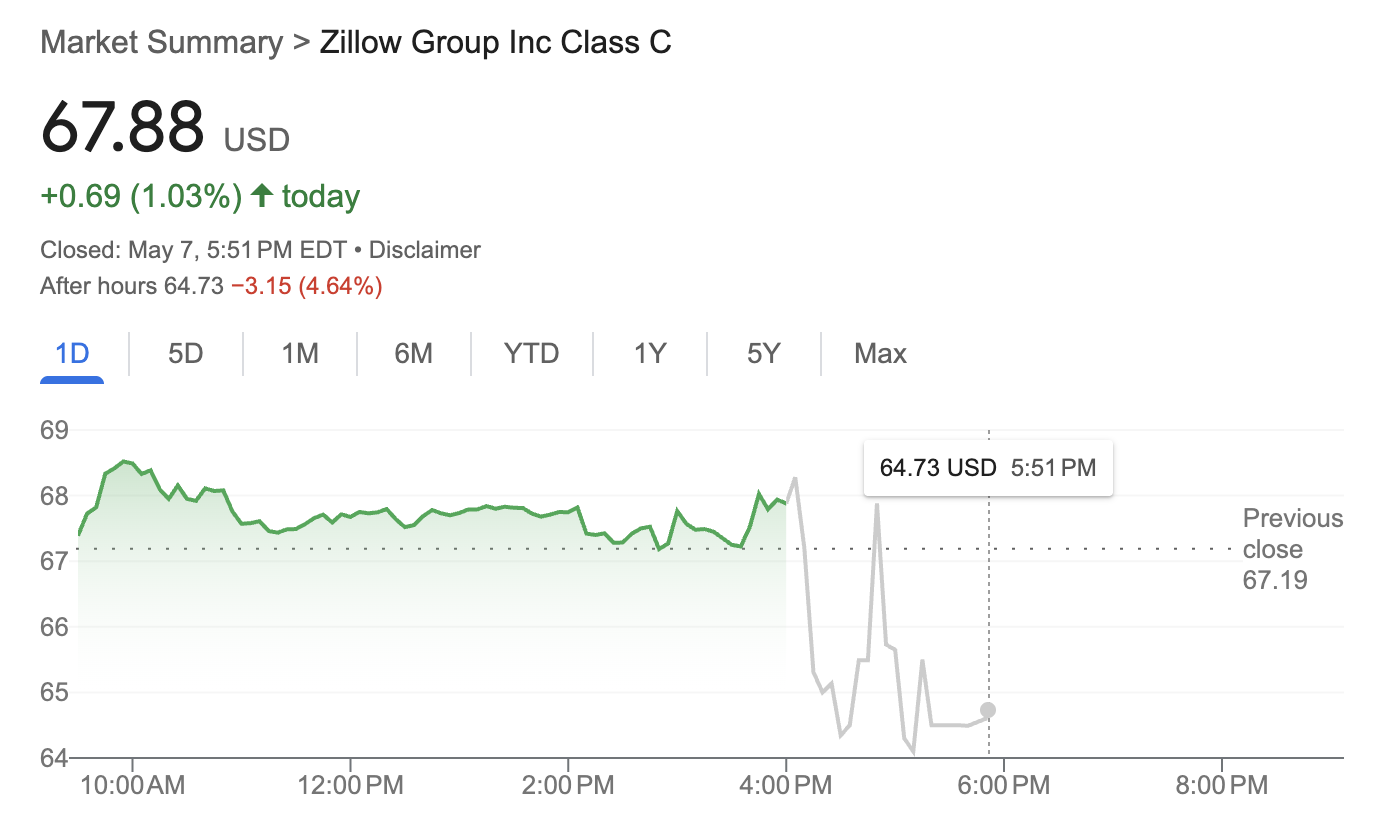
Credit: Google
The portal had a market cap of about $16.3 billion as of Wednesday afternoon.
Aside from turning a profit and growing revenue generally, Zillow’s earnings report reveals that revenue from Zillow’s residential segment hit $417 million in Q1, up 6 percent year over year. The company’s residential segment includes the Premier Agent program through which agents pay the company for leads.
Additionally, revenue from Zillow’s mortgage business grew 31 percent to $41 million in the first quarter.
During Wednesday’s analyst call, Wacksman was asked about Rocket’s recent announcement that it is acquiring Redfin and Mr. Cooper. Wacksman replied that “there’s going to be multiple winners here,” but that the deals prove Zillow’s thesis.
“Rocket announcing their acquisition of Redfin is about a recognition that the future of real estate is this integrated transaction,” he said. “The great news for us is that’s been our strategy for a while.”
Zillow’s latest earnings come against the backdrop of a raging debate in the real estate industry over private listings, or homes that are marketed privately between agents but not added to the local multiple listing service. Zillow has come out against private listings and, last month, banned such properties from its platform. The move prompted intense debate and thrust the portal into the center of the issue.
On Wednesday’s analyst call, Wacksman said that most of the real estate industry already agrees with Zillow’s position on listings, and that the response from brokerages, MLSs and other organizations has been positive. While speaking with Inman, he further defended the move, saying it’s “about protecting consumer transparency.”
“What makes this market so beneficial for buyers and sellers,” Wacksman said, “and beneficial for agents as well, is buyers have access to all the listings, sellers understand the risks of not marketing publicly, and most importantly, agents can do their job effectively.”
Update: This story was updated after publication with additional details from Zillow’s earnings report, and with remarks from the company’s analyst call.
Email Jim Dalrymple II
This post was originally published on this site
by Jim Dalrymple II | May 6, 2025 | Industry, News Feed
The iBuyer also revealed Tuesday that it bought 3,609 homes in the first three months of 2025. That number represents a 4 percent year-over-year increase.
Bigger. Better. Bolder. Inman Connect is heading to San Diego. Join thousands of real estate pros, connect with the Inman Community and gain insights from hundreds of leading minds shaping the industry. If you’re ready to grow your business and invest in yourself, this is where you need to be. Go BIG in San Diego!
Against significant market headwinds, Opendoor managed to trim losses in the first quarter of the year, despite seeing a modest drop in revenue, according to earnings data released Tuesday.
In total, the iBuyer brought in $1.2 billion in revenue between January and March, according to a newly published earnings report. That’s a dip of 2 percent compared to the same period in 2024.
The company also lost $85 million during the quarter. However, that figure is an improvement over the $109 million Opendoor lost during the first three months of 2024.

Carrie Wheeler | Opendoor CEO
In the report, CEO Carrie Wheeler said the first quarter results “reflect disciplined execution” on a “plan to drive toward profitability while strengthening our product experience and platform.”
“At the same time, we are investing in our future — evolving Opendoor into a broader selling platform, one that gives every homeowner more choice — whether that’s a cash offer or listing with a trusted agent,” she added.
Tuesday’s report also showed that Opendoor is holding a growing portfolio of homes. The company specifically bought 3,609 houses between January and March, which is up 4 percent year over year. At the same time, the iBuyer ended the quarter with 1,051 homes under contract, which is down 60 percent.
The result of these numbers is that Opendoor had an inventory of 7,080 homes — a year-over-year increase of 24 percent.
During a call with analysts Tuesday afternoon, Wheeler said the company is positioned “for long-term success,” though she added that there is currently an “extremely challenging macroeconomic environment.” Wheeler cited rising rates, tariffs and other factors that have prompted housing consumers to take “a pause.”
Heading into Tuesday’s earnings, shares in Opendoor were hovering around an all-time low price in the low $0.70 range. That was down for the day, but more significantly, it’s also well below the $1 threshold above which companies have to stay or risk getting booted from the stock market. Opendoor shares first fell below $1 just over a month ago and have continued losing value ever since.
Opendoor shares fluctuated, but generally rose, Tuesday in after hours trading following the publication of the company’s earnings report.
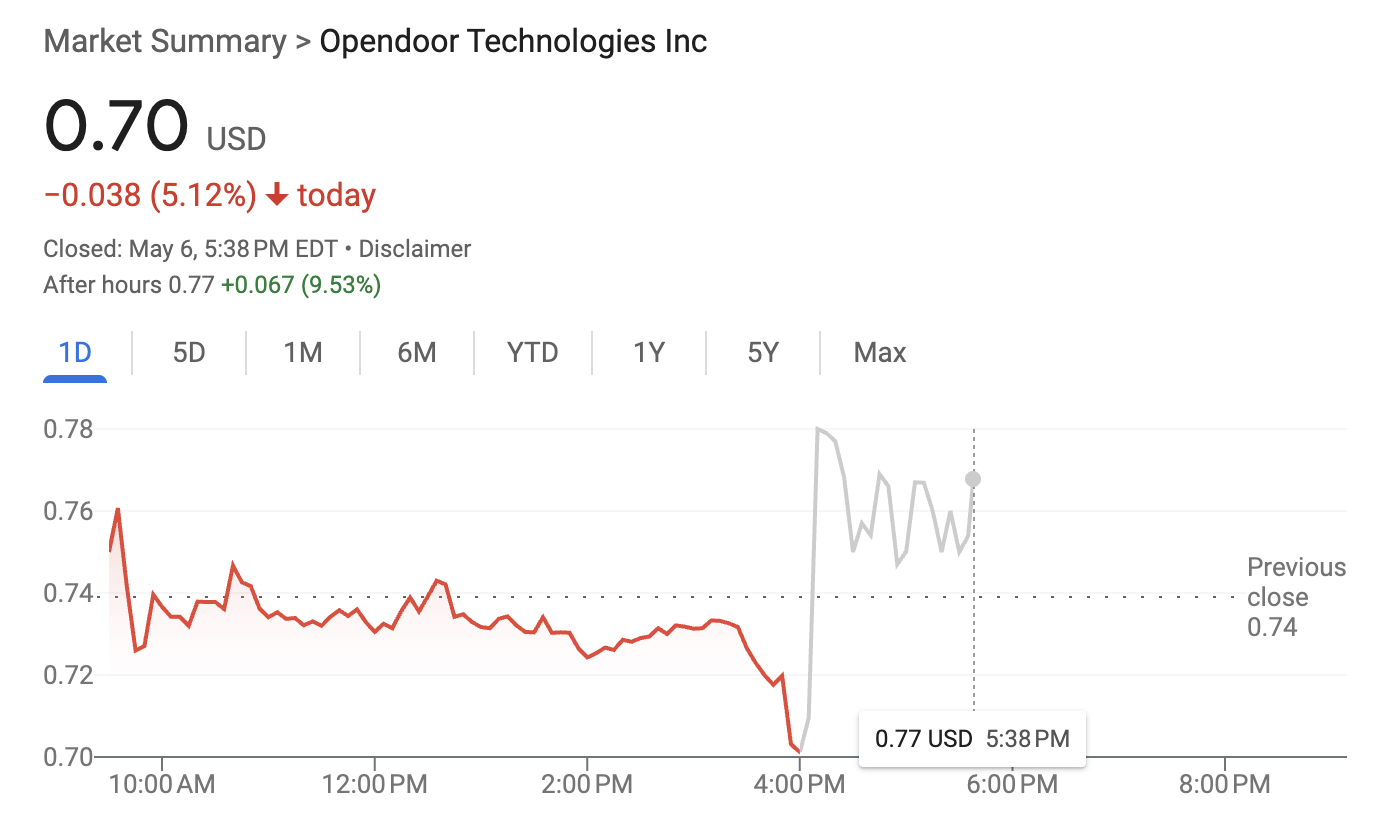
Credit: Google
Opendoor — which had a market cap of about $524.5 million as of Tuesday afternoon — is not unique in facing investor skepticism. Fellow iBuyer Offerpad has also seen shares shed significant value in recent days, and it too faces the threat of delisting.
Offerpad reported earnings on Monday, revealing among other things that both revenue and sales were down. The company’s struggles may have weighed on investors’ minds and helped push down Opendoor shares Tuesday as well.
Either way, both companies are contending with a market that makes it extremely challenging to flip homes. During the pandemic years, rising home prices theoretically made it easier for flippers — including at the institutional level — to turn a profit after buying and renovating homes. However, as rates rose in recent years and home price growth slowed considerably, it became much more difficult to turn a profit using the iBuyer model.
Those conditions have prompted the iBuyers to develop a variety of asset-light offerings and have weighed on balance sheets. In the final quarter of 2024, for example, Opendoor reported that it managed to increase revenue year over year, but also that its losses rose.
During Tuesday’s analyst call, Wheeler emphasized the importance of real estate agents to Opendoor’s business, saying that a “meaningful percentage of our acquisitions come to us” via referrals from industry professionals. Wheeler also said that Opendoor is “evolving into a platform where every seller can explore all their selling options,” and that consumers benefit from having an agent help them navigate those options.
Opendoor is also piloting a program in which it sends referrals to agents. Wheeler said the program, which is being tested in 11 markets, “allows us to drive more asset-light revenue” and increase conversions.
Update: This story was updated after publication with additional details from Opendoor’s earnings report and commentary from the company’s analyst call.
Email Jim Dalrymple II
This post was originally published on this site
by Jim Dalrymple II | May 5, 2025 | Industry, News Feed
The campaign features McEntire advising would-be homebuyers in sitcom-like scenarios. It’s also the largest such campaign in the portal’s history.
Bigger. Better. Bolder. Inman Connect is heading to San Diego. Join thousands of real estate pros, connect with the Inman Community and gain insights from hundreds of leading minds shaping the industry. If you’re ready to grow your business and invest in yourself, this is where you need to be. Go BIG in San Diego!
Realtor.com announced Monday that it is launching a new ad campaign featuring country music singer Reba McEntire.
The company has dubbed the campaign “Nearly Home,” and, according to a statement, will rely on McEntire to “offer something many homebuyers haven’t felt in years: optimism.” The company did not disclose what it is spending on the campaign, but did say in the statement that it is the “largest brand investment” in Realtor.com’s history.
Videos from the campaign Inman previewed are structured to imitate a classic sitcom, complete with a laugh track, and show a young couple struggling to choose a house.
McEntire then bursts in through the front door and advises the couple to check Realtor.com for listings. According to the statement, the “episode” is “called ‘The One without the Break-Up,’” and “highlights the very real drama that often comes along with buying a home.”
The campaign will air on TV as well as online and includes a sponsorship of the Country Music Awards, which stream on Amazon Prime on May 8. McEntire is hosting that show.
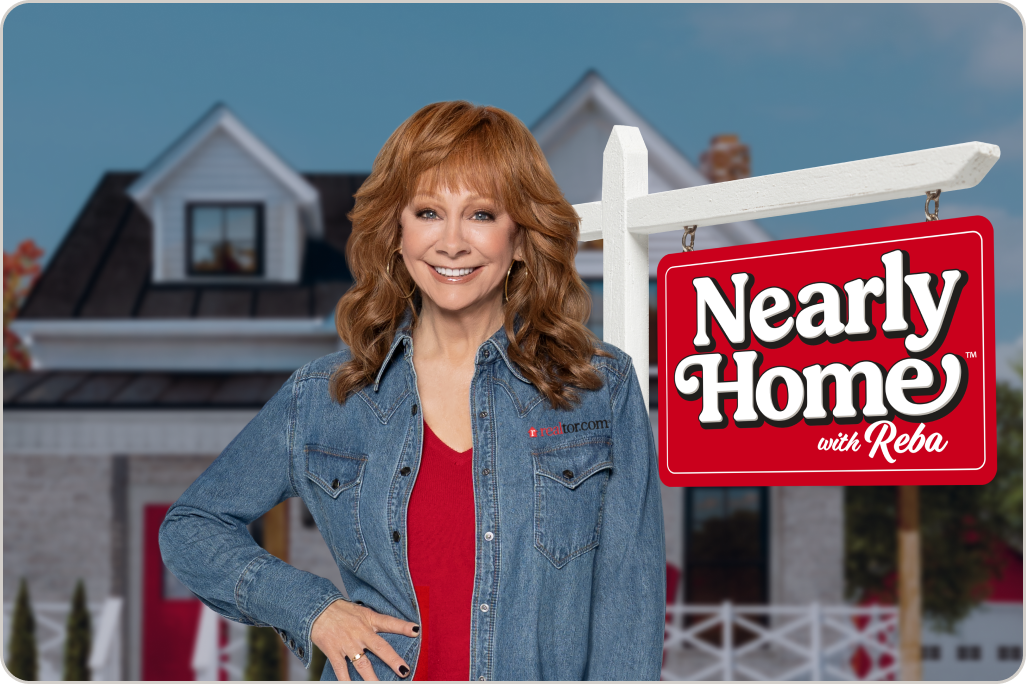
An image from Realtor.com’s new campaign. Credit: Realtor.com
The campaign arrives against the backdrop of intense competition in the consumer portal space. Though Zillow maintains the No. 1 spot in the space, Realtor.com and CoStar’s Homes.com have battled it out in recent years for No. 2. Homes.com has, in part, managed to grow thanks to CoStar’s intense marketing spend, which has included, among other things, Super Bowl ads.
In the case of Realtor.com, the company said in its statement that it expects the new ad campaign to reach about half of Americans. The statement notes that the campaign is “a direct response to the anxiety, confusion and doubt that define today’s housing market.”
Mickey Neuberger, chief marketing officer at Realtor.com, said in the statement that the goal of the campaign is to “make home search feel more human, more hopeful and less overwhelming — especially for a generation of buyers who’ve been navigating a complex market.”
“As the most trusted brand in real estate and the brand most trusted by real estate professionals, partnering with Reba McEntire was an easy choice,” Neuberger added. “She’s got the trust, the charm and the boots-on-the-ground wisdom to bring a genuine sense of reassurance, and a little humor, to our message. She helps us remind people that finding a home shouldn’t feel impossible — it should feel like coming home.”
Email Jim Dalrymple II
This post was originally published on this site
